Career
New Esthetician Mistakes: What Goes Wrong in the First Year

Quick answer
Most new esthetician mistakes happen around the service, not in technique: a rushed skin assessment without health history, one protocol for every client, skipped patch tests, wiping tools instead of disinfecting them, overpromising results, weak aftercare instructions, back-to-back booking, underpricing, working outside state scope of practice, and panicking over a skin reaction. Each has a specific, learnable fix.
Most new esthetician mistakes have little to do with hands-on technique. School and the state board exam drill the steps of a facial, and new graduates usually perform those steps well. What goes wrong in the first year happens around the service: a rushed consultation, a protocol copied from the last client, a disinfection shortcut on a busy afternoon, an overpromise made to close a booking, a price set by guesswork, and panic when a client's skin reacts. I have trained and mentored beginners for many years, and the same patterns repeat with remarkable consistency.
This guide groups those mistakes into seven areas, because each area needs a different fix. Assessment problems are solved with attention and better questions. Sanitation problems are solved with discipline and a system. Communication needs honesty and prepared wording. Self-organization needs templates and a schedule. Pricing needs arithmetic instead of intuition. Skin reactions need a plan made in advance. For each mistake I describe what the beginner typically does and what works better, and at the end there is a self-check list you can keep at your station.
The ten mistakes that cost new estheticians the most
Before the detail, here is the short version. These ten come up most often, and each has a specific consequence and a specific correction. If you are short on time, read the table, pick the two rows that describe you, and work on those for a month. Trying to fix everything at once is its own beginner mistake.
| Mistake | What it leads to | What to do instead |
|---|---|---|
| Glancing at the skin without talking to the client | Missing information the treatment plan depends on | Schedule dedicated consultation time and ask specific questions |
| Skipping health history and medications | Unnoticed contraindications | Use a written intake form and read it before every service |
| One protocol for every client | Treatment that does not fit the skin in front of you | Keep several versions and choose fresh at each visit |
| No patch test before a new active product | Unpredictable reactions | Test a small area and respect the waiting time |
| Wiping tools instead of fully disinfecting them | Risk of spreading infection, state board violations | Clean, then disinfect or sterilize as your state rules require |
| Promising results at the consultation | Disappointed clients and bad reviews | Describe a realistic range and an honest timeline |
| Not explaining what skin will do afterward | Client mistakes a normal reaction for an error | Explain it in advance and send written aftercare |
| Booking back to back with no buffer | Rushing, sloppy cleanup, poor notes | Build turnover time into every appointment |
| Pricing far below the local market | Hard to raise later, signals doubt in your skill | Calculate from real costs and time |
| Panicking when skin reacts | Chaotic actions that make things worse | Follow a prepared step-by-step plan calmly |
Mistakes in skin analysis and consultation
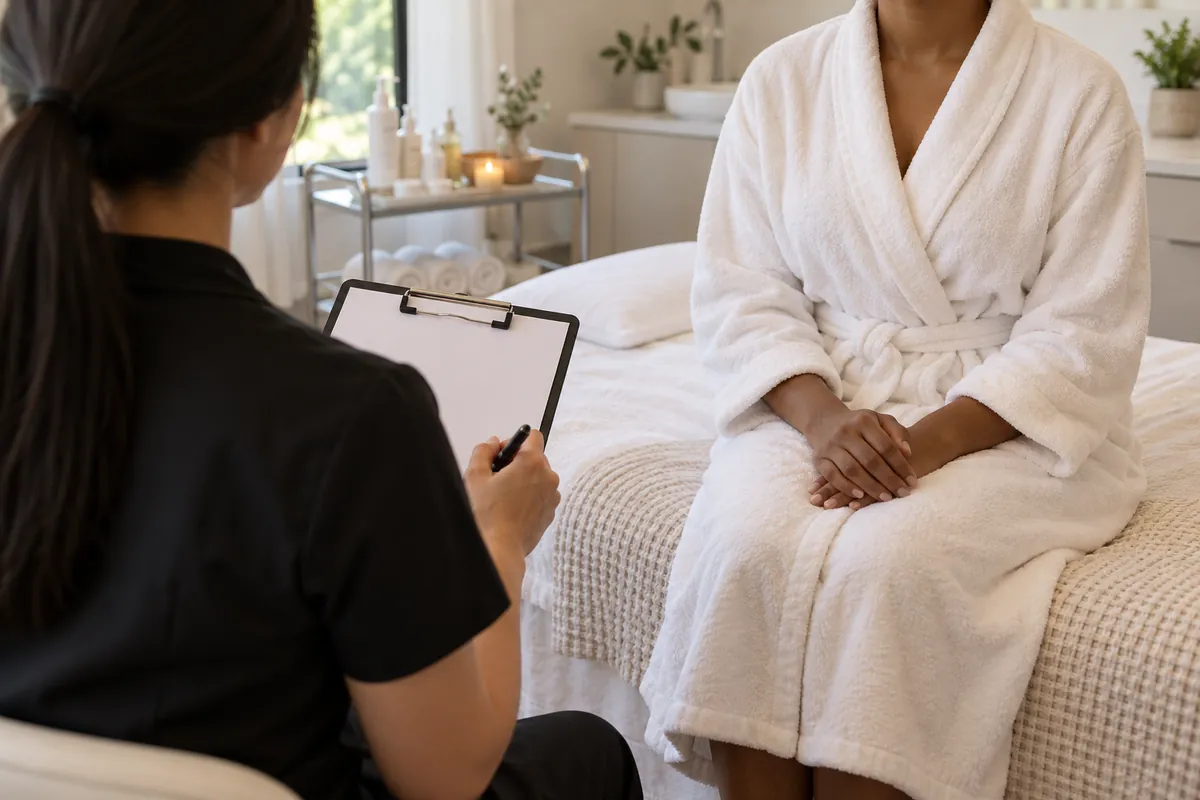
Assessment is the first stage of every appointment, and it is where a beginner loses the most information. The first mistake is a quick visual check with no conversation. The esthetician looks for a few seconds, sees an even tone, and moves straight to cleansing. What works better is a fixed block of time at the start of the visit and concrete questions: any recent flare-ups, what the client has used at home in the past month, recent sun exposure, earlier professional treatments and how the skin responded.
The second mistake is ignoring health history. A new esthetician focuses on what is visible today and does not ask about chronic conditions, medications, pregnancy, allergies, or recent procedures with other providers, trusting that the client will mention anything important. Clients often do not, because they have no idea that a prescription retinoid or a recent laser treatment matters for a facial. Use a written intake form with direct questions, and do not begin until it has been completed and read carefully, not skimmed.
The third is underestimating contraindications because you lack the experience to recognize them. The answer is not to get better at diagnosing by eye. Diagnosis is outside an esthetician's scope of practice in every state. When you have any doubt about a client's skin or general health, refer them to a dermatologist or their physician before treating, and do not guess at the cause. Referring out is a standard part of the work and a sign of professionalism, not of weakness. My guide on what an esthetician does explains where those boundaries sit.
The fourth mistake is jumping to a single explanation. A beginner sees redness and ties it to one cause, though redness can come from a new product, weather, over-exfoliation, a skin condition, or a dozen other things. Then the service is built around the first idea that came to mind. Hold several possibilities, ask about details, and if the picture is unclear, choose the gentlest option or postpone the active treatment to the next visit. Performing it "just in case" is how avoidable reactions happen.
The fifth and sixth go together: judging skin only as a snapshot, and rushing the assessment because the next client is already in the waiting area. Photograph the treatment area at each visit, with the client's consent, in the same lighting and angle, and compare the photos before changing a protocol or its intensity. And put consultation time into the schedule separately from service time, so one appointment's delay does not eat into the next client's assessment.
Mistakes in choosing and running the treatment protocol
The second large group comes from applying the same protocol to everyone because it worked once and feels safe. A beginner reaches for the routine they learned first and are confident with, whatever the client's skin type. Keep several versions in mind for different skin types and sensitivity levels, and make a deliberate choice at each appointment. A close relative of this mistake is copying intensity from the previous client: the same enzyme time, the same peel strength, the same device setting, because it went well an hour ago. Each client's skin thickness, sensitivity, and current condition need to be judged anew, even when the situation looks similar.
The third mistake is skipping the patch test before a treatment that is new to the client, particularly peels and other active formulas. Skipping saves a few minutes and raises the risk of an unpredictable reaction. Beginners go straight to the full area when a client says they have "always been fine". Past experience with another provider or another product guarantees nothing today. Test a small area, follow the manufacturer's directions on timing, and accept that the visit will be a little longer.
The fourth is changing the order of steps or cutting processing times to fit the clock: applying an active before the skin is properly cleansed and prepped, or shortening a step because the appointment is running late. That is fitting the protocol to the schedule. It should be the reverse. Book enough time for the complete protocol from the start. If time has truly run out, drop an optional step entirely and tell the client. Do not rush a step that depends on timing.
The fifth and sixth concern flexibility. Skin can show an unusual response in the middle of a service, with more flushing, stinging, or swelling than expected, and a beginner sometimes finishes the routine by the book anyway. Check the skin at every stage and be ready to shorten or change the plan in the moment. Likewise, a plan agreed at the last visit is not binding today. The same client's skin varies with season, stress, travel, and whatever they did at home last night, so reassess at each visit and adjust.
Mistakes in sanitation and infection control
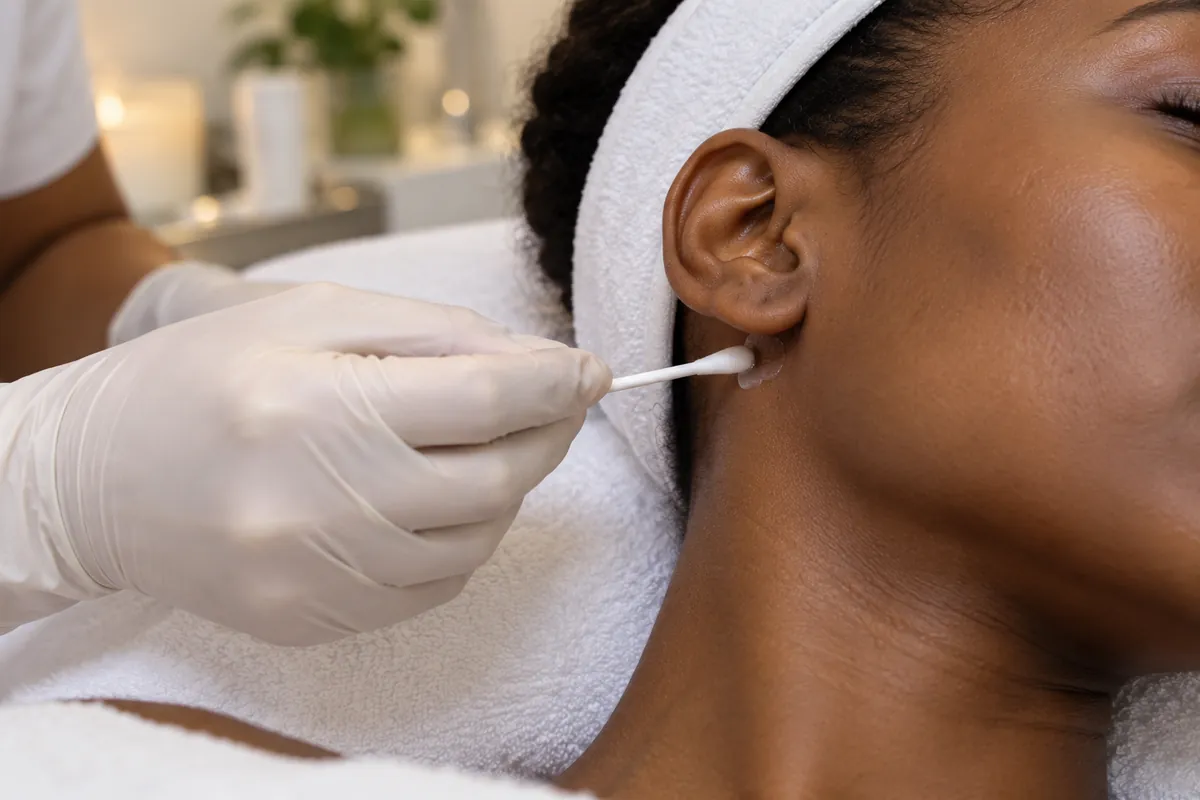
Hygiene errors are invisible to the client at the time, which is exactly why beginners give them less attention than the visible parts of a service. The first mistake is treating a quick wipe as disinfection. A multi-use implement, such as a comedone extractor or tweezers, is wiped with an alcohol pad and used again. Proper practice is to clean the tool of visible debris first, then fully immerse it in an EPA-registered disinfectant for the contact time on the label, or to process it as your state board requires. Anything porous or single-use is thrown away after one client.
The second mistake is letting clean and used items share one surface. In the rush between clients, a used extractor ends up beside the clean ones. Set up your station so there is a physical separation: a covered, labeled container for disinfected tools and a separate, clearly different container for used ones. The third mistake is reusing a disposable because the box ran out and the next client is waiting. "Just this once" is how standards erode. Keep stock for several appointments ahead, and if something essential is truly missing, reschedule the service.
The fourth is hand hygiene done once. Hands are washed at the start, and then the esthetician touches a drawer, a phone, a product jar, and the client's face again. Wash or sanitize hands and change gloves whenever your protocol calls for it during the service, not only on the way in. Never dip fingers or a used spatula into a jar. Dispense product with a clean spatula and do not double-dip, including with wax.
The fifth is assuming a tool is safe because it looks clean, or because it was processed at some point. Keep a simple log of disinfection, change the disinfectant solution as often as its label directs, and if your workplace uses an autoclave, follow its testing and record-keeping routine. The sixth is forgetting surfaces. The treatment bed, the lamp handle, the steamer arm, door handles, and the bottles on your cart are all part of the chain of contact. Disinfect every surface the previous client or your gloved hands touched, and change linens for each person.

Mistakes in client communication
A communication mistake does not injure anyone's skin. It damages trust, and in this profession trust recovers more slowly than skin. The first mistake is promising results at the consultation. A beginner wants the booking and says something like "you will see a difference after one visit", when the outcome depends on factors outside their control: the client's skin, lifestyle, home care, and consistency. Describe a realistic range instead, and say plainly that a single service usually does less than a series combined with good home care.
The second mistake is not preparing the client for what the skin will do afterward. They go home, see redness, flaking, or mild swelling a few hours later, and conclude that something went wrong. A parting "drink water and do not touch your face" is not enough. Explain what is expected over the next hours and days, what would be a reason to contact you, and put it in writing. The third is staying silent about restrictions. Sun, hot yoga, saunas, retinoids, and scrubs seem obvious to you. They are not obvious to the client. Say them aloud and include them in the written aftercare, even for clients who have had similar treatments elsewhere.
The fourth is being afraid of awkward questions: how often the client really sees other providers, what actives they use at home, whether they have been picking, what they may be embarrassed to admit. Beginners accept the first answer so as not to seem pushy. Ask follow-up questions in a calm, neutral tone and explain that you are asking for the client's safety. Most people open up when they understand the reason.
The fifth is defending yourself the moment a client is unhappy. If a result did not match expectations, the beginner starts explaining why everything was done correctly before the client has finished speaking. Listen to the whole complaint first. Then go through the facts calmly and offer a specific next step. The sixth is talking in professional jargon. Clients do not know what "desquamation" or "TEWL" means, and many will not ask. Translate every term into plain language as you go.

Mistakes with scope of practice and licensing
This group is specific to working in the United States, and it is the one that can end a career early. An esthetics license authorizes a defined set of services, and that set differs from state to state. Depth of chemical peels, microneedling, dermaplaning, certain devices, lash and brow services, and laser or light treatments are permitted to estheticians in some states, restricted or supervised in others, and prohibited in others. The first mistake is assuming that because a class taught a service, or a supplier sold you the device, you are allowed to perform it.
A weekend certificate in an advanced technique is training. It is not a license and it does not expand your legal scope. Before adding any service, check your own state board's rules, and if they are unclear, ask the board in writing. The second mistake is taking the employer's word for it. If a spa asks you to perform something outside your scope, the liability and the disciplinary action fall on your license. You can look up the rules for each state on the esthetics licensing hub, and my guide on what a medical esthetician is explains how work under medical supervision differs.
The third mistake is treating the license as a one-time achievement. Renewal dates, continuing education where it is required, posting your license at your station, and updating the board when you move are easy to forget in a busy first year, and practicing on a lapsed license has real consequences. The fourth is working without professional liability insurance, or assuming an employer's policy covers you as an independent contractor. Read the policy, confirm that every service you offer is listed, and keep your own records of training.
Mistakes in self-organization
Schools spend far less time on organization than on technique, yet organization is what usually decides whether a new esthetician gets through the first year without burning out. The first mistake is booking with no turnover time. Appointments are stacked back to back, based only on how long the service takes. Then cleanup, disinfection, linens, and notes pile up until the end of the day. Build a buffer into every appointment for resetting the room and completing the client record.
The second and third mistakes concern records. Notes are written from memory in the evening, when details have faded or blended with another client's, and the level of detail varies with how busy the day was. Record the key facts immediately after the client leaves: products and strengths used, timing, how the skin responded, what you recommended, what to change next time. Use one template with required fields that you fill in the same way every time. Good records are also your protection if a client ever disputes what was done.
The fourth is leaving rebooking to chance. The beginner assumes the client will remember to return at the right interval. Many do not, results suffer, and the esthetician gets the blame for an uneven outcome. Note the recommended interval in the record, offer to book the next visit before the client leaves, and send a reminder. How to think about intervals is covered in my guide on how often to get a facial.
The fifth is working without days off. In the first months a new esthetician accepts every booking at any hour, afraid of losing a client. Fatigue shows up first in the places that matter most, attention during assessment and care during disinfection. Plan the week ahead with fixed days off. The sixth is keeping everything in your head: client details, promises made, supplies to reorder. That works while the book is thin and collapses as it fills. Set up a booking and record system and a simple inventory list in your first month, however basic.

Mistakes in pricing and positioning
Price is the first thing a prospective client sees, and beginners tend to set it by feel. The first mistake is pricing well below the local market to fill the book faster: finding the lowest price nearby and going lower. Low prices are hard to raise later, attract clients who will leave for the next discount, and quietly signal that you doubt your own skill. Work out your price from real numbers: product cost per service, the full time including consultation and turnover, rent or booth fees, supplies, insurance, and taxes.
The second mistake is the opposite swing: a sharp increase once a loyal base forms, with no warning. Give regular clients notice well ahead and a short, honest reason, such as additional training, upgraded products, or a fuller schedule. The third is constant discounting. When nearly every client is offered something off to secure the booking, the menu price stops meaning anything. Use promotions rarely and for specific, planned purposes, such as an introductory offer with a clear end date.
The fourth is not knowing what an hour of your time really costs. If you rent a booth or a suite, the fixed costs continue whether or not the chair is full, and a price chosen "by eye" can leave you working for very little after expenses. Keep simple books from the first month. The differences between employment, commission, and rental are laid out in my guide to booth rental versus commission, and the wider picture of income is in the guide on how much estheticians earn.
The fifth is positioning yourself as the esthetician for everyone. Afraid of narrowing the audience, a beginner lists every service they were ever taught with no emphasis. Choose one or two directions you are truly confident in, perhaps acne-prone skin, sensitive skin, or brow shaping and waxing, build your message around them, and widen the menu as experience grows. The sixth is measuring yourself against practitioners with a decade of experience and a waiting list, and trying to match their prices immediately. Raise prices in steps as your results, reviews, and repeat bookings accumulate. Practical ways to fill the book are in my guide on how to attract clients.

Mistakes in handling an adverse skin reaction
Unexpected reactions happen to experienced estheticians too. At the start they are simply more frightening, and fear produces mistakes that a clear plan would prevent. The first is panic in place of sequence: trying one product after another without understanding what is happening. Have a written plan before you ever need it. Stop the service, remove the product as its manufacturer directs, cool and calm the skin with the simplest means, observe, document, and decide whether the client needs medical care. Follow it step by step.
The second mistake is trying to manage alone something that has gone beyond the usual for that treatment, in order not to look inexperienced. An esthetician does not diagnose or treat medical conditions. If a reaction is stronger than expected or does not settle in the normal time, advise the client to see a dermatologist or physician. Swelling of the lips, face, or throat, difficulty breathing, or widespread hives are emergencies, and the right response is to call 911. Keep the product's safety data sheet where you can find it quickly.
The third is waiting for the client to complain. After any service where a visible response is likely, contact the client yourself a few hours later and again the next day to ask how the skin is doing. The fourth is blaming the client's aftercare as a first response. Ask what happened after they left, in detail, and only then draw conclusions, even when non-compliance seems the likeliest explanation. Clients who feel accused do not come back, whoever was right.
The fifth is not documenting. The situation is handled in the moment and never revisited. Record every notable reaction in the client's file with photos, and review those notes every few weeks for a pattern: a particular product, area, or skin type that keeps reacting. Inform your employer and your insurer as your policy requires. The sixth is hiding behind vague comfort. "That is normal, it will pass" is tempting when you want to lower the tension, but if the reaction needs attention, say so. Naming what is happening, the probable cause, and the next step calms a client more than soothing words that turn out to be wrong.
Mistakes with retail, continuing education, and comparison
Three quieter mistakes deserve a mention. The first is treating home care as "sales" and avoiding the subject out of embarrassment. A client's daily routine does more for their skin than a monthly facial, and if you say nothing, they will buy whatever an advertisement suggests and may undo your work. Recommend what the skin needs, few products, explained plainly, with no pressure. The reverse mistake, loading every client with a long list of products to hit a target, costs trust just as surely.
The second is chasing every trend. New devices and techniques appear constantly, and beginners spend money on equipment and certificates before they have mastered consultation, cleansing, extractions, and massage, or before checking that the service is within their scope. Depth in fundamentals earns more than breadth in novelties. Choose continuing education that builds on the services you already perform well. The third is isolation. Find a mentor, stay in touch with classmates, and ask questions. Nobody learns this profession alone, and comparing your first year with someone's tenth on social media is a reliable way to lose heart.
A self-check list for every appointment
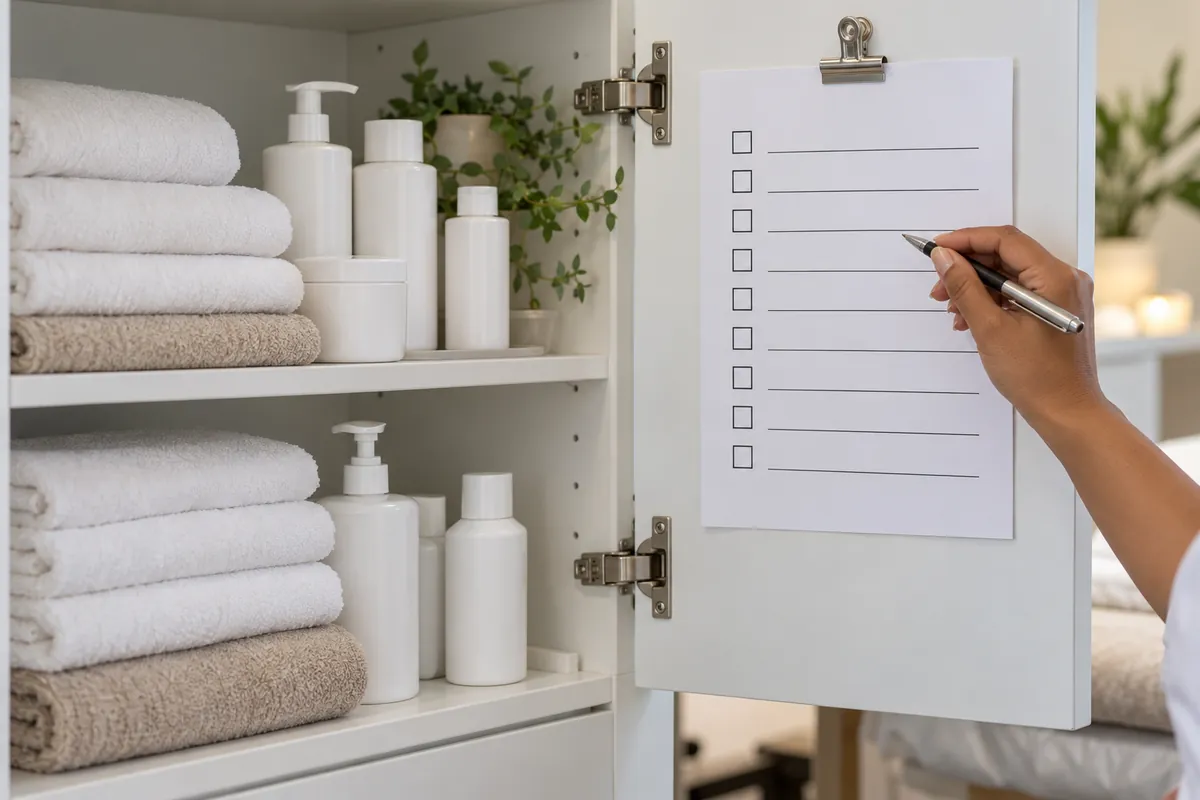
The list is divided by stage of the appointment, so you can go straight to the point that applies at that moment. It will not remove mistakes entirely and it does not replace experience. What it does is help you notice a problem sooner and trace it to a specific cause, so that a one-off accident can be told apart from a repeating pattern that needs deliberate work, with a mentor or instructor where necessary.
- Before: Has the intake form been completed and read in full, including health history and medications?
- Before: Is there any doubt about the skin or the client's health that should be cleared with a physician first?
- Before: Is this service within my state's scope of practice and covered by my insurance?
- Before: Is the protocol chosen for this client today, not copied from the last appointment?
- Before: Has a patch test been done for any new active product?
- Before: Are the tools properly disinfected and the surfaces and linens fresh?
- During: Am I checking the skin's response at each step and ready to shorten the service?
- During: Am I keeping up hand hygiene and avoiding double-dipping?
- During: Am I explaining what I am doing in plain language?
- After: Does the client know what to expect, what to avoid, and when to contact me, in writing?
- After: Is the client record updated now, with products, timing, and response?
- After: Is the next visit booked or the interval noted, and a follow-up message scheduled if a visible response is likely?
Come back to the list not only in the first months but every few months afterward. Many points become automatic with time, and that automatic quality is what sometimes hides a newer, less obvious mistake that has crept into the routine. I still run through a version of it myself after more than twenty years.
Where to start if you recognized yourself
Sorting mistakes into groups works better than a general list of what not to do, because each group calls for a different remedy. If your problems are mostly in assessment, lengthen your consultations and rewrite your intake form. If they are in sanitation, redesign your station and your turnover routine this week. If clients seem surprised by their skin afterward, write an aftercare sheet for each service. If you are exhausted, fix the schedule before anything else. Choose one group, work on it for a month, then move to the next.
If you are still a student or considering the profession, use this guide as a map of what the first year will ask of you beyond technique. A structured esthetics course can strengthen the theory behind skin analysis, contraindications, and infection control, alongside the in-person hours and licensing exam your state requires. Online theory supports that training and never replaces it. The steps to licensure are laid out in my guide on how to become a licensed esthetician, and exam preparation in the guide on passing the esthetician state board exam.

State Requirements
State licensing guides
Hours, exams, fees, and the licensing board differ by state. Open your state for the current requirements.
Common Questions
FAQ
A superficial skin assessment. The new esthetician looks at the skin briefly, skips the health history and follow-up questions, and moves on to the service. Most later problems trace back to this step: a protocol that does not suit the skin, a missed contraindication, or an unexpected reaction. A written intake form, a fixed block of consultation time, and specific questions about products, medications, sun exposure, and past treatments correct most of it.
No. Skin thickness, sensitivity, and current condition differ from person to person, and the same client's skin changes with season, stress, and home care. Keep several versions of each protocol for different skin types and choose again at every visit. Reassess intensity and timing each time as well, and be prepared to shorten the service if the skin responds more strongly than expected partway through.
Whenever you have doubt about the condition of the skin or the client's general health. Estheticians do not diagnose, so the goal is not to identify the condition but to recognize that something is outside the ordinary: an unexplained rash, a lesion that looks unusual or has changed, severe or painful acne, signs of infection, or a reaction that does not settle. Postpone the service and suggest a medical visit. Scope of practice by state is listed on the esthetics licensing hub.
Yes, for any active product that is new to that client, peels especially. A good experience with another provider, another brand, or at another time does not guarantee the same response now. Apply a small amount to a discreet area, follow the manufacturer's directions for how long to wait, and check the result before treating the full area. It adds a little time and removes a great deal of risk.
From real costs, not from the lowest price nearby. Add up product cost per service, the full time including consultation and room turnover, rent or booth fees, supplies, insurance, and taxes, then compare the result with the local market. Avoid starting far below it and avoid constant discounts. Raise prices gradually as experience and repeat bookings grow, with advance notice to regulars. The guide on how much estheticians earn gives the broader context.
Follow a plan prepared in advance. Stop the service, remove the product as the manufacturer directs, cool and calm the skin simply, and observe. Tell the client honestly what is happening. If the reaction is stronger than expected or does not settle, advise them to see a physician, and call 911 for facial or throat swelling or trouble breathing. Document everything with photos, follow up the same day and the next, and notify your employer and insurer as required.
Build the system so the right action is the easy one. Keep disinfected and used tools in separate, clearly different containers, clean implements before immersing them in an EPA-registered disinfectant for the full label contact time, discard single-use items, never double-dip, and disinfect surfaces and change linens for every client. Schedule turnover time into each appointment and keep enough supplies for several appointments ahead. Follow your state board's rules exactly.
Very. The first year asks for skills that school barely touches: consultation, record keeping, pricing, scheduling, and handling unhappy clients. Feeling stretched does not mean you chose the wrong profession. Work on one group of mistakes at a time, keep fixed days off, set up simple systems early, and find a mentor or peer group. The guide on what an esthetician does describes the full range of the job.
Keep Reading
Related Guides


