Career
How Much Do Estheticians Earn? What Drives Esthetician Salary

Quick answer
Esthetician income depends on setting and pay structure more than on the license itself. Pay combines base wage, service commission, tips, and retail, while suite renters keep the full price but cover rent, supplies, insurance, and taxes. Client retention is the strongest driver. For current figures, check the US Bureau of Labor Statistics data for skincare specialists.
How much do estheticians earn is usually the first question I hear from people who are thinking about esthetics school, and it is the question with the least satisfying short answer. Two estheticians with the same license, in the same city, with the same years behind them, can take home very different amounts. One is paid by the hour at a resort spa and relies on tips. Another is on commission at a waxing studio and lives by how full her book is. A third rents a suite, keeps everything she charges, and pays every bill herself. The license is identical. The income is built from different parts, and each part behaves differently from month to month.
This guide does not print an esthetician salary figure, and that is deliberate. Wage numbers go stale quickly, they differ sharply from state to state, and an average hides more than it shows. For current figures, look up the occupational data for skincare specialists published by the US Bureau of Labor Statistics, which is updated regularly and can be filtered by state and metro area. What I can give you, after more than two decades as a licensed cosmetologist and electrologist working beside estheticians in several kinds of businesses, is the part the tables leave out: what actually drives the number up or down, and which of those drivers you control.
Why a Single Esthetician Salary Number Misleads
Published wage data for estheticians has several built-in blind spots. Government surveys collect what employers report, so they describe employees far better than self-employed suite renters and studio owners, who make up a large share of experienced estheticians. Tips are reported unevenly. Part-time work is common in this field, and an annual figure that blends part-time and full-time workers tells you little about what a full book pays. Job sites have a different problem: their numbers come from postings and self-reported entries, which lean toward entry-level employed roles. None of these sources is wrong. Each one measures a slice, and a reader who treats the slice as the whole picture ends up either discouraged or overconfident.
The more useful habit is to read the official data as a range and then ask where a specific job would place you inside it. The Bureau of Labor Statistics publishes the low end, the middle, and the high end for skincare specialists, plus breakdowns by state and by type of employer. Look at the spread between the bottom and the top, not only the midpoint. That spread is the real story of this profession: the distance between someone newly licensed with an empty book and someone established with loyal clients, a specialty, and a pay arrangement that rewards both. The rest of this guide is about what moves a person across that distance.
The Parts That Make Up Esthetician Pay
Almost every esthetician's income is a combination of the same few streams. The mix changes with the setting, and so does the reliability of each stream. A base wage arrives no matter how the week went. Commission rises and falls with the book. Tips depend on the clientele and the culture of the business. Retail commission depends on whether you recommend home care and whether the business stocks products worth recommending. Independent estheticians replace all of that with one stream, the full service price, and then subtract rent and expenses. Before comparing any two jobs, write down which of these streams each one actually includes, because an offer that sounds stronger on one line is often weaker on the others.
| Income stream | How it works | What makes it grow | Main weakness |
|---|---|---|---|
| Hourly base wage | Paid for time on the schedule, booked or not | Seniority, employer policy, local wage floor | Low ceiling on its own |
| Service commission | A share of the price of each service you perform | A full book, higher-priced services, a rising commission tier | Slow weeks pay little |
| Tips | Paid by clients at their discretion | Hospitality settings, repeat clients, consistent service | Unpredictable, rare in medical settings |
| Retail commission | A share of products you sell | Honest home care recommendations that clients follow | Depends on what the business stocks |
| Membership or series bonus | Extra pay for signing clients to plans or packages | Businesses built around memberships | Can push toward pressure selling |
| Full service price (independent) | You set the price and collect all of it | Retention, pricing, specialization | You carry rent, supplies, taxes, and empty hours |
Notice that only the first row pays you for being present. Everything else pays you for a client being in the room. That is why two people in the same building can earn so differently: the esthetician with returning clients collects commission, tips, and retail on nearly every hour, while a newer colleague collects mostly base wage while waiting for walk-ins. It is also why the question to ask an employer is never just the rate. Ask how clients get onto your schedule, who fills the gaps, and how long it typically takes a new hire there to reach a steady book.

Pay Structures: Hourly, Commission, Tips, and Retail
Straight hourly pay is the simplest structure and the most common at large spa chains, hotel spas, and medical offices. Its strength is predictability. You can plan a budget around it in your first months, when your book is thin. Its limit is that a fully booked day and a quiet day pay nearly the same before tips, so the reward for building a following is smaller. Hourly roles suit people who value stability, who are new and still slow at their services, or who work somewhere that supplies clients steadily without any effort on their part.
Straight commission pays a share of each service and nothing for idle time, although wage laws generally require that an employee's total pay for the period does not fall below the legal minimum. On a busy book, commission usually beats hourly pay in the same market. On an empty book it is hard to live on. Read the details carefully. Is commission calculated on the full menu price or on the discounted price the client paid? Are product costs or a "back bar" charge deducted before your share is calculated? Does the share rise once you pass a sales threshold, and does that higher tier apply to everything or only to sales above the line? Small wording differences here change take-home pay more than the headline rate.
Hybrid structures are the most common in practice. One version pays an hourly base plus a smaller commission on services and retail. Another pays whichever is greater, the hourly total or the commission total, for each pay period. The second version protects you while you build and rewards you once you are busy, and it is the structure I generally suggest new estheticians look for. Whatever the model, ask to see how a real pay period is calculated, with the client names removed. An employer who is paying fairly can show you the arithmetic in a few minutes. Reluctance to explain how pay is computed is itself useful information.
Tips are a real part of esthetician income in hospitality-style settings such as day spas, resort spas, and waxing studios, and they are frequently left out when people quote a wage. They are also the least stable part. Tipping follows the culture of the business and the habits of its clientele. A regular who has seen you monthly for years tends to tip consistently. A tourist using a discount voucher may not. Many medical practices do not accept tips at all, which matters when you compare a medspa offer with a day spa offer: the medical setting may show a higher base, while the day spa job may come out close once gratuities are counted. Tips are taxable income, and they should be reported.
Retail commission is the stream most estheticians underuse. Many people who chose this work dislike the idea of selling, and I understand that. But recommending a cleanser, a sunscreen, and one treatment product that suits the skin you just examined is part of the service, not an add-on to it. Clients who follow a simple home routine get better results, and clients who see results come back. The estheticians I have watched earn well from retail do not push. They explain what they used during the facial and why, write down a short routine, and let the client decide. The commission follows from being specific and honest, and it arrives without adding a single appointment to the day.

Day Spas, Resort Spas, and Salon Spas
The day spa is where most new estheticians start, and the pay pattern there is recognizable: a modest base or commission, meaningful tips, retail commission, and a menu built around facials, body treatments, and waxing. The business supplies the room, the products, the laundry, the booking system, and the marketing. In exchange it keeps the larger share of each service price. For a new graduate that trade is usually a good one. You are paid, at least something, while you gain speed and confidence, and you see a wider variety of skin than you would alone. If you are still deciding whether the work suits you, our overview of what an esthetician does day to day covers the tasks behind the pay.
Resort and hotel spas follow the same model with a different clientele. Guests are often visitors who book once, so there is little chance to build a personal following, yet service prices and gratuities tend to be higher and the schedule is filled by the property. Income there depends on occupancy and season more than on your own retention. Salon spas, where an esthetics room sits inside a hair salon, work the opposite way. Walk-in volume for skincare is low, and the esthetician builds a book mostly from the salon's existing hair clients. The upside is a ready pool of people who already trust the business. The risk is a slow start if the stylists do not refer.

Waxing Studios and Speed-Based Pay
Dedicated waxing studios, both franchise and independent, are one of the largest employers of estheticians, and the income logic there is the clearest in the industry. Services are short, they repeat on a predictable cycle because hair grows back, and the schedule is dense. Pay is commonly an hourly base with commission or bonuses tied to service volume, rebooking, pass or package sales, and retail. Tips come on every service, and many small tips over a full day add up differently than a few larger ones after long facials. An esthetician who is fast, thorough, and comfortable with intimate services can build a full book in a waxing studio sooner than in almost any other setting.
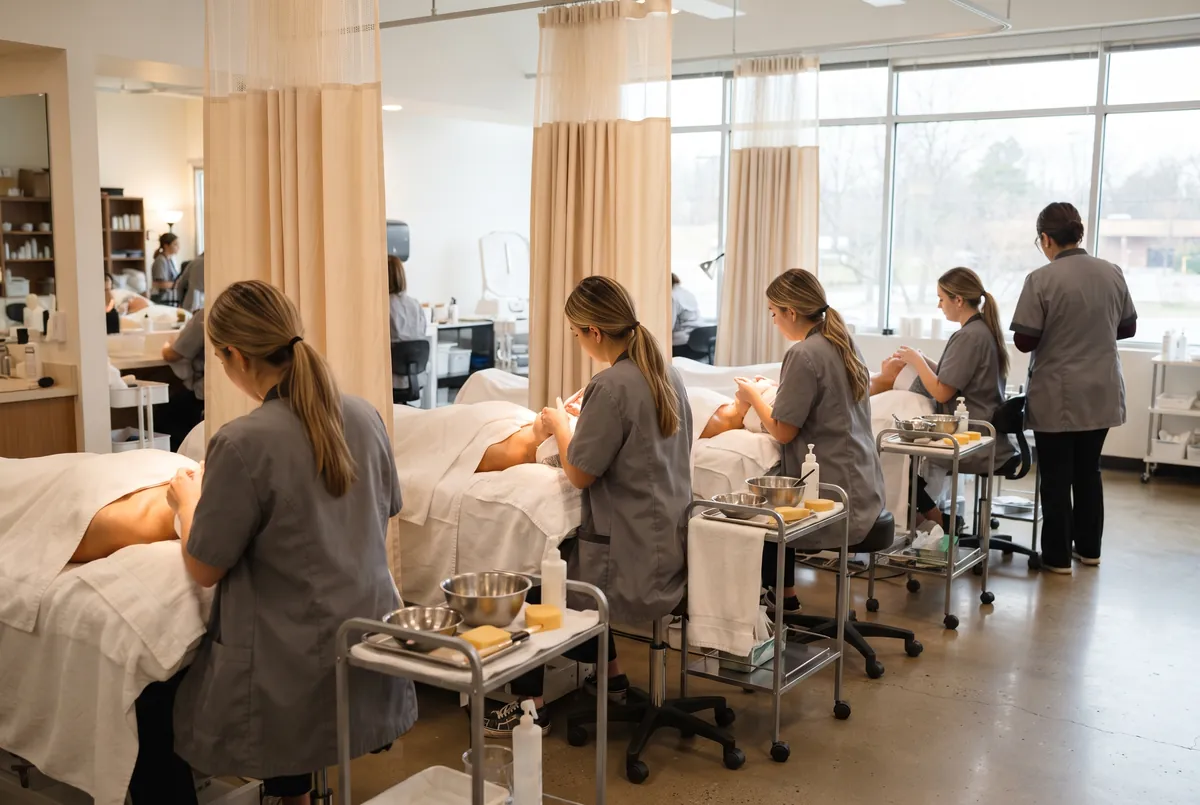
The same structure makes skill directly visible in pay. A waxer who finishes a clean service within the scheduled slot, with little redness and no missed hairs, can keep a tight schedule without running late, and clients request her by name. A slower or rougher waxer loses time on every appointment and sees fewer rebookings. That is why hands-on training matters so much here. Theory about hair growth, skin anatomy, contraindications, and sanitation can be studied from books and courses, but speed and control come only from supervised practice on real clients in a licensed program and then in the studio.
Medspas and Dermatology Offices
Medical settings have a reputation for paying estheticians more, and the official data broken down by type of employer generally supports the idea that physician offices sit toward the upper part of the range. The reasons are structural. Services cost more because they involve devices, stronger peels, and physician oversight. Clients arrive through the practice's own patient base. Positions are more often full-time with a steady wage and, in some practices, benefits such as health coverage or paid leave, which are worth real money even though they never appear in an hourly figure. Check the current employer-type breakdown from the Bureau of Labor Statistics for your state before assuming the gap applies where you live.
What the reputation leaves out is how the pay is put together. Tips are often not accepted. Commission, where it exists, may apply only to certain treatments, packages, or product sales. Part of the role can be supportive: preparing rooms, assisting providers, pre- and post-procedure skincare, patient education, and photography. And the higher-priced procedures that bring in the most revenue are frequently reserved by law for nurses, physician assistants, or physicians. In many states an esthetician may not perform injectables at all, and the rules on lasers, microneedling depth, and medium peels differ widely. Your scope under your own license decides which services you can be paid for.
It also helps to know that "medical esthetician" is a job description in most states, not a separate license. The credential is the same esthetician license, sometimes supplemented by an advanced or master tier where the state offers one, plus training in the practice's devices and protocols. That training has value and can support a better offer, but a certificate from a private course does not expand what the law lets you do. I explain the role and its limits in what a medical esthetician is and is not. For anyone weighing a medspa job, ask which services you would perform personally, who supervises, and how each one is paid.

Suite Rental and Running Your Own Studio
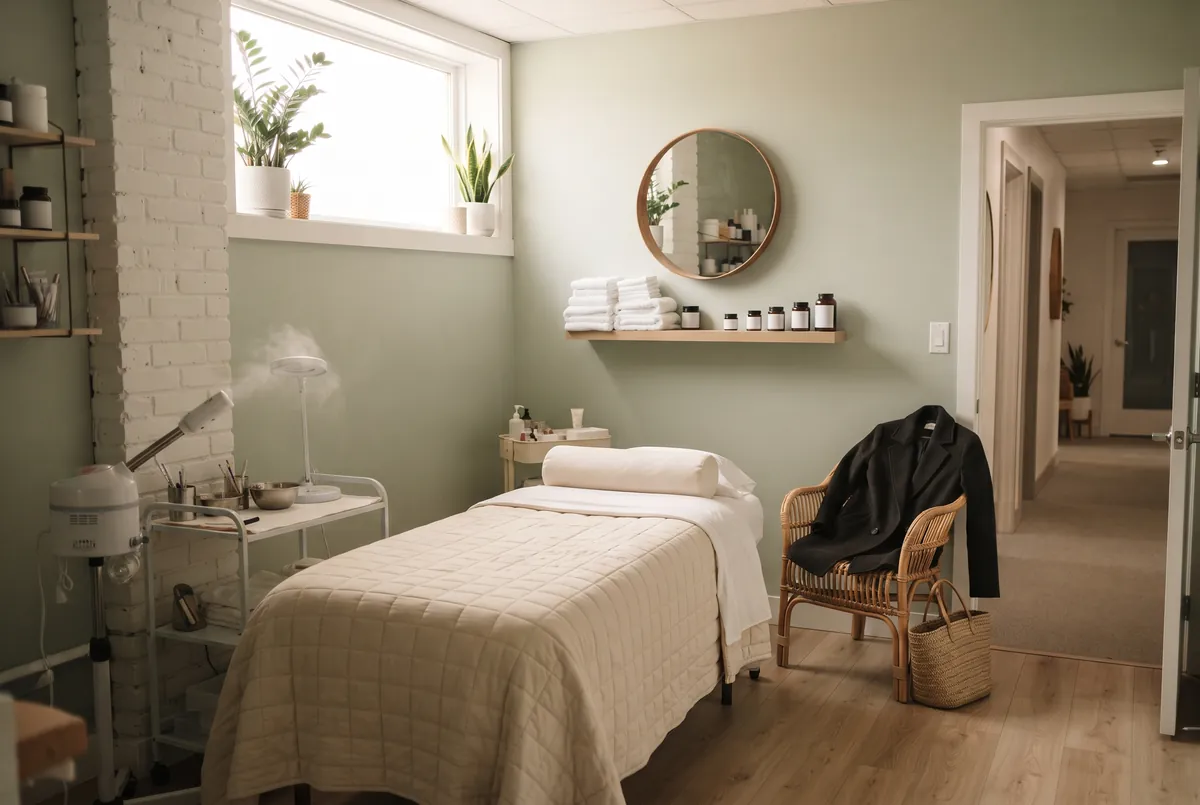
Independence changes the arithmetic completely. A suite renter or studio owner sets her own prices and keeps the entire amount each client pays. On paper that looks like an enormous raise compared with a commission share. In practice, the full price now has to cover weekly rent whether or not the room was busy, every product and disposable, linens and laundry, a booking and payment system with its card processing fees, liability insurance, license and permit renewals, marketing, and both the employee and employer portions of payroll taxes that self-employed people pay on their own. There is no paid vacation and no sick pay. The right comparison is what remains after all of that, not the price on the menu.
Independence pays well for one kind of esthetician: the one who already has a following. If a meaningful share of your current clients would follow you, the rent is covered early in the month and the rest is yours. If you leave an employer with no clients, or if a non-solicitation agreement limits who you can contact, you will be paying rent on an empty room while you rebuild. I have seen talented estheticians go independent a year too early and return to employment tired and in debt, and I have seen others wait until their book was overflowing and never look back. The timing matters more than the ambition.
A home studio lowers the fixed cost further, where zoning, the state board, and any homeowner or lease rules allow one, but it brings its own requirements, such as a separate entrance or dedicated sink in some states, and it can limit growth. Owning a multi-room studio with staff is a different business again: income then comes partly from other people's work, and so does the responsibility for payroll, compliance, and management. Our comparison of a home studio versus renting a suite walks through the practical trade-offs. For income purposes, the rule is simple. Fixed costs should be low enough that a slow month does not frighten you.
Location and the Local Market
Where you work moves esthetician income as much as how you work. Large metro areas and affluent suburbs support higher service prices and more medical and resort employers, and the official state and metro wage tables reflect that. They also come with higher rent, both for your home and for any room you lease, and with more competition for the same clients. A high wage in an expensive city can leave less at the end of the month than a moderate wage in a smaller market. When you read the Bureau of Labor Statistics figures by area, set them next to local housing costs before drawing conclusions about where estheticians are better off.
State rules shape income as well. Scope of practice decides which services you can offer, and that differs from state to state. Some states have an advanced or master esthetician tier that opens additional services, and others have a single license. If you move, your license does not automatically move with you: you apply to the new state, which may ask for additional hours, exams, or proof of work experience, and you cannot legally earn until it is issued. Plan for that gap. The esthetics licensing hub links to each state's requirements.
Schedule and Client Retention
An esthetician's income depends on paid hours, and paid hours cluster at the times other people are not working. Evenings and weekends are when most clients can come in. A new esthetician who is available only on weekday mornings will build slowly in most markets, however skilled she is, because the demand is simply elsewhere. This is a real cost of the profession for people with young children or a second job, and it is better to plan around it than to be surprised. Many established estheticians eventually move to a schedule they prefer, but they earned that freedom by first being available when clients wanted them.
Hours on the schedule and hours with a client are different things. Between them sit gaps, late cancellations, no-shows, room turnover, laundry, charting, and messages. Two estheticians who both work a full week can differ widely in how much of it is paid. The ones who earn more protect their booked time. They confirm appointments, keep a waiting list to fill cancellations, hold a clear cancellation policy where the business allows one, and group appointments so that a single gap does not strand them for an afternoon. These are plain administrative habits, and over a year they change income more than a small raise in price does.
If I had to name the single strongest driver of esthetician income in every setting, it would be retention: the share of clients who come back to you specifically. A returning client costs nothing to acquire. She books ahead, which fills the schedule weeks in advance. She tips more reliably, buys the products you recommend, accepts add-ons, refers friends, and follows you if you change location. An esthetician who depends on new clients every week is always starting over, and usually at a discount, because new clients tend to arrive through promotions. Under commission the difference shows up directly in each paycheck. Under suite rental it decides whether the rent feels light or heavy.
Retention is built through a handful of ordinary practices done every time. Take notes after each visit: what you used, how the skin responded, what the client mentioned about an upcoming event or a product that stung. Open the next appointment by referring to those notes. Explain what you are doing and what result to expect, without overpromising. Finish on time. Then rebook before the client leaves, with a reason attached: skin treatments work in a series, and waxing works best on a regular cycle matched to hair growth. Asking "would you like to book your next visit" as a routine part of checkout is the highest-paying sentence in this profession.

The First Year Versus an Established Book
The first year after licensing is the leanest, and it is better to know that going in. You are slower at every service, so you fit fewer into a shift. You have no following, so you depend on whatever clients the business sends you, and those often go first to senior staff. Tips are smaller because relationships are new. Many new estheticians work part-time at first because that is what was offered, and some keep a second job for a while. None of this is a sign of failure. It is the normal starting position, and it is why a base wage or a guaranteed minimum matters more in your first job than a high commission share you cannot yet use.
What changes over the next few years is not mainly the pay rate. It is the fullness and quality of the book. Speed improves, so more services fit into the same shift without rushing. Regulars accumulate, and the schedule fills further ahead. You learn which services you are best at and clients begin asking for them. Commission tiers, where they exist, start to apply. You gain enough confidence to recommend home care and series treatments. At that stage the same esthetician in the same room earns noticeably more than she did at the start, and she also has options: a better split, a move to a medical practice, or a suite of her own.
Costs That Reduce Take-Home Pay
Gross income and take-home pay are far apart in this field, and the gap is widest for independents. Before the first paycheck there is the cost of school, the state exam and license fees, and often a kit. If training was financed, loan payments come out of early earnings, when earnings are lowest. After that come recurring professional costs that continue for the whole career. Looking at them plainly before choosing a pay structure prevents the most common disappointment I hear from new estheticians, which is that the number they were told and the number they kept were not the same number.
- License renewal and continuing education: every state sets its own renewal cycle and fees, and some require continuing education to renew.
- Professional liability insurance: often provided for employees, almost always your own expense as a renter or owner.
- Rent or booth fees: due whether the week was full or empty.
- Products, disposables, and linens: back bar products, wax, gloves, sheets, laundry, and the retail stock you buy before you sell it.
- Equipment: beds, steamers, lamps, wax warmers, and devices, plus repairs and replacement.
- Booking software and card processing: a fee on nearly every payment you accept.
- Taxes: withheld for employees, self-paid for contractors and owners, including the portion an employer would otherwise cover.
- Benefits you fund yourself: health coverage, retirement savings, and any time off.
- Advanced training: classes in new techniques or devices, which only pay back if clients book the service.
- Uniforms, commuting, and parking: small individually, steady over a year.

Specialization, Add-Ons, and Skills Such as Waxing or Electrolysis
A general facial menu earns a general wage. Estheticians who move toward the upper part of the range almost always become known for something: acne-focused care, brow shaping, lash services where their license covers them, corrective treatments within scope, full body waxing, or skincare for a particular group such as teens, men, or clients with deeper skin tones who have had trouble finding someone experienced with their concerns. A specialty does three things for income. It lets you charge more for the same time, because clients are paying for a result and not for a generic service. It brings referrals, because people describe you by what you are good at. And it shortens the list of products and equipment you need to carry.
Add-on services raise income without lengthening the day. An enhancement added to a facial, a brow tidy added to a lip wax, or a targeted mask or scalp treatment takes a few extra minutes inside an appointment the client has already booked. Under commission, each add-on raises the ticket your share is calculated on. Under rental, it raises revenue per hour of room time, which is the figure that matters most. The technique for offering them is the same as for retail: suggest the one addition that suits what you see, explain the benefit in a sentence, and accept a no without comment. Clients quickly learn to trust recommendations that are specific and occasional.
Waxing is the most common income-building skill for estheticians, and in most states it already sits within the esthetician scope of practice, so no additional license is needed. Its value is in the rhythm. Hair returns on a cycle, so a satisfied waxing client rebooks again and again throughout the year, far more often than most facial clients. Services are short, which allows many appointments in a shift, and they pair naturally with skincare: a waxing regular is easy to introduce to a facial, and a facial client often adds brows or lip. An esthetician who is equally comfortable with both has two ways to fill every gap in her schedule.
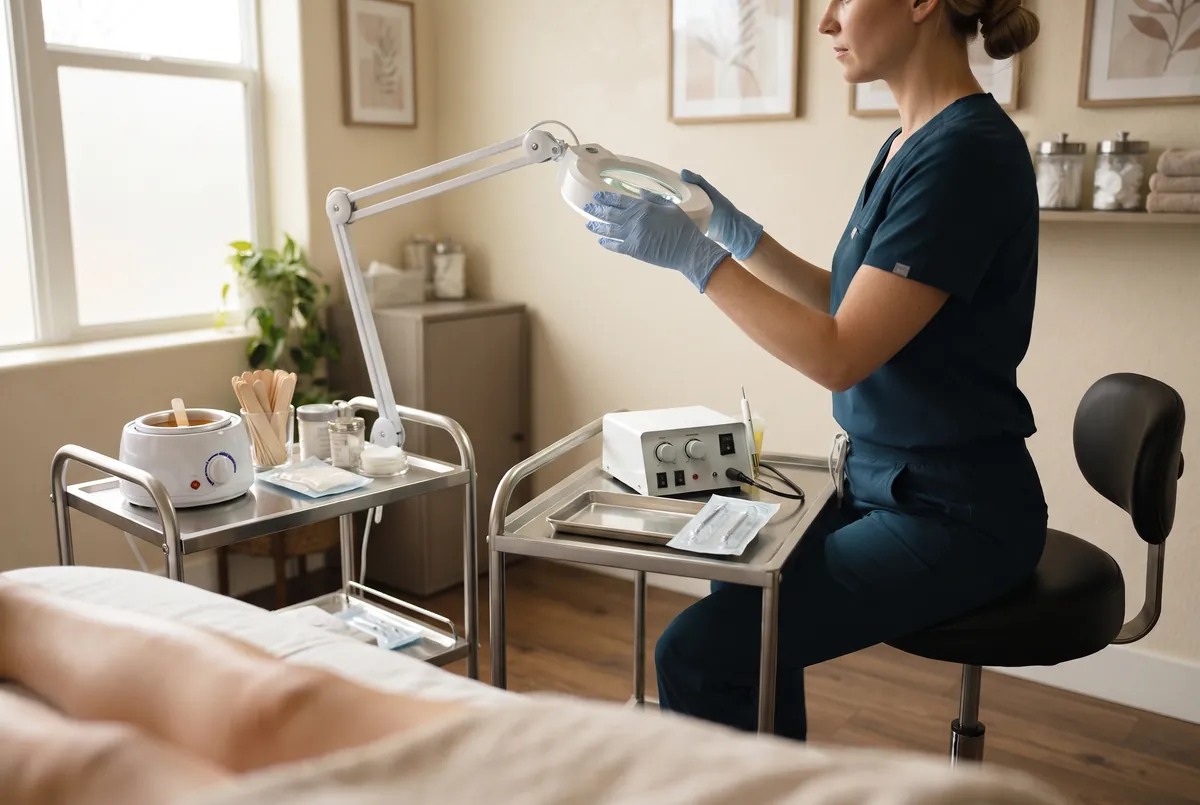
Electrolysis is a different case, and the legal part comes first. It is a separate profession from esthetics. In many states it requires its own electrologist license, with its own training hours and exam, and an esthetician license does not cover it. A smaller group of states handle it differently or do not license it at all, and the rules change, so the only reliable source is your own state board. Our guide on whether estheticians can do electrolysis explains the question in detail. Online study can build your theory. It never replaces state-required in-person training or the license itself.
Where an esthetician does hold both credentials, the effect on income comes from the nature of the service. Electrolysis is the only method the FDA accepts for permanent hair removal claims, it works on every hair color and skin tone, and it is done as a long series of appointments on the same client. That creates a kind of retention facials rarely match: a client working on a chin or a larger area returns regularly for many months. There are fewer providers than there are waxers or facialists in most areas, tipping is less central, and the work is seated and precise instead of fast and physical. It suits people who want steady, focused appointments and are willing to invest in a second course of training.
I hold both a cosmetology and an electrology license, and in my own practice the combination has always been steadier than either alone. Still, I would not tell an esthetician to add electrolysis for the money without weighing the cost. It means more schooling, another exam where the state requires one, a professional epilator, and a period of slower work while skill develops. Because electrologist earnings follow their own logic, I cover them separately in how much electrologists actually earn. If you are comparing license paths more broadly, how much cosmetologists earn looks at income under the wider cosmetology license.
Questions to Ask Before Accepting an Esthetician Job
Most disappointment about pay comes from details nobody asked about at the interview. An employer who values staff will answer the following questions without hesitation, and the answers let you estimate a real week instead of guessing from a rate. Take notes, and if possible speak with someone who already works there. Then run the same imagined week through each offer you are considering: the same number of clients, the same services, the same retail sales. The offer that pays best on that test is frequently not the one with the most impressive headline figure, and the exercise takes less time than a single facial.
- Am I an employee or an independent contractor, and who sets my hours and prices?
- What is the base pay, and is commission paid on top of it or instead of it?
- Is commission calculated on the menu price or on the discounted price, and are any product or back bar charges deducted first?
- How are tips handled, including card tips, pooled tips, and tips on prepaid or membership visits?
- What is the retail commission, and on which product lines?
- How do new clients reach my schedule, and how long do new hires here usually take to build a steady book?
- Which services on the menu will I perform personally, and are all of them within my state scope of practice?
- Who pays for products, linens, liability insurance, and required training?
- What happens to my pay during slow hours, required meetings, cleaning time, and training?
- Are there sales or membership targets, and what follows if I miss them?
- Does the agreement restrict where I can work or which clients I can contact if I leave?
- Are any benefits offered, such as paid time off, health coverage, or education allowances?

Your Next Step
Start with the facts for your own area. Open the Bureau of Labor Statistics occupational data for skincare specialists, look at the range for your state and nearest metro area, and note the gap between the low and high ends. Then look at local job postings to see which settings are hiring and how they describe pay. With those two pieces you can place the factors from this guide in context: which settings exist near you, what structure they use, and where a new esthetician would realistically begin. That is a sounder basis for a decision than any single national figure.
If you are not yet licensed, the path runs through a state-approved program and your state board exam. Read how to become a licensed esthetician for the sequence, and check your state's requirements on the licensing hub before enrolling anywhere. Our online esthetics theory course can help you build the knowledge base in skin science, sanitation, and client care alongside your schooling. It does not replace required in-person hours or the license. Once you are working, the drivers are in your hands: be available when clients want to come, rebook every visit, recommend honestly, choose a specialty, and review your pay structure each time your book outgrows it.
State Requirements
State licensing guides
Hours, exams, fees, and the licensing board differ by state. Open your state for the current requirements.
Common Questions
FAQ
There is no single reliable figure, because esthetician pay combines base wage, commission, tips, and retail in different proportions, and many experienced estheticians are self-employed. For current numbers, check the US Bureau of Labor Statistics occupational data for skincare specialists, which shows a range from low to high and can be viewed by state and metro area. Read the range, not only the midpoint, and remember that tips and self-employment income are captured unevenly in survey data.
Both are common, and many employers combine them. Hourly pay is typical at hotel spas, large chains, and medical offices. Commission is typical at day spas and salons. Hybrid models pay a base plus commission, or whichever of the two is greater in a pay period. Ask whether commission is calculated on the full or discounted price and whether product charges are deducted first, because those details change real pay more than the headline rate.
Official data by employer type generally places physician offices toward the upper part of the range, and medical settings more often offer steady full-time wages and benefits. Tips, however, are frequently not accepted there, and the highest-priced procedures are often reserved by law for medical staff. A busy day spa esthetician with strong tips and retail can come close. Ask which services you would perform personally and how each one is paid.
Only once you have a following. A suite renter keeps the full service price but pays rent, supplies, insurance, software, card fees, and self-employment taxes, with no paid time off. With a full book, that usually leaves more than a commission share. With a thin book, rent can consume most of what comes in. Compare what remains after all costs before signing a lease.
Services that repeat on a cycle and services that carry a higher price per hour of room time. Waxing brings clients back regularly all year. Specialized treatments such as acne-focused or corrective facials within your scope support higher prices. Add-ons and retail raise the value of each appointment without extending the day. Which services you may legally perform depends on your state, so confirm scope with your state board before investing in training.
Only where state law allows and with the credential that state requires. Electrolysis is a separate profession, and in many states it needs its own electrologist license, training, and exam. It is the only method the FDA accepts for permanent hair removal claims and is performed as a long series, which builds steady repeat appointments. Confirm the rules with your state board before paying for any training.
Considerably. Large metro areas and affluent suburbs support higher prices and more medical and resort employers, and the state and metro tables from the Bureau of Labor Statistics show clear differences between areas. Higher wages often come with higher living costs and commercial rents, so compare both. State rules matter as well, because scope of practice and license tiers decide which services you can offer and be paid for.
Keep Reading
Related Guides


