Career
Booth Rental vs Commission: A Guide for Beauty Professionals

Quick answer
On commission you work inside someone else's business and receive a share of what your services bring in. As a booth renter you pay the owner for space and run your own small business: clients, supplies, taxes, insurance and any permits your state requires. Compare the two with your own numbers and check your state board's rules before signing.
Booth rental vs commission is the decision that shapes a beauty career more than almost any technique you will learn after school. On commission, you work inside someone else's business and receive a share of what your services bring in. As a booth renter, you pay the owner for a chair, a room, or a treatment bed and run your own small business inside their walls. The license in your wallet is the same in both cases. What changes is who finds the clients, who buys the supplies, who handles the taxes, who carries the risk of a slow month, and who decides how you work.
I am Aida Khazieva, a licensed electrologist and cosmetologist with more than twenty years in treatment rooms, and I have watched talented people do well and do badly under both arrangements. This guide explains how each model works, what each one really asks of you, how to read a rental agreement, and how to compare the two with your own numbers. You will not find typical splits or rent figures here, because they differ by city, by service, and by building, and a number borrowed from the internet is the fastest way to make a bad decision. Tax and legal points are general information. Confirm your own situation with a CPA or an attorney and with your state board.
How Booth Rental and Commission Work
In a commission salon or spa, the business owns the client relationship in a practical sense. The owner pays for the lease, the front desk, the booking software, the products, the laundry, and the advertising. Clients book with the business, pay the business, and the business pays you. Your pay is usually a share of the service revenue you produce, sometimes with an hourly base underneath it, sometimes with a share of retail sales on top. In return, the owner sets the menu, the prices, the schedule, the dress code, and the product lines you use. You bring your license, your hands, and your time.
In a booth rental, the direction of payment reverses. You pay the owner, usually a flat amount each week or month, for the right to use a defined space. Everything the client pays for the service is yours, and so is every bill that comes with serving that client. You choose your services, set your prices, keep your own book, buy your own products, and collect your own payments. The owner is your landlord, not your boss. A salon suite is the same idea with a door that locks: a small private room inside a building of similar rooms, rented by one professional.
The table below summarizes who normally handles what. Real workplaces vary, and some of the most uncomfortable arrangements I have seen are the ones that mix rows from both columns without anyone writing it down. Use the table as a checklist during an interview: go row by row and ask who is responsible in this specific building, then write the answers down next to each line.
| Area | Commission (employee) | Booth rental (independent) |
|---|---|---|
| Who pays whom | The business pays you a share of your service sales, sometimes with a base wage | You pay the owner rent and keep what clients pay you |
| Clients | Supplied largely by the business, its location and its marketing | Found, booked and kept by you |
| Prices and menu | Set by the business | Set by you |
| Schedule | Set or approved by the business | Set by you, within building access hours |
| Products and disposables | Supplied by the business | Bought by you |
| Large equipment | Supplied by the business | Depends on the agreement, often yours |
| Booking and payment system | The business system | Your own system and your own card processing |
| Taxes | Withheld from your paycheck by the employer | Calculated and paid by you |
| Liability insurance | Usually carried by the business, ask what it covers | Your own policy |
| Slow weeks | Lower pay, but no rent owed | Rent is due regardless |
Employee vs Independent Contractor in General Terms
Underneath the pay question sits a legal one: are you an employee or an independent contractor? Commission workers are normally employees. They receive a Form W-2, the employer withholds income and payroll taxes, pays its own share of payroll taxes, and generally must meet wage and hour rules. Booth renters are normally self-employed. Nobody withholds anything, and the renter reports business income and pays self-employment tax on their own return. Those are two different legal positions, and the label on a contract does not decide which one you are in. The facts of the working relationship do.
Federal tax guidance looks broadly at who controls the work. Does the business direct how, when, and where you perform services? Does it control the financial side, such as prices, supplies, and how you are paid? Is the relationship set up like ongoing employment? Many states apply their own tests for wage law, unemployment insurance, and workers' compensation, and some of those tests are stricter than the federal approach. In general, the more a salon tells you what to charge, when to be there, what to wear, and which products to use, the more the arrangement looks like employment, whatever the paperwork says.
This matters to you personally, not only to the owner. A worker who is treated as a contractor but managed like an employee can end up with the costs of both models and the protections of neither: paying their own taxes and supplies while having no say over price or schedule, and without unemployment coverage or workers' compensation if something goes wrong. If an offer sounds like "you are independent, but here are our required hours, our prices, and our commission split", slow down and ask a CPA or an employment attorney in your state to look at it before you agree.

What a Commission Employee Gets and Gives Up
The first thing commission gives you is clients you did not have to find. A salon with a good location, an established name, and a front desk that answers the phone puts people in your chair during the period when you are slowest, least confident, and least known. For a new licensee this is worth a great deal. Your first year is when you build speed, learn consultation, and discover which services you are good at. Doing that on someone else's marketing budget, with someone else's products, is a form of paid training even when the paycheck feels small.
The second thing is a floor under your income and a set of protections that come with employment. Wage laws generally require that an employee's pay for the period does not fall below the legal minimum, even on a commission plan. The employer handles withholding, so tax season is simple. Depending on the business and the state, you may have workers' compensation coverage, unemployment insurance eligibility, and in some workplaces paid time off, health coverage, or paid continuing education. None of these are guaranteed everywhere, so ask about each one by name during the interview and get the answer in writing.
The third thing is people. A team means someone to ask when a service goes sideways, someone to cover you when you are ill, a manager who handles the difficult client, and colleagues who send their clients to you for the services they do not perform. In my experience this is the benefit that new professionals value least at the time and miss most after they leave. Working alone in a rented room can be quiet in a way that surprises people who are used to a busy floor.
What you give up is control and upside. You do not set your prices, so a price increase is the owner's decision. You may be required to work hours that suit the business, perform services you would rather drop, and recommend a product line you did not choose. Your share of each service is fixed by the pay plan, so once your book is full, your income can only grow through raises, tips, retail, or a higher tier. Many employers also ask staff to sign agreements about client lists and about working nearby after leaving. Read those carefully, because they affect your options later.
Look closely at how the commission is calculated, not only at the headline share. Ask whether it is figured on the menu price or on the discounted price the client paid, whether a product or service charge is taken off first (and whether your state allows that), how tips paid by card reach you, whether retail earns a separate share, and whether the plan has tiers. Ask to see a sample pay statement with the names removed. For a fuller look at how these pieces add up in different settings, see my guides on what shapes a cosmetologist's earnings and how estheticians are paid.

What a Booth Renter Takes On
Is booth rental worth it? It can be, when you already have the clients to fill the space and the discipline to run a small business. The attraction is obvious: you keep the full price of every service, you choose your hours, you raise your prices when you decide to, and you build something with your own name on it. The part that gets less attention is that every task the salon used to do in the background becomes yours, and every one of those tasks either costs money or takes unpaid time.
Taxes are the first adjustment. No one withholds from the money clients hand you. A self-employed person generally pays income tax plus self-employment tax, which covers both the worker and employer portions of Social Security and Medicare, and is usually expected to send estimated payments during the year instead of settling everything in April. New renters who spend what arrives and discover the bill later are a familiar story. Open a separate account for the business, move a set portion of every deposit into a tax reserve, and have a CPA tell you what that portion should be for your situation.
Insurance is the second. As a renter you normally need your own professional and general liability policy, and many rental agreements require proof of it before you move in. The owner's policy generally protects the owner. Health coverage, disability coverage, and retirement saving also become your own project. There is no paid sick day and no paid vacation: a week away means no income and the same rent. Price your services with that in mind, because the rate that felt generous as an employee has to cover far more when you are independent.
Then come the daily operating jobs. The list below is what I ask every professional to read slowly before they tell an owner yes. None of the items is difficult alone. Together they are a second job that runs alongside the services you perform, and most of it happens in the evening or on your day off, when no client is paying for your time.
- Taxes and bookkeeping: tracking income and expenses, keeping receipts, making estimated tax payments, and filing as a self-employed person.
- Licenses and permits: your professional license, plus any booth rental or establishment permit and local business license your state or city requires.
- Insurance: your own liability policy, and your own health and disability arrangements.
- Supplies and products: ordering, storing, and paying for everything you use on clients, including disposables and disinfectants.
- Equipment: buying, maintaining, and replacing whatever the agreement does not provide.
- Booking and payments: your own scheduling software, card processing, reminders, deposits, and cancellation policy.
- Marketing: your own website or booking page, business profile, photos, reviews, and referral habits.
- Client communication: answering messages, rescheduling, handling complaints and refunds.
- Retail: buying stock with your own money and collecting sales tax where your state requires a seller's permit.
- Sanitation compliance: meeting your board's infection control rules in your space and being the person an inspector speaks to.
The legal form you choose for all of this, sole proprietor or limited liability company, and how to separate business money from personal money, is its own subject. I cover it in my guide to business structure for independent beauty professionals, so I will not repeat it here. For this decision, the point is simpler: count the unpaid hours. Time spent ordering, messaging, posting, cleaning, and bookkeeping is time you are not paid for directly, and it belongs in your comparison just as much as the rent does.

State Rules: Permits, Restrictions, and Where to Check
Booth rental is not treated the same way across the United States. Some states regulate it closely, some require the renter to hold a separate booth rental license or permit or their own establishment license in addition to a personal license, and some restrict or do not recognize the arrangement in the form people assume. Requirements can also differ by profession within one state, so what applies to a hair stylist's chair may not match what applies to an esthetics or electrolysis room. Rules change, and I am deliberately not listing them here.
Before you sign anything, go to the source. Your state board's website or office can tell you whether booth rental is permitted for your license type, whether you need your own permit, whether the salon's establishment license must list renters, what must be posted in your space, and how inspections work when several independent professionals share one location. The state licensing hub on this site is organized by profession and state and links to each board, and electrologists can start from the electrolysis licensing pages, since electrolysis is regulated differently from state to state. Check city and county rules as well, because a local business license is a separate matter from board licensing.
One point applies everywhere. Renting a booth requires the same professional license as working on commission. Independence is a business arrangement, not a different credential. Online theory courses are useful for building knowledge and preparing for exams, but they never replace the in-person training hours your state requires or the license itself, and no rental agreement can stand in for either. If someone offers you space without asking to see your license, treat that as information about how the building is run.

Hybrid and Sliding Arrangements
Between pure commission and pure rental there is a range of in-between arrangements. On the employee side, common versions include an hourly base plus a smaller commission, a plan that pays whichever is higher between the hourly total and the commission total, and tiered commission where your share rises once your sales pass a threshold. These protect a new professional during slow months and reward growth later. They are still employment, and the employer still sets the terms of the work.
On the rental side, you will see part-time rental by the day, rent that starts lower and steps up as your book grows, and rent that rises and falls with your sales. Day rental is a sensible way to test independence with limited risk, especially for someone keeping a part-time job elsewhere. Sliding rent sounds friendly but deserves a careful read: if the owner takes a share of your revenue and also tells you how to work, you are back in the gray zone between renter and employee. Ask what the rent is tied to, who calculates it, and what records you have to show.
Some salons offer a planned path from one model to the other: start on commission, build a book with the salon's help, then convert to rental at a defined point. When it is written down and honored, this is one of the fairest arrangements in the industry, because the owner is repaid for developing you and you leave the employee role with clients and a place to work. Ask whether such a path exists, how many people have taken it, and what happens to your client records at the moment of conversion.
How to Compare the Two With Your Own Numbers
The honest way to compare booth rental vs commission is to put both on the same footing: what you keep after every cost and tax, for the same number of weeks worked, divided by all the hours you put in. Gross numbers mislead in both directions. A renter's full service price looks large until rent, supplies, fees, insurance, and self-employment tax come out. An employee's share looks small until you add the things the employer pays for that you would otherwise buy yourself.
Start with real data, not hopes. Pull three to six months of your own records: services performed, what clients paid, tips, retail, and hours on the schedule. Then mark each client honestly as likely to follow you, possibly, or unlikely. Clients who came for the salon's location, walk-ins, and people who book whoever is free usually stay with the building. Build your rental estimate only on the "likely" group. If you are newly licensed and have no records yet, that fact is the answer for now: you do not have the numbers a rental decision needs.
Next, collect real quotes for the rental side. Ask the owner for the rent and exactly what it includes. Price your product and disposable cost per service from a supplier catalog. Get an insurance quote, the fees for the booking and payment tools you would use, and the cost of any permits from your board and city. Ask a CPA what portion of profit to reserve for tax. Then fill in the worksheet below, one column for staying and one for renting, using the same months for both. Every blank is yours to fill. I have left out example figures on purpose.
| Worksheet line | Commission (your figure) | Booth rental (your figure) |
|---|---|---|
| A. Service revenue you produce per month | From your pay records | Only from clients likely to follow, at your planned prices |
| B. Your share of line A | Per your pay plan, after any deductions | All of line A |
| C. Tips and retail income | From your pay records | Your estimate, minus the cost of retail stock |
| D. Rent or space fee | None | From the owner's written quote |
| E. Products, disposables, laundry | None unless charged to you | Cost per service times number of services |
| F. Card processing and booking software | None | From provider fee schedules |
| G. Insurance, permits, license fees | Your personal license only | From quotes and board fee lists |
| H. Marketing, phone, website | Usually none | Your planned monthly spend |
| I. Equipment purchase and upkeep, spread per month | None | Purchase cost divided over its useful life |
| J. Taxes | Withheld, shown on your pay statement | Reserve advised by your CPA |
| K. Value of benefits (paid time off, coverage, education) | Add what your employer provides | Subtract what you must now buy |
| L. Monthly take-home: B plus C, minus D through J, adjusted by K | Your result | Your result |
| M. Total hours, including unpaid admin time | Scheduled hours | Service hours plus admin hours |
| N. Take-home per hour: L divided by M | Your result | Your result |
Run the rental column three times: once with the clients you expect, once with noticeably fewer, and once for a month with a week off. The middle version is the one to trust. Then work out your break-even point, which is the number of services per week at your planned price that covers lines D through J before you have paid yourself anything. Compare that number with the "likely to follow" count you made earlier. If break-even sits above it, you would be starting in debt to your own rent and hoping that marketing closes the gap.
Add one more figure that the worksheet does not hold: a cash reserve. Moves are rarely smooth. Some clients take months to find you, equipment arrives late, and the first tax payment comes sooner than expected. Having several months of rent and personal expenses set aside turns a slow start into an inconvenience instead of an emergency. If you want the same method applied to a different choice, the break-even section of my home studio vs suite rental comparison walks through it for a private room.


When to Switch From Commission to Booth Rental
The question I hear most is when to switch from commission to booth rental. My answer is that readiness is not about years in the field. I have met professionals who were ready quickly because they had a narrow specialty and loyal clients, and others with long experience whose books depended entirely on the salon's foot traffic. Readiness shows up in your records and your habits. The signs below are the ones I look for, and I would want to see most of them, not one or two.
- Your schedule has been consistently full for many months, across busy and quiet seasons.
- Most of your appointments are returning clients who ask for you by name and rebook before they leave.
- New clients reach you mainly through referrals from your existing clients, not through the salon's advertising or walk-ins.
- You are turning people away or booking far ahead, and your income is capped by the pay plan, not by demand.
- Your break-even number on the worksheet sits comfortably below your count of clients likely to follow.
- You have a cash reserve for rent and living costs during the transition.
- You already track your own numbers and know your rebooking and retention patterns.
- You have checked your state board's booth rental rules and your current employment agreement.
- You are prepared to do the marketing, messaging, and bookkeeping yourself, or to pay someone to do it.
There are equally clear signs to wait. If your book has gaps most days, if you are still building speed, if you rely on the front desk to fill your chair, or if the idea of quoting your own prices makes you uneasy, commission is still doing its job for you. The same is true if your main reason for leaving is a conflict with a manager. Frustration is a reason to look for a better employer, which is a much smaller step than starting a business. A calmer commission salon often solves the problem that rental was supposed to fix.
If you are close but not there, use the waiting time. Ask clients to rebook before they leave, request reviews, photograph your work with permission, and learn where your new clients come from. My guides on attracting clients as a cosmetologist and finding your first electrolysis clients cover those habits in detail. Do all of this within the terms of your employment agreement. Building your reputation is fair. Copying the salon's client list is a different matter, and the next sections explain why.

Questions to Ask Before You Sign
Visit the building more than once, at different times of day, and talk to current renters without the owner present if you can. Then put these questions to the owner. A serious landlord will answer all of them without irritation, and the answers should match what the written agreement says. Take notes during the conversation so you can compare them with the document later.
- What exactly does the rent include: utilities, internet, laundry, towels, back bar, reception, cleaning of common areas, parking?
- Is rent weekly or monthly, when is it due, what is the late fee, and is a deposit required?
- How long is the term, how does it renew, and how and when can rent be increased?
- How much notice does each side have to give to end the agreement?
- What hours can I access the building, and do I have my own key or code?
- Do I set my own prices, hours, services, and product lines without approval?
- May I use my own booking system and take my own payments?
- May I sell retail, and are there limits on brands or on competing with the salon's shelves?
- Which equipment and furniture is provided, who maintains it, and may I bring or install my own?
- What insurance do you require from me, and what does the building's own policy cover?
- Does this location hold the establishment license my board requires, and do renters here need their own permit?
- Who is responsible when an inspector finds a problem in a shared area?
- How are walk-ins and calls to the main number handled, and do any reach renters?
- Are there other renters offering the same services, and is there any limit on that?
- If I leave, are there any restrictions on where I work next or on contacting my clients?
Listen for answers that reveal control. "Our renters all use our booking system", "we like everyone here on the same price list", or "you will need to cover the front desk on certain days" are employee terms attached to a rental bill. Listen also for vagueness about licensing. An owner who cannot say clearly what the board requires of renters in that building has probably not asked, and you will be the one standing next to the inspector.

Reading a Booth Rental Agreement
Never rent on a handshake. A written agreement protects both sides, and reading it line by line tells you how the owner thinks. Begin with the basics: the names of the parties, a clear statement that you are an independent business and not an employee, the exact space you are renting, the rent, the due date, the deposit, and the term. If the space is described loosely, ask for a precise description, including storage, shared sinks, and any room you will use on certain days only.
Next, find the money clauses beyond the rent itself. Look for late fees, charges for utilities or laundry, fees for using the reception desk, rules about rent during your vacation or illness, and the conditions for raising rent. Check what happens to the deposit and how quickly it is returned. Look for an early termination clause: can you leave before the term ends, and at what cost? A long term with no exit is a heavy commitment for someone testing independence for the first time.
Then read the control clauses. A rental agreement can reasonably include building rules that apply to every tenant, such as access hours, cleanliness of shared areas, noise, and compliance with board regulations. It becomes a different kind of document when it sets your prices, fixes your working hours, requires specific product lines, routes your clients' payments through the salon, or requires you to attend staff meetings. If you see those, ask for them to be removed or have an attorney explain what they mean for your status in your state.
Finally, look at insurance, liability, and the end of the relationship. The agreement should say what coverage you must carry and whether the owner must be named on your policy. It should say who is responsible for damage to the space and to your equipment. And it should say plainly who owns client records and contact details (in a true rental, that should be you), plus any limits on working nearby after you leave. Enforceability of such limits varies by state. Paying an attorney for an hour to review the document costs far less than one bad clause.
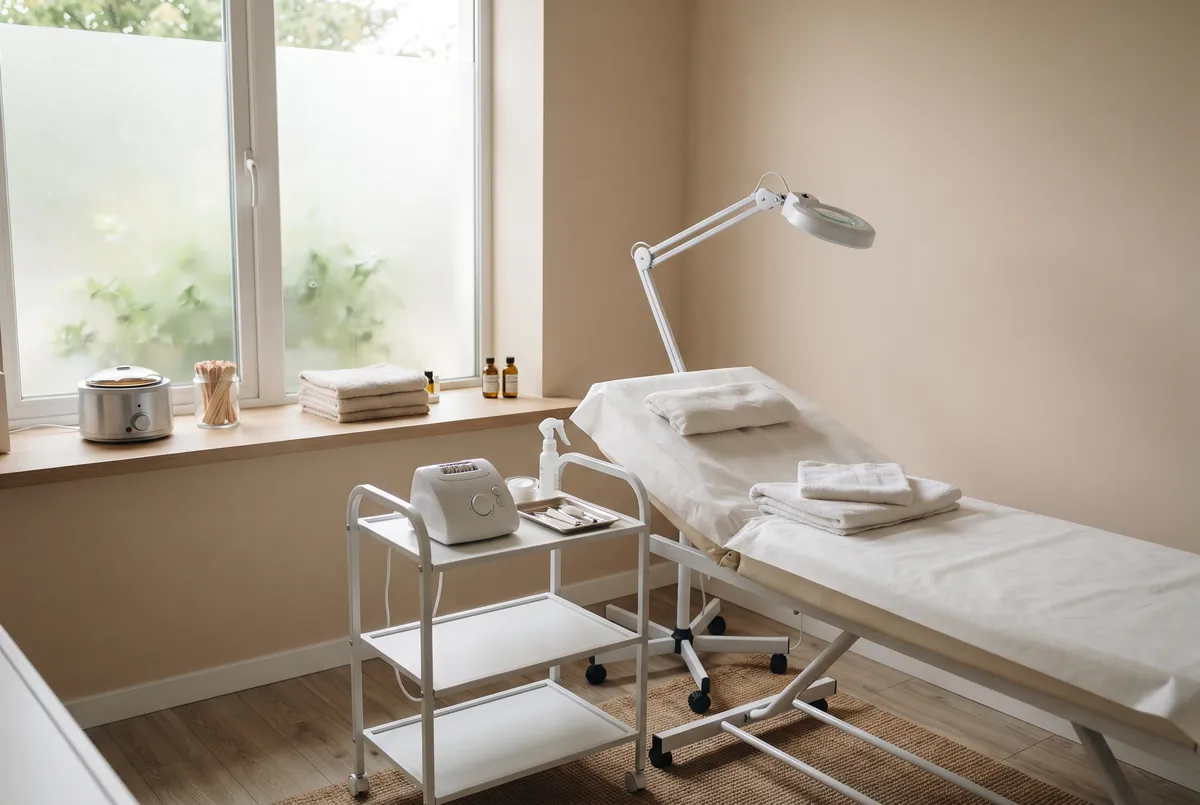
How It Differs for Electrologists and Waxers Versus Hair Stylists
Most advice on this topic is written for hair stylists, and the stylist's situation has its own shape. A stylist rents a chair on an open floor, shares shampoo bowls and dryers, and often shares the atmosphere and foot traffic of the salon. Color and chemical services mean a meaningful product cost on many tickets, so the question of who buys the back bar carries real weight. Visits are fairly long and spaced weeks apart, and clients tend to be loyal to the person, which is why an established stylist's book often travels well.
Electrology works differently. The service needs a private room, a treatment table, good magnification and lighting, and an epilator, which is a significant purchase and often the renter's own. Consumable cost per visit is modest by comparison, mostly sterile probes and disposables. Treatment happens as a long series of appointments over many months, so a client who starts with you is likely to return again and again, and scheduling is steady once a caseload exists. That pattern suits rental well. The catch is that few commission positions exist for electrologists in many areas, so a new electrologist may face rental sooner than they would like. I describe the income side in my guide to what drives electrologist income.
Electrolysis also raises specific compliance questions. Licensing differs widely by state, sterilization and sharps disposal are your responsibility in a rented room, and some states have particular rules about where and under what establishment license the work may be done. An electrologist renting inside a hair salon should confirm with the board that the location is acceptable for the service, not assume it because the salon is licensed for hair.
Waxing sits between the two. Appointments are short and frequent, so income depends on volume and on tight scheduling. A busy studio with a front desk and a steady flow of new guests can keep a waxer's day full in a way that is hard to reproduce alone, which makes commission attractive for longer than people expect. Wax and disposables are an ongoing cost that rises with every service, so line E on the worksheet matters more for a waxer than for an electrologist. A waxer or esthetician who rents also needs a room with a door, a sink nearby, and enough ventilation and storage to work cleanly at speed.
Common Mistakes on Both Sides
The most frequent mistake is renting before the book is full. People assume clients will follow in the same numbers they see on the salon's schedule, then find that a share of those clients belonged to the location. The second is comparing the wrong figures: the full service price against a commission paycheck, with no allowance for rent, supplies, fees, tax, time off, or unpaid hours. Both mistakes come from optimism, and both are prevented by the worksheet when it is filled in honestly with the cautious version of the client count.
The next group of mistakes is about paperwork. Renters sign without reading the termination and rent increase clauses, skip the board check and learn about a permit from an inspector, or let their liability insurance lapse because no one reminds them. Others spend their tax reserve and face a bill with penalties. Some keep the salon's prices out of habit even though their costs have changed completely. A renter's price has to be built from their own costs and their own demand, and it should be reviewed on a schedule you set for yourself.
Commission employees make their own errors. They accept a pay plan without seeing how a pay period is calculated. They treat the job as temporary and never learn where their clients come from, so they have no data when a decision arrives. They sign agreements about client contact and nearby work without reading them, then feel trapped. Or they stay too long out of fear, fully booked for years under a plan with no room to grow, when a tier increase, a planned conversion to rental, or a move would serve them better.
The last mistake is choosing by reputation instead of fit. Rental is not a promotion and commission is not a beginner's stage that everyone must leave. I know excellent professionals who have spent whole careers as employees because they prefer to finish the last client and go home with no orders to place and no books to keep. I know others who needed their own room and their own rules to do their best work. The right model is the one that matches your clients, your numbers, and your temperament at this point in your career.
Leaving a Commission Salon the Right Way
If the numbers say go, leave well. Reread what you signed when you were hired, and if anything in it concerns client contact or working nearby, ask an attorney what it means in your state before you act. Do not copy client lists or contact details from the salon's system. Give proper notice, work your remaining days fully, and tell the owner your plans yourself instead of letting them hear it from a client. Beauty communities are small, and the owner you leave today may be the person a future landlord or employer calls.
Line up everything before your last day: the board's answer on permits, the signed rental agreement, insurance in force, the booking and payment tools tested, supplies ordered, and a business account open. Make it easy for clients to find you through your own public channels once you have left. Then expect a slower first stretch and do not panic about it. A move always loses some clients, and a well-prepared one replaces them through referrals from the people who did follow.
Your Next Step
Do one concrete thing this week. If you are on commission, pull the last three to six months of your records and fill in the left column of the worksheet, then mark each regular client as likely, possible, or unlikely to follow. If you are already looking at a space, ask the owner for the agreement in writing and take it, with your worksheet, to a CPA. In both cases, look up your state board's position on booth rental for your license type and note what permits, if any, apply to you.
Once those three pieces are in front of you (your own numbers, a real quote, and the board's rules), the choice between booth rental and commission usually stops being a debate about freedom and security and becomes a plain reading of facts. Sometimes the facts say stay another year and build. Sometimes they say you were ready a while ago. Either answer is a good one when it comes from your own records and not from someone else's story.
State Requirements
State licensing guides
Hours, exams, fees, and the licensing board differ by state. Open your state for the current requirements.
Common Questions
FAQ
Neither is better in general. Commission suits professionals who are still building a clientele or who value steady support, supplied products, and simple taxes. Booth rental suits those with a full book of returning clients who want control over prices and schedule and are willing to run a business. The only reliable way to decide is to compare take-home per hour under both models using your own records, a written rent quote, and realistic costs, then check the result against how many clients are likely to follow you.
Usually not at the very start. Rent is due every week or month regardless of how many clients you see, and a new licensee rarely has enough returning clients to cover it. A commission or hourly position gives you clients, products, and colleagues while you build speed and confidence. There are exceptions, such as fields or areas where employee positions are scarce, and in those cases part-time day rental with a cash reserve is a safer first step than a long full-time agreement.
Consider it when your schedule has been consistently full across seasons, most appointments are returning clients who ask for you, new clients arrive through referrals, your worksheet shows break-even well below the number of clients likely to follow, and you have savings for the transition. Check your state board's booth rental rules and your employment agreement first. If your main reason is conflict with a manager and your book still has gaps, a better commission salon is usually the wiser move.
Generally, yes. A booth renter is normally self-employed, so no one withholds tax from client payments. The renter reports business income, pays self-employment tax in addition to income tax, and is usually expected to make estimated payments during the year. Depending on the state, selling retail may also mean collecting sales tax. This is general information only. A CPA can tell you what to set aside and which expenses you can deduct.
In a true rental, the renter sets their own hours, prices, services, and products, within reasonable building rules such as access times and sanitation standards. When an owner dictates schedules, prices, or product lines, or collects client payments and pays the renter a share, the arrangement starts to resemble employment. Worker classification tests differ by state and the consequences can be significant for both sides, so have an employment attorney or CPA review any agreement that mixes rent with that kind of control.
You always need your professional license. Beyond that, it depends on the state: some require a separate booth rental permit or an establishment license for each independent renter, some regulate the arrangement in other ways, and some restrict it. Cities and counties may also require a business license. Rules change and differ by profession, so confirm directly with your state board. The licensing hub on this site lists requirements by profession and state with links to each board.
Yes. These services need a private room instead of a chair, so the rent is for a room and the renter often supplies major equipment such as a treatment bed, lamp, wax warmers, or an epilator. Waxing depends on high volume, which a busy studio's front desk supports well. Electrolysis builds a steady caseload through repeated visits, which suits rental, though commission positions are less common. Sanitation, sterilization, and any establishment rules for the room are the renter's responsibility.
Clients are free to choose who provides their services, but how you may contact them is another matter. Many employers ask staff to sign agreements about client lists, solicitation, or working nearby, and whether those are enforceable varies by state. Do not copy records from the salon's system. Reread what you signed, ask an attorney if anything is unclear, give proper notice, and let clients find you through your own public channels after you have left.
Keep Reading
Related Guides


