Career
State Board Exams in Spanish and Other Languages
Quick answer
Many states let you take the written cosmetology theory exam in Spanish or Vietnamese, and some add Korean or Chinese, but each state board decides which languages it approves, and the list can differ by license. The practical exam is often English only. Check your state's candidate bulletin and confirm with the board before you schedule.
Many people who want to work in beauty speak English as a second language, and the first question they ask me is whether they can take the state board exam in Spanish, Vietnamese, Korean, or Chinese. The honest answer is: often yes for the written theory part, rarely for everything, and it depends entirely on your state and on the license you are chasing. There is no single national rule. Each state board decides which languages it allows, and the testing company that runs the exam only offers what the board has approved.
I am Aida Khazieva, a licensed electrologist and cosmetologist with more than twenty years of experience, and I came to this profession as an immigrant myself. I have sat beside many students who knew the work with their hands but were afraid of the English on the screen. This guide explains how language options on US beauty board exams really work, what is usually offered in a second language and what is not, how to find your state's current answer, how to register, how to prepare in your own language, and what to do when your language is not on the list.
How language options work on beauty board exams
Two separate bodies are involved, and mixing them up causes most of the confusion. The first is the state board of cosmetology (or the department of licensing that houses it). The board writes the rules: how many training hours you need, which exam you must pass, and which languages are allowed. The second is the testing vendor, a company such as PSI, Prometric, or Pearson VUE, that actually delivers the exam at a testing center. The vendor does not choose languages on its own. It publishes a candidate bulletin that lists what the board has approved.
Many states use the written exams developed by the National-Interstate Council of State Boards of Cosmetology, usually called NIC. The NIC theory exams exist in more than one language, and Spanish and Vietnamese are the most common alternatives to English. Some states also list Korean and Simplified Chinese. But a language existing at the national level does not mean your state turns it on. A board can approve English only, or English and Spanish, or a longer list, and boards change these rules from time to time.
Some states do not use the NIC exam at all and write their own. Those exams can have different language policies, and sometimes the translated version is administered differently, for example on paper by appointment instead of at a normal computer station. That is why the only reliable source is your own state's current bulletin, not a forum post, a school brochure from three years ago, or a chart on a test-prep website.
Written theory versus the practical exam
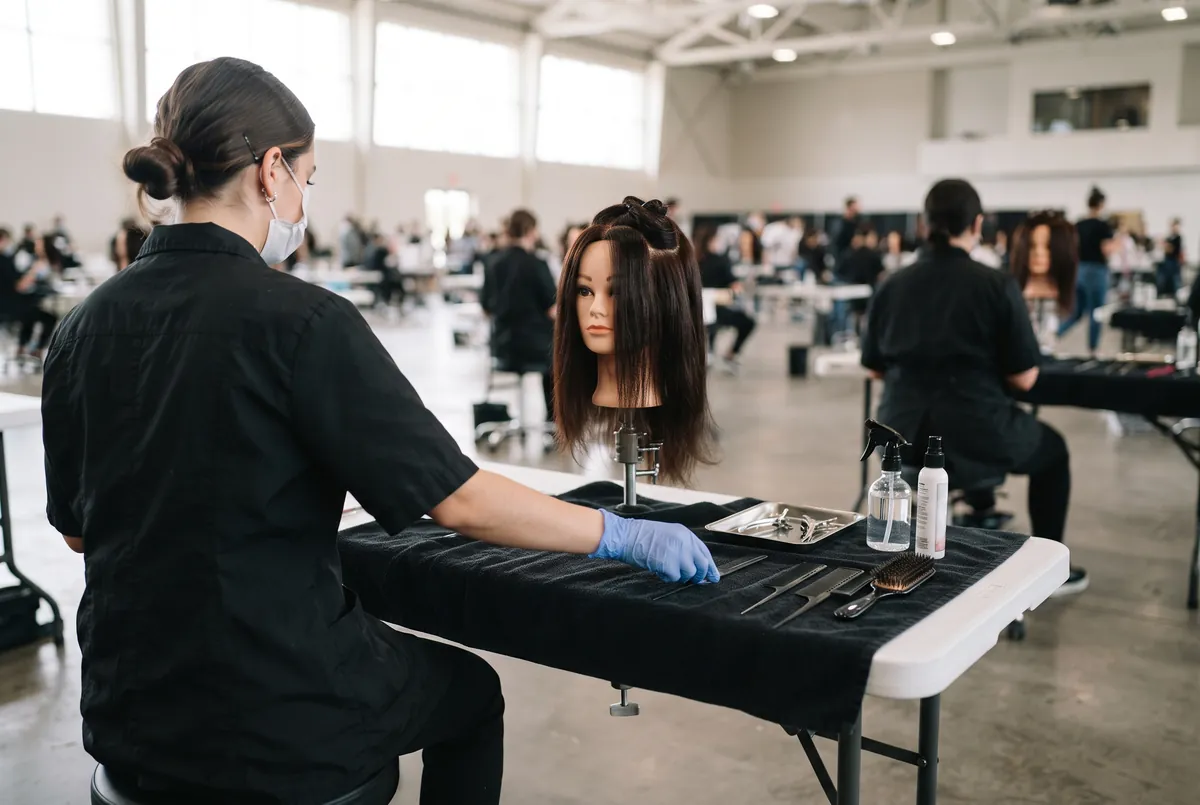
Most licensing systems split the exam into two parts. The written (theory) part is multiple choice and is where translated versions are most common. The practical part is a hands-on demonstration, either done in front of an examiner at a testing site or, in some states, handled in a different way. Language access for the practical part is much less uniform than for theory.
In a practical exam the examiner usually gives instructions and watches whether you follow safe, correct procedure: sanitation steps, draping, tool handling, the order of a service. If your state does not provide an interpreter or a translated instruction sheet, you are expected to understand the English instructions on the day. In my experience, students who are strong in the hands-on work handle this far better than they fear, because the vocabulary is limited and repeated. But you should not assume. Ask your board and the vendor in writing whether translated materials or an approved interpreter are allowed for the practical portion.
There is also a difference between a translated exam and a translation aid. A translated exam is a full version of the questions in another language. A translation aid, such as a printed bilingual dictionary or an interpreter in the room, is a separate accommodation that each board treats differently, and many boards forbid it. Never bring a dictionary, a phone, or notes into a testing room unless the written policy clearly allows that exact item. Being removed from the exam for a prohibited item can cost you the fee and put a mark on your record.
Languages most often offered
Across states that use the NIC theory exam, the languages you will see most often are English, Spanish, and Vietnamese. Some states add Korean, and some add Simplified Chinese. A few boards have been expanding access in recent years. For example, Illinois announced a broader set of language options for its cosmetology theory exam, which shows that these lists do change and that older information may be out of date. California has publicly listed English, Korean, Spanish, Vietnamese, and Simplified Chinese for its national theory exam, while other states list only a subset.
That variety is the reason I do not print a state-by-state table here. Any table I wrote today could be wrong by the time you read it, and a wrong table is worse than none, because you might book the wrong test or study from the wrong source. What I can give you is the method for confirming your own situation in about twenty minutes, which is in the next section.
One more point: the language list can differ by license type inside the same state. Cosmetology, esthetics, nail technology, barbering, and electrology are separate licenses with separate exams. A state might offer cosmetology theory in Spanish and Vietnamese but offer esthetics only in English. Always confirm the language for the exact license you are applying for, not for "the beauty exam" in general.
How to check your state in twenty minutes
Start at your state board's website and find the page for the license you want. Look for words such as "examination," "candidate handbook," "candidate information bulletin," or "language." Most boards link directly to the vendor's bulletin for that license. Open the bulletin and search the document for the word "language," "Spanish," or "translation." The language options are normally stated in the section about scheduling or about the exam content.
Next, confirm the vendor's own page. PSI, for instance, asks you to indicate your language preference at the time you schedule. If the language you need is not in the drop-down or on the scheduling page, you cannot add it afterward by showing up and asking. Write down the date you checked, because policies change and you may need to prove what the page said if something goes wrong.
Finally, send the board a short email. Ask three direct questions: which languages are approved for the written exam for this license, whether the practical portion has any language accommodation, and whether the school has to submit anything on your behalf. Keep the reply. A written answer from the board is stronger than anything a school advisor tells you by phone. Use the steps below as a checklist.
- Find your license type on the official state board website.
- Open the candidate bulletin from the testing vendor named there.
- Search the bulletin for the languages approved for the written exam.
- Check how the practical portion is delivered and whether any language help is allowed.
- Email the board with the three questions and save the reply.
- Confirm on the vendor scheduling page that the language appears for your license.
- Note the application and scheduling deadlines before you pay anything.
Registering and scheduling in your language
The sequence matters. In most states you cannot schedule the exam until the board has approved your application and confirmed that your training hours are complete. Only then does the vendor open your eligibility. When you schedule, the language choice is usually one field in the booking form. Select it carefully. Changing it later may require canceling and rebooking, and late changes can cost a fee or a forfeited seat.
If you need an accommodation for a disability, that is a separate request with documentation, and it has its own deadline. Language preference is not treated as a disability accommodation, so do not try to combine them in one form. Read the section of the bulletin about special requests and submit the right form early. Some vendors need several weeks to process an accommodation.
On exam day, arrive early with the exact identification the bulletin requires. The name on your ID must match the name on your application. I have seen immigrants lose an appointment because a surname was spelled with a different order or a missing second name on the ID. If your documents show your name in more than one form, ask the board how to handle it before you schedule, not at the testing center door.
What a translated exam does and does not change
A translated written exam covers the same content as the English one. The same topics are tested, the same pass standard applies, and you do not get extra time or easier questions simply because you chose another language. What changes is only the language of the question and the answer choices. Many technical terms, such as the names of chemicals, the names of skin conditions, or the words for tools, are translated, and sometimes the translation of a term is less familiar than the English term you used in your classroom.
This is the quiet problem. If you studied in English at a US school and then take the exam in Spanish, you may recognize the English word instantly and stumble on the translated one. If you studied in Spanish with a translated textbook, the opposite can be true. The best language for the exam is the language in which you studied the material, not necessarily your first language at home. Think about which one you learned the vocabulary in.
Some students are surprised to learn that a translated version is not always a mirror of the current English version at the same moment. Exam content is reviewed and updated on a cycle, and the translated forms follow their own production process. Do not rely on old practice questions from a friend who took the test years ago. Use materials that match the current exam outline published by your board or the vendor.
Choosing the best language for you
Many candidates assume that their native language is automatically the safe choice. Sometimes it is, especially for a student whose entire training was delivered in that language. But a student who trained in English and works in an English-speaking salon every day may actually do better in English, because the terms are what they hear and say all day. There is no moral meaning in the choice. Pick the language where you read fastest and with the fewest doubts.
A simple test works well. Take a practice quiz of about thirty questions in each available language on the same topics, timing yourself and noting your score. Compare both the accuracy and the time. If the scores are close, consider the long game: if you plan to work and study continuing education in English, passing in English may reduce friction later. If the scores differ clearly, choose the stronger one and do not feel embarrassed. The license you earn is the same.
Also consider reading stamina. The theory exam is long, and reading in a language you are less comfortable with is tiring. Fatigue creates careless errors on questions you actually know. If you have to concentrate hard just to decode each sentence, the cost builds over the whole test. Be realistic about how you read on a screen for two hours, not only how you speak in conversation.
Preparing in your own language and in English
Even when you test in Spanish, build an English glossary for the terms you will use every day at work. Clients, suppliers, product labels, and safety sheets will be in English. Make a two-column list: the term in your language and the English equivalent, with a one-line plain definition. Add to it every time you meet a new word in class. Keep it by topic: infection control, skin structure, hair structure, chemistry, electricity for electrology, and business law.
Look for a study resource that matches the exam outline for your license. Many schools use a major textbook series and those series often have workbooks and flashcards. Some are published in Spanish. If a translated resource is not available for your license, you can still study the English text with a bilingual partner, taking turns explaining each section aloud in your first language. Explaining a concept aloud is one of the strongest ways to learn it, and it exposes gaps fast.
Plan the study in blocks, not marathons. Short daily sessions work better than a weekend cram. Rotate topics so that the heavy memorization subjects, such as the names of bones, muscles, and chemical safety rules, are reviewed repeatedly over weeks. In my own career I passed boards in a second language, and what worked for me was reviewing each chapter three times in three different ways: reading, summarizing in my own words, and answering questions. Do the same with whatever language you choose.
- Infection control and sanitation: the most heavily tested safety area in every license.
- Skin and hair structure: the vocabulary base for all services.
- Chemistry and product safety: the topic where translated terms most often differ.
- Anatomy and physiology basics: muscles, nerves, circulation.
- Electricity and equipment safety: essential for electrology and also for esthetic devices.
- State laws and rules: always specific to your state, so study the official source.
- Client consultation and records: reading consent forms and intake sheets.
The practical exam and the language you hear
For the hands-on exam the key risk is not vocabulary in the abstract but following instructions at speed. The examiner explains what to do, and then you perform. Practice with your instructor in English commands for the exact tasks in your state's practical checklist. Learn the verbs: drape, disinfect, section, apply, remove, dispose. Ask your instructor to run a mock practical entirely in English, with the same tone and speed an examiner would use, so the real day feels familiar.
If your state does allow an interpreter for the practical exam, find out in advance who provides the interpreter, whether you pay, and what the interpreter is allowed to do. In some places an interpreter may only translate the examiner's instructions, never coach you or explain how to do a service. Misunderstanding this can disqualify you. Get the rule in writing, bring the confirmation, and tell the testing site at the time you schedule, not on the morning.
Pack your kit exactly as the bulletin lists it. A missing item is a common reason candidates lose points regardless of language. Our cosmetology practical exam kit checklist goes through the typical items in detail. Check your state's own list against it, because states differ in what they require, what they supply, and what they forbid.
Esthetics, electrology, nails, and barbering
Language rules for other beauty licenses are not automatically the same as for cosmetology. Esthetics and nail technology exams are often delivered by the same vendors and under the same board, and some boards offer translated versions of those too. Others offer translations only for the largest license, cosmetology. Barbering has its own history and its own set of exams in many states. Check each license separately, even when they share a board.
Electrology is a special case. Many states do not license electrologists at all, and where they do, the exam may be a state-written exam or a national one, such as the credentialing exams used by professional bodies. Some of these exams are offered in English only. If you plan to become an electrologist, read our guide to the electrology state board exam and our overview of the IBEC certification exam, then ask your state board about language directly. Because the number of candidates is small, translated forms are less common than in cosmetology.
For esthetics, our esthetician state board exam guide explains the format. Whatever the license, the principle is the same: confirm language, scheduling, and any accommodation with the board and the vendor before you pay for a course or an exam attempt that depends on them.
| Question to ask | Who answers it | Why it matters |
|---|---|---|
| Which languages are approved for the written exam? | State board | The vendor can only offer what the board approves. |
| Is the practical exam available with an interpreter or translated sheet? | State board and vendor | Practical rules differ more than theory rules. |
| Can I select my language when I schedule? | Testing vendor | Booking errors may require rescheduling. |
| Does my license type have the same language list? | State board | Cosmetology, esthetics, nails, and electrology may differ. |
| Are accommodations separate from language? | Testing vendor | Disability requests follow their own deadline. |
Training hours and school language
The exam language is only one piece. Before you can sit for the exam you must complete the training hours your state requires, and those hours must be completed at an approved school or in an approved apprenticeship. Some schools teach classes in Spanish, Vietnamese, or another language, and some states approve them. Others require instruction to be delivered in English or require that theory be taught in a language the board accepts. Ask the school directly how it handles language and whether its graduates test in a second language.
Be careful with any program that promises a license quickly or from overseas. Online study can help you understand theory, and it is useful in your own language, but it never replaces the state-required practical hours or the license. If a seller says you can skip hours because you speak another language, treat it as a warning. Your state board is the only source of what counts. Our guide to using a foreign cosmetology license in the USA explains how states evaluate training and experience from other countries.
If you are comparing schools, look at graduate pass rates only if the school can show them in writing, and ask whether students who test in a second language get exam preparation in that language. A good school will say honestly what it can and cannot support. You can also browse approved options on our schools directory and then confirm each program with the board.
Mistakes I see most often
The first mistake is relying on hearsay. A cousin passed in Spanish in another state five years ago, so the student assumes the same is true now. Rules differ by state and change with time. The second is booking the exam before checking the language is available for the license. The third is choosing the language for emotional reasons rather than for performance. Candidates sometimes pick their mother tongue out of pride, then discover they studied the material in English and the terms look unfamiliar.
The fourth mistake is ignoring the practical part. A student passes the written exam in a second language and then is surprised that the hands-on exam is in English with no interpreter. The fifth is forgetting identity paperwork. A mismatch between the name on a foreign document and on the application is a classic delay. The sixth is paying a third party for an "exam in your language" service that is not connected to the board at all. Only the board and its named vendor can deliver your exam.
The last mistake is giving up. I have seen people with years of skill and strong clients decide they could not be licensed because of language. Almost always there was a path, even if it took more months. A student with a plan, an honest practice schedule, and a written answer from the board is in a far better position than one who guesses.
Keep a simple record of every contact you have with the board and the vendor: the date, the person or department, what you asked, and what they answered. Save emails as PDF files in one folder. If a scheduling system misapplies your language choice or an old bulletin conflicts with a new one, this record lets you resolve it calmly in a single message instead of arguing from memory. Students who keep this folder almost never lose a fee over a misunderstanding, and the habit also serves you later when you renew your license and need your records ready.
Think also about the people around you. A family member can quiz you from a printed question list, a classmate can practice the practical sequence with you, and an instructor can listen to you describe each step aloud in English. Language anxiety shrinks when you hear yourself say the words many times in a safe setting. Schedule at least three of these practice sessions in the two weeks before the exam, and treat them as seriously as the exam itself. Confidence on exam day comes from repetition, not from talent or from being a native speaker.
If your language is not offered, and life after you pass
If your language is not on the approved list, you still have options. First, ask the board whether a request for another language is possible. Some vendors say that candidates may request an exam in a language outside the standard options, and the board decides. These requests can take time, so ask early and keep your documents together. Do not assume the answer is no until the board says so in writing.
Second, plan to test in English and prepare deliberately. That does not mean learning perfect conversational English. The exam uses a defined vocabulary that you can master in a limited number of weeks with a glossary, repeated practice questions, and a study partner. Many students find that after the first two weeks of focused drilling, the English becomes familiar because the same terms recur in every chapter. Reading questions aloud is an effective habit.
Third, consider another state only if the move truly makes sense for your life. Some people ask whether they can license in a state with more language options and then transfer. That route exists through reciprocity or endorsement in some cases, but it adds cost and rules. Read our cosmetology license reciprocity guide before deciding, and talk to both boards. A license in one state does not automatically transfer to another without meeting that second state's conditions.
Passing the exam is not the end of language work, it is the start of your advantage. Bilingual practitioners are valuable, especially in areas where many clients prefer to receive a service explained in their first language. Clear consultation matters for safety. A client who understands the aftercare for a chemical service or the contraindications of a treatment is a client who comes back healthy. That is professional value no exam can measure.
Still, keep your intake forms, consent forms, and aftercare sheets in plain language that your state allows, and make sure any translated document is accurate. Do not guess at medical terms. If a translated sheet is used with clients, have a qualified person check it, and keep the English version on file for your records and any inspections. Licensing inspectors review documents in English in most places.
Continue your education. Many continuing education classes are taught in English, and building comfort with industry vocabulary helps you read product safety data and manufacturer instructions. Our cosmetology courses overview shows how theory training fits next to the licensing path, as a complement to state-required hours and never a replacement for them.
Your next step this week
Pick the license you want, find your state board page, and read the candidate bulletin today. Write down the languages listed, the practical exam rules, and the scheduling steps. Send the three questions to the board. Then take two timed practice quizzes, one in each language you are considering, and choose the stronger one. That short sequence turns a vague fear into a concrete plan, and it keeps you from spending money on the wrong exam.
If you are still choosing a license, compare the options in our esthetics licensing hub and the cosmetology hub, then decide. The right path is the one you can complete and legally practice in your state. Language is a hurdle, not a wall. Plan for it, ask for the rules in writing, and prepare with a glossary and honest practice.
Finally, do not wait until you have finished school to ask these questions. Language planning works best at enrollment, when you can still choose a school that supports your needs, and again about two months before your hours are complete, when you can confirm the bulletin has not changed. A short email at each stage costs nothing and protects months of effort and the exam fees you have already saved for.
State Requirements
State licensing guides
Hours, exams, fees, and the licensing board differ by state. Open your state for the current requirements.
Common Questions
FAQ
In many states, yes, for the written theory part, because the national theory exam is available in Spanish and several boards approve it. But each state board decides, and the choice can differ by license type. Check your state's candidate bulletin and email the board to confirm. The practical portion may be English only. Start at the cosmetology licensing hub and open your state page.
No. A translated exam covers the same content and uses the same passing standard as the English version. You do not get extra time or easier questions because of the language you choose. The only difference is the language of the questions and answers. Choose the language in which you studied the vocabulary and read fastest, since that is where you will make the fewest careless errors.
It varies much more than the written exam. Some states provide no language help for the hands-on part, some allow an approved interpreter, and some offer translated instruction sheets. Ask the board and the testing vendor in writing, well before you schedule. Practice your state's practical checklist with an instructor giving commands in English so exam day sounds familiar. See the practical exam kit checklist.
Usually not. Most testing centers forbid phones, notes, and dictionaries in the testing room, and being caught with a prohibited item can end your attempt and cost your fee. Some boards allow a specific accommodation, but only if approved in advance in writing. Read the candidate bulletin's list of permitted items and do not assume any exception.
Not necessarily. A state can offer cosmetology theory in several languages and offer esthetics, nails, or electrology in fewer, or in English only. Always check the exact license. For electrology, read the electrology state board exam guide and ask your board directly.
Ask the board whether a request for another language is possible, since some vendors accept requests outside the standard list. If not, prepare to test in English with a glossary, timed practice, and a study partner. The exam vocabulary is limited and repeats often. Also compare your options under license reciprocity before considering another state.
No. Online courses can build theory and help you understand the material in your own language, but they never replace state-required training hours or the license itself. Only your state board decides which hours count. Confirm the rules on the licensing hub and check that any school you consider is approved. Browse the schools directory as a starting point.
Keep Reading
Related Guides


