Career
Is Esthetician a Good Career? Honest Pros, Cons, and Fit
Quick answer
Esthetics is a good career for people who enjoy detailed, one-on-one, hands-on work, can get through a slow first year while building clients, and are willing to keep learning. It offers visible results, flexible schedules once established, and several growth paths. The drawbacks are uneven early income, physical strain, evening and weekend hours, sales expectations, and a legal scope limited by state law.
Is esthetician a good career? For the right person, yes, and I say that as someone who has spent more than twenty years in treatment rooms and has trained many people entering the field. It offers skilled hands-on work, visible results, long relationships with clients, and several ways to grow without going back for a degree. It is also a career with a slow start, physical demands, income that depends heavily on your own clientele, and a legal scope that is narrower than social media suggests. Both halves of that sentence are true, and you need both to decide well.
This guide gives you the honest pros and cons, describes the kind of person the work suits and the kind it wears down, compares the main types of workplaces as places to build a working life, and lays out the realistic growth paths. I am not going to quote salary figures here. Earnings vary too much by setting, location, and pay structure for one number to mean anything, and I cover that subject separately. The question here is whether the work itself, and the life around it, would be good for you.
The short answer, and what it depends on
Whether esthetics is a good career depends on three things more than any others. The first is whether you like the actual daily work: close, quiet, repetitive in structure, and centered on another person's comfort for hours at a time. The second is whether you can afford and tolerate a building period at the beginning, when your book is thin and your income reflects it. The third is whether you are willing to keep learning and to do some selling, because in most settings your income grows through rebooked clients, retail recommendations, and added skills, not through seniority alone.
If all three are a yes, esthetics can be a satisfying long career with real flexibility. If one is a firm no, the same career can feel like a poorly paid service job with sore shoulders. I have seen both outcomes among people of equal talent. The difference was almost never skill with the hands. It was fit, expectations, and the choice of a first workplace. The sections below are meant to help you predict which side you would land on before you spend tuition finding out.
One clarification on terms. An esthetician is a licensed skin care professional who performs facials, exfoliation, hair removal such as waxing, makeup, and related services on the outer layers of the skin, within the scope set by the state. It is a license, not a medical qualification, and estheticians do not diagnose or treat disease. If you are unsure what the job includes day to day, read what an esthetician does first and then return here for the career judgment.
The real advantages
You see your results. Many jobs produce outcomes that are abstract or far away. In esthetics the client's skin is calmer when they leave than when they arrived, the brows are balanced, the congestion is cleared, and over months you watch acne settle or texture improve because the client followed a plan you made. People underestimate how much that visible, finished quality contributes to liking your work. Clients tell you directly that they feel better. That feedback comes many times a day, and it does not get old.
The relationships are long. A regular client may see you every month for years. You learn their skin through seasons, pregnancies, illnesses, and stress, and they come to trust your judgment. For people who are energized by one-on-one connection, this is the heart of the career. It also has economic value: a loyal clientele is the nearest thing an esthetician has to job security, and it tends to follow you if you change workplaces, subject to whatever agreement you signed with your employer.
The training is comparatively short and practical. Esthetics programs are measured in months, not years, and no college degree is required. The exact requirement is set by each state, and you can check yours in the esthetics licensing hub. For career changers and for people who learn best by doing, that is a meaningful advantage: you can be licensed and working without the time and debt of a long academic route.
There is room to shape the work around your life. Estheticians work full time, part time, weekends only, or school hours only. Experienced professionals often move to a rented suite and set their own schedule and prices. Few skilled careers let a parent, a caregiver, or a person with a second pursuit adjust the hours so freely. The flexibility is earned, mostly after you have clients who will follow your schedule, but it is real, and it is one of the main reasons people stay in the field for decades.
The skill travels with you. Skin care is needed in every town, so an esthetician is not tied to one employer, one industry hub, or one city. If your family relocates, you can usually find work wherever you land. The caveat is that licenses are issued by states, so moving across a state line means applying to the new state's board and meeting its requirements, which may differ from those where you trained. My guide to esthetician license reciprocity explains how transfers generally work. Within that limit, few careers are as portable.
The real drawbacks
The start is slow. A new license does not come with clients. In your first year you are building speed, confidence, and a book of regulars at the same time, and in commission or rental settings your income tracks that book closely. Many new estheticians keep a second job for a while or choose an hourly position at a high-volume business to get through this period. People who quit the profession usually do it here, a few months in, when the effort is highest and the reward is lowest. Planning for this stage financially is the single most protective thing you can do.
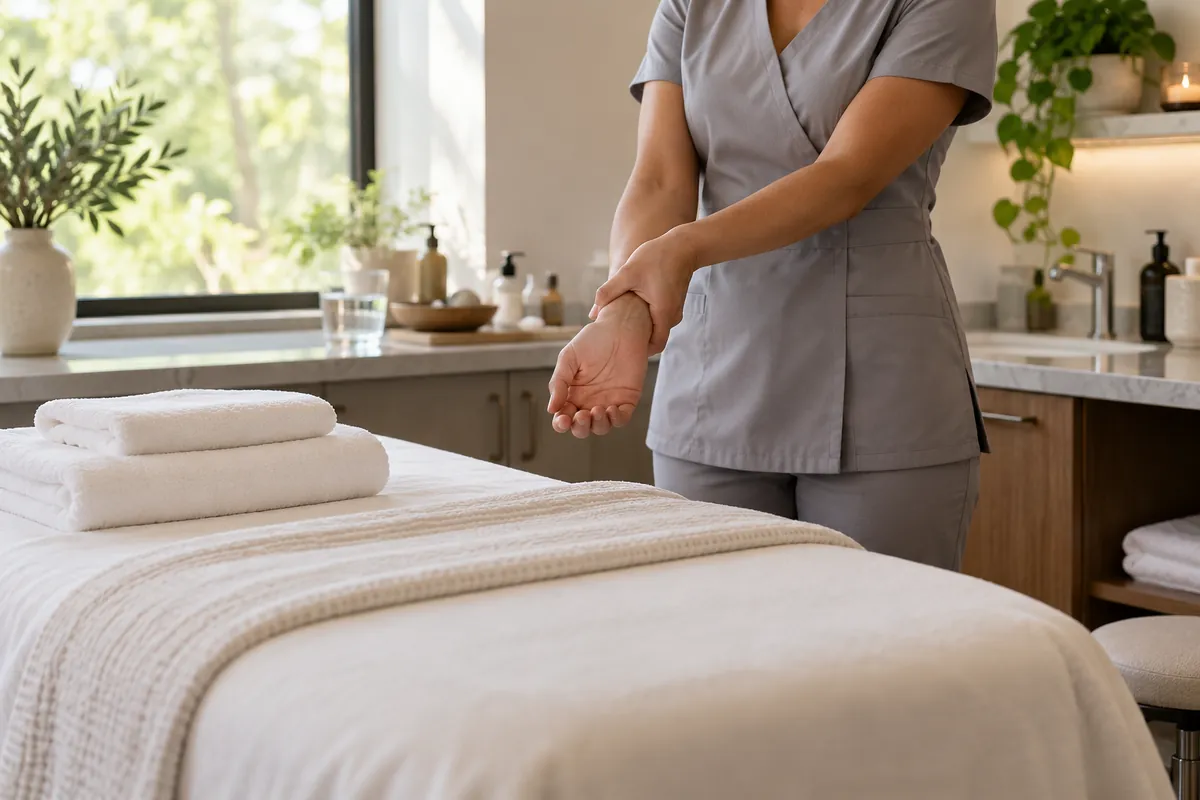
The work is physical. You sit or stand in fixed positions with your arms extended and your neck bent, performing small repetitive movements. Waxing adds repeated pulling. Rooms are warm, and days at busy spas are scheduled tightly. Hand, wrist, shoulder, neck, and lower back strain are the occupational complaints of this field. Good body mechanics, an adjustable stool and bed, and sensible scheduling prevent a lot of it, but the demands are real, and you should weigh them honestly if you already have joint or back problems.
Selling is part of the job. In most spas, part of your pay and much of your value to the employer comes from retail products and rebooked appointments. Some people enjoy recommending home care, since a facial once a month cannot outwork what a client does at home every day. Others hate the feeling of selling. If you are in the second group, you can learn to frame recommendations as professional advice, and that helps. But if the idea of sales targets is intolerable to you, choose your workplace very carefully, because many employers track them.
Scope and benefits are limited. The services that draw attention online, such as injectables, deeper peels, and lasers, are either outside esthetics practice or tightly regulated by state. Entry-level work is more about facials and waxing than about dramatic transformations. In addition, many positions in this industry do not include health insurance, paid leave, or retirement contributions, and independent estheticians provide those for themselves. Evenings and weekends are when clients are free, so those are prime working hours.
Your day is at the mercy of the schedule. A late cancellation or a no-show leaves an empty hour that cannot be resold, and in commission settings that hour is unpaid. A client who arrives late compresses the service or pushes the rest of the day back. Slow weeks happen after holidays and in the height of summer in many markets. Employers and independent estheticians reduce this with deposits, reminders, and cancellation policies, and you will get better at filling gaps, but some unpredictability is built into appointment-based work and it bothers some temperaments more than others.
Pros and cons side by side
It can help to see the trade-offs in one place. Every item on the right side below has a workable answer, and none of them should be dismissed. Read the table with your own situation in mind: your savings, your health, your family schedule, and your temperament. Something that is a minor inconvenience for one person, such as working Saturdays, is a dealbreaker for another.
| Area | What works in your favor | What works against you |
|---|---|---|
| Training | Shorter than most licensed careers, no degree required | Tuition is still significant, and school teaches only entry-level skills |
| Daily work | Hands-on, calm environment, visible results | Repetitive structure, physical strain, constant cleaning and room turnover |
| Income | Grows with clientele, skills, retail, and specialization | Uneven in the first year, often dependent on commission and tips |
| Schedule | Flexible once established, part-time options common | Evenings and weekends are peak hours |
| Security | Loyal clients are portable, and services are done in person | Benefits are often absent, and slow seasons affect pay |
| Growth | Many specializations and paths to independence | Advanced services are limited by state scope and cost extra training |
| People | Long, trusting client relationships | Emotional labor, difficult clients, no-shows |
If you want to go deeper on the income row, including how hourly, commission, tips, and retail combine in different settings, that is the subject of how much estheticians earn. I keep it separate on purpose. People who choose this career only for the money are usually disappointed in the first year, and people who choose it for the work often end up earning more than they expected, because they stay long enough to build a full book.
Who the career suits
Certain traits predict success more reliably than artistic talent. Patience with detail is the first. Skin work is precise and unhurried, and the person who enjoys getting a brow perfectly even or clearing a congested area methodically will find the work absorbing. Comfort with quiet is the second. Much of a facial is performed in near silence while the client rests, and you need to be content in your own head for long stretches while staying attentive to the person on the bed.
Genuine interest in skin is the third, and it matters over the long run. The field changes constantly, with new ingredients, devices, and research, and estheticians who keep reading and taking classes stay engaged and in demand. Warmth with boundaries is the fourth. Clients share personal things in the treatment room, and you need to be kind, discreet, and able to steer back to the service without absorbing every worry they bring in. People from nursing, caregiving, hospitality, and teaching often have this already.
Finally, the career suits people who are self-directed. Even as an employee you are, in practice, running a small business inside someone else's: your rebooking habits, your follow-up, and your reputation fill your schedule. People who like having that control thrive. I have also seen the profession suit career changers very well. Adults who arrive from other fields bring reliability, communication skills, and perspective, and clients respond to that maturity. It is never held against you that you started at thirty-five or fifty.
Who tends to struggle
It is just as useful to know who has a hard time. People who need constant variety and movement can find the treatment room confining. The services have a fixed structure, the room is small, and a full day means repeating a similar sequence many times with different clients. Some estheticians solve this by mixing service types or working in a busy waxing studio where the pace is quick. Others discover they would be happier in a more active corner of the beauty industry.
People who are strongly uncomfortable with bodies will struggle too. The work involves close contact, extractions, skin conditions that are not pretty, and, with body waxing, intimate areas. Most students get past initial squeamishness within weeks. A few do not, and it is better to learn that on a school tour or during a service you book for yourself than after enrollment. Likewise, people who take criticism personally find client-facing work draining, because occasional complaints, no-shows, and unreasonable requests come with any service job.
The last group is people who expect the license to do the work. A license lets you practice legally. It does not bring clients, and it does not make you good. Those who stop learning at graduation, wait for the front desk to fill their schedule, and resent the building period tend to leave within a couple of years. The pattern is common, and it is avoidable. Treat the license as permission to begin learning in earnest, and you are already ahead of most of your graduating class.
Workplace types: which one fits which person
Where you work shapes the career as much as the license does. Day spas and salon spas are the classic setting: a mix of facials, waxing, and sometimes body treatments, a relaxation-focused clientele, and usually commission-based pay with retail. They suit people who like variety across services and a calm atmosphere. For a new graduate, a well-run spa with an experienced lead esthetician is a good place to learn, provided the business is busy enough to put clients on your bed.
Waxing studios and other high-volume specialty chains offer something different: a steady stream of clients from the first week, structured training in one skill, and a fast pace. The work is narrower and more physically repetitive, and appointments are short. Many estheticians start here on purpose, since the volume builds speed and confidence quickly, and then move on or stay because they like the rhythm. Resort and hotel spas offer polished surroundings and guests who are on vacation, with the trade-off that few of them become regulars and demand follows the tourist season.
Medical settings, such as dermatology and plastic surgery offices and medspas, appeal to estheticians who like corrective, results-driven work. Under the practice's supervision and within state rules, the esthetician may perform facials, peels, and pre and post procedure care, and often assists with patient education and product programs. These positions usually expect experience and additional training, and the environment is clinical. If that direction interests you, read what a medical esthetician is to understand what the title does and does not mean legally.
Independent practice, in a rented suite or a small studio, is where many established estheticians end up. You choose your services, products, prices, and hours, and you keep what you earn after expenses. You also carry the rent, supplies, insurance, booking system, marketing, taxes, and every slow week yourself. It suits organized people with an existing clientele and some savings. It is a poor first job. I generally advise working for someone else long enough to build a following and learn how a business runs, then deciding with real numbers in hand.
Growth paths after the first years
One reason I consider esthetics a good career is that the entry-level job is not the ceiling. Growth comes in several directions, and you can combine them. The most common is specialization. An esthetician who becomes known for acne care, for brows, for sensitive and reactive skin, or for a particular client group can fill a schedule with people seeking exactly that and can price accordingly. Specialists are easier to recommend. "She is the person for acne" travels by word of mouth in a way that "she does facials" does not.
A second direction is adding licensed or certified skills. Depending on your state, that might be an advanced or master esthetics credential, lash services, laser training where estheticians may operate lasers under the required supervision, or electrology. Electrolysis is worth a mention because it is the only method the FDA allows to be marketed as permanent hair removal, it serves clients for whom laser is unsuitable, and practitioners are in short supply in many areas. It requires its own license or certification in many states. See whether estheticians can do electrolysis for how that works.
A third direction leads out of the treatment room. Experienced estheticians become lead estheticians and spa managers, educators for product and device companies, sales representatives calling on spas, state-licensed instructors in beauty schools, and writers or consultants. These roles matter for longevity. A person whose shoulders are tired after fifteen years of treatments can shift to teaching or brand education and keep using everything they know. Some combine a reduced client schedule with one of these roles, which is a comfortable arrangement in the later part of a career.
The fourth is ownership: a solo suite, then perhaps a small studio with other providers. Ownership changes the work from giving treatments to running a business, with hiring, compliance, and finances, and not everyone enjoys that change. It is an option, not an obligation. Some of the most contented estheticians I know have stayed solo for decades, with a full book, a waiting list, and no interest in managing anyone. My guide to a home studio versus renting a suite compares the first steps toward independence.

Stability and demand: an honest view
People often ask whether the field is stable. A few things work in its favor. Skin care services are performed in person, by hand, on an individual, which makes them hard to outsource or automate. Interest in skin care has grown across age groups and among men, and federal labor projections in recent years have listed skincare specialists among occupations expected to grow faster than average. Clients who see results tend to treat their appointments as maintenance, like a haircut, not as an occasional luxury.
There are also real limits to that stability. Facials and waxing are discretionary spending, and when household budgets tighten, some clients stretch the time between visits. Income can dip in slow seasons. Local competition matters: a town with many spas and few residents is a harder market than a growing suburb. And job security in the employee sense is modest, since spas open, close, and change ownership. The estheticians who ride this out are the ones with a loyal clientele and more than one skill, because both are portable.
I would put it this way. Esthetics is not a guaranteed-salary profession, and anyone who promises you a fixed income from a license is selling something. It is a skilled trade where stability is built by the practitioner, appointment by appointment. If that idea appeals to you, the career can be very steady indeed. If you need a predictable paycheck with benefits from day one, look closely at hourly positions with established employers, or consider whether a different field fits your needs better.
Staying well: the physical and emotional side of a long career
A career is only good if you can keep doing it. Physically, the habits that protect you are simple and need to start in school: adjust the bed and stool for every client so that you are not hunching, keep wrists neutral, alternate sitting and standing where services allow, stretch your hands and shoulders between clients, and do some strength work outside the job. Schedule a real break in a full day. Estheticians who book eight services back to back to maximize a paycheck often pay for it within a few years.
The emotional side deserves the same care. You are attentive, soothing, and positive for hours, including on days when you do not feel that way, and clients sometimes unload serious personal troubles while you work. Learning to listen kindly without carrying it home is a professional skill. So is setting policies, such as cancellation rules, and holding to them calmly. People who cannot say no to clients burn out, and it usually shows first as resentment of the schedule.
Esthetics as a second career
A large share of esthetics students are not teenagers. They are adults leaving offices, hospitals, restaurants, classrooms, and retail floors, or parents returning to paid work. If that is you, the career has particular strengths. Training is short enough to complete without years out of the workforce, and many schools offer part-time schedules. Your previous experience transfers more than you might expect. Customer service, record keeping, sales, and bedside manner are all directly useful in a treatment room.
The cautions for career changers are mostly financial. You may be leaving a salary with benefits for a commission-based start, so run the numbers for the school period and for the first year after it. Decide how you will cover health insurance. Consider keeping part-time income from your old field while your book grows. And check your physical readiness honestly. Starting a hands-on career in midlife is entirely feasible, and I have trained excellent estheticians who began in their fifties, but the ergonomics matter more, not less.
If you are comparing licenses, think about which one matches the work you want. Esthetics is the direct route to skin care. A cosmetology license is broader and longer, built around hair, with skin as a smaller component. I lay out the comparison in cosmetologist or esthetician: the difference. Choosing the longer program "to keep options open" is a common and expensive mistake when you already know that skin is what interests you.

How to test the career before you commit
You do not have to guess. Several inexpensive steps will tell you a great deal before you sign an enrollment contract. First, book services as a client at two or three different kinds of businesses: a day spa, a waxing studio, and if possible a medspa. Watch what the esthetician actually does, how the room is run, and how the day seems to be paced. Ask, politely, how they like their work and what they would tell someone starting out. Most professionals are generous with an honest answer.
Second, tour schools and ask to observe a class. See whether the reality of students practicing on each other, cleaning stations, and studying anatomy appeals to you or deflates you. Third, look at local job listings for estheticians. They show which employers are hiring in your area, what experience they ask for, how they describe pay structure, and which skills, such as waxing speed or laser certification, are in demand. That is local market research no article can give you.
Fourth, study some of the theory. The science of skin, infection control, and ingredients forms a large part of both school and the licensing exam, and your reaction to it is informative. Our online esthetics theory course is one way to do that at your own pace and low cost. It will show you whether the subject holds your interest and give you a head start if you enroll. It is not a license and does not count toward the in-person training your state requires. For what the school curriculum involves, see what you learn in esthetician school.

What a good first two years looks like
If you do go ahead, the shape of a good start is fairly consistent. You choose a first job for the learning and client volume it offers, not for the prettiest lobby. You say yes to the services others avoid, since that is how you become versatile. You rebook every client before they leave the room and keep notes on each one, so the second visit feels personal. You take one or two solid advanced classes in the area you are leaning toward, after confirming the service is within your state scope.
By the end of the second year, a person on this path usually has a recognizable specialty forming, a core of regulars, a realistic sense of what different workplaces offer, and enough information to decide the next move: stay and grow, change settings, add a credential, or begin planning for independence. That is a strong position to be in after a relatively short education. It comes from steady habits repeated daily, which is good news, because habits are available to everyone.

Your next step
Decide with evidence. Book the services, visit a school, read the local job listings, and check what your state requires through the esthetics licensing hub. Write down your honest answers to the three questions from the beginning of this guide: do I like the daily work, can I get through a building year, and am I willing to keep learning and recommending? If the answers are yes, you have good reason to believe this career will suit you.
If you would like to begin learning while you decide, start with the theory. The esthetics theory course covers the science and safety knowledge every esthetician needs and lets you find out, cheaply and privately, whether the subject keeps your attention. Then take that preparation to a state-licensed school for the hands-on training and required hours, which is where the license is earned. A career in esthetics rewards people who enter with clear eyes, and now you have them.
State Requirements
State licensing guides
Hours, exams, fees, and the licensing board differ by state. Open your state for the current requirements.
Common Questions
FAQ
It is a good choice for people who enjoy close, detailed, one-on-one work, can manage a slow first year while building clients, and are willing to keep learning. It offers visible results, flexible scheduling once established, and several growth paths. It is a weaker fit for people who need a guaranteed salary with benefits from the start or who dislike physical, repetitive work and recommending products.
The common ones are an uneven income during the first year, physical strain on the hands, shoulders, neck, and back, evening and weekend hours, sales expectations in many spas, limited employer benefits, and a legal scope that excludes medical procedures. Each can be managed with planning, good ergonomics, and a careful choice of workplace, but none should be ignored when you decide.
Earnings range widely and depend on the setting, pay structure, location, tips, retail, and above all the size and loyalty of your clientele. New estheticians often earn modestly while they build a book, and established specialists and independent practitioners can do considerably better. I avoid quoting single figures because they mislead. The factors are explained in how much estheticians earn.
It has real strengths: services must be performed in person, interest in skin care is broad, and labor projections have been favorable. It also depends on discretionary spending and on local competition, and many jobs lack benefits. Stability comes mainly from a loyal clientele and more than one marketable skill. Estheticians who build both tend to stay busy even when a particular employer closes or the economy slows.
Often, yes. Training is short compared with degree programs, part-time schedules exist, and maturity and customer service experience are assets with clients. Plan the finances for school and the first working year, think about health insurance, and be honest about physical demands. Many people start successfully in their forties and fifties. Check your state's requirements in the esthetics licensing hub before comparing schools.
Common settings include day spas, salon spas, waxing studios, resort and hotel spas, medspas, dermatology and plastic surgery offices, and independent suites or studios. Experienced estheticians also work as educators, brand representatives, spa managers, and beauty school instructors. Each setting has a different pace, clientele, and pay model, so it is worth experiencing more than one as a client before choosing where to start.
Yes. Growth usually comes through specialization, continuing education classes, manufacturer certifications, and added credentials such as an advanced esthetics license, lash services, laser training, or electrology, depending on state rules. Some of these require additional formal training, but they are generally much shorter than a degree. Always confirm that a service is within your legal scope before paying for a class.
Book treatments at different types of businesses and observe the work, talk with practicing estheticians, tour a school and sit in on a class, read local job postings, and study some of the theory. An online theory course is a low-cost way to test your interest in skin science. It does not replace state-required in-person training, but it will tell you whether the subject matter engages you.
Keep Reading
Related Guides


