Waxing
How Long Should Hair Be for Waxing? Length Guide by Area

Quick answer
Hair should be about a quarter of an inch long for waxing, roughly the length of a grain of rice. If you can pinch it between two fingers and feel a light tug, wax can usually grip it. After shaving, many people need about two to three weeks of growth. Hair much longer than half an inch should be trimmed first.
How long should hair be for waxing? It is the question I hear most often on the phone before a first appointment, and it is also the reason behind most disappointing waxes. A client shaves on Monday, books for Friday, and leaves with a patchy result and sore skin. Another client grows everything out for three months to be safe, and the service takes twice as long and hurts more than it had to. In both cases the wax was fine and the technique was fine. The hair was simply the wrong length for the wax to do its job. I have been a licensed electrologist and cosmetologist for more than twenty years, and length is still the first thing I check when a client lies down.
This guide explains the commonly used rule of thumb, why it exists, and where it bends. It covers what happens when hair is too short or too long, how to trim safely at home, how the answer changes by body area and by wax type, how long to grow hair out after shaving, and why a first wax often looks uneven a week or two later even when everything was done correctly. The last sections are written for waxing and esthetics students, because judging length quickly and honestly is a skill that has to be learned at the table. Everything here is general education, not medical advice. Skin conditions and medication questions belong with a physician or dermatologist.
The Short Answer: About a Quarter Inch
The guideline taught in most waxing classes and repeated in most studios is that hair should be about a quarter of an inch long before it is waxed. The comparison people remember is a grain of rice. If the hair on the area you want waxed is roughly as long as a grain of rice lying flat against the skin, the wax has enough to hold. This is an industry rule of thumb, not a law of nature, and it was never meant to be measured with a ruler. It gives clients a simple picture they can check at home in good light without any tools.
There is an upper end as well, although it is talked about less. Many practitioners prefer hair somewhere between a quarter inch and about half an inch, and they trim anything noticeably longer before applying wax. Past that point the hair starts to lie flat in several directions, tangles in the wax, and pulls on the skin during application. So the practical target is a window, not a minimum: long enough to grip, short enough to stay tidy. Fine hair can often be removed toward the shorter end of that window, and coarse hair usually behaves better with a little more length.
A simple home check works better than guessing from the calendar. Pinch a few hairs between your thumb and forefinger. If you can hold them and feel a light tug on the skin when you pull gently, the wax can probably hold them too. If your fingers slide off, or you can see the hair but cannot catch it, it is too short. If the hair curls over on itself or you can wrap it around a fingertip, it is long enough to benefit from a trim. When you are unsure, leave it alone and let the practitioner decide. Hair that is slightly too long is an easy fix at the appointment. Hair that is too short is not.
Why Hair Length Matters: Grip, Breakage, and Pain
Wax does not dissolve hair or loosen it. It is a mechanical method. The wax flows around each hair shaft while it is warm, firms up as it cools, and then the practitioner removes it in one quick motion so the hair comes out of the follicle with it. For that to work, the wax needs enough of the shaft above the skin to wrap around. A hair that barely clears the surface offers almost nothing to hold. The wax then bonds mostly to the skin and to the dead cells on top of it, and the pull lands on the skin instead of the hair.
Breakage is the second issue. A hair that is gripped well slides out whole, with the rounded bulb at the bottom. A hair that is gripped poorly, or that is so long it gets pulled sideways, tends to snap. Sometimes it snaps at the surface and you see stubble the next day. Sometimes it snaps just below the surface, which is worse, because the blunt end sits inside the follicle and can struggle to find its way out. That is one of the routes to bumps and trapped hairs after a wax. I cover the full picture in my guide to preventing and treating ingrown hairs after waxing, but wrong length is a common starting point.
Pain is the third. Clients often assume shorter hair means a gentler wax, and it is the opposite at the very short end. When the wax cannot hold the hair, the practitioner has to go over the same patch again, and each pass removes a little more of the skin's surface and leaves it more tender. At the long end, hair gets dragged during application and pulls from several angles at removal, which feels sharper and more tugging than a clean pull. A wax done on hair of the right length is over faster, needs fewer passes, and leaves calmer skin.

What Happens When Hair Is Too Short
Hair that is too short is the most common length problem I see, and it almost always follows a recent shave. The surface looks hairy enough to the client because the stubble is dark and feels prickly. Under the lamp it is a field of blunt tips that barely clear the skin. Soft wax laid over that surface grabs the skin and slides over the stubble. Hard wax does somewhat better, because it shrinks around the hair as it sets, but even hard wax has a limit. The typical outcome is a wax that removes some hairs, breaks others, and misses the rest.
The client usually notices the problem within a day or two. The area feels smooth in patches and rough in others, and small dark dots show where hairs were broken or left behind. There may be more redness than expected, because the skin took the pull that the hair should have taken. Some clients then shave the leftovers, which resets the growth and guarantees the same problem at the next visit. Others ask for a second wax a few days later. Waxing the same skin again that soon is something I avoid, because the surface has not recovered yet and is easier to irritate or lift.
What Happens When Hair Is Too Long
Hair can be too long to wax comfortably, but it is never too long to wax at all, because the fix is a pair of scissors or a guarded trimmer. Long hair causes trouble at three moments. During application, the spatula catches the hair and drags it, which tugs on the follicle before any wax is removed. As the wax sets, long hairs lie across each other in a mat, so the wax bonds to the upper part of the mat and never reaches the base of the hairs near the skin. At removal, the pull travels along a long, bent shaft instead of straight out of the follicle, and the hair is more likely to snap.

How to Trim Before a Wax
Trimming before a wax is optional for most clients and helpful for some. If you wax on a regular schedule, your hair will rarely get long enough to need it. Trimming is mainly for a first wax after a long break, for areas where hair grows long by nature, such as the bikini area, underarms, and men's chest and back, and for anyone whose hair is coarse and curly enough to coil back toward the skin. The goal is modest. You are not shaping anything. You are bringing the longest hairs down so they are closer to the rest, while leaving more than the minimum.
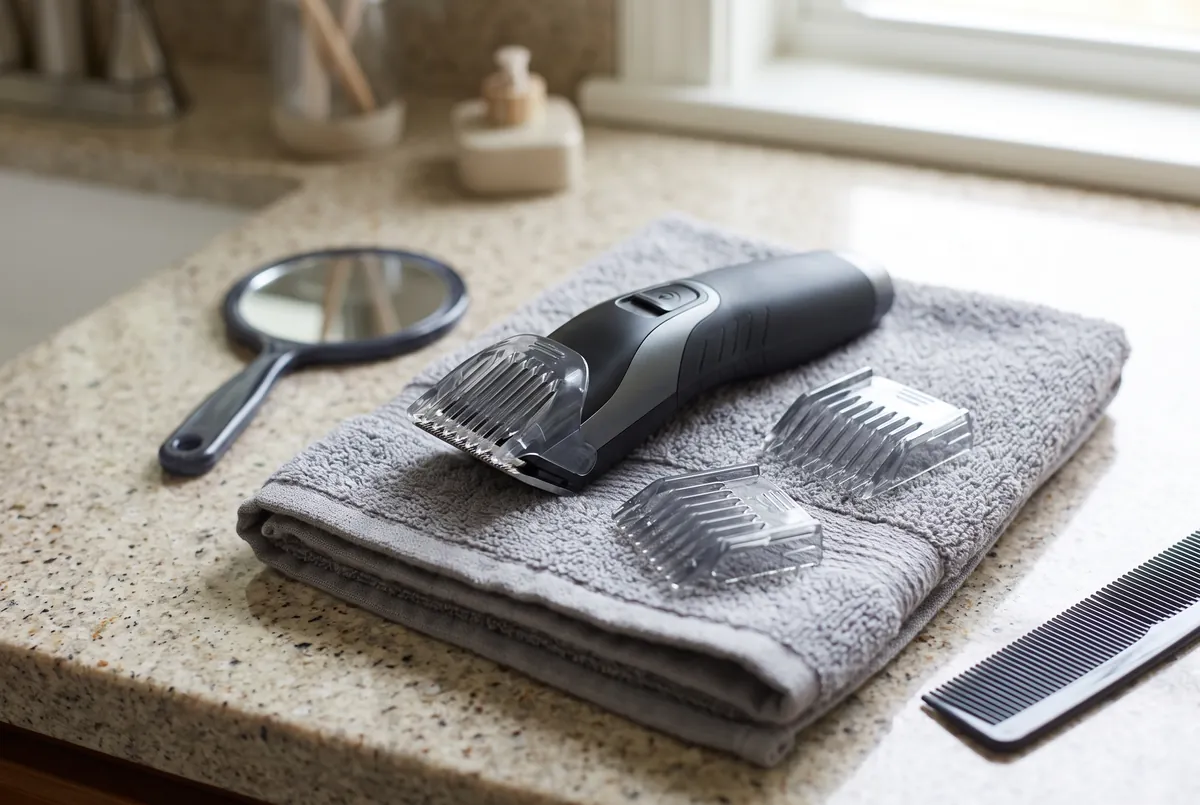
The safest tool is an electric trimmer with a plastic guard, because the guard sets the length for you and keeps the blade off the skin. Choose a guard that leaves hair clearly longer than a grain of rice. Trimmers vary, so test on a small patch first and check with the pinch test before you continue. Small scissors with rounded tips also work, used with a comb: lift the hair with the comb and cut what sticks out above it. Never use a razor, and never use a trimmer without its guard, since a bare trimmer blade cuts close enough to leave you with stubble.
- Trim on dry hair in good light. Wet hair lies flat and stretches, so it is easy to cut it shorter than you intended.
- Start with the longest guard you own. Check the result with your fingers, and only go shorter if the hair still curls over or tangles.
- Work in the direction the hair grows, in short passes, without pressing the trimmer into the skin.
- Leave more length than you think you need. A practitioner can take off a little more at the appointment in seconds.
- Trim a day or two before the visit, not an hour before, so any loose clippings are washed away and the skin is settled.
- Stop if you see nicks or irritation. Broken skin should not be waxed, so a careless trim can cost you the appointment.
Hair Length for Waxing by Body Area
The quarter inch guideline is a starting point for the whole body, but hair is not the same everywhere. Facial hair is often fine and short by nature. Underarm and bikini hair is coarse, deeply rooted, and grows in several directions. Leg hair grows slowly and evenly on most people. The table below summarizes how I think about length in each area. It is a practical guide from the treatment room, not a set of measurements, and your practitioner may adjust it for your hair and the wax they use.
| Area | What to aim for | What to watch |
|---|---|---|
| Eyebrows | Enough growth to see the natural shape. Stop tweezing well ahead of the visit. | Stray hairs plucked between visits leave gaps and uneven regrowth. |
| Upper lip and chin | Fine hair can be waxed fairly short. Darker corner hairs need the full grain of rice length. | Shaved or dermaplaned facial hair needs time to grow back before waxing. |
| Underarms | Grain of rice length across the whole underarm, trimmed if it curls. | Hair grows in more than one direction, so even length makes mapping easier. |
| Arms | Usually long enough as it is. Rarely needs trimming. | Previously shaved arms need a full grow-out first. |
| Bikini and Brazilian | Grain of rice length or slightly more. Trim longer hair before the service. | Coarse, curly hair that is left very long tangles and makes the wax more uncomfortable. |
| Legs | Grain of rice length on both lower and upper legs. | Lower legs often reach length before thighs and knees do. |
| Chest and back | Trimmed to an even, moderate length before a first wax. | Dense, long growth hides the skin and the growth pattern. |
Faces are the main exception at the short end. Fine vellus hair on the upper lip, cheeks, and around the brows is short even when it is fully grown, and a skilled practitioner removes it with a wax suited to delicate skin. What does not work is waxing facial hair that has been shaved, dermaplaned, or cut down with a facial razor a few days earlier. For brows, the issue is less about length and more about leaving the hair alone, so there is enough to shape. My eyebrow waxing guide covers how long to stop tweezing and what to expect from a first shaping.
For bikini and Brazilian services, the hair is coarse enough that length matters in both directions. Too short, and the thick stubble resists the wax and breaks. Too long, and it tangles, holds wax unevenly, and makes each pull feel heavier than it needs to. Most practitioners trim this area as part of the service when needed. If it is your first time, my first Brazilian wax guide explains how to prepare and what the appointment involves. Underarms follow the same logic on a smaller scale: coarse hair, multiple growth directions, and a strong benefit from even, moderate length.

Does the Type of Wax Change the Answer?
It does, within limits. Soft wax, also called strip wax, is spread thin and removed with a cloth or paper strip. It bonds to the hair and also to the top layer of the skin, and it depends on having a reasonable length of hair to hold. It is efficient on large areas with hair of normal waxing length, and it is the least forgiving of stubble. If a studio uses soft wax for your service, the grain of rice guideline should be taken seriously.
Hard wax is applied thicker and removed on its own, without a strip. As it cools it tightens around each hair, and it adheres less to the skin itself. That shrink-wrap behavior lets hard wax hold hair that is a little shorter than soft wax can manage, and it is one reason hard wax is preferred for coarse hair on sensitive areas. A little shorter does not mean stubble, though. Freshly shaved hair is still too short for hard wax to remove cleanly. For a fuller comparison of formulas and where each is used, see my guide to the types of wax for hair removal.
Sugaring is the method most often described as tolerating shorter hair. Sugar paste is worked onto the skin at a low temperature, pressed in against the direction of growth, and flicked off in the direction of growth. Because the paste is molded into the hair by hand and removed with the growth, practitioners who sugar commonly accept hair somewhat shorter than the standard waxing length. How much shorter depends on the paste, the area, and the practitioner's skill, so ask the studio what they want to see. If you are a student choosing between the two methods, I compare them in wax versus sugaring: which to learn.

How Long After Shaving Can You Wax?
The honest answer is: when the hair has reached length, however long that takes for you. The figure clients hear most often is two to three weeks after the last shave, and that is a reasonable expectation for many people on legs and body. It is still only an estimate. Hair grows at different rates on different people and on different parts of the same person. Some clients with fast, coarse growth are ready sooner. Some with fine, slow growth need longer. Use the calendar to plan and the pinch test to decide.
Shaved hair also misleads the eye. A razor cuts every hair straight across at its thickest point, so the regrowth has a blunt tip. It looks darker and feels coarser than the same hair with its natural tapered end. Clients see dark, prickly stubble a week after shaving and conclude there is plenty to wax. Viewed from the side, that stubble is still very short. Feel is a better judge than appearance. Stubble that scratches the palm is too short. Hair that has started to feel soft and lie down slightly is getting close.
The grow-out period is uncomfortable for a lot of people, and I do not pretend otherwise. The hair is visible, it can itch, and there may be an event on the calendar. A few things help. Plan the switch from shaving to waxing for a cooler season or a quiet stretch when the area is covered. Wear loose, breathable clothing while the hair comes through, since tight fabric rubbing on stubble is a main source of itch. Keep the skin moisturized with a plain, fragrance-free lotion. And resist a quick tidy-up shave, because one pass of the razor returns you to the start.
Hair Growth Cycles and Why First Waxes Look Patchy
Every hair follicle works through a repeating cycle. In the growing phase, called anagen, the hair is attached to its blood supply and actively lengthens. In the short transitional phase, called catagen, growth stops and the hair detaches from its supply. In the resting phase, called telogen, the old hair sits loosely in the follicle until it sheds and a new one begins. The important point for waxing is that follicles do not run on the same clock. At any moment, some hairs on your legs are growing, some are resting, and some follicles are between hairs with nothing showing above the skin.
That staggering explains the most common complaint after a first wax. The client leaves smooth, and a week or two later a scattering of hair appears. They assume the practitioner missed those hairs or broke them. In most cases those hairs were not above the skin on the day of the wax, or they were only just emerging and too short to grip. They are new growth from follicles that were on a different schedule. This is especially noticeable in people who shaved for years, because shaving cuts everything level every few days and hides how staggered the growth really is.
Regular waxing gradually brings the hair into closer step. Each appointment removes everything that is long enough, and the hairs that come back afterward start from roughly the same point. After several visits on a steady schedule, more of the hair arrives at waxing length together, so each service clears more of it and the smooth period feels longer. Practitioners sometimes call this getting the hair on a cycle. It is the reason I ask new clients to judge waxing after a few consistent appointments, not after the first one.
One caution belongs here. Hair growth that changes suddenly, such as new coarse hair on the face, chest, or abdomen, or growth that becomes much denser over a short period, is not a waxing question. It can have hormonal or medical causes, and it deserves a conversation with a physician. A practitioner can remove the hair, but cannot tell you why it appeared. In my practice I mention this gently whenever a client describes a clear change, because removing hair without asking about the cause does not serve them well.

What to Do Between Appointments
The single most useful habit between appointments is to leave the hair alone. No shaving, no depilatory cream, and no tweezing or epilating the early regrowth. Shaving cuts every hair back to skin level and makes the next wax a first wax again. Tweezing and epilating are less obvious problems, but they pull individual hairs out of step with the rest, so the area never settles into an even pattern. If a few hairs bother you before an event, trimming them with small scissors is the least disruptive option, because it shortens the hair without resetting the follicle.
Booking rhythm matters as much as restraint. Most studios suggest returning every few weeks, with the exact interval depending on the area, your growth, and the method. If you come back too early, a share of the hair is still too short and gets left behind. If you stretch the gap for months, the hair falls out of step again and the service feels like starting over. Ask your practitioner at the end of each visit when they would like to see you next, based on what they saw that day. They are looking at your actual regrowth, which is better information than any general schedule.
- Do not shave between waxes. One shave resets the length and brings back the blunt, stubbly regrowth.
- Trim instead of removing. If long hairs bother you, cut them with scissors or a guarded trimmer and leave waxing length.
- Exfoliate gently and regularly. Once the skin has settled after a wax, mild exfoliation a few times a week helps new hairs reach the surface.
- Moisturize daily. Soft, hydrated skin releases hair more easily and tolerates waxing better than dry, flaky skin.
- Rebook before you leave. A set date removes the temptation to shave and keeps the hair on a steady cycle.
- Tell your practitioner about changes. New medications, skincare, or skin conditions can matter more than hair length.

What a Professional Does When Hair Is the Wrong Length
A responsible practitioner checks length before warming up to the service, not halfway through it. I look at the area under good light, run a gloved finger against the growth, and pinch a few hairs in more than one spot. That takes a few seconds and tells me which of four situations I am dealing with: ready, too long, slightly short, or far too short. Each one has a different honest response, and the client should hear it before any wax touches the skin.
When hair is too long, the answer is simple. I trim it to a workable length with scissors and a comb or a guarded trimmer, brush away the clippings, cleanse the skin, and proceed. When hair is ready, I proceed. The more delicate situations are the short ones. If the hair is slightly short, or ready in some parts of the area and short in others, I explain what I can and cannot remove. Often I can switch to hard wax, work in smaller sections, and get a good result on most of the area. I tell the client in advance that some shorter hairs will remain and will be ready at the next visit.
When hair is far too short, the right call is to reschedule. This is uncomfortable for both sides. The client has made time, sometimes taken leave from work, and may have an event in two days. Still, waxing stubble gives a poor result, irritates the skin, and risks ingrown hairs, and the client will associate all of that with me and with waxing. I would sooner explain why, show them the pinch test so they can check at home, and book them for the date when the hair should be ready. Studios handle the fee side of this differently, so it is worth asking about the policy when you book.
There are things a careful practitioner will not do to rescue a wrong-length appointment. They will not go over the same patch again and again with wax in the hope of catching stubble. They will not press harder or leave soft wax on longer to improve grip. They will not tweeze an entire area hair by hair to make up for a wax that could not hold, although cleaning up a few stray hairs with tweezers at the end is normal. If a practitioner tells you the hair is too short and offers to rebook, that is a sign of good judgment, not poor service.

Notes for Students and New Waxers
Students usually learn the quarter inch rule in the first week and then discover that the hard part is applying it under pressure. A client is on the table, the next client is in the waiting area, and the hair is borderline. The temptation is to try anyway. My advice is to build the length check into your routine so firmly that it happens before you think about it: look, feel against the growth, pinch in at least three places across the area. Say what you find out loud to the client. Speaking it forces you to make a decision instead of drifting into the service.
Learn to read mixed lengths, because that is what real clients bring. Very few people arrive with uniform hair. You will see long hair at the edges and short hair in the middle, one leg shaved more recently than the other, or a bikini line that was tidied with a razor while everything else was left. Decide zone by zone. It is perfectly professional to wax the areas that are ready, leave the areas that are not, and explain the difference. What undermines trust is treating everything the same and letting the client find the rough patches at home.
Practice trimming as a real skill. New waxers often trim too short because they are trying to be neat, and they turn a too-long problem into a too-short one. Use a comb as your guide, cut above it, and check with your fingers before you cut again. Keep the client draped and comfortable, brush or wipe away all clippings, and cleanse before you apply anything, since loose cut hairs under the wax interfere with the bond. On larger areas, a trimmer with a guard is faster and more consistent than scissors. Clean and disinfect your tools between clients according to your state board's rules.
The conversation matters as much as the technique. When you have to tell a client their hair is too short, be direct and kind. Explain what the wax needs, show them the pinch test on their own arm, and give them a specific date to return. Avoid blaming them, and avoid vague phrases like "it might not be perfect". Say exactly what will happen: these hairs will come out, these will not, and here is why. Clients respect clear information. Over the years, the clients who stayed with me longest were often the ones I turned away at a first visit and rebooked properly.
If you are still deciding whether waxing is the right field, start with the basics before you buy equipment. My guide on waxing for beginners lays out what to learn first, and the waxing course overview describes how the theory is organized. Keep the legal side clear in your mind: online study builds knowledge of skin, hair, products, and safety, but it does not replace the in-person training hours or the license your state requires to work on the public. Requirements differ from state to state, and the waxing licensing hub is the place to check yours.

Your Next Step
If you are a client, the plan is short. Stop shaving the area today. Let the hair grow until you can pinch it and it is about the length of a grain of rice, which for many people takes a couple of weeks or a little longer. Check more than one spot. Leave trimming to the practitioner unless the hair is clearly long and you have a guarded trimmer. Book with a licensed professional, tell them when you last shaved and what you use on your skin, and rebook before you leave so the hair stays on a steady cycle.
If you are a student or a new waxer, make the length check a fixed part of every service and practice saying honestly what you see. Learn to trim well, learn which wax gives you a little more room on shorter hair, and learn to reschedule without apology when the hair is not ready. Then build the rest of your foundation: skin anatomy, contraindications, sanitation, and your state's requirements. The waxing course on this site is a place to study the theory, and the licensing hub linked above will tell you what your state expects in person before you take your first paying client.

State Requirements
State licensing guides
Hours, exams, fees, and the licensing board differ by state. Open your state for the current requirements.
Common Questions
FAQ
The widely used guideline is about a quarter of an inch, roughly the length of a grain of rice. Many practitioners like hair between that and about half an inch, and they trim anything much longer. A practical test is to pinch a few hairs between your thumb and forefinger. If you can hold them and feel a light tug, the wax can usually grip them. Fine hair can sometimes be waxed a little shorter, and coarse hair often does better with slightly more length.
Wait until the hair has grown back to about grain of rice length. Many people reach that roughly two to three weeks after their last shave, but growth rates differ between people and between body areas, so use the pinch test instead of counting days. Shaved regrowth looks darker and feels coarser than it really is because the tips are blunt, so it often seems ready before it is. Do not shave again during the grow-out, since one pass of the razor resets the wait.
It is probably too short if you can see it but cannot pinch it, or if it feels like scratchy stubble against your palm. Wax needs enough of the shaft above the skin to wrap around. On stubble it grips the skin instead, which leads to broken hairs, patchy results, and extra redness. Hard wax and sugaring can manage somewhat shorter hair than soft wax, but neither works well on freshly shaved skin. If in doubt, wait another week or ask your practitioner to look.
Hair can be too long to wax comfortably, but that is easy to correct. Long hair tangles in the wax, gets dragged during application, and is more likely to snap at removal, so the service is slower and more uncomfortable. The fix is trimming to a moderate length first, which most practitioners do as part of the appointment. If you want to trim at home, use a trimmer with a guard or small rounded scissors and a comb, and leave more than a grain of rice of length.
Usually because those hairs were not long enough, or not above the skin at all, on the day of your wax. Follicles grow, rest, and shed on different schedules, so new hairs keep surfacing after the others have been removed. This is most noticeable after years of shaving. With consistent appointments the growth comes into closer step and the smooth period feels longer. If the hairs feel like stubble the very next day, some may have broken, which is worth mentioning to your practitioner. See how long waxing lasts for more.
Sugaring is generally described as tolerating somewhat shorter hair, because the paste is pressed into the hair by hand and removed in the direction of growth. Hard wax also holds slightly shorter hair than soft strip wax, since it tightens around the shaft as it cools. In all three cases there is still a minimum, and freshly shaved skin is below it. Ask the studio what length they want for the method they use, and follow that guidance over any general number.
Call the studio and tell them when you shaved and which area. If it was the day before, expect to reschedule, because stubble cannot be waxed cleanly and trying usually irritates the skin. If it was a week or more ago, the practitioner may be able to assess the hair in person, work with hard wax on the parts that are ready, and leave the rest for next time. Ask about the rescheduling policy when you call, and do not shave again while you wait.
Keep Reading
Related Guides


