Waxing
Can You Wax Over a Tattoo? Healing Times and Safety Rules
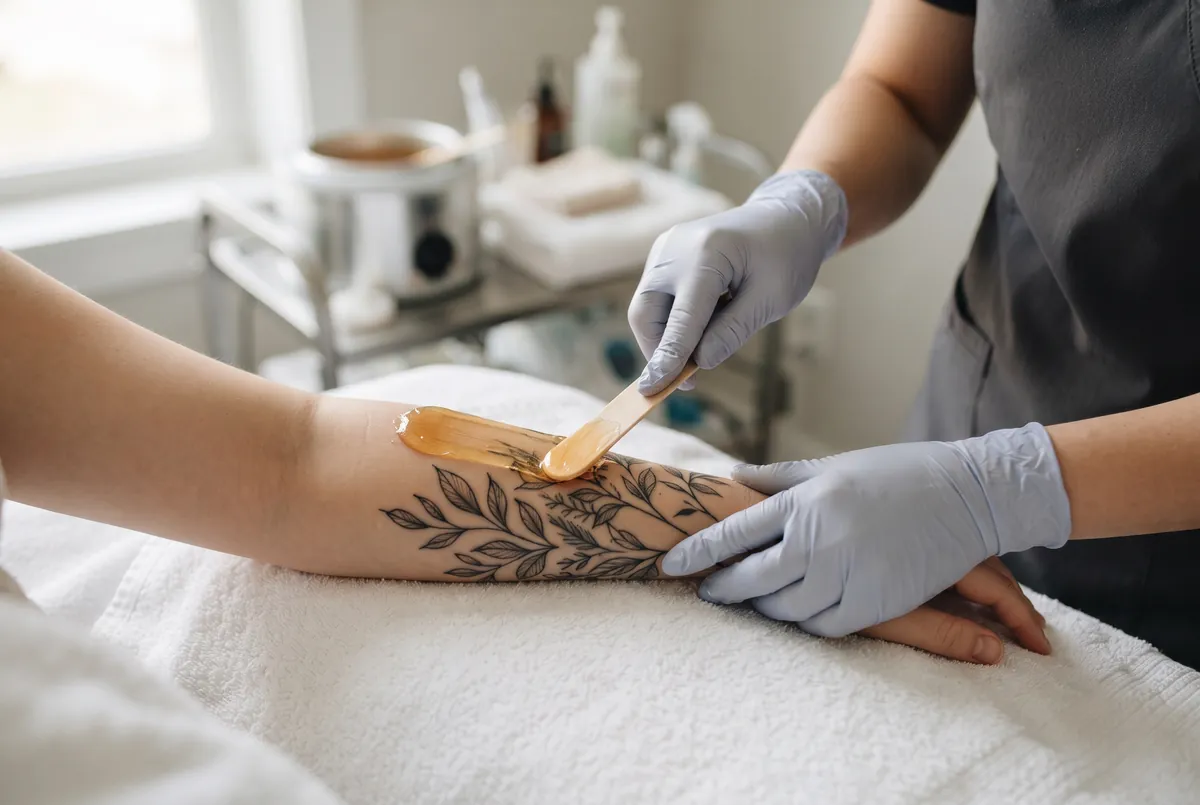
Quick answer
You can wax over a tattoo once it has fully healed. Wax works on hair and the surface of the epidermis, while tattoo pigment sits deeper, in the dermis, so waxing does not pull out or fade ink. Most artists and estheticians advise waiting at least four to six weeks after new ink. Laser hair removal must never be used over a tattoo.
Can you wax over a tattoo? Yes, once the tattoo has fully healed. Waxing over a tattoo that is settled and healthy is safe, it does not pull ink out of the skin, and it will not fade the design. Tattoo pigment sits in the dermis, the deeper layer of the skin, while wax grips hair and the loose dead cells on the very surface. A fresh tattoo is a different matter. Until the skin has closed and rebuilt itself, a tattoo is a wound, and waxing a wound risks torn skin, infection, patchy healing, and damage to artwork you just paid for.
I am Aida Khazieva, a licensed electrologist and cosmetologist with more than twenty years in hair removal. Tattooed clients are an everyday part of a waxing practice now, and the same questions come up every week: how long to wait, whether wax dulls color, what to do about hair growing through a new piece, and which methods are safe when wax is not. This guide answers them from a practitioner's side of the table, including how I assess a tattoo before I agree to wax it and what I tell clients who are planning new ink.
The short answer
A fully healed tattoo can be waxed like any other skin. A new tattoo cannot. As a general guide, most tattoo artists and estheticians advise waiting at least four to six weeks after getting tattooed before waxing the area, and longer for large pieces, heavy color packing, or skin that heals slowly. The surface of a tattoo often looks finished well before the deeper layers have recovered, so appearance alone is not a reliable signal. When in doubt, wait another couple of weeks and ask your artist.
Three simple checks tell me a tattoo is ready. The surface is smooth, with no scabs, flakes, or shiny, tight patches. The color looks settled, without the cloudy or milky film that covers a tattoo in the middle of healing. And the skin feels like the skin around it: not raised, not warm, not tender to the touch. If any of those checks fail, I wax around the tattoo with a margin and leave the piece alone until the next visit.
Why a healed tattoo is safe to wax
To understand why waxing does not harm a healed tattoo, it helps to know where each thing happens in the skin. The outer layer, the epidermis, is constantly renewing itself. Cells form at its base, move upward, flatten, die, and are shed from the surface. Below it lies the dermis, a thicker, stable layer of connective tissue. A tattoo machine deposits pigment through the epidermis into the dermis, where the particles are held in place for decades. Any pigment left in the epidermis is shed during healing.
Wax works entirely at the top. It adheres to the hair shaft and, to some degree, to the loose dead cells at the surface, and when it is removed it takes the hair out of the follicle and lifts some of those cells with it. It has no way of reaching the dermis in healthy skin. This is the same reason exfoliating, shaving, and years of daily washing do not erase a tattoo. Sun exposure and time fade ink. Hair removal on healthy skin does not.
In fact, tattoos usually look better after waxing. Hair lying over a design softens the lines and mutes the color, and a layer of dull surface cells does the same. Removing both leaves the piece looking sharper and brighter for a few weeks. Many of my clients with sleeves or leg pieces wax specifically for that reason, and tattoo collectors often remove hair before photographs or events.
Why fresh tattoos and wax do not mix
A new tattoo is made by thousands of needle punctures. For the first days the area is an open, weeping wound. Over the following weeks it passes through predictable stages: redness and swelling, then a dry, tight phase with scabbing or flaking and itching, then a period when the surface has closed but looks slightly shiny or cloudy while the skin underneath continues to remodel. Throughout this time the new epidermis is thin and loosely anchored to the layer beneath it.
Wax applied to that kind of skin does what wax does: it bonds to the surface and is pulled away with force. On a healing tattoo the surface layer can come away with it. Estheticians call this lifting, and on a tattoo it means reopening the wound. Pigment that had not yet settled can be lost with the lifted skin, leaving a pale or blotchy spot in the design. The injury may scar, and scar tissue holds ink poorly, so a touch-up may not fully correct it.
Heat and infection are the other concerns. Warm wax on inflamed skin increases swelling and discomfort. Any break in the skin is an entry point for bacteria, and a waxing room, however clean, is not a sterile environment. An infected tattoo is a medical problem, not a cosmetic one, and it can permanently distort the artwork. No smooth week is worth that risk. If hair around a new tattoo bothers you, there are safer ways to manage it, which I cover below.
If a tattoo has already been waxed too soon, the signs are usually obvious within minutes: a raw, shiny, or weeping patch where the top layer came away, sharper stinging than a normal wax, and sometimes a visibly lighter spot in the design. Treat it as you treated the tattoo in its first days. Wash gently with mild soap and clean hands, pat dry, apply the aftercare product your artist recommended, keep clothing from rubbing it, and stay out of the sun, pools, and hot tubs. Do not pick at any scab that forms. Once the skin has completely recovered, go back to your artist, who can tell you whether the piece needs a touch-up.
How long to wait after a new tattoo
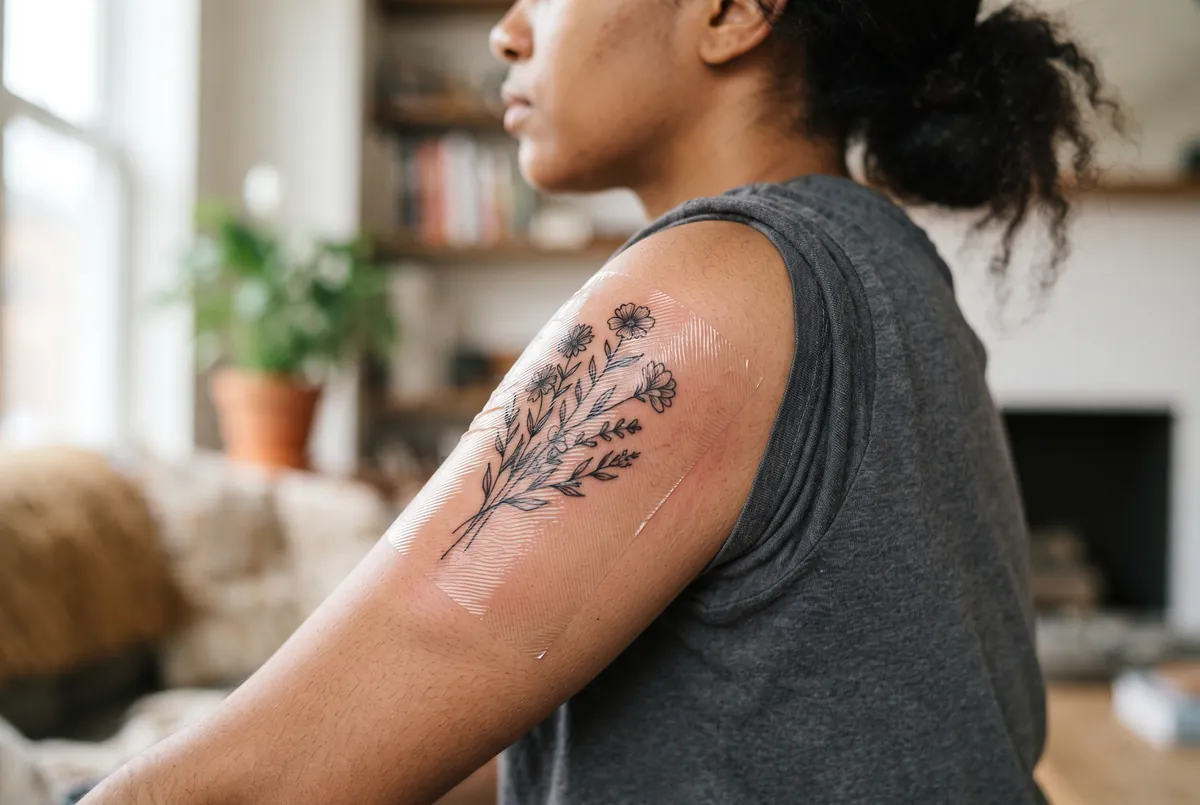
The common guidance of at least four to six weeks is a minimum, and it assumes healing has gone smoothly. The outer layer of skin typically closes within the first few weeks, but the deeper tissue keeps repairing for considerably longer. Several things lengthen the timeline: large areas of solid color or dense shading, which traumatize the skin more than fine line work, locations that bend or rub such as the inner elbow, ankle, ribs, and bikini line, and any setback during healing such as heavy scabbing or irritation.
Your own health matters as well. Diabetes, circulation problems, immune conditions, smoking, and some medications slow wound healing, and so can simply being run down. Skin that has always been slow to recover from cuts and scrapes will be slow with a tattoo. If any of these apply, add time, and ask your tattoo artist to look at the piece before you book. Artists see healed and half-healed tattoos every day and can usually tell at a glance.
Multi-session tattoos need planning. If you are building a sleeve or a back piece over several months, part of the area is nearly always in some stage of healing. In that situation I map the arm or leg with the client: this section is from last spring and is fine, this section was done three weeks ago and stays untouched. A touch-up session resets the clock for the area that was reworked, even if it was only a few lines.
Vacations and events are where timing goes wrong most often. Clients get a tattoo a few weeks before a beach trip and then want a bikini or leg wax right before leaving. If the dates do not allow a full healing period, something has to give, and it should be the wax on that area, not the tattoo. A new tattoo should be kept out of strong sun and out of the ocean and pools anyway while it heals, so the trip is already a compromise. The better order, if you can plan ahead, is the tattoo well before the season, or after the trip, with waxing kept on its normal schedule.
| Stage of the tattoo | What the skin looks like | Waxing |
|---|---|---|
| First days | Red, swollen, weeping, often under a bandage or film | No |
| Peeling and scabbing phase | Dry, flaking, itchy, scabs in places | No |
| Surface closed, still settling | Shiny, slightly cloudy, may feel tight or raised | No, wait longer |
| Fully healed | Smooth, settled color, feels like surrounding skin | Yes |
| After a touch-up | Reworked area looks fresh again | Wait as for a new tattoo |
What to do about hair while a new tattoo heals
Before the session, your artist will shave the area with a disposable razor. That is part of the standard setup and you do not need to remove the hair yourself. In the first days of healing, leave the hair entirely alone. Stubble growing through a healing tattoo is itchy, and that itch is one of the hardest parts of aftercare, but scratching, picking, tweezing, or shaving over scabs can pull out pigment just as waxing can.
Once the scabs and flakes have gone by themselves and the surface is closed, careful shaving is usually the first hair removal that is safe to resume. Use a new, sharp blade, a gentle shaving gel, and light pressure, and stop if the skin stings. An electric trimmer that does not touch the skin directly is gentler still. Depilatory creams are a poor idea on a recent tattoo: they are chemically harsh and can irritate new skin. Epilators and tweezers pull the hair like wax and should wait as long as waxing does.
For skin next to a new tattoo, waxing is possible with a sensible margin. I leave at least an inch or two of untouched skin around a fresh piece, more if the area is swollen, and I do not let wax, strips, or cleansers travel onto the healing section. If the tattoo covers most of the area you wanted waxed, the honest answer is to skip that area this month. My comparison of waxing vs shaving explains what to expect if you shave for a cycle and return to wax.
How waxing a tattooed area is done
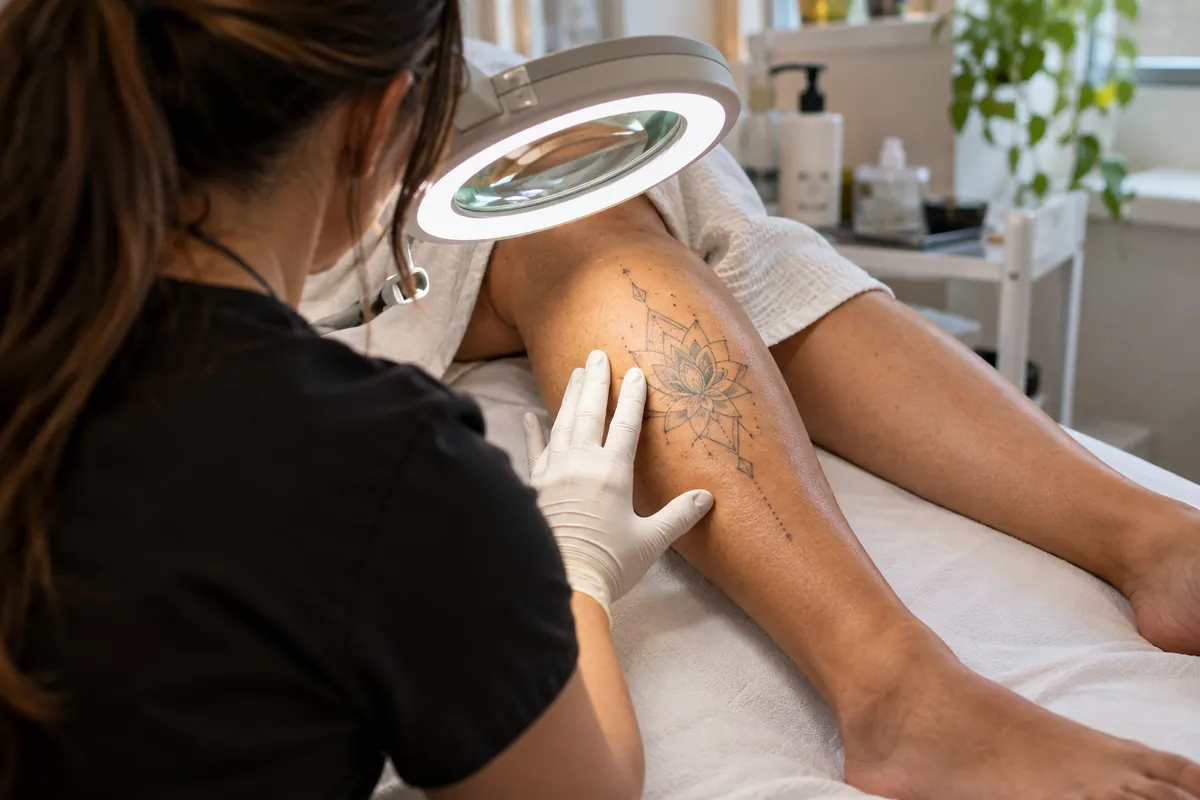
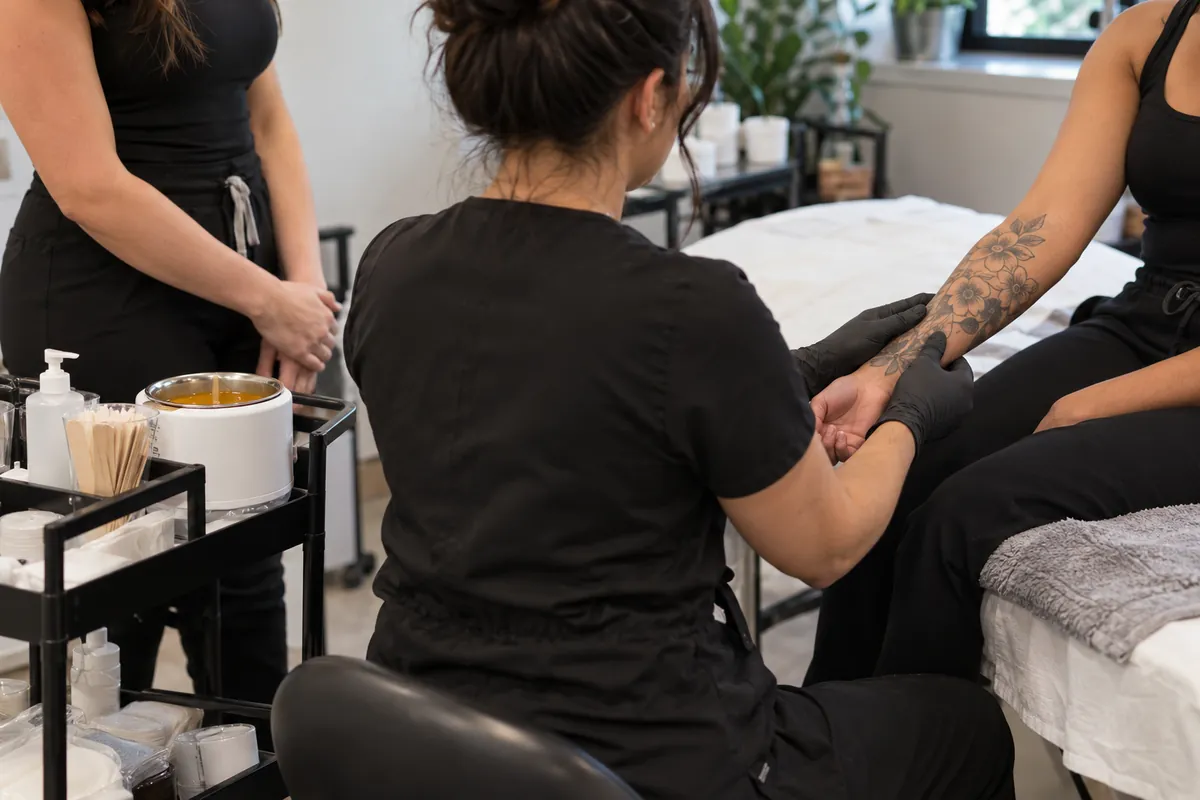
On a healed tattoo the procedure is the same as on any skin, with one adjustment in attention. Ink hides things. On a dense black or dark blue piece I cannot see redness, small irritations, or moles as easily as on bare skin, so I rely more on touch and on good light. I run a gloved hand over the area before I start, feeling for raised lines, bumps, and dry or rough patches, and I ask about any spot that feels different.
The steps are standard. The skin is cleansed and dried, and a light powder or a pre-wax oil is applied depending on the wax. Hair should be about a quarter inch long, as I explain in how long hair should be for waxing. Wax is applied with the growth and removed against it, close and parallel to the skin, with the other hand holding the skin taut. Afterward I remove residue, apply a soothing product, and check the tattoo again once the wax is off.
For tattooed skin I tend to choose a wax that is gentle on the surface. Hard wax shrinks around the hair as it sets and adheres less to the skin, so it is my usual choice for tattoos on sensitive areas such as the bikini line, underarms, and ribs. A thin, well-applied soft wax works well on arms and legs with sturdy skin. Sugaring is another gentle option. The choice matters less than temperature control and avoiding repeat passes over the same patch. More on this in my guide to types of wax.
Clients often ask whether waxing over a tattoo hurts more. On healed skin it does not. The nerves in the area are the same as before the tattoo, and the sensation depends on the usual factors: the body area, how coarse the hair is, how long it has been since your last wax, and where you are in your cycle. Large tattooed areas such as a full back or chest on a man simply take longer, because there is more hair and I work in smaller sections for control. Ways to make any wax easier, such as coming in rested and avoiding caffeine beforehand, apply equally here.

What to tell your esthetician before the appointment
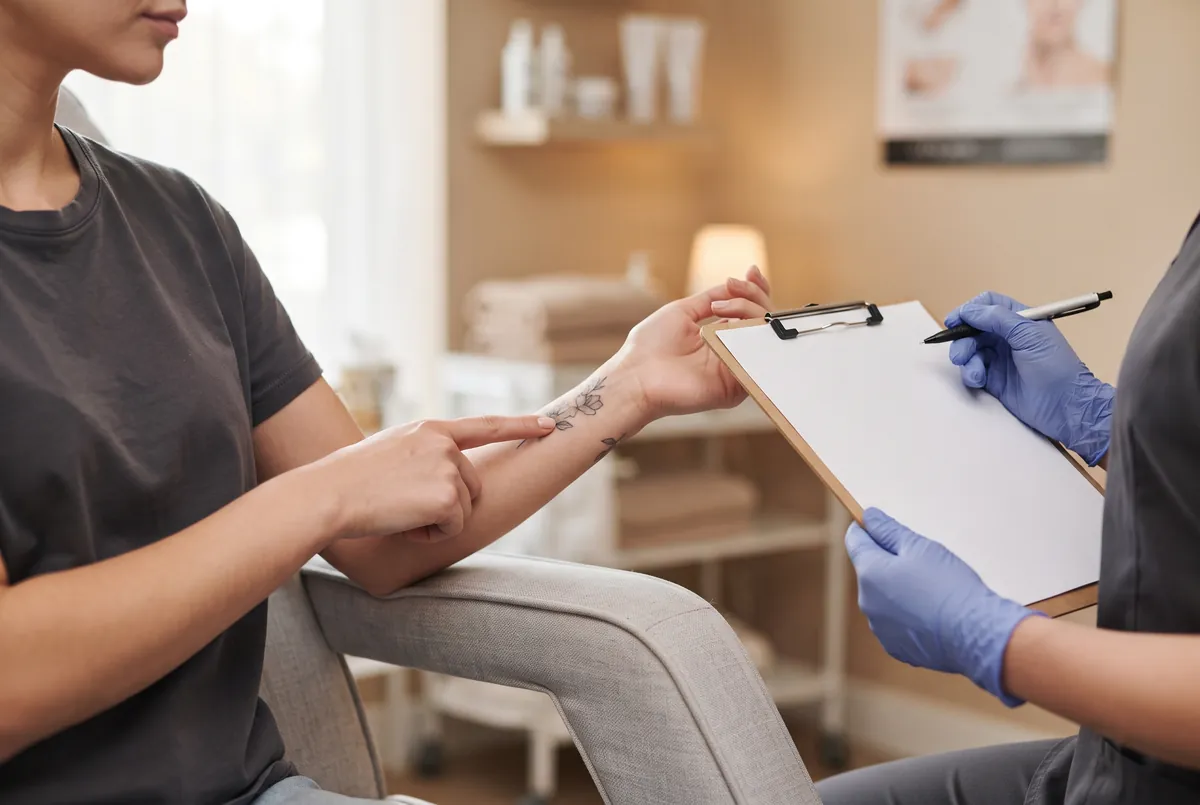
Mention tattoos when you book, especially recent ones. The questions I ask are short. When was the tattoo done, and has it been touched up since? Did it heal without problems? Is any part still raised, itchy, or sensitive? Are you having laser tattoo removal on it? What products are you using on it? The last question matters because some clients use retinoids, exfoliating acids, or prescription creams on tattooed skin, and those can make waxing unsafe regardless of the ink.
- The date of the tattoo and of any touch-up or added section.
- Any healing problems: heavy scabbing, infection, allergic reaction, or raised scarring.
- Areas that still itch, swell, or become raised from time to time.
- Laser tattoo removal, past or in progress, and the date of the last session.
- Skin care and medications, especially retinoids, acne medication, and blood thinners.
- Upcoming tattoo appointments, so waxing can be timed around them.
An honest answer protects your artwork. I have had clients take a week or two off the age of a tattoo because they wanted to be smooth for a trip, and I understand the temptation. But an esthetician who is told a three-week-old tattoo is two months old will wax it, and the client is the one who lives with a patchy result. A professional may also decline to wax a piece that does not look ready. That is not caution for its own sake. It is the same judgment I apply to sunburn or broken skin, as described in my guide to waxing contraindications.
Aftercare for waxed, tattooed skin
Aftercare is the same as for any wax, with extra emphasis on the sun. For the first day or two, avoid hot baths, saunas, hot tubs, heavy sweating, tight clothing over the area, and fragranced products. Keep the skin clean and use a simple, fragrance-free moisturizer. After two or three days, begin gentle exfoliation a couple of times a week to help prevent ingrown hairs. The full routine is in my waxing aftercare guide.
Sun protection deserves special attention on tattooed skin. Freshly waxed skin has lost some of its dead-cell surface layer and is a little more vulnerable to ultraviolet light for a short time, and ultraviolet light is the main thing that fades tattoos over the years. Cover the area or use a broad-spectrum sunscreen once the skin has calmed down. Clients sometimes blame waxing for fading that actually came from the beach vacation the wax was booked for.
Watch the area for a few days. Mild pinkness and small bumps at the follicles are normal and fade quickly. Ingrown hairs can be harder to spot under dark ink, so pay attention to any tender bump and resist squeezing it. If you see spreading redness, pus, increasing pain, or a raised, hot area on the tattoo, see a physician. For ordinary ingrowns, my guide to ingrown hairs after waxing covers safe home care.

Tattoos that need extra care, and laser tattoo removal
Some healed tattoos are not quite ordinary skin. Occasionally the lines of a tattoo stay raised, or become raised and itchy from time to time, sometimes with heat, sun, or changes in the weather. This can be scar tissue from heavy-handed work, or a reaction to a particular pigment, with red ink the color most often mentioned. Raised or reactive areas are more likely to be irritated by waxing. I either avoid them or test a very small section first, and I suggest the client mention recurring reactions to a dermatologist.
Scarring within a tattoo, whether from the tattooing itself, from a healing problem, or from a keloid tendency, calls for caution. Scar tissue can be thinner or less elastic than normal skin and can tear more easily. Cover-up tattoos placed over old scars or old ink have often been worked more intensely and may have denser tissue. None of this rules out waxing, but it is a reason to choose hard wax, small sections, and a patient provider.
Location matters more than style. A healed tattoo on the outer forearm or calf behaves like sturdy skin. The same tattoo on the ribs, inner arm, groin, or along the bikini line sits on thinner, more mobile skin that needs gentler handling with or without ink. Brazilian and bikini waxing over tattoos in that area is routine once healed. It simply calls for the careful technique that area always needs.
If you are having a tattoo removed or lightened by laser, treat the area as off limits for waxing during the course unless your laser provider says otherwise. Each removal session deliberately injures the skin to break up pigment, and the area may blister, crust, and stay sensitive for weeks. Sessions are usually spaced well apart for that reason. Waxing in between can lift fragile skin and interfere with healing. Ask the provider when, if at all, hair removal is acceptable between sessions, and expect shaving to be the answer.
After a removal course is completely finished and the skin has returned to normal texture, waxing can resume. Skin that has been through removal sometimes remains lighter, darker, or slightly different in texture, and it may stay more reactive. I treat it the way I would treat a scar: a test section first, hard wax, and no repeat passes.
Permanent makeup, microblading, and brow waxing
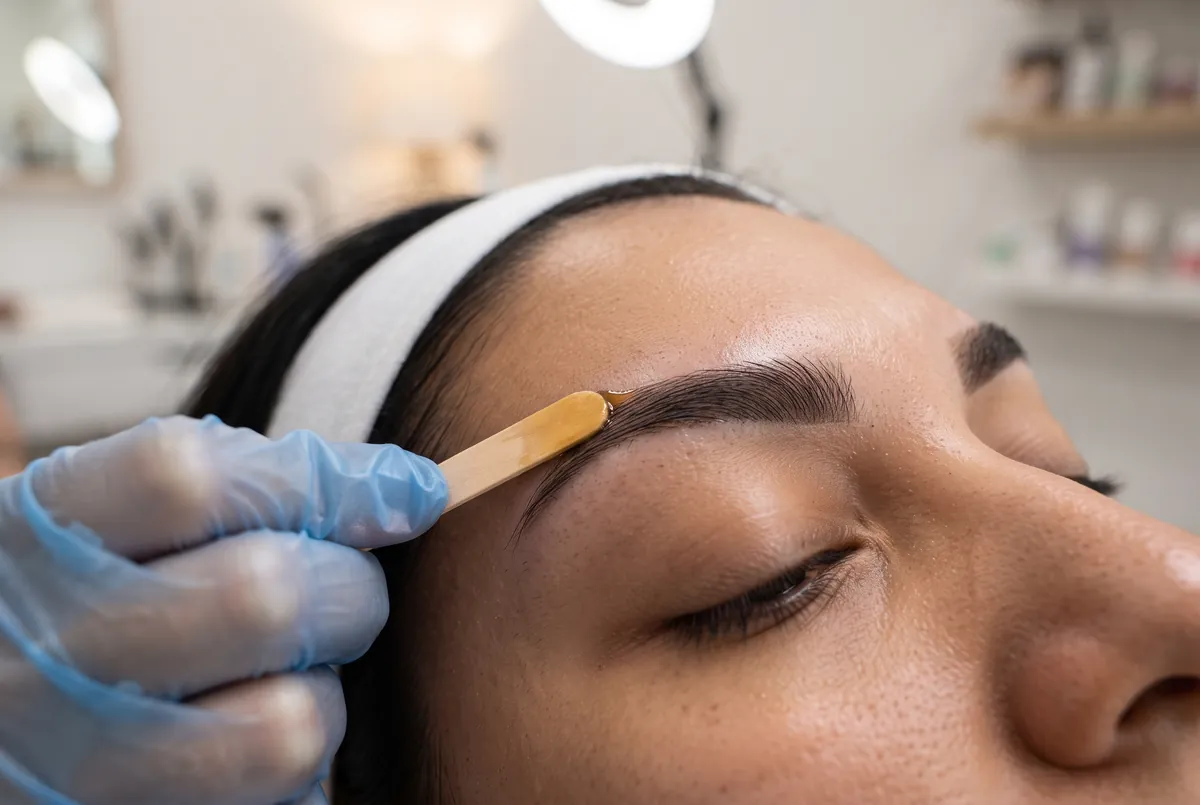
Cosmetic tattooing follows the same logic with tighter margins. Microblading, powder brows, lip blush, and permanent eyeliner place pigment in the skin of the face, generally more superficially than a body tattoo, in an area that is thin and constantly moving. Fresh cosmetic tattoos must not be waxed. Brow artists usually ask clients to wait until the brows are fully healed before any waxing, and many give a specific timeline in their aftercare sheet. Follow the artist's instructions over any general rule.
The practical solution is timing. Have your brows shaped by waxing or threading several days to a week before a microblading appointment, so the artist works on calm skin with a clean outline. After the procedure, stray hairs outside the new shape can be left alone or carefully trimmed until healing is complete. Once healed, brows can be waxed again, and a careful esthetician keeps the wax on the skin outside the pigmented shape. Details on shaping are in my eyebrow waxing guide.
Brow tint and henna are not tattoos, but they raise a similar scheduling question. Waxing lifts surface cells, and tint that stains the skin sits in those cells, so waxing immediately after tinting can shorten how long the stain lasts. Most brow specialists wax first and tint second in the same visit. If you have had a reaction to hair dye, henna, or tattoo pigment in the past, tell your provider before any brow service.
Other hair removal methods on tattooed skin
Sugaring behaves like waxing for this purpose: safe on healed tattoos, not on fresh ones. Because sugar paste is used at close to body temperature and adheres mainly to hair and dead cells, many clients with sensitive tattooed areas like it. Shaving is safe on healed tattoos and is the first method to return to after a new one. Depilatory creams are safe on healed tattoos if your skin tolerates them, and unwise on healing ones. If you are a professional weighing which technique to offer, see wax vs sugaring.
Laser and IPL hair removal are the important exceptions. They must never be used over a tattoo, healed or not. These devices work by sending light into the skin to be absorbed by dark pigment in the hair. Tattoo ink is a dense deposit of pigment, and it absorbs that energy intensely. The result can be a painful burn, blistering, scarring, and a damaged or distorted tattoo. Reputable laser technicians cover tattoos and leave a margin around them. The same warning applies to home IPL devices.
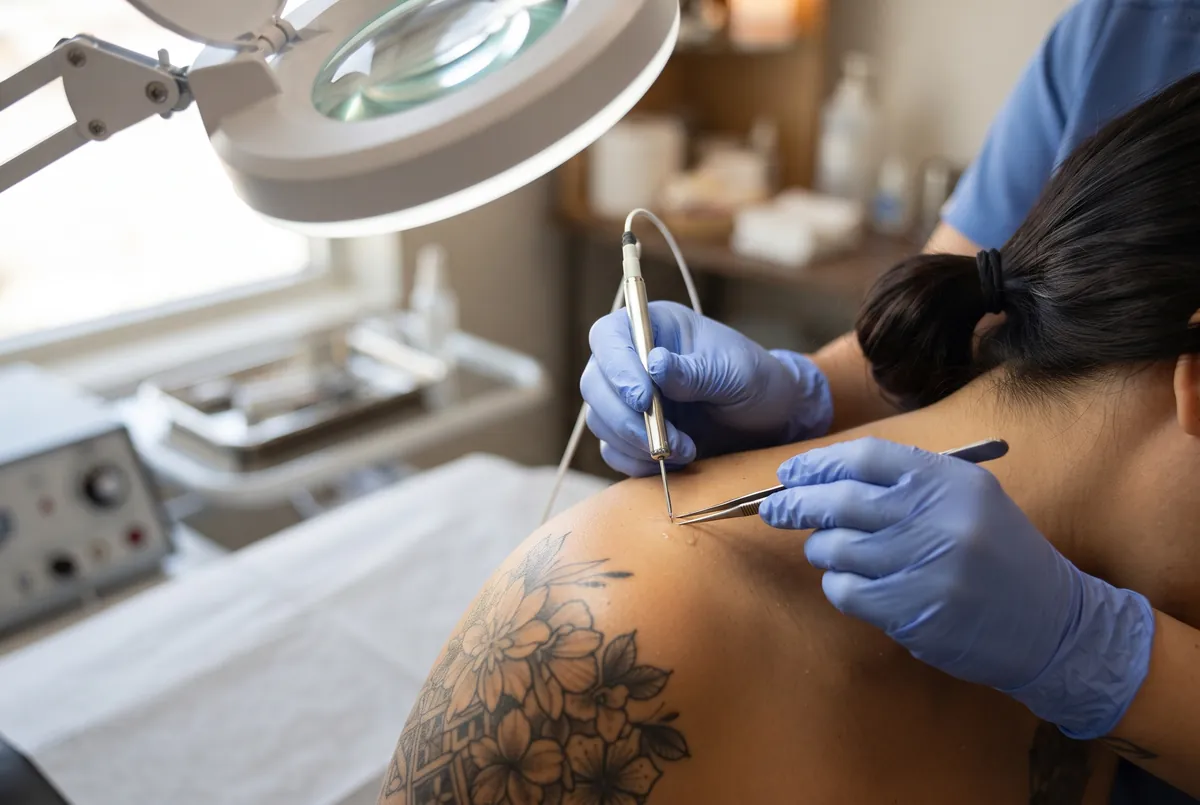
That leaves a clear gap: what if you want permanent hair removal on tattooed skin? Electrolysis is the answer. It destroys each follicle with a small current delivered through a fine probe inside the follicle, and it does not rely on light or pigment, so it can be performed over a fully healed tattoo without affecting the ink. It is the only method the FDA accepts for permanent hair removal claims. My complete guide to electrolysis explains how it works.
This matters for planning. If you are considering both laser hair removal and a tattoo on the same area, do the laser course first and the tattoo afterward, because once the ink is there, laser is no longer an option for that skin. If the tattoo already exists and the hair growing through it bothers you, your long-term choices are waxing or sugaring on a schedule, shaving, or electrolysis for a permanent result.
Home waxing over tattoos deserves a word of caution. On a healed tattoo on the lower leg or forearm, a careful person with some experience can use a home kit as they would elsewhere. The problems come from wax that is too hot, going over the same patch several times, and pulling upward instead of along the skin, all of which can lift the surface even on healthy skin. On tattooed skin a lifted patch is more upsetting because it sits in the middle of a design, and the ink makes it harder to see how the skin is reacting as you work. For pieces on sensitive or hard-to-reach areas, a professional appointment is the safer choice.
Common mistakes and myths
The most common mistake is impatience: booking a wax two or three weeks after a tattoo because the surface looks closed. The second is hiding the age of a tattoo from the esthetician. The third is home waxing over a new piece, where there is no trained eye to say stop. Others include waxing the day before a tattoo session, which can leave the skin irritated when the artist needs it calm, and assuming that a touch-up does not count as a new wound.
The myths run in both directions. Some people believe waxing strips ink and avoid it for life, which is unnecessary on healed skin. Others believe that because a healed tattoo is safe to wax, laser hair removal over it must be safe too, which is dangerous. Another myth is that tattooed skin hurts more to wax. Healed tattooed skin has the same sensitivity as it had before. What clients remember is the tattoo session itself, and the comparison usually makes waxing feel mild.
One more misunderstanding concerns hair growth. Tattooing does not destroy hair follicles, and hair grows back through a tattoo as it did before. Occasionally clients feel that hair looks more noticeable afterward, usually because light hair shows up against dark ink. If that bothers you, removing the hair is the fix, by any method that suits healed, tattooed skin.
For students and professionals
If you wax for a living, add tattoo questions to your intake form and ask them aloud, because clients do not think of a tattoo as a health matter. Record the date of any recent work. Decline to wax a tattoo that is not healed, explain why in one sentence, and offer to wax around it. Clients respect that, and tattoo artists in your area will hear about it. A working relationship with a local artist is good for business: they send clients to you for pre-session waxing, and you send clients back with healthy skin.
Waxing must be performed within the scope of your state license, and requirements for estheticians, cosmetologists, and waxing specialists differ by state. Our waxing licensing hub links to each state's rules, and the waxing course covers skin assessment, contraindications, and technique in depth. Online theory supports your training, and it does not replace the in-person hours or exams your state requires. Tattooing and cosmetic tattooing are regulated separately, usually by health departments, and are outside a waxing license.
Your next step
If your tattoo is fully healed, book your wax and mention the tattoo when you do. If it is new, give it at least four to six weeks, check it against the three signs of healed skin, and ask your artist if you are unsure. If you are planning new ink, wax about a week before the session. And if you want the hair over a tattoo gone permanently, skip the laser clinic and talk to a licensed electrologist. Our studio directory can help you find professionals near you.
State Requirements
State licensing guides
Hours, exams, fees, and the licensing board differ by state. Open your state for the current requirements.
Common Questions
FAQ
Yes, as long as the tattoo is fully healed. Wax removes hair and loose surface cells from the epidermis, while tattoo pigment sits deeper, in the dermis, so waxing does not pull out or fade ink. A fresh or healing tattoo should never be waxed, because the wax can lift fragile new skin, remove pigment in patches, and open the area to infection.
Most tattoo artists and estheticians advise waiting at least four to six weeks, and longer for large or heavily shaded pieces, areas that rub or bend, or slow healers. The tattoo should be smooth, free of scabs and flaking, settled in color, and feel like the surrounding skin. A touch-up restarts the wait for the reworked area. If you are unsure, ask your artist to check it.
No. On healed skin, waxing cannot reach the layer where the ink sits. Tattoos often look brighter after waxing because hair and dull surface cells are no longer covering the design. The main cause of fading is ultraviolet light over time, so protect a freshly waxed tattoo from the sun with clothing or a broad-spectrum sunscreen once the skin has calmed.
You do not need to do either, because the artist will shave the area during setup. If you prefer to arrive waxed, do it about a week before the session so any redness or bumps have settled. Do not wax the day before or the day of your appointment. Irritated or broken skin can make the artist postpone, and it is harder to tattoo well.
No. Laser and IPL hair removal must not be used over tattoos, including healed ones and permanent makeup. Tattoo ink absorbs the light energy intensely, which can cause burns, blisters, scarring, and damage to the tattoo. Technicians shield tattoos and leave a margin. For permanent hair removal on tattooed skin, electrolysis is the suitable method, since it does not depend on pigment.
Only after the brows have fully healed, and according to the timeline your brow artist gives you. Waxing, tweezing, or threading over healing microblading can remove pigment and scar the skin. The easiest approach is to have your brows waxed several days to a week before the microblading appointment, then leave them alone until the artist confirms they have healed.
Both are safe on a healed tattoo. Hard wax adheres more to the hair than to the skin, so I usually prefer it for tattoos on sensitive areas such as the bikini line, underarms, and ribs. Soft wax applied thinly works well on arms and legs. Correct temperature and avoiding repeat passes matter more than the type. See my guide to types of wax.
The wax may lift the new surface skin and leave a raw, shiny, or weeping patch. Treat it as a wound: keep it clean, do not pick, avoid the sun, and follow your tattoo artist's healing advice. See a physician if there is spreading redness, pus, fever, or increasing pain. Once it has healed completely, your artist can judge whether a touch-up is needed.
Keep Reading
Related Guides


