Career
What Does an Electrologist Do? Job, Daily Routine, and Skills

Quick answer
An electrologist permanently removes unwanted hair one follicle at a time with a fine sterile probe and a measured electrical current. The job also includes client consultations, skin assessment, strict infection control, treatment records, and long-term planning of a course of sessions. Most electrologists work alone in a private practice or medical office, and in many states they must hold a state license.
An electrologist removes unwanted hair permanently, one follicle at a time, using a very fine probe and a measured pulse of electrical current. That sentence is accurate, and it still leaves out most of the job. In a normal week I spend as much effort on consultations, skin assessment, infection control, record keeping, and plain conversation as I do on the insertions themselves. People who look at the profession from the outside tend to picture a quiet room and a pair of tweezers. The room is quiet, but the work inside it is a mix of fine motor skill, applied skin science, and long-term client care.
I am Aida Khazieva, a licensed electrologist and cosmetologist, and I have done this work for more than twenty years. This guide describes what an electrologist actually does: who walks through the door, what happens in a consultation and in a session, what a working day looks like hour by hour, which skills matter, and where the limits of the role are. If you are thinking about entering the profession, read it as a job description written by someone who does the job, including the parts that never make it into a school brochure.
The role in plain terms
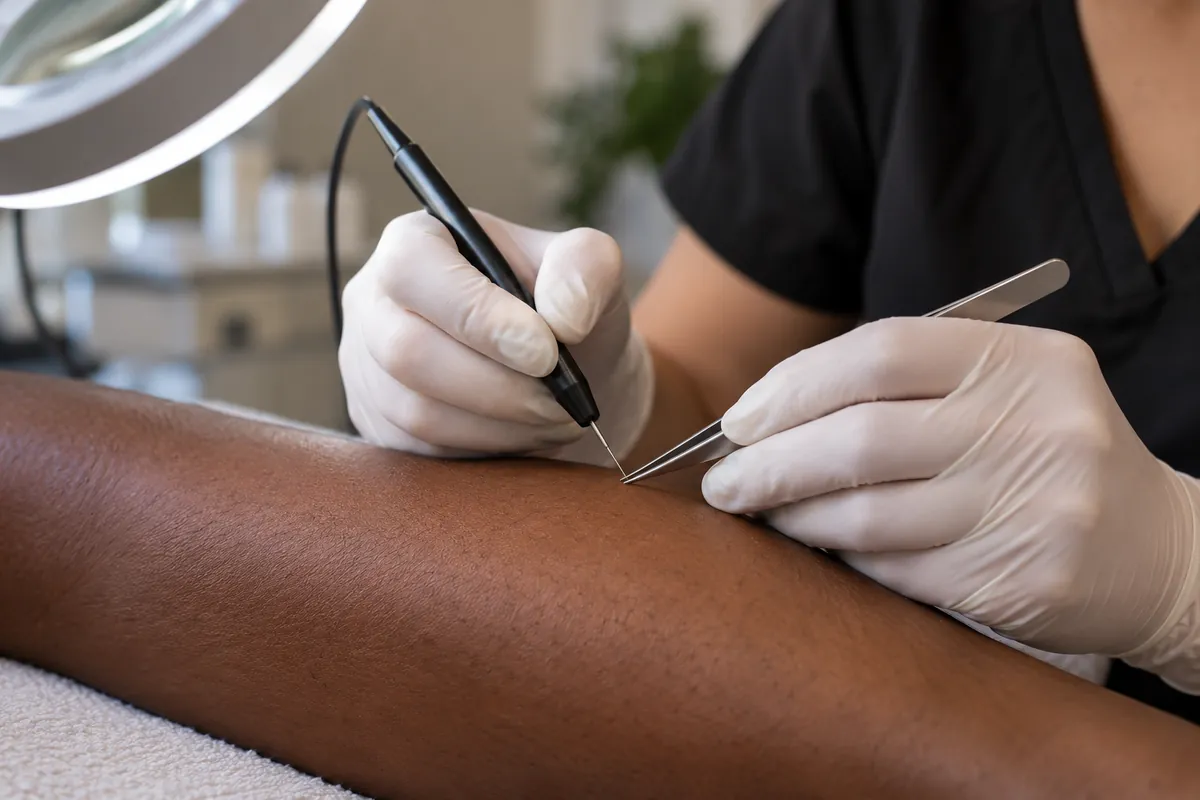
Electrolysis is the only hair removal method the FDA accepts for a claim of permanent hair removal, and the electrologist is the professional trained to deliver it. The principle is simple. A sterile probe, about as fine as the hair itself, slides into the natural opening of the follicle alongside the hair shaft. A short pulse of current then destroys the cells at the base of the follicle that produce the hair. The treated hair releases with almost no resistance and is lifted out with tweezers. Then the electrologist moves to the next follicle and repeats the sequence, hundreds of times in a session.
What makes this a profession and not a technique anyone can pick up in a weekend is everything that surrounds that sequence. Follicles differ in depth, angle, and moisture. Skin differs in how it reacts to heat and to chemical change. A coarse chin hair driven by hormones behaves nothing like a fine hair on the upper lip. The electrologist chooses the probe, the modality, and the settings for the hair in front of her, watches how the skin responds, and adjusts constantly. The goal is always the same pair of outcomes: the follicle is disabled, and the skin around it heals without a mark.
The job is also a long relationship. Hair grows in cycles, so only part of the hair in any area is visible and treatable on a given day. That is why permanent results come from a series of sessions spread over many months, not from one visit. An electrologist therefore plans a course of treatment, keeps the client motivated through the slow middle of it, and tracks progress honestly. If you want the client's view of the method itself, our complete guide to what electrolysis is covers it in detail. This article stays on the practitioner's side of the treatment bed.
The client list of an established electrologist is far more varied than most newcomers expect. A large share of my clients are women dealing with facial hair on the chin, upper lip, jawline, and neck, often connected to hormonal changes at different stages of life. Many have polycystic ovary syndrome or have gone through menopause, and many have spent years tweezing every morning before work. For these clients the service is rarely cosmetic in a light sense. It is relief from something that has affected how they hold their head in a conversation.
A second group arrives after laser hair removal. Laser depends on pigment in the hair, so it leaves behind gray, white, blonde, and red hairs, and sometimes fine regrowth that the device can no longer target. Electrolysis does not depend on hair color or skin tone, which makes the electrologist the person who finishes what laser could not. A third group is transgender and nonbinary clients, for whom facial hair removal or surgical site preparation is part of gender-affirming care. That work is long, emotionally significant, and often coordinated with a surgeon's written instructions about the exact area to clear.
Then there are men who want a cleaner beard line or relief from ingrown hairs on the neck, clients shaping eyebrows permanently, people with a few stubborn hairs around the areola or on the stomach, and clients referred by physicians for hair that causes repeated irritation. Each group brings different expectations, different pain tolerance, and different emotional weight. A good part of the job is reading which of those you are dealing with in the first few minutes, and adjusting how you explain things so the person on the bed feels understood and not processed.

The consultation: where the real work starts
Before any current is used, an electrologist conducts a consultation. I ask about medical history, medications, skin conditions, previous hair removal, and what the client has been doing to the hair at home. The answers matter. Tweezing and waxing distort follicles and make insertions harder for a while. Certain medications change how skin heals. Some conditions call for a physician's clearance before treatment, and a few mean the answer for now is no. Knowing the contraindications is a core part of the job, and our guide to electrolysis contraindications for practitioners shows how much judgment that involves.
The second half of the consultation is expectation setting. Clients want to know how many sessions they will need, and the honest answer is that nobody can promise a number. It depends on the density of hair, the growth cycle, hormonal activity, and how consistently the client keeps appointments. What I can do is explain the growth cycle in plain language, describe what a typical course looks like for that area, and explain why spacing matters. An electrologist who overpromises at this stage creates a disappointed client four months later. One who explains the process clearly creates a client who stays through the whole course.
Most consultations end with a short test treatment. It lets the client feel the sensation, and it lets me see how the skin reacts over the next day or two before a longer session. I also explain aftercare, what normal redness looks like, and what to avoid for the first day. None of this is billed as glamorous work, but it is where trust forms. An electrologist is also not a diagnostician. When hair growth looks sudden, unusually heavy, or paired with other symptoms, the right move is to suggest the client see a physician or dermatologist, and to continue treatment alongside medical care if the doctor agrees.
What happens during a treatment
A session begins with clean hands, gloves, a prepared tray, and skin that has been cleansed and assessed under magnification. I position the client so the area is stable and well lit, then position myself so my hands are supported. Each insertion follows the direction of hair growth. The probe enters the follicle opening without piercing skin, travels to the correct depth, and stops. When an insertion is accurate the client feels the current but not the probe. Learning to feel that depth through a fine instrument is the central manual skill of the profession, and it takes many supervised hours to develop.
There are three ways to deliver the current, and an electrologist is expected to understand all of them. Galvanic electrolysis uses direct current to create a chemical reaction in the follicle. Thermolysis uses high frequency current to produce heat. The blend method combines the two. Each has strengths for certain hair types and skin types, and each has its own timing. Our explanation of galvanic, thermolysis, and blend goes through the differences. In daily practice the choice comes down to the hair in front of you, the client's comfort, and how the skin is responding in that particular session.
Throughout the session I am watching three things at once: the skin surface around each follicle, the ease with which each hair releases, and the client's body language. A hair that resists means the follicle was not fully treated, and plucking it would defeat the purpose. Skin that blanches or reacts too strongly means the settings need to come down. A client who has gone silent and rigid needs a pause. The electrologist adjusts intensity, timing, spacing between insertions, and even which part of the area to work on next, all without breaking the calm rhythm that makes a long session tolerable.
At the end, the area is soothed, aftercare is repeated, and the next appointment is scheduled at an interval that suits the growth cycle. I also tell the client what they will probably see over the next days, because a prepared client does not panic at ordinary redness. People who would like to see how the insertion skill is taught can read our sibling guide on electrolysis insertion technique for beginners, which breaks down hand position, angle, and depth.
A working day, start to finish
People ask me what a day actually looks like, so here is an ordinary one in a solo practice. The details shift between a home studio, a rented suite, and a medical office, but the shape is similar everywhere. Notice how much of the day happens before and after clients. The treatment itself is the visible part, and it rests on preparation that nobody sees. A newcomer who plans only for hands-on time ends up surprised by how long the rest takes.
- Opening the room. I arrive well before the first client, check the sterilization log, set up clean trays, restock single-use probes and gloves, wipe down surfaces, and test the epilator and lamp.
- Reviewing charts. I read the notes for each client booked that day: area, modality, settings used last time, how the skin reacted, and anything the client mentioned about health or medication.
- Morning sessions. Usually a run of shorter facial appointments. Between clients the bed paper is changed, surfaces are disinfected, instruments go to reprocessing, and notes are written while details are fresh.
- A new client consultation. Health history, explanation of the process, a short test treatment, aftercare instructions, and a realistic plan for the course.
- A real break. Food, water, stretching the neck, shoulders, and hands, and resting the eyes on something far away.
- Afternoon sessions. Often the longer appointments: body areas, beard work, or surgical site preparation, which demand sustained concentration.
- Messages and scheduling. Answering questions about aftercare, confirming appointments, and returning calls from prospective clients.
- Closing down. Cleaning and sterilizing instruments, logging the cycle, disposing of sharps correctly, laundering linens, and finishing any incomplete records.
What the list does not show is the mental pattern of the day. Each session asks for deep focus on a field of view smaller than a postage stamp, and each gap between sessions asks for a switch to cleaning, writing, and greeting. The electrologists who last in the profession are the ones who build a rhythm between those two modes. They leave real buffers between clients, they do not book the most demanding work back to back, and they treat the break in the middle of the day as part of the job and not as a luxury that disappears when the schedule fills.
The day also changes with experience. In the first year, sessions feel slower, and a new practitioner needs longer buffers to write notes and reset the room. With time, the hands speed up, the eye reads follicle angle faster, and more follicles are cleared in the same appointment. That gain in efficiency is one of the quiet rewards of the work. It is also why experienced electrologists can take on large areas that a beginner would find exhausting. Speed never comes from rushing. It comes from thousands of accurate insertions made at a calm pace.
Infection control is half the job
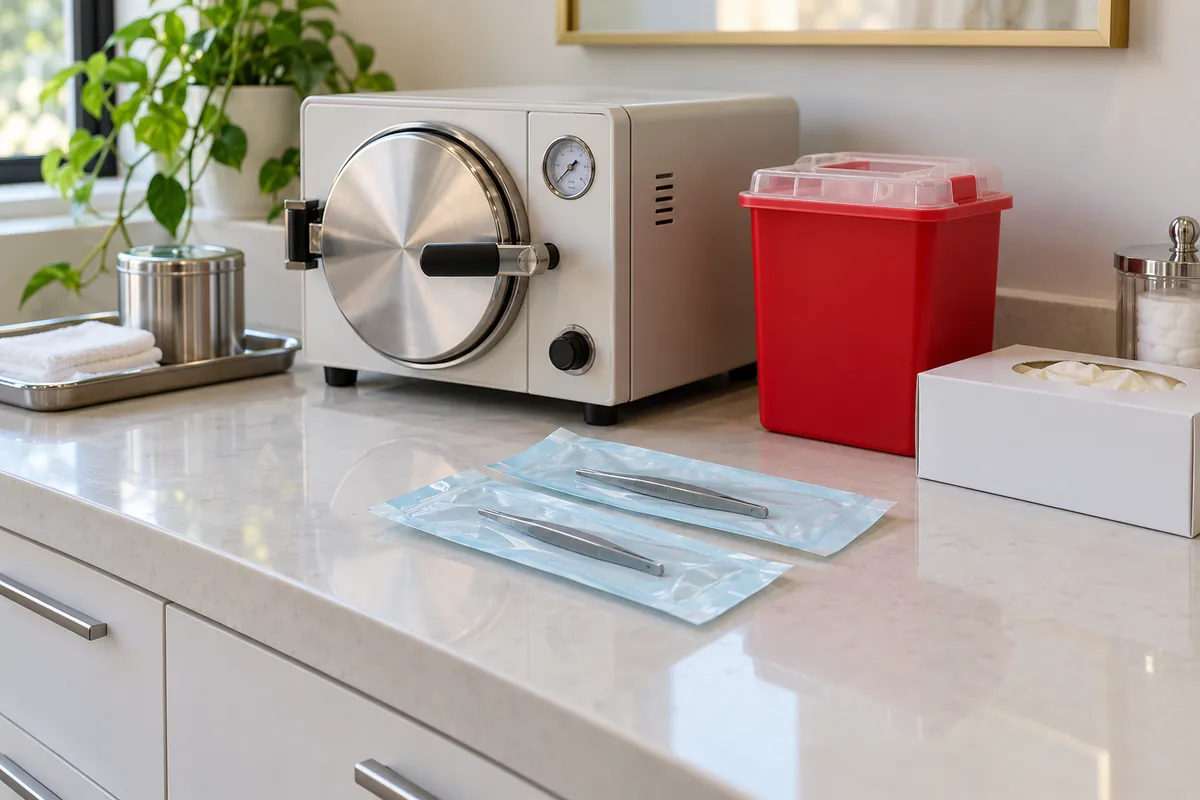
An electrologist works with an instrument that enters a follicle, so infection control is not a side duty. It is built into every step. Probes are sterile and, in modern practice, single use and disposed of in a sharps container. Tweezers and other reusable instruments are cleaned and sterilized between clients according to the standards that apply in the state. Surfaces touched during a session are disinfected. Hands are washed before gloving and after removing gloves. The treatment area on the client is cleansed before the first insertion and cared for after the last one.
This discipline has a documentation side as well. Many practitioners keep a log of sterilizer cycles and maintenance, and inspectors in regulated states can ask to see how instruments are handled. Even where the law is light, professional associations publish infection prevention standards that responsible electrologists follow. Clients rarely see this work, but they feel its results: skin that heals predictably, session after session. A practitioner who cuts corners here may not see a problem for months, and then sees one that damages a client and a reputation at the same moment.
It also shapes how you think during treatment. You learn to keep a clean hand and a working hand, to avoid touching your face or phone with gloves on, and to stop and re-glove without irritation when something breaks the chain. People who enjoy order and routine usually take to this side of the profession naturally. People who find procedure tedious tend to struggle, because there is no version of this job where the cleaning is optional or where it can be handed to someone else entirely.
Records and treatment planning
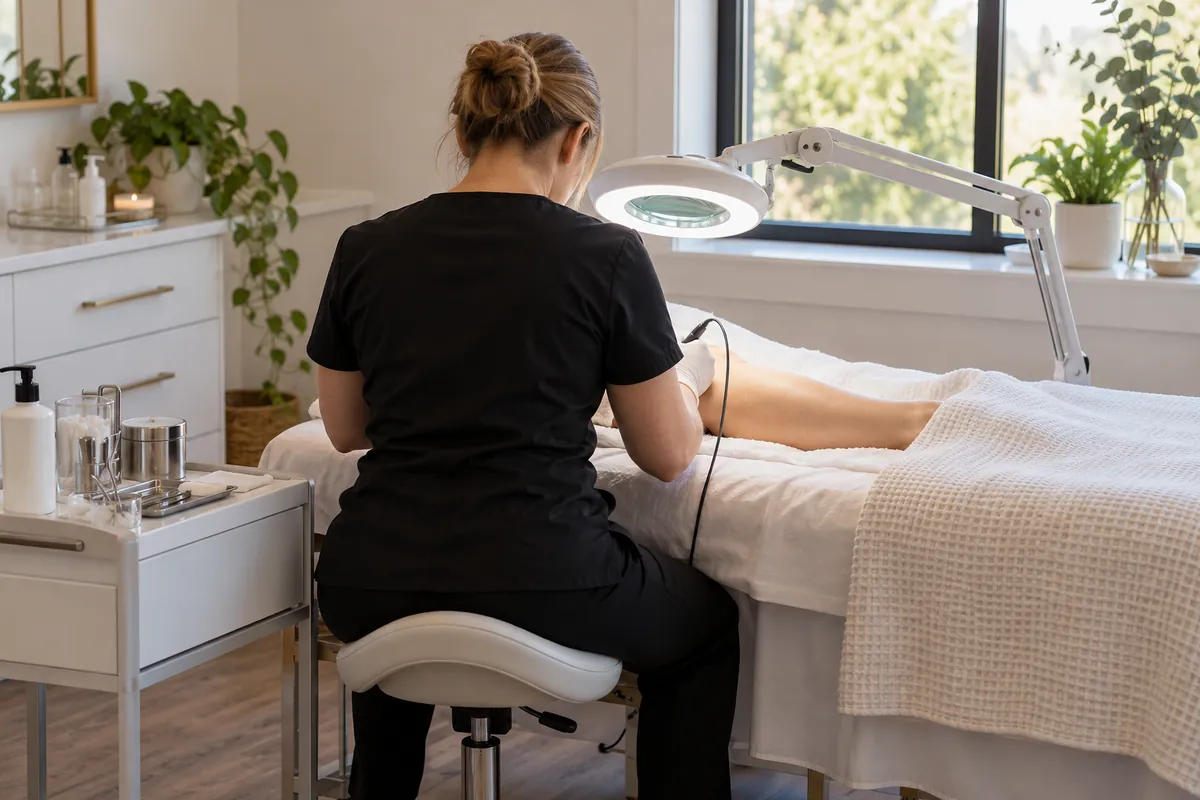
After each session I write down the area treated, the modality, the probe size, the settings, the length of the session, and how the skin looked at the end. At the next visit I add how the area healed. Over months, those notes become the map of the client's course. They show whether regrowth is thinning, whether settings should change, and whether the interval between visits is right. Without records, an electrologist is guessing. With them, she can show a client real progress during the stretch when the mirror seems to say nothing is changing.
Records also protect both people in the room. The intake form documents what the client disclosed about health and medication. The consent form documents what was explained. If a client later reports a reaction, the chart shows exactly what was done. In an office that works with physician referrals or surgical preparation, the chart may also hold the surgeon's diagram of the area to be cleared. Handling that information carefully, keeping it private, and storing it securely is part of the professional standard an electrologist is held to.
Planning is the forward-looking side of the same habit. For a new client with dense growth, I usually begin with longer or more frequent sessions to get ahead of the hair, then taper as regrowth slows. For a client with scattered hairs, short regular visits are enough. I revisit the plan openly every few months. Clients appreciate hearing where they are in the course in plain words, and they are far more likely to finish treatment when the plan feels like something built for them and not a standing appointment with no end in sight.
The skills that matter most
Fine motor control comes first. The work asks for steady, small, repeatable movements of both hands, with one hand guiding the probe and the other stretching skin and handling tweezers. This is a trainable skill, and most people with ordinary dexterity can develop it with enough supervised practice. What cannot be skipped is patience with the learning curve. Early insertions are slow and uncertain, and the only way through is repetition under the eye of an instructor who corrects angle and depth before poor habits set in.
Visual attention is the second skill. You work under magnification for long stretches, judging the angle at which each hair leaves the skin and the faint changes in skin tone around a treated follicle. Good near vision, corrected if necessary, matters a great deal. So does knowledge. An electrologist needs working understanding of skin and hair anatomy, the growth cycle, basic electricity, the endocrine system as it relates to hair, bacteriology, and wound healing. That body of theory is what lets you reason about a difficult case and not simply repeat settings that worked on the last client.
The third skill is communication. You explain a slow process to people who want fast results. You ask about health and hormones without making anyone feel examined. You hold a professional boundary while working on intimate areas. You deliver unwelcome news, such as the fact that tweezing between sessions is setting the client back. Much of client retention in this field comes from how people feel in your room, and that depends on tone, discretion, and steadiness far more than on decor or marketing.
Finally, there is self-management. Many electrologists are self-employed, so reliability, scheduling, bookkeeping, and the habit of continuing education all fall on one person. Even employed electrologists are trusted to manage their own room and their own clients with little supervision. People who do well tend to be calm, methodical, and comfortable working alone for hours. If you are weighing whether your temperament fits, the sibling guide on whether electrology is a good career looks at that question from both sides.
Electrolysis looks gentle, and for the client it is. For the practitioner it is a physically specific job. You sit for long periods with your head tilted toward a small field, your arms held in controlled positions, and your hands making tiny precise movements. Without good habits, that adds up to strain in the neck, shoulders, wrists, and eyes. The electrologists I know who have practiced comfortably for decades all took ergonomics seriously from the beginning. They invested in an adjustable stool and bed, positioned the client to suit their own posture, and moved between sessions.
Magnification and lighting matter as much as furniture. A lamp or loupes with the right working distance let you sit upright and still see clearly. Poor magnification pulls your head forward and down, and the body pays for it within a few years. I also vary the day on purpose. A schedule that alternates short facial sessions with longer body work lets me change position and use different muscles. Scheduling is, in that sense, a health tool as well as a business tool.
There is an emotional load too. You spend the day with people in a vulnerable situation, some of whom carry years of embarrassment about their hair. Listening well is part of the service, and it takes energy. Most practitioners find this the most meaningful part of the job. It still helps to have ways of leaving the day behind, and to keep the number of daily sessions at a level where the last client receives the same attention as the first.

Where electrologists work
The most common setting is a private practice: a single treatment room in a rented suite, a room inside a salon or spa, or a dedicated space at home where local rules allow it. Private practice gives control over hours, pricing, and clientele, and it places all business tasks on the practitioner. Our guide comparing a home studio with renting a suite covers the practical tradeoffs. Some electrologists share a space with estheticians or massage therapists, which brings referrals and company without merging businesses.
A second setting is the medical or medically adjacent office. Dermatology practices, endocrinology clinics, plastic surgery offices, and gender-affirming care programs sometimes employ or contract with electrologists. The work there may involve more referral paperwork, coordination with a surgical team, and stricter documentation. In exchange, the practitioner often has a steadier flow of clients from the first day and colleagues to consult. Dedicated electrolysis clinics with several practitioners exist as well, and they are a good place for a new graduate to gain speed while working near experienced people.
A smaller number of electrologists teach in schools, work for equipment makers as educators, or combine electrolysis with another license such as esthetics or cosmetology. What each of those licenses allows is defined by the state, and the combinations are not interchangeable. If you already hold another beauty license, our guide on whether estheticians can do electrolysis explains why the answer depends on where you practice.

What an electrologist does not do
The scope of practice is narrower than people assume, and knowing its edges is part of being a professional. An electrologist does not diagnose the cause of hair growth, prescribe or recommend prescription medication, or treat skin disease. She does not treat hairs growing from moles unless the applicable rules and a physician's written approval allow it. She does not inject anesthetic. Whether she may operate a laser or light-based hair removal device is a separate legal question that each state answers in its own way, often with a different license or with medical supervision.
Topical numbing products, treatment of minors, work on certain body areas, and treatment of clients with implanted medical devices are other points where state rules, professional standards, and medical advice all come into play. A careful electrologist learns the rules for her own state and, when a situation falls into a gray zone, asks the client to bring clearance from a physician. That is not timidity. It is how you protect a client whose health picture you can only partly see from a treatment room.
There is also a line around who may call themselves an electrologist and perform the service at all. Many states require a license, with training hours and an examination. Some states do not license electrologists as a separate profession, and the rules there look different. Because the requirements vary so widely, I never quote hours or fees from memory. The state pages in our electrolysis licensing hub are the place to check what applies where you live, and the sibling guide on whether you need a license to do electrolysis gives the overview.
The business side of the job
For a self-employed electrologist, a meaningful part of every week is not treatment at all. There is booking and rescheduling, replying to inquiries, ordering probes and supplies, maintaining equipment, keeping the books, carrying professional liability insurance, renewing the license, and completing continuing education where the state requires it. None of this is difficult on its own. Together it is a second small job that sits on top of the clinical one, and new practitioners do better when they block time for it and do not leave it for evenings.
Client flow in electrolysis has a particular shape. Because each client returns many times over a course, a practice fills gradually and then becomes stable. That is a great strength of the field, and it changes what marketing looks like. Most established electrologists rely on referrals from clients, from other beauty professionals, and from medical offices more than on advertising. Building those relationships is real work in the first years: introducing yourself to local estheticians, laser clinics, and physicians, and being easy to refer to.
Policies are part of the job as well. A clear cancellation policy, a consistent approach to late arrivals, and transparent pricing by session length prevent most of the friction a solo practitioner encounters. I learned early that vague policies do not feel kinder to clients. They only create awkward conversations later. If the financial structure of the profession interests you, our guide to the factors that shape an electrologist's income explains what drives earnings without pretending there is one number for everyone.
How the job changes over a career
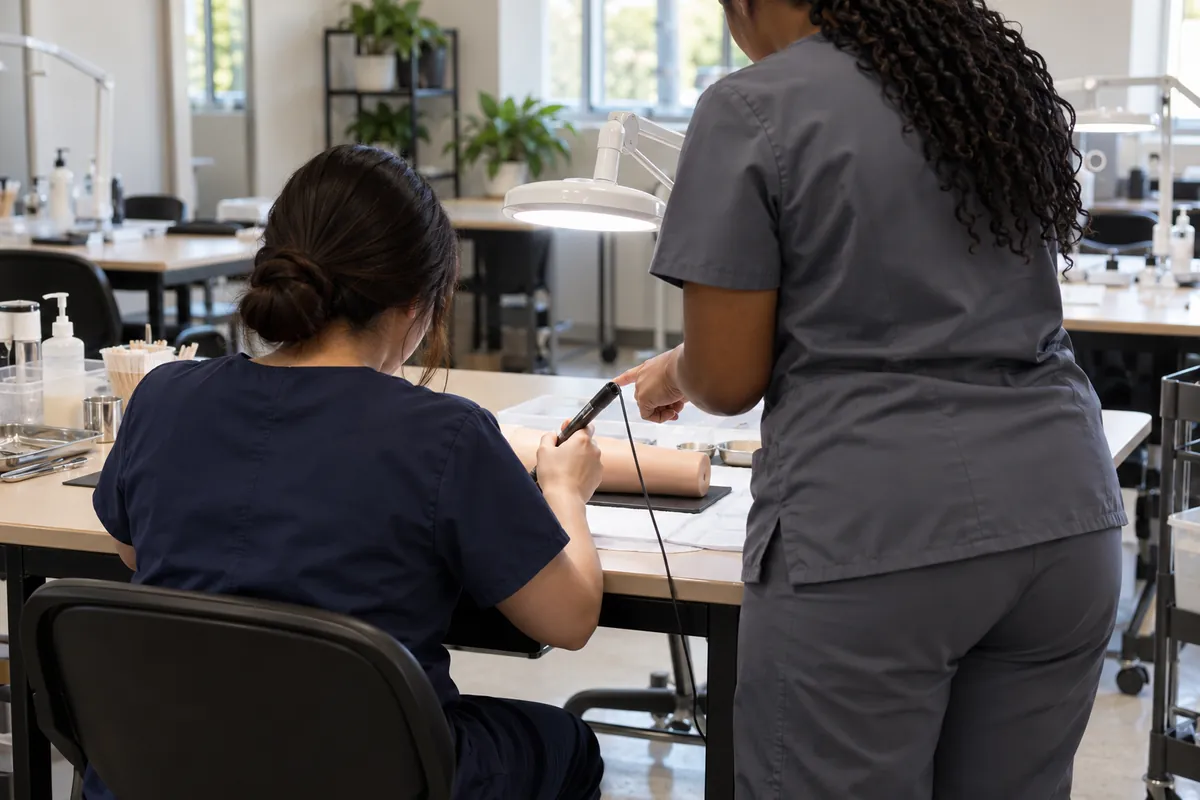
In the first year the work is mostly about consistency. A new electrologist concentrates on accurate insertions, safe settings, and learning how different skin heals. She usually starts with smaller areas and simpler cases, keeps sessions shorter, and leans on a mentor or former instructor when something puzzles her. Confidence comes from seeing her own clients return with less hair and healthy skin. That first set of completed cases is worth more than any certificate on the wall, because it proves to her that the method works in her hands.
In the middle years the practice broadens. With speed and judgment in place, an electrologist takes on dense beard work, large body areas, curved and distorted follicles, and clients with complicated histories. Many develop a focus that suits their community and interests: hormonal facial hair, gender-affirming care, finishing work after laser, or eyebrow shaping. A focus is not a legal category. It is a reputation, built through results and referrals, and it tends to make the work more satisfying because the practitioner becomes truly good at something specific.
Later, some practitioners move toward teaching, mentoring, or running a clinic with several treatment rooms. Others stay solo by choice and adjust their hours as life changes. One of the things I value about this profession is that it allows both. The skill does not expire, clients keep needing the service, and an experienced electrologist can keep a small, loyal practice for a very long time. Voluntary credentials, such as the Certified Professional Electrologist designation offered through the national association, are another way some practitioners mark their progress, though a credential is never a substitute for a required state license.
Misconceptions about the job
The first misconception is that the work is repetitive in a dull way. The motion repeats, but the problem in front of you changes with every client and often with every area on the same client. Hair angle shifts across a chin. Skin on the neck reacts differently from skin on the lip. A client's hormones change and the plan changes with them. Practitioners who enjoy the work describe it as absorbing, the way detailed craft work is absorbing, and time in a session passes faster than outsiders imagine.
The second is that technology has made the profession obsolete. Laser hair removal is a useful method for many people, and it has real limits tied to hair color, skin tone, and the difference between reduction and permanent removal. Electrolysis fills those gaps, which is why the two methods coexist and why laser clinics often refer clients onward. Our sibling guide comparing an electrologist career with a laser technician career looks at how the two jobs differ in training, daily routine, and independence.
The third is that anyone with a steady hand can start after watching videos. Theory can be studied well at a distance, and I am a strong supporter of doing that. The hands-on skill cannot. It requires an instructor beside you, practice on models, and, in states that license the profession, a set number of in-person training hours and an examination. An online course gives you the science and the vocabulary so that your practical hours are spent on your hands and not on catching up with the textbook. It does not replace those hours or the license.

How training prepares you for the job
Training for this profession has two halves. The theory half covers skin and hair anatomy, the hair growth cycle, the endocrine system, electricity and the three modalities, bacteriology, sterilization, contraindications, and professional ethics. The practical half is supervised work on live models, beginning with easy areas and progressing to more demanding ones. Schools combine both, and the balance and total length are set largely by the state where the school operates. Details differ enough from state to state that a general figure would mislead you, so check your own state in the licensing hub.
Many of my students study theory first, at their own pace, before or alongside hands-on training. The advantage is practical. When you already understand why a follicle in the growing phase responds better, or why moisture affects the galvanic reaction, your instructor's corrections make sense the first time. Our online electrolysis theory course was built for that purpose. It prepares you for the knowledge side of the profession and for written examinations, and it is honest about what it cannot do: it does not supply state-required in-person hours, and it is not a license.
If you are comparing ways to begin, the existing guide on electrolysis school versus online theory first lays out the order that tends to work for career changers and for people who live far from a school. Whichever route you choose, judge it by one test: does it lead to you being able to do the job described on this page, safely and legally, in the state where you plan to practice.

Your next step
An electrologist assesses, treats, protects, records, explains, and keeps a small business running, usually alone and usually with great care. If that mix of precise handwork, science, and one-to-one client contact sounds like you, the practical next step is to find out what your state requires. Open the electrolysis licensing hub, select your state, and read the requirements before you contact a single school. Then decide how you will cover the theory. Starting with the online theory course lets you test your interest in the subject at low risk and arrive at hands-on training prepared.
From there, visit a school if one is within reach, sit in on a class if they allow it, and talk with a working electrologist about her week. The profession rewards people who enter it with clear eyes. It is slow to learn, steady once learned, and unusually meaningful for work that happens one follicle at a time. If you want to keep reading, the sibling guide on how long it takes to become an electrologist walks through the timeline stage by stage.
State Requirements
State licensing guides
Hours, exams, fees, and the licensing board differ by state. Open your state for the current requirements.
Common Questions
FAQ
An electrologist prepares and disinfects the treatment room, reviews client charts, performs electrolysis sessions one follicle at a time under magnification, and holds consultations with new clients. Between sessions she resets the room, reprocesses instruments, and writes treatment notes. A self-employed electrologist also handles scheduling, client messages, supply orders, and bookkeeping. The treatment is the visible part of the day, and preparation, infection control, and records take up a significant share of the rest.
No. An esthetician is trained and licensed in skin care services such as facials, exfoliation, and often waxing. An electrologist is trained specifically in permanent hair removal with electrical current. In many states these are separate licenses with separate training, and holding one does not allow you to perform the other's services. Some professionals hold both. The rules differ by state, so check the electrolysis licensing hub for your location.
The main skills are fine motor control in both hands, good near vision with sustained focus under magnification, and solid knowledge of skin, hair, electricity, and infection control. Communication is just as important, because you explain a slow process to clients who want quick results and you work on sensitive areas. Patience, discretion, and comfort working alone for long periods round out the list. Self-employed practitioners also need basic business organization.
Some do. Dermatology, endocrinology, and plastic surgery practices, as well as gender-affirming care programs, sometimes employ or contract with electrologists, particularly for surgical site preparation and for clients with hormone-related hair growth. Most electrologists, however, work in private practice: a rented suite, a room in a salon or spa, or a home studio where local rules allow it. The setting affects paperwork and referrals more than the treatment itself.
That depends entirely on the state. Laser and light-based hair removal are regulated separately from electrolysis in many places, sometimes under medical supervision and sometimes under a different license or added certification. An electrology license by itself does not automatically cover laser. If you want to offer both, look up the laser rules for your state before investing in training or equipment. Our guide on becoming a laser hair removal technician explains the general picture.
It is not heavy work, but it is physically specific. You sit for long periods, hold your arms in controlled positions, and focus on a very small field. Without good ergonomics that can strain the neck, shoulders, wrists, and eyes. An adjustable stool and bed, proper magnification, regular movement between clients, and a sensible daily limit on sessions make the difference between a short career and a long, comfortable one.
In many states, yes, and the license usually involves approved training hours and an examination. Some states do not license electrologists as a separate profession, and other rules may apply there. Requirements, hours, and fees vary too much to summarize in one answer, so look up your own state in the electrolysis licensing hub. An online theory course supports your study, but it never replaces state-required in-person training or the license itself.
Book a session as a client with a local electrologist and pay attention to the routine around the treatment, not only the sensation. Ask her about her week. Then study some of the theory to see if the science holds your interest: the online electrolysis theory course is a low-commitment way to do that. If you enjoy both the room and the reading, hands-on training is a reasonable next investment.
Keep Reading
Related Guides


