Career
How Long Does It Take to Become an Electrologist? Timeline

Quick answer
There is no single answer, because each state that licenses electrologists sets its own required amount of in-person training. Depending on the state and on full-time or part-time attendance, the path from research to license can run from a few months to well over a year. Exam scheduling, license processing, and setup add time, and real fluency develops during the first year of practice.
How long it takes to become an electrologist depends mostly on one thing you do not control and two that you do. The one you do not control is your state: each state that licenses the profession sets its own required amount of training, and the difference between the lightest and heaviest requirements is large. The two you control are how many hours a week you can train and how well prepared you are when you start. Put together, the path from first research to first paying client runs from a few months for some people to well over a year for others.
I am Aida Khazieva, a licensed electrologist and cosmetologist with more than twenty years in practice, and I have watched many students move through this path at very different speeds. In this guide I break the timeline into stages, explain what each stage involves and why it takes the time it does, and show what tends to shorten or lengthen it. I do not print state hour counts, because they change and because a wrong number is worse than none. For exact figures, use the state pages in our electrolysis licensing hub.
Why there is no single number
People want one figure, and I understand why. The trouble is that electrology is regulated state by state. States that license electrologists each decide how much in-person training a candidate needs, what the curriculum must include, and which examination to use. Some set a comparatively short program. Others require a program several times as long. A few license the profession together with other fields under one board, and some do not license electrologists as a separate profession at all. A timeline that is accurate in one state can be badly wrong in the next one over.
The second variable is schedule. A required number of training hours is a fixed quantity, and how fast you move through it depends on how many hours you can attend each week. A full-time student finishes the same program in a fraction of the calendar time a part-time evening student needs. Neither is better. They are different arrangements for different lives, and schools vary in which ones they offer. When someone tells you how long their training took, always ask what state and how many days a week.
The third variable is everything around training: how far you live from a school, when the next class begins, how often examinations are held, and how quickly your state processes applications. These are waiting periods more than working periods, and they are easy to overlook. In my experience, students lose more calendar time to gaps between stages than to the stages themselves. Much of this guide is about closing those gaps with early planning, because that is the part of the timeline you can influence most.
Before going into detail, here is the whole path in order. Every licensed electrologist has passed through some version of these stages. In states without a dedicated license, the examination and application steps look different or fall away, but the learning stages do not, because safe work on clients requires the same knowledge and the same hand skill everywhere. Notice that the list does not end with the license. The period after licensing is where a new practitioner becomes truly capable, and it belongs in any honest timeline.
- Research. Confirm what your state requires and which schools are approved. Usually a matter of days to a few weeks if done carefully.
- Theory. Study anatomy, the hair growth cycle, electricity, modalities, and infection control. This can begin immediately and overlap with later stages.
- Hands-on training. Complete the supervised practical program your state requires. This is the longest stage and the one that varies most between states.
- Examination. Prepare for and pass the written exam, and the practical exam where one is required.
- Application and license. Submit documents and wait for the state to issue the license.
- Setup. Arrange a workplace, equipment, insurance, and local business requirements, or secure a position in an existing practice.
- Early practice. Build speed, judgment, and a clientele during the first year of real work.
Several of these stages can overlap, and that is the main way to shorten the calendar without cutting any corner. Theory can start while you are still choosing a school. Exam preparation can run through the last part of training. Setup planning can happen while you wait for your license. Students who treat the stages as strictly sequential, finishing one before thinking about the next, usually take noticeably longer than students who keep two stages moving at once.

Stage one: research your state
The first stage is short, and skipping it is the most expensive mistake on the whole path. Find out whether your state licenses electrologists, which board is responsible, how much training it requires, whether training must come from a school the state has approved, what examination it uses, and what documents the application needs. Then check the same for any state you might move to in the next few years. Our licensing hub organizes this by state, and the board's own website is the final authority.
Next, identify the schools that satisfy those rules. Electrology programs are much rarer than cosmetology or esthetics programs, and you may find only one or two within reach, or none. If the nearest approved school is far away, that single fact reshapes your timeline, because you will need to plan travel, temporary housing, or an intensive schedule. The sibling guide on how to choose an electrolysis school lists the questions to ask before enrolling, including how the school's hours are counted by your state.
Ask each school three timing questions. When does the next class start, and how often do new classes begin? What schedules are available, full-time, part-time, or modular? How long do students usually take from enrollment to finishing their hours? A school that enrolls only a few times a year can add months of waiting if you miss a start date. Knowing the dates early lets you line up your savings, your work schedule, and your theory study so that you arrive ready on day one.
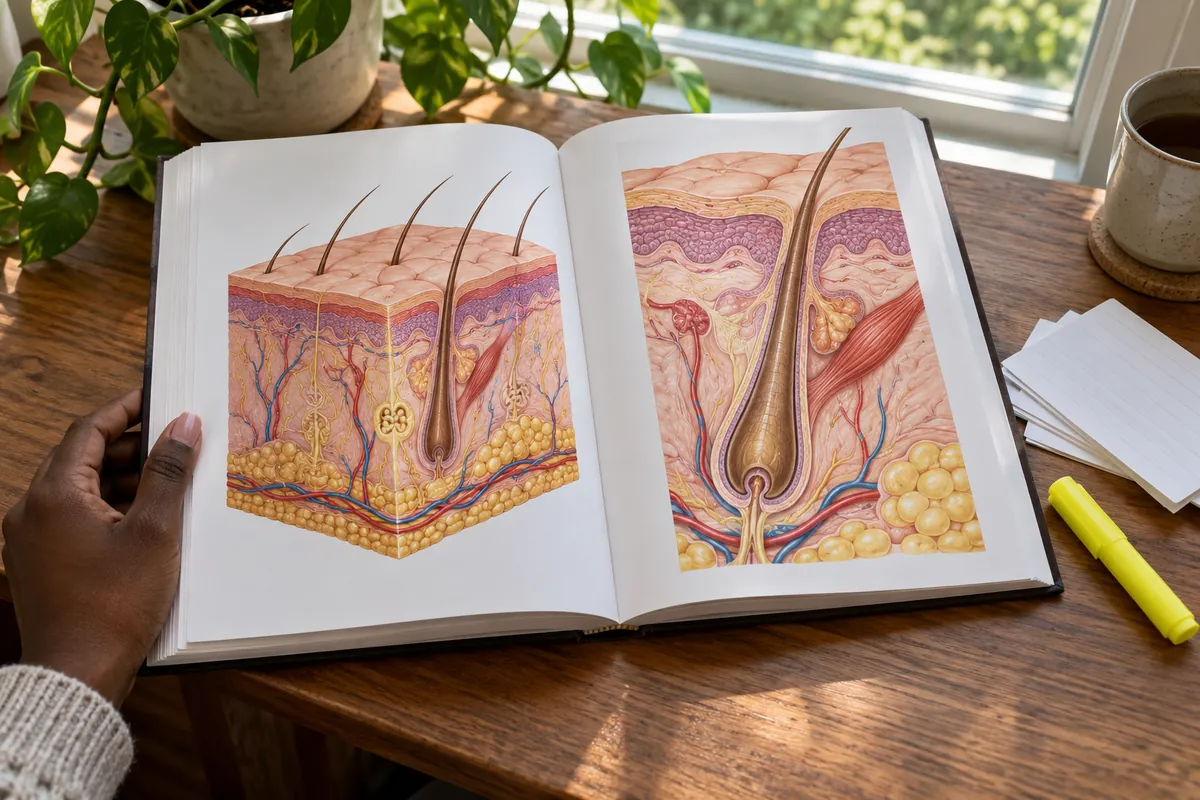
Stage two: theory
Theory is the knowledge foundation of the profession: the structure of skin and hair, the growth cycle, the endocrine system and its effect on hair, basic electricity, the galvanic, thermolysis, and blend modalities, bacteriology, sterilization, contraindications, and professional conduct. Schools teach it as part of their program. It is also the one part of the path that can be studied anywhere, at any hour, without a model or an instructor's hands. That makes it the natural place to gain time.
How long theory takes depends on your background and your weekly study time. Someone with previous training in esthetics, nursing, or biology moves faster through anatomy. Someone new to science needs longer, and that is fine. Working steadily for several weeks alongside a job is realistic for most people. What matters is that you understand the material and do not simply read it. The test is whether you can explain, in your own words, why a hair in its growing phase is the best target, or why moisture in the follicle matters to the galvanic reaction.
Our online electrolysis theory course is designed for exactly this stage. You can begin it the day you decide to explore the career, before a school place opens, and you can keep using it to review for the written exam. I need to be exact about what it does. It builds knowledge. It does not count as state-required in-person training, and it is not a license. What it changes is how you use your practical hours, which I will come to next.
There is a common question about order: theory first, or theory and practice together? Both work. For career changers and people far from a school, starting with theory at home has clear advantages, and our guide on electrolysis school versus online theory first explains them. Either way, do not leave theory to the end. Students who cram it in the last weeks before the exam extend their timeline with retakes more often than any other group I see.
Stage three: hands-on training
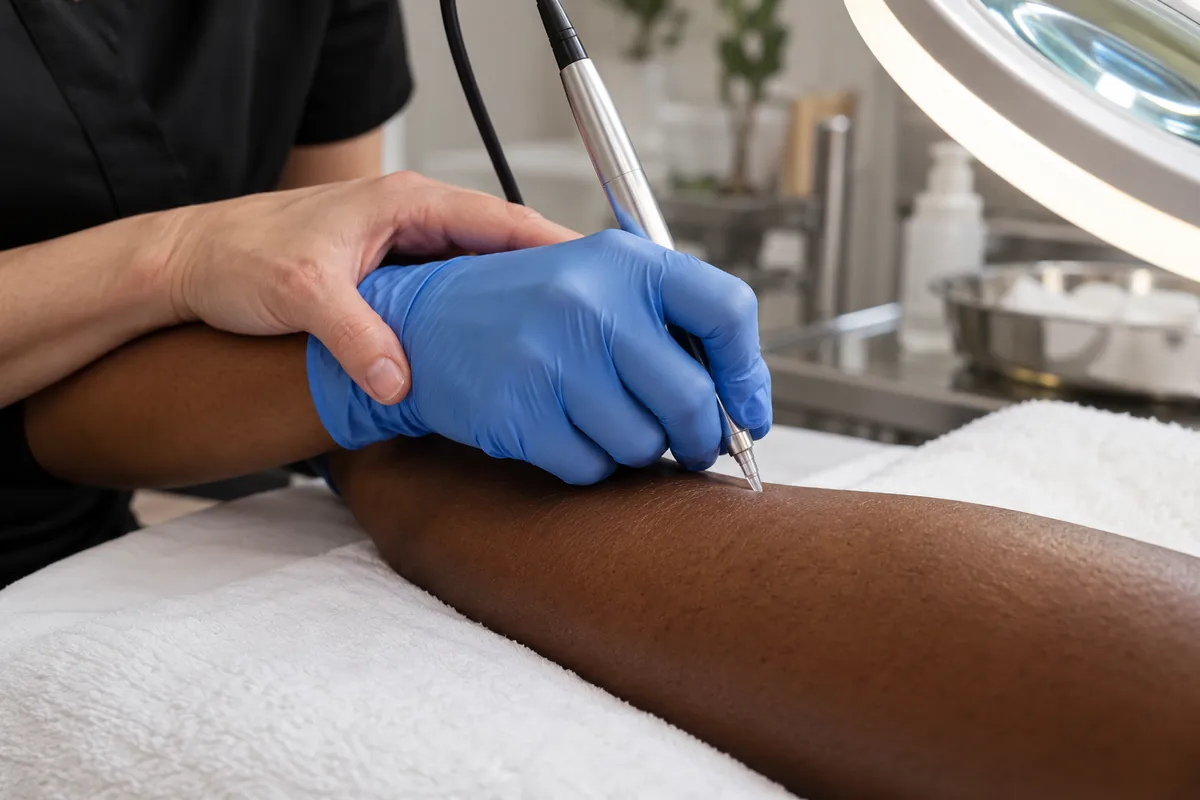
This is the core of becoming an electrologist and, in licensed states, the longest stage. You learn to position a client and yourself, to read the angle of a hair, to insert a probe to the right depth without resistance, to choose and adjust settings, and to judge skin reaction. You start on easier areas and progress to more demanding ones. All of it happens under supervision, with an instructor correcting your hand before errors turn into habits. No amount of reading replaces it, and no responsible program suggests otherwise.
The length of this stage in calendar terms is the state's required training divided by the hours you attend each week. In a state with a shorter requirement, a full-time student may be done in a matter of weeks or a few months. In a state with one of the longest requirements, a part-time student can be in school for a year or more. I cannot narrow that range for you without knowing your state and schedule, and I would be misleading you if I tried. Your school can give you a projected completion date on enrollment. Ask for it in writing.
What I can tell you is how the stage feels. The first weeks are slow and sometimes frustrating. Your hands feel clumsy, your eyes tire, and each insertion takes thought. Somewhere in the middle, the movements begin to connect, and you clear more follicles with less effort. Toward the end, you are working on real variety: coarse and fine hair, different skin tones, curved follicles. Students who arrive with theory already in place reach that middle point sooner, because they are not splitting their attention between new concepts and new movements.
Attendance is the quiet factor here. Training hours only count when you are present, and many states require the school to document them precisely. Missed days push your completion date back one for one, and some schools limit how quickly you can make them up. Before you enroll, look honestly at your work, family, and transport situation for the whole training period. A schedule you can keep without exception is faster in the end than an ambitious one that collapses in the second month.
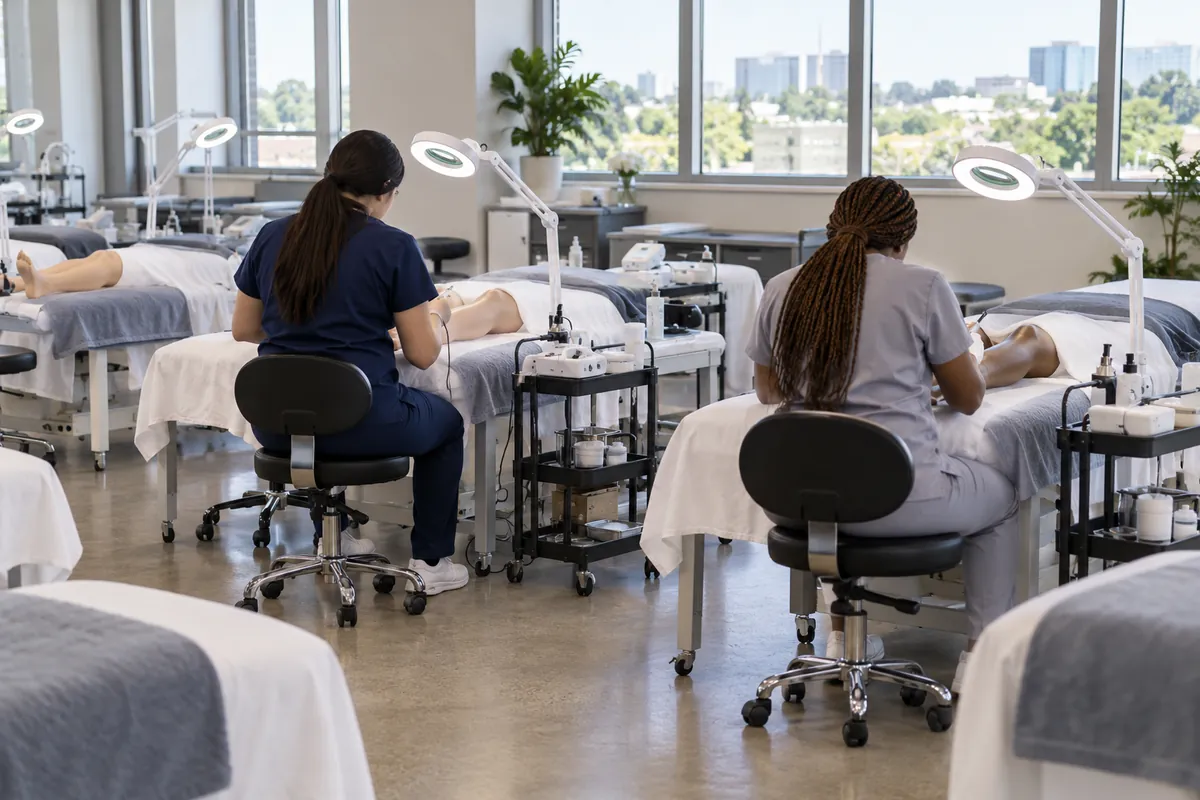
Stage four: the examination
Licensing states test candidates before granting a license. The format differs. Many use a written examination covering theory, and some add a practical examination in which you demonstrate setup, infection control, and treatment on a model. Some states use a national examination from a professional board, and others write their own. Your state page and your school will tell you which applies. If your state uses the national exam, our guide to the IBEC certification exam describes what it covers and how candidates prepare.
The time this stage takes has two parts: preparation and scheduling. Preparation is short if you studied theory properly along the way and reviewed during training. It becomes long if the exam is the first time you have looked at the endocrine system since week two. Scheduling depends on how often the exam is offered and how far ahead it books. In some places you can sit within a short time of applying. In others, dates are less frequent, and missing one means a long wait for the next.
The practical lesson is to find out the exam calendar and the eligibility rules well before you finish your hours. Some states let you apply for the exam as you approach completion. Others require proof of completed training first. Knowing which applies lets you submit paperwork on the first possible day. A failed attempt is the largest single delay in this stage, since retakes come with waiting periods and extra fees, so steady review through training is the most effective time saver you have.

Stage five: application and license
After the exam comes paperwork. A typical application includes proof of completed training sent by the school, exam results, identification, a fee, and whatever else the state asks for, which may include a background check or proof of age and education. The board then reviews the file and issues the license. Processing time is outside your control and varies with the board's workload. What you control is whether your file is complete the first time, and incomplete applications are the usual reason this stage drags.
Collect your documents during training, not after. Ask the school how and when it sends your hours to the state. Order any transcripts or certificates you need early. Keep copies of everything, permanently. If your state asks for something that takes time to obtain, start it before your final weeks of school. I have seen students finish training on schedule and then sit idle for weeks because one document was missing. That is an entirely avoidable delay.
You may not treat paying clients while you wait unless your state specifically provides for it, and you should assume it does not until the board tells you otherwise. Working before the license is issued can jeopardize the license itself. Use the waiting period productively instead. Plan your workspace, compare equipment, arrange insurance quotes, and keep your hands in practice in whatever supervised way your school allows. The sibling guide on whether you need a license to do electrolysis explains why practicing early is never worth the risk.
Stage six: setting up to work
With a license in hand, you need a place to use it. The fastest route is a position in an existing electrolysis practice or a clinic that wants to add the service, because the room, the equipment, and often the first clients are already there. Such positions are not available everywhere, but where they exist they can put you in front of clients almost immediately, and they give a new graduate the benefit of experienced colleagues nearby during the first months.
Starting your own practice takes longer. You need a suitable room, an epilator, a treatment bed and stool, lighting and magnification, sterilization equipment, supplies, liability insurance, and whatever business registration and local permits apply. A room in an established salon or a rented suite can be ready quickly. A home studio depends on zoning and sometimes on inspection, which adds time. The existing guide on how to choose an electrolysis machine helps with the largest equipment decision, and most of this planning can be done before your license arrives.
People often underestimate this stage because it feels like an afterthought to training. In practice, a well-prepared graduate can open her door within a short time of receiving her license, and an unprepared one can spend months deciding on a room and waiting for deliveries. If you intend to be self-employed, begin visiting spaces and collecting quotes during the second half of your training. The sibling guide on how to start an electrolysis business lists the steps in order.

Stage seven: becoming capable, not only licensed
A license says you met the minimum standard to practice safely. It does not say you are fast, or that you have seen every kind of skin and hair. The first year of real work is where that develops. Your insertions become more consistent, you learn how different clients heal, you begin to recognize which settings suit which hair almost on sight, and your sessions clear more follicles in the same time. I consider this year part of becoming an electrologist, and I tell students to plan for it.
The clientele builds over the same period. Electrolysis clients return many times, so a calendar fills gradually and then stays full. The first months are usually light, which is useful, since a new practitioner needs longer appointments and more time between them anyway. Our guide on finding your first electrolysis clients covers how that early growth usually happens. Expect the practice to feel established after a sustained period of steady work, not in the first few weeks.
This stage has no finish line, but there is a recognizable point where the work stops feeling like an examination. You notice that you have stopped thinking about your hands and started thinking only about the follicle and the client. For most people that arrives sometime in the first year or two of regular practice, sooner with a full schedule and good mentoring, later with only occasional clients. Staying in touch with an instructor or an experienced colleague during this period shortens it considerably.
What speeds the path up
None of the legitimate ways to move faster involve skipping anything. They all work by removing idle time or by making required time more productive. The biggest single gain is starting theory before school. When you already know the vocabulary and the reasoning, practical instruction lands the first time, your written exam preparation is review and not first exposure, and you can spend evenings resting your eyes and hands. Over a whole program, that difference in how each practical hour is used is substantial.
The second gain is full-time attendance where your life permits it. The required training is the same, and the calendar shrinks. The third is overlapping stages: preparing for the exam during the last part of training, assembling application documents before you finish, and planning your workspace while the board processes your file. The fourth is choosing a school whose start dates and schedule fit you, even if it is not the closest one. A program that starts next month and runs full-time can beat a nearby program that starts in half a year.
A fifth factor is prior experience. People who already hold a license in esthetics, cosmetology, or nursing are familiar with infection control, client handling, and often skin anatomy, so they absorb that part of the curriculum faster. Whether a state gives formal credit toward electrology training for another license is a question for that state's board, and you should never assume it does. Even without formal credit, the head start in understanding is real and tends to show in the first weeks of practice.
What slows the path down
The most common cause of delay is training in a way your state will not accept. That includes enrolling in a school the state has not approved, completing a program shorter than the state requires, or assuming that a certificate from a short workshop or an online course satisfies a licensing requirement. In each case the student has to start over or add training, and months are lost. This is why the research stage exists. A single phone call or email to the board before enrolling prevents it.
The second cause is interrupted attendance. Illness, job changes, family needs, and transport problems all happen, and each missed week moves the finish date. Schools have rules about leaves of absence and about how long you may take to complete a program, and long interruptions sometimes mean repeating material. If you can foresee a disruption, such as a move or a busy season at work, start after it and not before. A later start with clean attendance usually ends sooner.
Other delays are smaller but add up: a failed exam attempt and its waiting period, an incomplete application returned by the board, a missed class start date, back-ordered equipment, or a lease that falls through. Money is a frequent hidden cause as well. Students who run short partway through training have to pause. Planning the full cost before enrolling, including the less obvious items, protects your timeline. The sibling guide on electrolysis school cost and what to expect lists what to budget for.

Full-time, part-time, and career-change scenarios
To make the range concrete without inventing figures, consider how the same path plays out for different people. The table describes patterns I see repeatedly. It gives relative length, not weeks or months, because the absolute length depends on your state's requirement. Use it to find the row closest to your situation, then ask your school for a projected completion date based on your state and schedule.
| Situation | How the timeline tends to behave | What helps most |
|---|---|---|
| Full-time student, state with a shorter training requirement | Shortest overall path; exam and license scheduling become the main waits | Applying for the exam at the earliest allowed date |
| Full-time student, state with a longer training requirement | Moderate length; training itself dominates the calendar | Theory done beforehand, perfect attendance |
| Part-time student keeping a job | Longest training stage; calendar length is several times the full-time equivalent | A sustainable weekly schedule and theory study on off days |
| Student who must travel to a distant school | Often compressed, intensive training with planning time added before it | Finishing theory at home first so on-site time is all practical |
| Licensed esthetician, cosmetologist, or nurse adding electrology | Same required training unless the state says otherwise; faster comprehension | Asking the board in writing whether any credit applies |
| Resident of a state without a dedicated electrology license | No state exam stage; training length is your choice, so quality control is on you | Choosing thorough training and a voluntary credential |
Career changers deserve a specific word. Most cannot stop working to study full-time, and they do not need to. A part-time path with theory at home and practical hours on set days is entirely workable. It simply takes longer on the calendar, and it requires stamina. The sibling guide on becoming an electrologist as a second career discusses how to pace that transition and when to reduce hours at your current job.
If your state does not license electrologists
In states with no dedicated electrology license, the legal stages of the timeline shrink or disappear, and the question changes from "how long does the state require" to "how long does it take to be safe and good." The honest answer to the second question is not short. The manual skill develops at the same pace regardless of the law. A brief workshop may be legal in such a state, but it will not make anyone competent to treat a client's face unsupervised, and an insurer may ask about training before offering coverage.
If you live in one of these states, I suggest you set your own standard using the requirements of a comparable licensing state as a guide, and choose training that covers full theory and substantial supervised practice. Many practitioners in unregulated states also pursue the voluntary Certified Professional Electrologist credential from the national association to show clients and referral sources a recognized benchmark. It is a credential, not a license, and it does not transfer you into a licensing state automatically, but it gives your training a clear target.
Think about mobility as well. If you may ever move to a licensing state, training that meets a stricter standard and is well documented will serve you far better than a minimal course. The guide on electrolysis license reciprocity by state explains how boards evaluate training from elsewhere. Choosing thorough training at the start costs more time now and can save you from repeating school later.
Building your own realistic plan
Here is how I would build a personal timeline. Write down your state's training requirement from the licensing hub and confirm it with the board. Ask your chosen school for its weekly schedule options and the projected completion date for each. Add the wait until the next class start. Add the exam scheduling wait and the board's typical processing time, both of which the school can usually estimate from recent graduates. Then add your setup period, shorter for employment and longer for your own studio. The sum is your planning figure.
Now put a margin on it. Almost everyone meets at least one delay, and a plan with no slack turns an ordinary setback into a crisis. I suggest treating your calculated figure as the best case and arranging your finances for somewhat longer. Then look for overlaps that pull the figure back: theory before the class start, exam review during training, documents prepared early, workspace planning while you wait for the license. Those overlaps are where a well-organized student gains weeks.
Finally, be honest about pace. A plan that requires you to study every evening and attend every weekend for many months, with no rest, is a plan that breaks. Hands and eyes learn better with recovery time. A slightly longer timeline that you actually complete is faster than an aggressive one you abandon halfway. I have seen both, many times, and the steady students are the ones practicing today.

Your next step
The time it takes to become an electrologist is set by your state's training requirement, your weekly schedule, and how well you close the gaps between stages. You cannot change the first. You can choose the second, and the third is almost entirely preparation. Start today with the two actions that cost the least and save the most time: look up your state in the electrolysis licensing hub, and begin the theory with the online electrolysis course while you compare schools and wait for a class start.
Then contact the board to confirm what you read, ask schools for start dates and projected completion dates, and sketch your own timeline with a margin. Whatever your figure turns out to be, remember that the license is a midpoint. The first year of practice finishes what school begins, and it goes better for people who arrived at each stage prepared for the next one.
State Requirements
State licensing guides
Hours, exams, fees, and the licensing board differ by state. Open your state for the current requirements.
Common Questions
FAQ
It depends on your state and your schedule. Each licensing state sets its own required amount of in-person training, and the requirements differ widely. A full-time student in a state with a shorter requirement may finish in a few months, while a part-time student in a state with a longer one can take well over a year. Add time for the exam, license processing, and setup. Check your state in the electrolysis licensing hub for the exact requirement.
Online study can make the path more efficient, but it cannot shorten required in-person hours. Learning theory at home before or during school means your practical time is spent on your hands and your written exam preparation becomes review. That often prevents delays such as exam retakes. It does not replace state-required hands-on training or the license, and no legitimate course will claim it does.
In states that license the profession, the hands-on training stage is the longest, because the state requires a set amount of supervised practice and you can only complete it as fast as your weekly attendance allows. In calendar terms, part-time students spend several times longer in this stage than full-time students. After licensing, building speed and a clientele during the first year is the other long stretch.
Many students do. Part-time and evening schedules exist at some schools, and theory can be studied at home around a job. The trade-off is a longer calendar, since the same required training is spread over fewer weekly hours. Choose a schedule you can keep without frequent absences, because missed days extend your completion date. You may not treat paying clients as an electrologist until you are licensed, where a license is required.
Most new practitioners need a sustained period of regular work, often the first year or two, before the technique feels automatic and sessions become efficient. A full schedule and access to a mentor shorten that period. Occasional practice lengthens it. This is normal for a fine manual skill, and it is the reason I advise new graduates to plan financially for a building phase.
Do not assume so. Electrology is a separate license in many states with its own required training, and whether any credit is given for another license is decided by the state board. Ask the board in writing before you enroll. Your existing knowledge of skin and sanitation will help you learn faster, even if the required amount of training is the same as for a complete beginner.
The biggest delay comes from training that the state will not accept, such as an unapproved school or a program shorter than the state requires. After that, the common causes are missed attendance, a failed exam attempt, an incomplete license application, and running short of money partway through. Careful research before enrolling, steady review, and a full budget prevent most of them.
Legally, the state exam and application stages do not apply, so the formal path can be shorter. Practically, the hand skill takes the same supervised practice to develop anywhere. I recommend choosing thorough training modeled on a licensing state's standard and considering a voluntary professional credential. That protects your clients, helps with insurance and referrals, and makes a later move to a licensing state much easier.
Keep Reading
Related Guides


