Cosmetology
What Do You Learn in Cosmetology School? Full Curriculum Guide
Quick answer
In cosmetology school you learn infection control, basic anatomy and chemistry, haircutting, styling, hair color, perms and relaxers, basic skin care, waxing, makeup, manicures and pedicures, state law, and an introduction to salon business. Training starts on mannequins, moves to real clients on the supervised clinic floor, and ends with state board exam preparation. Required subjects and training time are set by each state.
People ask me what you learn in cosmetology school expecting a short answer: hair, nails, a little makeup. The real answer is broader and more structured than that. A cosmetology program is built backward from the state license. The state board decides which subjects must be taught and how much training time a student must complete, and the school arranges those subjects into theory classes, mannequin practice, work on classmates, and finally paid services on real clients in the student salon. Hair takes the largest share of the time, but sanitation, chemistry, anatomy, skin care, nail care, and state law are all on the schedule too.
I am a licensed cosmetologist and electrologist, and I have watched many students enter school surprised by how much reading there is and leave surprised by how much the school never covered. This guide walks through the curriculum in the order you are likely to meet it: the theory subjects, the practical blocks, the clinic floor, state board preparation, and the gaps you will need to fill yourself. Exact subjects and required training time are set by each state, so treat this as a map of a typical program and confirm the details for your state before you enroll.
How a cosmetology program is organized
Most US cosmetology schools measure training in clock hours, which means the time you are physically present and working is recorded and reported, in many states directly to the board. Some programs, especially at community colleges, use credit hours instead, but the logic is the same: the state names a minimum amount of training and a list of subjects, and the school must document that you received both. That is why attendance is treated so seriously. A missed day is not just a missed lesson. It is training time you still owe before you can graduate and sit for the exam.
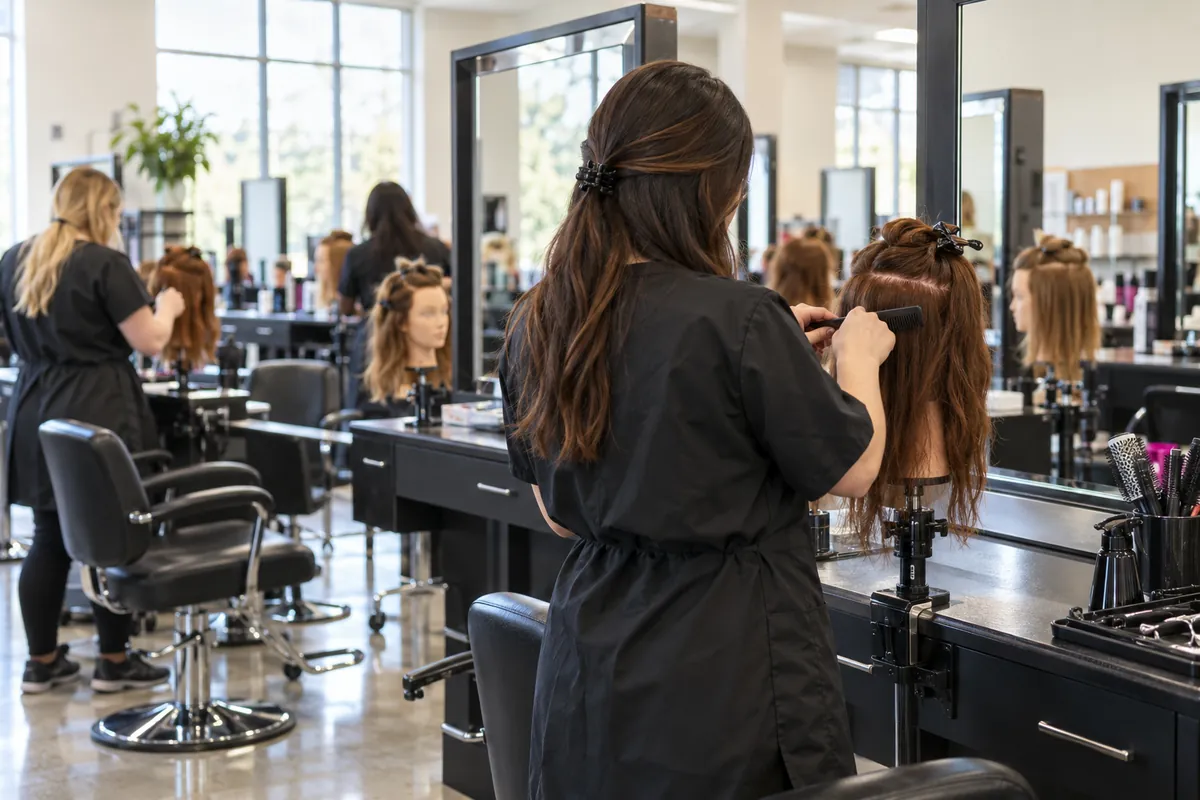
The program usually moves through three phases. The first phase, often called the freshman or core phase, takes place in a classroom with mannequins. You learn the foundations, safety rules, and basic techniques before the school lets you near a paying client. The second phase moves you onto the clinic floor, the school's working salon, where you perform services under instructor supervision while continuing theory classes on a regular schedule. The last phase adds advanced techniques, speed work, mock exams, and the paperwork for your license application.
The split between theory and practice is uneven on purpose. Cosmetology is a manual trade, so most of your time is spent with tools in your hands. Theory is the smaller part by time, but it carries the written exam and most of the safety knowledge. Students who treat theory as an interruption of the fun part tend to struggle later with color formulation, chemical services, and the written test. The required totals and the subject breakdown differ by state, and you can compare them on the cosmetology licensing hub before you read any school brochure.
Infection control and safety: the first thing you learn
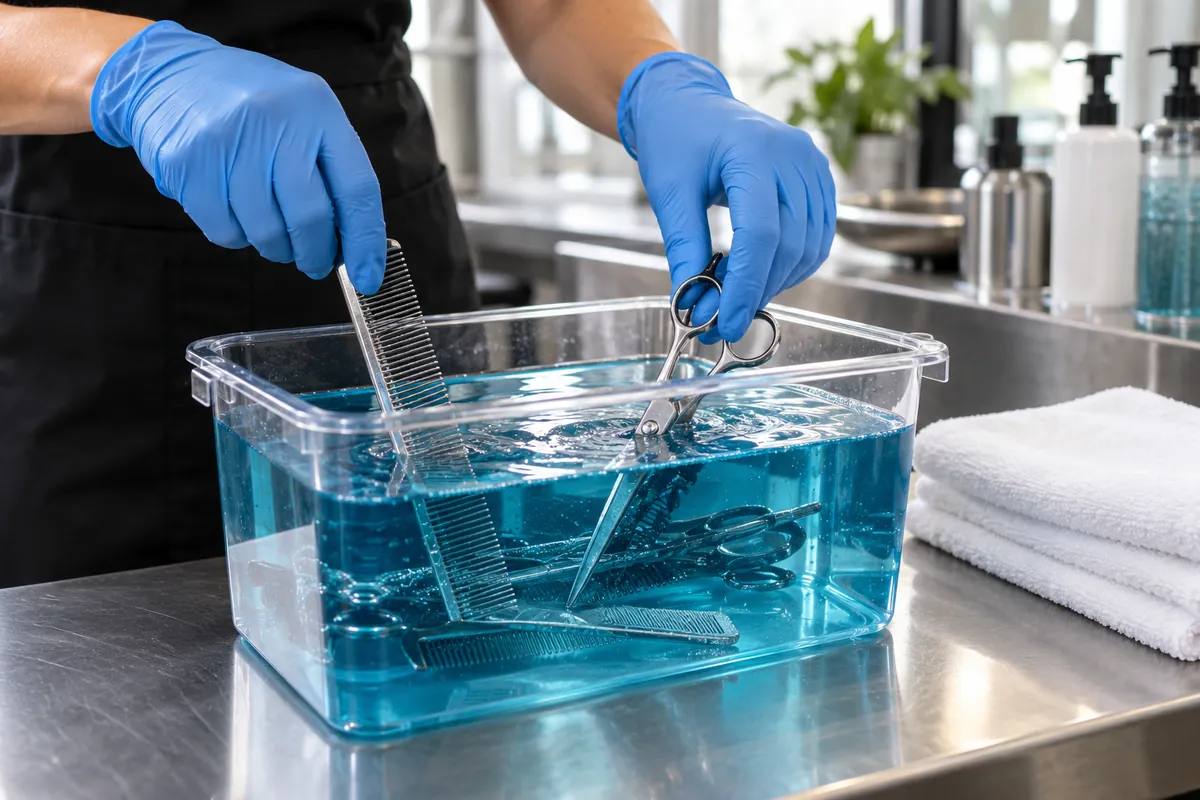
Before anyone hands you shears, you learn how not to hurt people. Infection control is the first unit in nearly every program and the one subject that follows you into every other class. You learn the difference between cleaning, disinfecting, and sterilizing, and why a tool must be washed free of hair and product before disinfectant can work. You learn to read a disinfectant label, mix it at the stated dilution, and leave implements immersed for the full contact time. You learn which items are single-use and must be thrown away, such as wooden sticks and many files, and which can be processed and reused.
The unit also covers how infections spread in a salon: through broken skin, contaminated tools, shared product containers, foot basins that were not cleaned between clients, and hands that were not washed. You learn the basic categories of microorganisms, what to do when a client or you are cut during a service, and how to recognize conditions that mean you should not perform a service at all. In my own work, where a probe enters the follicle, this discipline is non-negotiable, and I can tell within minutes which new professionals took this unit seriously in school.
Chemical safety belongs here as well. Salons use oxidizers, alkaline relaxers, acid solutions, acetone, monomers, and aerosols every day. School teaches you to read a safety data sheet, store products correctly, ventilate the space, protect your own skin and lungs, and respond to a spill or a chemical splash in the eye. None of this is glamorous, and all of it is tested. State board practical exams are graded heavily on safe, sanitary procedure, so a beautiful haircut performed with a dropped comb picked up off the floor still loses points.
The science behind the services
New students are often startled by the amount of science. Cosmetology theory includes general anatomy and physiology at an introductory level: cells, tissues, the major body systems, and in more detail the bones, muscles, nerves, and circulation of the head, face, neck, arms, hands, lower legs, and feet. The reason is practical. You massage the scalp and the face, you work around the nail unit, and you need to know what lies under your hands and where pressure is unwise.
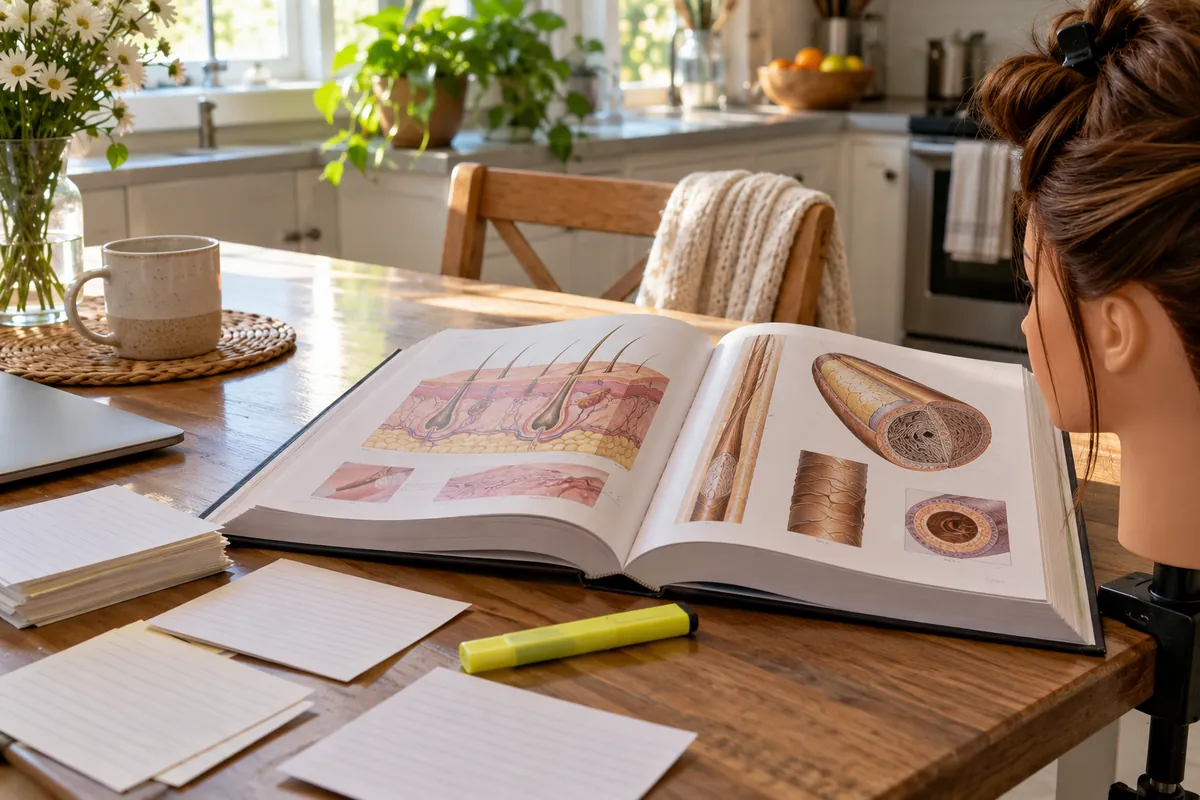
Skin structure and hair structure get their own units. You learn the layers of the skin, how the follicle produces a hair, the growth cycle, and what the cuticle, cortex, and medulla do. This is the foundation for every chemical service. Hair color works inside the cortex. Permanent waves and relaxers break and reform bonds within the hair. If you do not understand porosity, elasticity, and texture, you cannot predict how a head of hair will take color or how long a chemical should process. You also study common disorders of the hair, scalp, skin, and nails, so you can tell what is cosmetic, what is contagious, and what needs a physician.
Basic chemistry and basic electricity round out the science block. Chemistry covers the pH scale, acids and alkalis, oxidation and reduction, and the general makeup of shampoos, conditioners, colors, lighteners, and waving solutions. Electricity covers current types, safe use of appliances, and an overview of the light and electrical modalities used in skin care. None of it reaches college depth, but it is real content with real vocabulary, and the written exam draws on it heavily. Students who build flashcards from the first week have a much easier final stretch.
Haircutting and styling
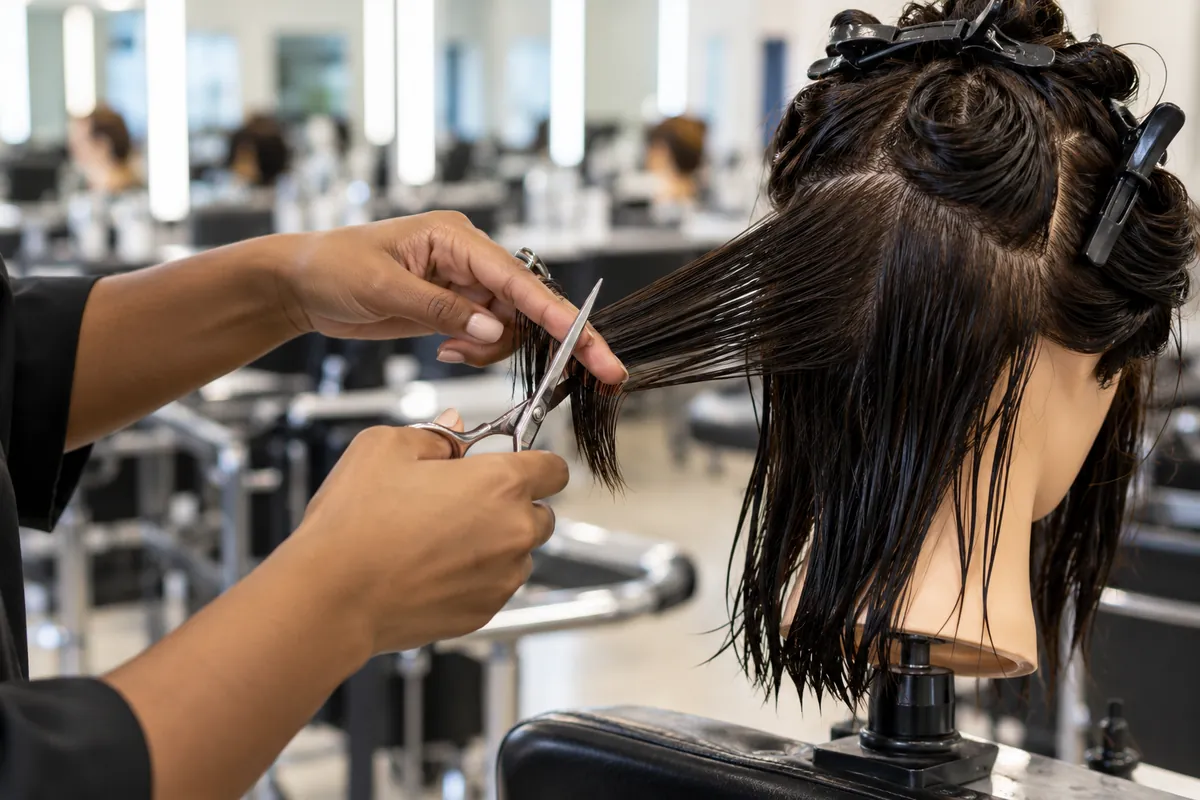
Haircutting is taught as geometry before it is taught as fashion. You learn the reference points of the head, how to section and part cleanly, and the concepts of elevation, cutting line, guide, and overdirection. From those ideas come the foundation cuts every school teaches in some form: a one-length cut with no elevation, a graduated shape that builds weight, a uniformly layered cut, and long layers. You cut them again and again on mannequins until your sections are clean and your guide does not drift.
Tools come next: shears, thinning and texturizing shears, razors, clippers, and trimmers, each with its own grip and safety rules. Most programs include clipper cutting, tapering, and basic men's haircuts, though the depth varies, and barbering is a separate license in most states with its own rules on shaving. You also learn the client side of a haircut: the consultation, reading face shape and growth patterns such as cowlicks and whorls, and checking density and texture before you choose a technique.
Styling covers shampooing and draping (which sounds trivial and is graded on the exam), scalp massage, blow-drying with round and paddle brushes, thermal styling with irons, and wet styling skills such as roller sets, pin curls, and finger waves. Students often resent the wet sets as old-fashioned. They remain in the curriculum because they train control of the hair and because some state practical exams still include them. Formal styling, updos, braiding, and an introduction to wigs and extensions are usually taught later in the program, often briefly.
Hair color, lightening, and chemical texture
Color is the subject most students look forward to and the one that demands the most theory. You begin with the color wheel and the law of color: primary, secondary, and tertiary colors, complementary pairs, and how one tone neutralizes another. Then you learn the level system used to describe how light or dark hair is, the underlying warm pigment that is exposed as hair is lightened, and the categories of hair color, from temporary and semipermanent through demipermanent and permanent, plus lighteners and toners.
Formulation is the skill built on that theory. You learn to identify the natural level, the percentage of gray, the existing artificial color, and the condition of the hair, then decide on the product, the developer strength, and the timing. In the practical room you learn application patterns: virgin application, root retouch, foil highlights and lowlights, and freehand painting. You also learn the strand test, the patch test for allergy, and what to do when a color goes wrong. Corrective color is introduced, but honest instructors say plainly that real correction skill takes years after graduation.
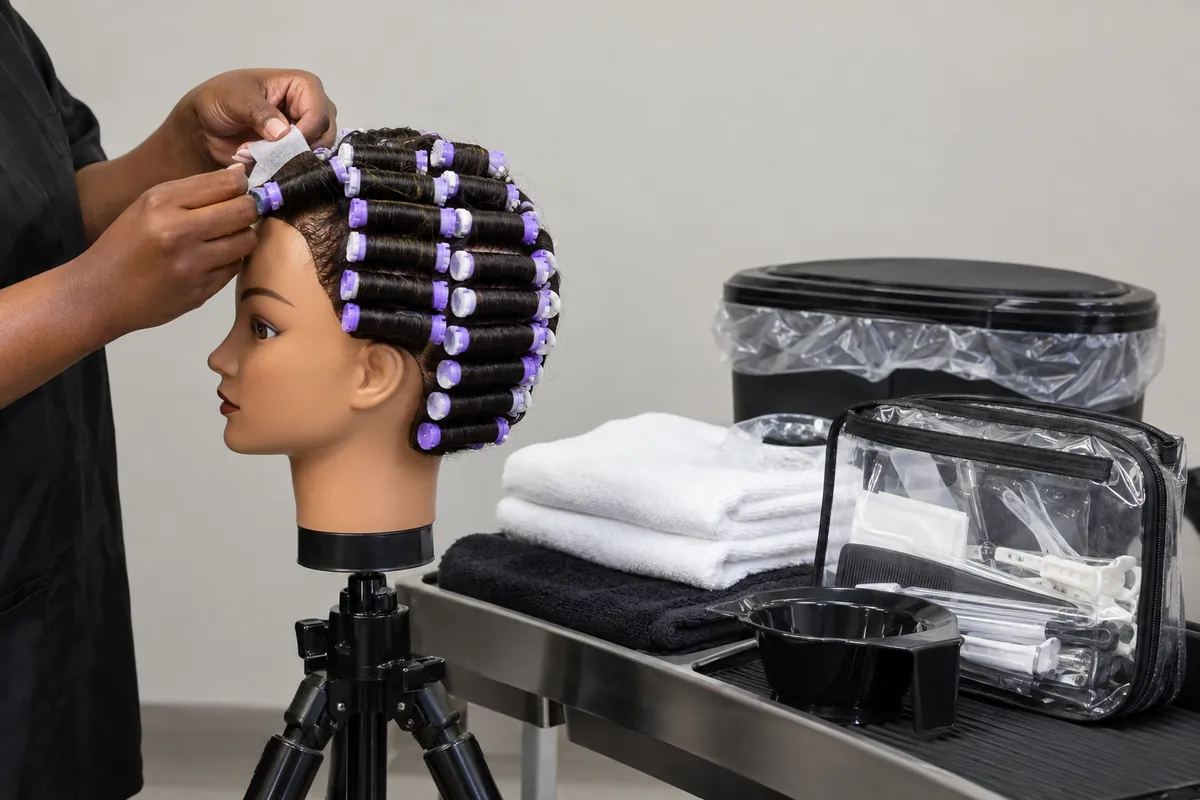
Chemical texture services are the other half of this block: permanent waving, chemical relaxing, and in some programs curl reforming and smoothing treatments. You learn rod selection and wrapping patterns, how to analyze the hair before applying anything, how processing and neutralizing work, and how to protect the scalp and hairline. These services carry real risk of breakage and chemical burns, which is why the theory comes first and why the exam checks your protective steps. Training in textured and tightly coiled hair has become a stronger part of many programs, and it is a fair question to ask any school how much time they give it.
Skin care, hair removal, makeup, and nails
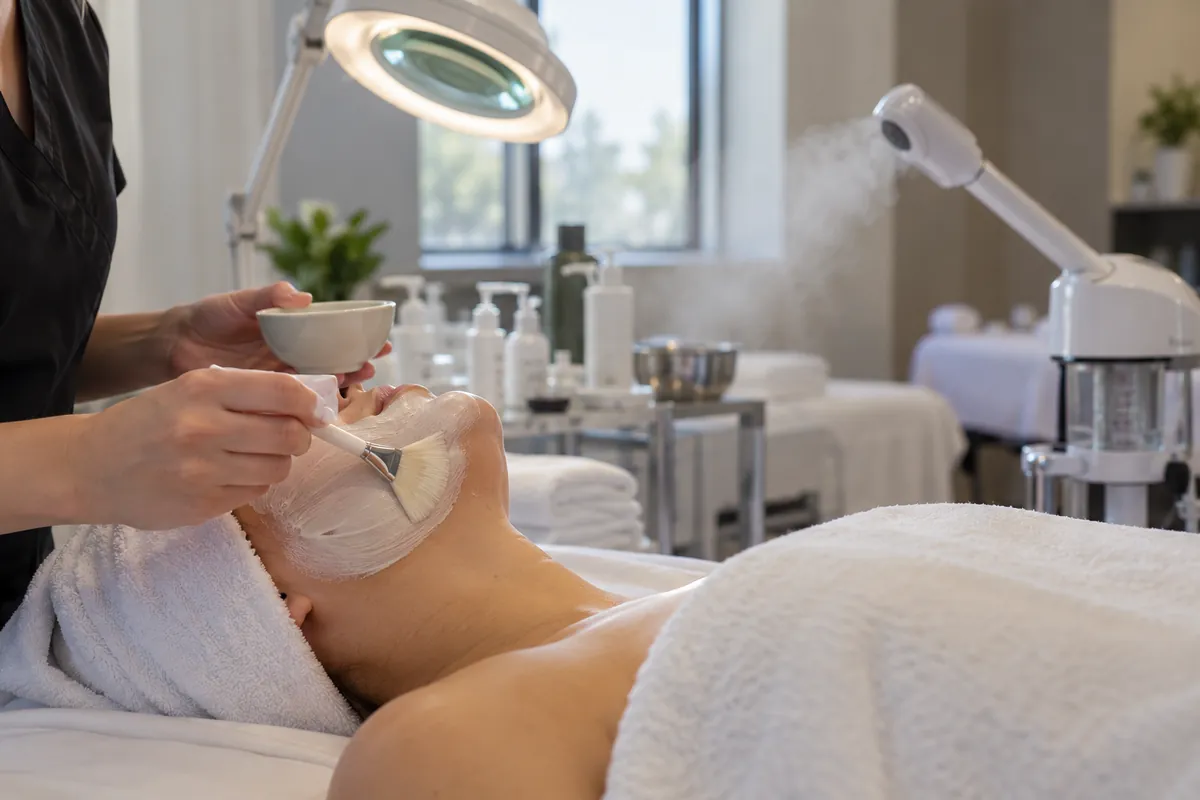
A cosmetology license in most states includes basic skin care, so the program has a skin unit. It is shorter than a dedicated esthetics program, and that difference matters. You learn skin analysis, skin types and common conditions, the steps of a basic facial, cleansing, exfoliation, steam, massage movements, and masks. You learn which conditions are contraindications and when to refer a client to a dermatologist. You are introduced to the electrical and light equipment used in facials, usually at an overview level.
Temporary hair removal is taught alongside: eyebrow shaping with tweezers, and waxing of the brows, lip, and often the legs or underarms. Coverage of body waxing varies a great deal from school to school. Makeup instruction typically covers color theory for the face, basic day and evening application, corrective techniques, and sanitation of brushes and products. Lash services, if included, are usually limited to strip or cluster lashes, because lash extensions and lash lifts are regulated differently from state to state and often require extra training.
If skin is the part of the program you care about most, pay attention to how little of the total time it receives. Many students who love facials and waxing would be better served by an esthetics program, which goes deeper into skin for less total time. I compare the two paths in cosmetologist or esthetician: the difference, and a sibling guide covers what you learn in esthetician school in the same walk-through format as this one. Permanent hair removal by electrolysis is a separate license in most states and is not part of a cosmetology curriculum.
The nail unit covers the structure of the natural nail, nail growth, and the disorders and diseases a professional must recognize. The rule taught here is simple and strict: a cosmetologist may beautify a healthy nail and must not treat an unhealthy one. If you see signs of infection, you do not perform the service, and you suggest the client see a physician. You learn the plain manicure and pedicure step by step, including filing, cuticle care within legal limits, massage of the hand and arm or foot and lower leg, and polish application.
Pedicure sanitation gets special attention because foot basins have been a source of real infections in salons. You learn the cleaning and disinfection routine between clients and at the end of the day, and why logs are kept. Enhancements are introduced next: nail tips, wraps, acrylic systems, and gels, along with their chemistry, safe filing, and proper removal. In a full cosmetology program this unit is an introduction. Someone who wants to do nails full time usually either attends a dedicated nail technology program or invests in advanced classes after licensing.
State law, professional conduct, and the business unit
Every program teaches the laws and rules of the state it operates in. You learn what your license permits and what it does not, how to renew it, how a salon must be licensed and inspected, what must be posted on the wall, and what the board can discipline you for. This unit looks dry, and it protects your career. Many of the complaints that reach a board involve people working outside their scope or working on an expired license, and both are avoidable by anyone who read the rules.
The business unit is usually the thinnest part of the curriculum. It typically covers professional image, communication, the client consultation, resume writing, interviewing, the difference between being an employee and renting a booth, basic record keeping, retail selling, and rebooking. Some schools add short units on social media and building a clientele. These are useful introductions, and they are rarely enough to run a business on. I return to this gap below, because it is the one graduates feel most sharply in their first year.
The clinic floor and a typical week
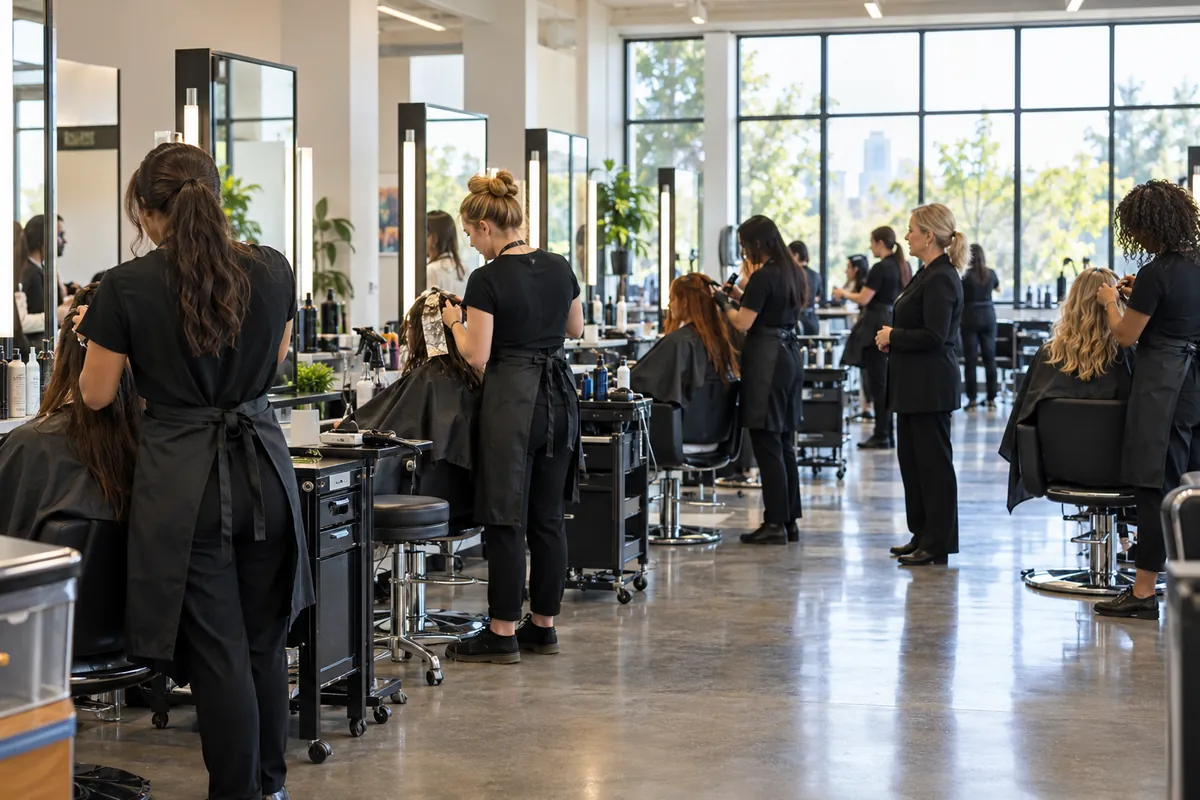
After the core phase, you move to the student salon. Members of the public book discounted services, and you perform them under the supervision of licensed instructors. A typical service runs like this: you greet the client, conduct a consultation, propose a plan, have an instructor approve it, perform the service, call the instructor to check your work at set points, finish, clean your station, and record the service on your sheet. Most schools require a minimum number of each service type, tracked on a card or in software.
The clinic floor teaches what a mannequin cannot. Real hair has cowlicks, old color, uneven porosity, and an owner with opinions. Real clients arrive late, describe one thing and want another, and bring photos of results that took a celebrity stylist many hours. You learn to manage time, to speak with confidence when you are not sure, to ask for help early, and to hear criticism in front of a client without falling apart. You also practice the front desk, the dispensary, laundry, and cleaning, because a salon runs on those jobs too.
The quality of this phase depends heavily on how busy the student salon is. In a school with a steady flow of clients, you get repetition and variety. In a quiet one, students spend long stretches on mannequins or idle, and they graduate with the hours but without the experience. This is one of the most important things to check before enrolling, and I explain how to check it in how to choose a cosmetology school.
Schedules differ, but the rhythm is similar across schools. A full-time student spends most weekdays at school for something close to a working day. Part-time and evening tracks spread the same required time over more months. Early in the program, a day might open with a theory lecture and a quiz, move to a demonstration by the instructor, and end with hours of mannequin practice. Once you are on the clinic floor, theory shrinks to a regular class slot and the rest of the day belongs to clients and assigned practice.
Expect written tests at the end of each chapter and practical evaluations where an instructor grades a service against a rubric. Expect a dress code, a required kit you must bring daily, and rules about phones. Expect homework in the form of reading and workbook pages. Students who arrive thinking school will feel like a salon are often caught off guard by how much it feels like school. If you are planning to keep a job during training, my guide on cosmetology school while working full time covers how the schedule options really play out.
| Phase | Where you work | What you mainly learn |
|---|---|---|
| Core or freshman phase | Classroom and mannequin stations | Infection control, science theory, foundation cuts, basic color application, shampoo and draping |
| Clinic floor phase | Student salon with real clients | Consultation, timing, full services under supervision, front desk and dispensary duties |
| Advanced and senior phase | Clinic floor plus classroom | Advanced techniques, speed, mock written and practical exams, license paperwork, job search |
State board exam preparation
Everything in the program points toward the licensing exam. Most states require a written theory exam, and many also require a practical exam, though some states have dropped or changed the practical portion. The written exam is multiple choice and covers the theory subjects described above, with infection control, chemical services, and hair care carrying a great deal of weight. Some states add a separate test on state laws and rules. The format for your state is listed on its board's site and summarized on our licensing pages.
Where a practical exam exists, it is a timed, scripted performance on a mannequin or model. Examiners watch a fixed list of tasks, such as a haircut, a chemical wave wrap, a mock color or lightener application, a relaxer application, thermal styling, and sometimes a basic facial or manicure. They grade procedure and safety, not artistry. You are scored on setting up a sanitary station, labeling your supplies, protecting the client, following the steps in order, and disposing of materials correctly. A candidate with average technique and perfect procedure passes. A talented candidate who contaminates a tool can fail a section.
Good schools build this into the final phase: timed mock practicals with instructors acting as silent examiners, kit checks, and practice written tests. Weaker schools leave it to the student. Either way, your own study habits decide the written portion. I describe a preparation plan in how to pass the cosmetology state board exam. The vocabulary load is the part people underestimate, and it is the part that structured theory review helps with most.
What cosmetology school does not teach
School is designed to make you safe and licensable. It is not designed to make you fast, specialized, or profitable, and there is no sense in blaming it for that. The time is limited and the required subject list is long. Knowing the gaps in advance lets you plan for them and saves you the shock of meeting them in your first job.
- Speed. School services are slow and supervised. Working at a pace that fills a real schedule comes from repetition in a salon, usually as an assistant or junior stylist.
- Advanced color. Complex blonding, major corrections, and vivid colors are introduced at most. Depth comes from advanced classes and years of practice.
- Specialty services. Extensions, lash extensions, advanced nail art, and specialized textured hair work often need separate training, and some need extra certification depending on the state.
- Business numbers. Pricing, taxes as a self-employed person, booth rental contracts, insurance, and retirement planning are barely touched.
- Building a clientele. Marketing, rebooking systems, reviews, and referrals get a short unit, if any.
- Body mechanics for a long career. Posture, wrist care, and footwear are mentioned, rarely trained.
- Difficult conversations. Handling complaints, refusals, and unrealistic expectations is learned mostly by doing.
There are also things school cannot teach because they are outside the license. A cosmetologist does not diagnose skin or scalp disease, does not perform medical procedures, and in most states does not perform electrolysis or laser hair removal without a separate credential. I have met graduates who assumed their license covered anything done in a beauty setting. It does not, and the limits are specific to each state. If your long-term interest is medical-adjacent skin work or permanent hair removal, plan your education with that in mind from the start.
The practical answer to these gaps is a deliberate first two years. Choose a first job for its training more than its pay. Assist a strong stylist if you can. Budget for a small number of good advanced classes. Read about the business side early, starting with how compensation models work, which I cover in booth rental vs commission for beauty professionals. Graduates who treat the license as the starting line tend to do well. Those who expect school to have finished the job often leave the field within a few years.

How hard is cosmetology school
The difficulty is real and it is not where people expect it. The academic content is manageable for anyone willing to read a chapter and memorize terms, but there is a lot of it, and it arrives while you are also on your feet most of the day. The physical side surprises people: standing for hours, arms raised, hands wet, with chemical exposure and constant cleaning. The emotional side surprises them more. You are corrected in public, you work on strangers while still unsure, and your early results are visible to everyone in the room.
The students I see struggle most fall into three groups. The first group has strong hands and avoids the book, then meets a written exam they are not ready for. The second group studies well and avoids clients, taking mannequin work whenever possible, and graduates without confidence. The third group underestimates attendance, falls behind on time, and pays for it in extra months and sometimes extra charges under the enrollment contract. All three are avoidable if you know they are coming.
Dexterity grows with repetition, so do not judge your talent by your first month. Judge your habits. Are you on time, do you take every client offered, do you ask the instructor to check your sections, do you review theory a little each day? Those behaviors predict who finishes and passes far better than natural flair. Many people who believed they were not academic find that theory makes sense once it is tied to something they can see happen on a head of hair.
How theory is taught, and where online study fits
Theory is delivered through a standard textbook, workbook exercises, lectures, demonstrations, and chapter tests. Some states allow schools to deliver part of the theory portion through distance learning, and some do not allow it at all, so a hybrid schedule depends on your state's rules and the school's approval. No state lets you complete the hands-on portion of cosmetology training through a screen, and no online course grants a license. Anyone who suggests otherwise is selling something you should not buy.
Where independent online theory does help is before and alongside school. Students who arrive already familiar with the vocabulary of infection control, anatomy, hair structure, and chemistry spend their classroom time understanding instead of decoding. Students close to graduation use structured review to prepare for the written exam. Career changers use it to find out whether the subject matter holds their interest before they sign an enrollment agreement. That is the purpose of our online cosmetology theory course: it builds the knowledge base and supports exam preparation, and it does not replace the state-required in-person training or the license itself.
I recommend a simple approach. Read the chapter before the lecture, not after. Write your own definitions for new terms in plain language. Connect each theory point to a service: pH to color and relaxers, the growth cycle to why hair sheds, bones of the skull to haircut reference points. Quiz yourself in short daily sessions instead of one long weekend session. This is ordinary study advice, and in cosmetology school it sets the students who pass the written exam on the first attempt apart from those who return for a retake.

Curriculum questions to ask a school before enrolling
Two schools in the same state must teach the same required subjects, yet the student experience can differ widely. The differences live in emphasis and execution. Ask for the curriculum outline with time per subject, and compare it with the state minimums. Ask how long the core phase lasts and what you must demonstrate before you move to the clinic floor. Ask how many clients a typical student serves and whether the school can show you service requirement sheets.
Ask what is taught beyond the minimum: textured hair, men's cutting and clipper work, extensions, advanced color, business skills. Ask who teaches, how long they have worked behind the chair, and how many students each instructor supervises on the floor. Ask how state board preparation is handled, including whether mock practicals are timed and graded. Ask whether any theory is delivered online and whether the state has approved that format. Then sit in on a class and spend an hour watching the clinic floor. What you observe will tell you more than any answer.
Finally, ask yourself what you want the license for. If your goal is a broad salon career with hair at the center, the full cosmetology curriculum fits. If your goal is only skin, only nails, or only hair removal, a narrower license may get you working sooner with training that goes deeper in your area. The school directory can help you see what programs exist near you, and the licensing pages show which license types your state offers.

Your next step
Start with your state. Open the cosmetology licensing requirements by state, find your state, and note the required training, the exam format, and the license types available. That page tells you what any school in your state is obligated to teach. Next, shortlist two or three schools and ask each the curriculum questions above. While you compare them, begin learning the theory vocabulary so your first weeks are easier. School will give you the license and a foundation. What you build on that foundation in the two years after graduation is up to you, and it is easier when you know from the first day what the program covers and what it leaves out.
State Requirements
State licensing guides
Hours, exams, fees, and the licensing board differ by state. Open your state for the current requirements.
Common Questions
FAQ
A typical program covers infection control and safety, basic anatomy and physiology, skin, hair and nail structure and disorders, basic chemistry and electricity, haircutting, hairstyling, hair color and lightening, permanent waving and relaxing, basic facials, temporary hair removal, makeup, manicures and pedicures, nail enhancements, state laws and rules, and an introduction to salon business. The exact list and the time given to each subject are set by the state. You can compare state rules on the cosmetology licensing hub.
Mostly hands-on by time, with a serious theory component. You spend the early phase in a classroom with a textbook and mannequins, then most of the program on the clinic floor serving real clients, with theory classes continuing throughout. Theory is the smaller share of the schedule, but it carries the written licensing exam and nearly all of the safety knowledge, so it deserves steady daily study.
You learn all three, with hair receiving the most time. The skin unit covers analysis, a basic facial, temporary hair removal, and makeup. The nail unit covers manicures, pedicures, and an introduction to enhancements. Both are shorter than dedicated esthetics or nail technology programs. If skin is your main interest, compare the paths in cosmetologist or esthetician before choosing.
Yes. After a core phase on mannequins, students move to the school's student salon, often called the clinic floor, and perform services on members of the public under the supervision of licensed instructors. Schools usually require a minimum number of each service type. How busy that student salon is varies a lot between schools, and it has a large effect on how prepared you feel at graduation.
Only at an introductory level. Most programs include a short unit on professional image, consultation, retail, resumes, and the difference between employment and booth rental. Pricing, self-employment taxes, contracts, insurance, and marketing are usually left for you to learn after graduation. Plan to study these on your own, and consider a first job that offers mentoring as well as a chair.
It depends on your state. Some states allow approved schools to deliver part of the theory by distance learning, and others require all training in person. In every state the hands-on training must be completed in person, and no online course grants a license. An independent online theory course is useful for preparing before school, reinforcing classes, and reviewing for the written exam.
Most states give a written multiple-choice exam on theory, with strong emphasis on infection control, hair care, and chemical services, and some add a section on state law. Many states also give a timed practical exam on a mannequin or model, graded on safe and sanitary procedure. Formats differ by state and change over time, so check your board's current candidate information. A study plan is in how to pass the cosmetology state board exam.
It is demanding, mainly because of the volume of new vocabulary and the physical and social pressure of working on clients while still learning. Many people who disliked traditional school do well, because the theory connects to something visible. Attendance, daily review, and a willingness to take every client offered matter far more than past grades or natural talent.
Keep Reading
Related Guides


