Cosmetology
Transferring Cosmetology School Hours: Steps for Students
Quick answer
Whether cosmetology hours transfer depends on your state board's rules, the new school's policies and the records your old school can produce. Ask the board and both schools in writing, request official transcripts and hour records before you leave, and do not stop logging approved hours. Out-of-state hours may be evaluated differently, so confirm early.
Transferring cosmetology school hours means moving the training hours you already completed at one school, or in one state, into a new program so you do not have to start from zero. It sounds simple, and sometimes it is. Often it is not. Whether your hours transfer depends on the rules of the state board where you want to be licensed, the policies of the new school, the paperwork your old school can produce, and sometimes how long ago you trained. Students who plan the move carefully usually keep most of their progress. Students who leave first and ask questions later sometimes lose a painful amount of it.
I am Aida Khazieva, a licensed cosmetologist and electrologist with more than twenty years in the beauty field, and I have helped students who had to change schools because of a move, a family situation, a school closure or simply a bad fit. This guide walks through how hour transfers generally work, which documents to collect before you leave, what commonly does not transfer, and how to protect your money and time. Every state handles this differently, so I will not print hour totals or deadlines. Use the cosmetology licensing hub to reach your state board and confirm its current rules.
How Cosmetology Hour Transfers Generally Work
In most states, the hours that matter for licensing are tracked in one of two ways. Some state boards register each student and record hours directly, so the board itself knows how many hours you have completed and at which school. Other boards rely on the school to keep records and certify your total when you apply for the exam or license. Some states also allow or require an apprenticeship route, with its own records. Knowing which system your state uses is the first step, because it decides who you need to ask for proof of your hours.
When you transfer within the same state, the new school usually needs to verify your completed hours, often through an official transcript or a board record, and then decide how to place you in its curriculum. The board's rules decide whether those hours still count toward licensing, and the school's policy decides how it accepts them into its program. Those two decisions are separate. The board may recognize your hours while the new school still requires you to repeat certain modules, practical evaluations or tests before you continue.
When you transfer between states, a third layer appears: the new state's board must decide whether training completed under another state's rules counts toward its own requirements. Some boards accept out-of-state hours with documentation, sometimes subject to review. Others accept only part of them, or accept them only when they match specific curriculum areas. A few may require additional training to fill gaps. You will not know which applies until you ask the receiving board, in writing, with your documents in hand.
Before You Leave Your Current School
The best time to plan a transfer is while you are still enrolled. Once you withdraw, getting records can become slower, especially if there is an unpaid balance, a dispute, or if the school is under financial stress. Start by reading your enrollment agreement and the school catalog. Look for sections on withdrawal, refunds, transcripts, and record requests. Many schools have a formal withdrawal process, and following it properly protects your refund rights and your record.
Then request your records while you still have access to the staff who keep them. Ask for an official transcript, a detailed breakdown of hours by subject or curriculum area, a record of practical operations or services completed if your school tracks them, and any grades or test results. If your state board records student hours directly, check your board account or ask the school to confirm your hours have been reported up to your last day. Gaps between the school's records and the board's records are much easier to fix before you leave.
Talk to the new school before you commit to leaving. Send copies of your records and ask, in writing, how many of your hours it expects to accept, what it would require you to repeat, how much tuition it would charge for the remaining program, and when you could start. If possible, also contact the receiving state board for an out-of-state move. Once you have those answers, you can make a real decision instead of hoping for the best.

Documents to Collect: A Transfer Checklist
Paperwork is the heart of an hour transfer. A new school or board cannot accept what it cannot verify, and a missing document can mean repeating hours you already completed. Collect originals or official copies, keep digital scans of everything, and store them in one place. Here is the list I give students who are planning a move. Not every item will apply in every state, but collecting them all costs little and protects you.
- Official transcript showing total hours completed and dates of attendance.
- Hours broken down by subject or curriculum area, such as theory, haircutting, chemical services, skin and nail care, and infection control.
- Record of practical operations or services completed, if your school tracks them.
- Grades, written test results and practical evaluation results.
- Copy of your enrollment agreement and the school catalog for your enrollment period.
- Proof of the school's state approval or license during your attendance.
- Board student registration or permit, if your state issues one.
- Withdrawal letter or form confirming your last date of attendance.
- Financial statement showing any balance, refunds and payments.
- Any letters from the board or school about your hours.
The breakdown by curriculum area is the item students most often forget, and it can matter a great deal. A receiving school or board may accept your total hours but still need to know whether you completed, for example, enough hours in chemical services or in infection control. If your transcript shows only a total, ask your school whether it can provide a subject breakdown. Many schools track this internally even if the standard transcript does not display it.
If your school uses an online student portal, download any hours reports it offers before your access ends. Portal accounts are often closed soon after withdrawal, and screenshots or exported reports can back up the official transcript if a question arises about a particular week.
Transferring Schools Within the Same State
A transfer within one state is usually the simplest case, because the same board rules apply to both schools. If the board tracks student hours itself, your hours are already on record, and the new school can often verify them directly. If the board relies on school records, the new school will need your official transcript. Either way, the main question becomes how the new school places you in its program.
Schools often have transfer policies that limit how many outside hours they accept, require a minimum number of hours completed at their own school before graduation, or require you to pass an entrance practical or written test to show your skill level. These are school policies, not board rules, and they vary widely. Two schools in the same city may treat the same transcript very differently. Ask each school you are considering for its transfer policy in writing and compare them before deciding.
Curriculum differences can also matter within one state. Schools teach the board's required subjects but may organize them differently. You might have completed a large share of your theory but little clinic floor work, or the reverse. The new school may place you in a phase that fits its structure, which can mean repeating some content. Ask exactly where you would start and what you would repeat, so the real time to graduation is clear.

Moving to Another State Mid-Program
Moving states during cosmetology school is where most transfer problems happen. Each state sets its own required training, its own subject areas and its own way of verifying hours. Your old hours were earned under the rules of the state where you trained. The new state's board decides how much of that training it recognizes. Some states have clear procedures for out-of-state students. Others review requests case by case.
Start by contacting the board in the state you are moving to. Ask whether it accepts training hours from out-of-state schools, what documentation it requires, whether hours must be certified by your old school or old board, and whether any subject areas must be completed in the new state. Ask whether there is a time limit on how old hours can be. Then contact schools in the new state with the same questions about their own policies. Do both before you move if you can, because the answers may affect where you choose to live or when you move.
Another option worth asking about is finishing your program in your current state before moving, then applying for a license in the new state by endorsement or reciprocity once licensed. In some situations, completing training and becoming licensed first can be simpler than transferring partial hours, because many states have established procedures for licensed practitioners. Whether this is better depends on how close you are to finishing, the rules of both states, and your personal circumstances. My guide on cosmetology license reciprocity by state explains how licensed transfers usually work.

What May Not Transfer
Even with complete paperwork, some hours or credits may not move with you. Knowing the common reasons in advance helps you ask the right questions and set realistic expectations. These are general patterns I have seen. Your own situation depends on your state board and the new school.
- Hours that cannot be verified by an official record from the school or board.
- Hours from a school that was not approved by the state at the time you attended.
- Hours older than a time limit set by the receiving board or school, where one exists.
- Subject areas that the new state requires but your old program did not cover in enough depth.
- Practical operations that were not documented individually.
- Hours beyond the new school's maximum transfer limit.
- Credits tied to a different license type, such as barbering or esthetics, that do not map to cosmetology.
- Online theory hours where the receiving board limits or does not accept distance learning.
The point about online hours deserves attention. Some states allow part of theory training to be completed online through approved programs, and some do not allow it at all for licensing hours. Hours you earned online in one state may not count in another. More broadly, online courses are a good way to build and review theory, but they never replace the in-person practical training a state requires. Our cosmetology course is designed as theory support for students and professionals, not as a substitute for state-required hours.
Hours from a different license type can also cause confusion. If you started in an esthetics or barbering program and want to switch to cosmetology, some overlapping subjects such as infection control may count, while others will not. The answer depends heavily on state rules. Ask the board directly how it treats crossover training rather than assuming that related hours count.
When Your School Closes or Loses Approval
School closures are one of the most stressful reasons for a transfer, because they often happen with little warning. If your school announces it is closing, act quickly. Request your records immediately, before staff leave. Ask whether the school has arranged a teach-out, which is an agreement with another school to let students finish their programs. Teach-out arrangements can sometimes make the transfer smoother, but you should still read the terms carefully and compare them with other options.
If a school closes suddenly and you cannot get records, contact your state board and the agency that oversees private schools in your state. They may have information about where student records were sent. If you used federal student aid, the U.S. Department of Education has information on closed school options, which may include a loan discharge in certain circumstances. Read the official guidance and talk to the agency directly rather than relying on third parties who contact you offering help for a fee.
Closures are a strong reason to keep your own copies of records throughout school, not only at the end. Every few months, ask for an updated hours statement and save it. If the worst happens, those statements can support your claim to the hours you completed, even if the official records take time to locate.

Money, Refunds and Financial Aid During a Transfer
Changing schools affects your finances in several ways. Your current school's refund policy, which should be in your enrollment agreement and catalog, decides what you may get back when you withdraw. Policies often depend on how much of the program or payment period you completed. Withdraw formally, in writing, and keep proof of the date, because the date can affect the refund calculation.
If you received federal student aid, withdrawing triggers rules about how much aid you earned up to that point. Some aid may have to be returned, and this can create a balance with the old school. At the new school, you will need to work with its financial aid office, which will consider the aid you already used. Ask both offices to explain the effect before you leave. My guide on cosmetology school cost and financial aid covers how aid usually works in beauty programs.
Also compare the true cost of finishing at the new school, not just the tuition rate. A school that accepts fewer of your hours may cost more overall even if its price looks lower. Ask for a written estimate of the tuition and fees for the remaining program, including kit, books and any repeated modules. Some schools require you to buy their own kit even if you already have one, which is worth knowing in advance.

Choosing the New School
When you transfer, you get a second chance to choose a school, and it pays to choose more carefully than the first time. Visit in person if you can. Watch a class and the clinic floor. Ask how the school tracks hours, how often students receive hours statements, and how it reports hours to the board where that applies. A school with clear, regular records is less likely to cause problems later, at graduation or at the board.
Ask specifically about transfer students. How many does the school take? How does it assess skills on entry? Does it assign a mentor or instructor to help transfer students fit into the curriculum? Schools that regularly accept transfers tend to have smoother processes. Ask also about exam preparation and pass rates if the school publishes them, and how it prepares students for the practical exam in your state.
My guide on how to choose a cosmetology school has a full list of questions. For a transfer, add three more: how many of my hours will you accept, what will I repeat, and when will I realistically graduate. You can also browse our beauty schools directory to compare programs in your new area.

Timeline, Gaps and Keeping Skills Fresh
Transfers often involve a gap between leaving one school and starting the next. Moves take time, schools have start dates, and paperwork can take weeks. During that gap, practical skills can fade, especially haircutting and chemical application, which depend on muscle memory. Some receiving schools assess skills on entry, so arriving rusty can mean being placed at a lower level than your hours suggest.
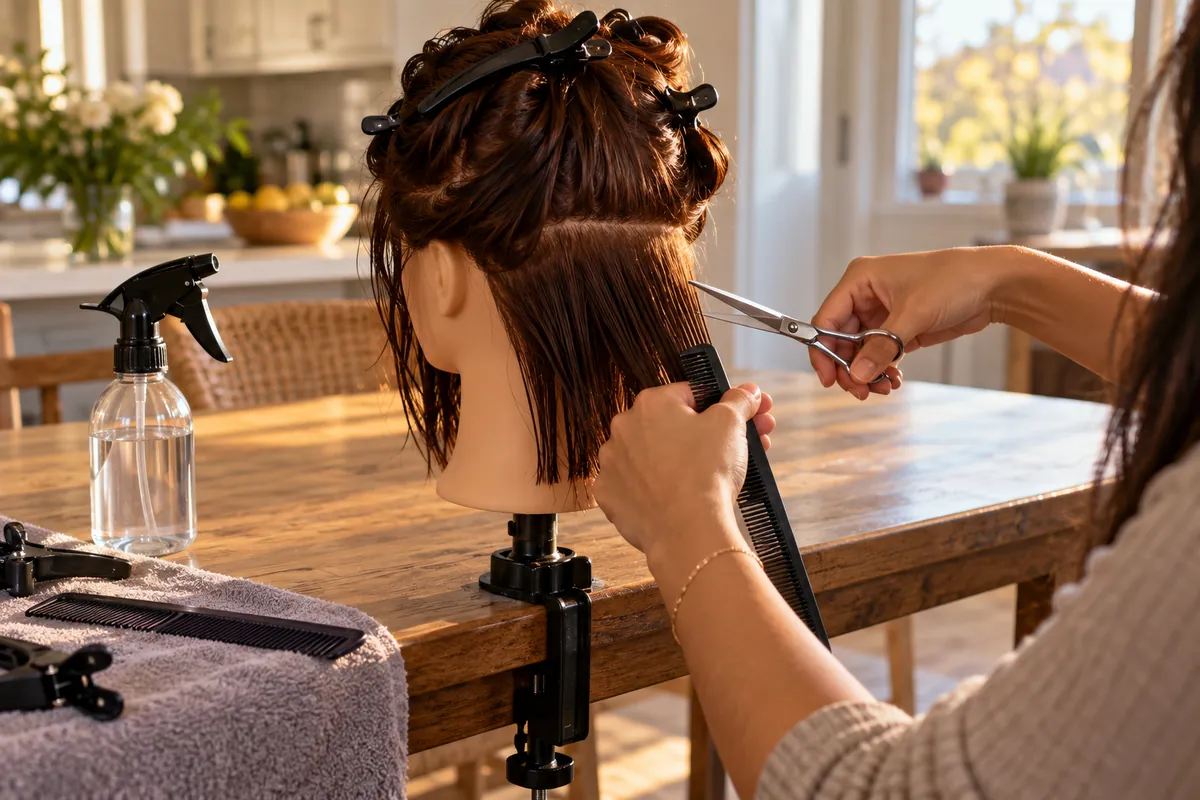
Keep practicing during the gap if you can do so safely and legally. Work on a mannequin at home for cutting, sectioning and roller or rod placement. Review theory, especially infection control, chemistry and anatomy, so you can pass any entrance test. Do not perform services on paying clients without a license or student status. That can create legal problems in many states and could affect your future licensing.
The overall time to finish depends on how many hours transfer, the new school's schedule and any repeated content. My guide on cosmetology school timeline factors explains what usually affects program length. After a transfer, ask the new school for a written estimated graduation date and check it against your plans.
Common Transfer Mistakes to Avoid
Most painful transfer stories I have heard share a few mistakes. They are easy to avoid once you know them. The most common is leaving a school before getting records, then struggling to obtain them. The second is assuming that all hours transfer because a friend's did. The third is choosing a new school based on price without asking how many hours it will accept. The fourth is moving states without contacting the new board first.
Other mistakes are quieter. Students sometimes withdraw informally by simply stopping attendance, which can complicate refunds and records. Some do not check whether their old school was properly approved by the state, which can make hours difficult or impossible to use. Others lose track of their own documents during a move. And some assume that online theory hours count everywhere, which is not true.
The pattern behind all of these is acting before getting written answers. A transfer involves your money, your time and your future license. Take a few extra weeks to get clear answers from the board and the new school, and keep copies of every reply. That patience usually saves months of repeated training.
After the Transfer: Graduating and Getting Licensed
Once you are settled in the new school, keep the same discipline with records. Ask for regular hours statements and compare them with your own log. Before graduation, make sure the school will certify your total hours, including transferred hours, in the way the board requires for exam or license applications. Some boards require extra documentation for transferred hours at the application stage, so ask early what you will need.
Then focus on the exam. Transfer students sometimes have gaps in exam preparation, because the two schools covered material in different orders. Review the board's exam content outline and fill any gaps. My guide on how to pass the cosmetology state board exam walks through preparation for both parts of the exam.
If you plan to work as a cosmetologist in more than one state over your career, start a simple personal record now: a document listing every school, dates, hours and license numbers, with copies attached. It takes an hour to set up and saves many hours later.

How to talk to both schools
A transfer involves two schools with different interests. Your current school wants to keep you or may be slow to release records, and the new school wants your enrollment but must follow the state's rules about crediting hours. Handle both conversations in writing. Ask your current school for the exact process and timing for transcripts and hour records, and ask your new school for a written statement of how it will evaluate your hours, what it needs to see, and who makes the final decision. Keep copies of every message, and note names and dates of calls.
Be specific about what you did. Hours in theory, practical hours on mannequins, clinic floor hours on clients and hours in specific subjects may all be counted differently. Ask both schools to use the same categories your state board uses. If something looks wrong on a record, correct it before you transfer, not after. A calm, organized request tends to be treated better than an urgent demand, and a missing signature caught early costs a day instead of a month.
Protecting your hours while the transfer is pending
Gaps hurt. While a transfer is in progress, you may be tempted to wait, but a long break can weaken your skills and may affect how some schools evaluate your records. Ask whether you can attend classes or do supervised work during the evaluation, and whether any hours earned in the interim will count. Never log hours at a place or under a supervisor that your board has not approved, because those hours may be rejected later. If a school closes or a license body changes its rules, contact the board right away.
Keep studying on your own in the meantime. Review theory, practice mannequin skills if you have access, and stay current with state exam content. If you have a break of several weeks, plan what you will do to stay sharp. The new school will find it easier to place you if you can show you kept learning, and you will recover quickly once classes resume. Ask your new school if they offer an assessment to place you at the right level.
Questions to ask your state board before you commit
Your board has the final word. Before you sign anything with the new school, ask whether it is approved, whether the hours from your previous school can be credited, whether any categories are capped, and what documentation the board needs. If you are moving between states, ask whether the receiving board accepts out-of-state hours and how it verifies them. Ask whether your exam eligibility or application date changes with the transfer. Put each answer in writing or make a note of the name and date.
Use the licensing hub for your state as a starting point, and compare what the board says with what each school says. When there is a conflict, follow the board. If it is not clear who to ask, call the board's main number and request the department that handles school transfers or applicants from other schools. A clear answer from the board may save you from taking a course you do not need, or from losing hours you could have kept.
Special situations: pauses, relocations and returns
Not every transfer follows a tidy path. Some students pause their studies for health, family or financial reasons and return months or years later. Others move across the country in the middle of the program, or return to a school after leaving it. In each case the central question is the same: which hours are on record, are they in categories your board accepts, and how old are they. Some boards or schools may limit how long hours stay valid, so ask early instead of assuming. Bring everything you have, including old schedules, attendance sheets and certificates.
If you left a program without finishing, request your records as soon as you decide to return, because older schools may archive them or close. If you were enrolled in a program that has since changed its curriculum, ask the new school how your earlier hours map onto the current requirements. Be patient with the process but persistent about getting answers in writing. A returning student who arrives with organized documents is usually placed faster, and often with fewer hours repeated, than one who shows up with only a verbal account.
- Request all records before you leave a school
- Ask about limits on how long hours stay valid
- Bring schedules, attendance sheets and certificates
- Ask how old hours map to current curriculum
- Confirm categories against your state board's list
- Keep signed copies of every document
Finally, count the cost of time as well as money. A transfer can add weeks of waiting, a new schedule and possibly repeated content. Compare that with staying where you are, if staying is possible, and ask both schools to describe the likely end date in writing. A realistic timeline helps you plan work, family and exam registration. Choose the path that gets you to a valid license with the least risk, not necessarily the fastest one on paper.
Share your plan with someone you trust, such as a mentor or a licensed professional, and ask them to read your documents before you sign. A second pair of eyes often catches a missing date, a mismatched category or a vague promise. Once the transfer is complete, review your new record line by line against the old one, and report any difference immediately while both schools still remember your file.
Keep a short written summary of your own timeline, listing each school, dates attended and hours earned by category. It helps you spot errors and gives any board or school a quick reference. Update it after every milestone.
Your Next Step
If you are thinking about changing schools or moving, start today by requesting an official transcript and an hours breakdown from your current school. Then contact the board in the state where you plan to be licensed through our cosmetology licensing hub, and ask two or three possible new schools for their transfer policies in writing. Make the decision only once you have clear answers from all of them.
State Requirements
State licensing guides
Hours, exams, fees, and the licensing board differ by state. Open your state for the current requirements.
Common Questions
FAQ
Often they do, at least partly, but it depends on the state board's rules and the new school's transfer policy. The board decides whether hours count toward licensing, and the school decides how many it accepts into its program. Get both answers in writing before you withdraw, and bring official records showing total hours and a breakdown by subject.
Many states accept some out-of-state training hours with proper documentation, but rules vary widely. Some accept all verified hours, some only part, and some require additional training in specific subjects. Contact the board in the new state through our cosmetology licensing hub before moving, and ask exactly what it needs from you.
Usually an official transcript with total hours and dates, a breakdown by curriculum area, records of practical operations if tracked, grades, proof of the school's state approval, your withdrawal confirmation, and any board student registration. Keep originals and scans of everything. Missing documents are the most common reason hours cannot be verified.
Some states or schools set time limits on how old training hours can be before they no longer count, and others do not. If you trained a long time ago, ask the board and the new school whether your hours are still accepted. If they are not, you may need to repeat part or all of your training.
Sometimes. If you are close to finishing, completing your program and getting licensed first can be simpler, because many states have established procedures for licensed practitioners moving in. If you are early in your program, transferring may make more sense. Compare both options with the boards involved. My guide on cosmetology license reciprocity explains the licensed route.
Withdrawing from a school triggers rules about how much aid you earned up to that point, and some may need to be returned. The new school's financial aid office will account for aid already used. Talk to both financial aid offices before withdrawing so you understand any balance and how much aid remains for your new program.
Not always. Some states accept limited online theory hours from approved programs, and others do not accept online hours for licensing. Hours accepted in one state may not count in another. Online courses are useful for learning and review, but they never replace the in-person training your state requires.
Keep Reading
Related Guides


