Cosmetology
How to Choose a Cosmetology School: A Practical Checklist

Quick answer
To choose a cosmetology school, first confirm it is approved by your state board, then check accreditation if you need federal aid. Ask for completion and first-attempt exam pass rates in writing, visit the clinic floor to see how many real clients students serve, compare the full written cost including kit, and read the refund terms at home before signing. Avoid any school that pressures you to enroll the same day.
Knowing how to choose a cosmetology school matters more than most applicants realize, because schools in the same city, teaching the same state-required subjects, can produce very different graduates. One sends people to the state board exam prepared and confident with real clients. Another delivers the same hours on paper and leaves its graduates needing months of catch-up. From the outside the two can look identical: similar websites, similar tours, similar promises. The differences show up only when you ask specific questions and check the answers against sources the school does not control.
I am a licensed cosmetologist and electrologist, I teach theory, and I have listened to a great many graduates describe what they wish they had asked before enrolling. This guide turns those conversations into a checklist: state approval, accreditation and why it matters for financial aid, the pass-rate questions worth asking, schedule, kit, clinic floor volume, instructors, contract terms, and red flags. I do not rank schools or quote prices here. The goal is to give you a method you can apply to any school in any state and reach your own conclusion.
Start with your goal and your state
Before comparing schools, be clear on what you are shopping for. A full cosmetology program suits someone who wants hair at the center of their work with the option of skin and nail services. If you only want skin care, an esthetics program is shorter and deeper in that area. If you only want nails, look at nail technology. If permanent hair removal is your interest, electrology has its own path. Enrolling in the wrong program type at an excellent school is still a mistake, so settle this first. My guide on whether cosmetology school is worth it walks through that decision.
Next, read your state's licensing rules. The state board decides how much training is required, which subjects must be covered, whether an apprenticeship is an alternative, and what the exam involves. Every legitimate school in your state builds its program around those rules. When you know them, you can tell which parts of a school's pitch are legal requirements every competitor also meets and which parts are real differences. Find your state on the cosmetology licensing hub and keep the page open while you research.
Then list every option within a distance you can travel daily: private beauty schools, community college and public technical school programs, and, where your state permits it, apprenticeship. People often compare only the two or three private schools that advertise most and never learn that a public program exists nearby. The school directory is one place to start a list, and your state board usually publishes its own list of approved schools.
Check state approval first
State approval is the one item on this checklist that is not negotiable. A cosmetology school must be licensed or approved by the state agency that regulates beauty schools, usually the board of cosmetology and sometimes an education agency as well. Only training from an approved school counts toward your license. If a school is not approved, or loses its approval while you are enrolled, your hours may not be accepted, and you could be left with a bill and nothing to show the board.
Verify approval yourself. Do not rely on a certificate in the lobby or a line on the website. Most boards publish a searchable list of licensed schools, and many show the license status and any public disciplinary actions. If you cannot find the list, call or email the board and ask whether the school is currently approved for the cosmetology program at the specific campus you plan to attend. Approval is given by location and by program, so a school approved for esthetics at one campus is not automatically approved for cosmetology at another.
While you are on the board's site, look for anything else it publishes about schools. Some boards post exam pass rates by school. Some post inspection results or consumer complaints. Some publish notices when a school is on probation or closing. This is information no admissions representative will volunteer, and it takes ten minutes to find. Save or print what you find, with the date, so you can compare it with what each school tells you in person.

Accreditation and why it matters for financial aid
Accreditation is a separate, voluntary review by an independent agency that checks a school against published standards and returns to check again on a regular cycle. In the beauty field, the best known accreditor is the National Accrediting Commission of Career Arts and Sciences, usually written NACCAS. Other accrediting agencies recognized by the US Department of Education also accredit career schools and colleges that run cosmetology programs. Community colleges are typically accredited through their regional institutional accreditor.
The practical reason it matters is money. A school must be accredited by an agency the Department of Education recognizes, and must be approved to participate, before its students can receive federal student aid such as Pell Grants and federal student loans. If you plan to use federal aid, an unaccredited school is not an option for you. Verify the claim directly: accreditors publish directories of their member schools, and the Department of Education maintains a public database of accredited institutions and programs.
Accreditation also brings accountability. Accredited schools are generally required to track and report outcomes such as how many students complete the program, how many pass the licensing exam, and how many find work in the field, and to meet minimum standards on them. They must follow published policies on refunds and student complaints. That oversight is useful protection. It does not guarantee a good education, and plenty of accredited schools are mediocre, so keep checking the remaining items on this list.
Is an unaccredited school always a bad choice? No. A small, state-approved school that does not participate in federal aid can provide excellent training, sometimes at a lower price, and its hours count toward the license just the same. You would need to pay without federal aid, and you would have fewer outside safeguards, so the other checks in this guide carry more weight. The full picture on paying for school is in cosmetology school cost and financial aid.
Pass rates and outcomes: the questions to ask
Every school will tell you its graduates do well on the state board. Ask for the figures, and ask how they are calculated, because a pass rate can be presented in ways that flatter. The questions below separate a meaningful number from a marketing one. Ask them at every school you visit and write down the answers, including who gave them.
- What is your licensing exam pass rate for the cosmetology program at this campus, for the most recent reporting year?
- Is that the first-attempt rate, or does it include retakes?
- Does it cover both the written and the practical exam, where the state has both?
- How many graduates took the exam in that period, so I know how many people the rate is based on?
- What share of students who start the program finish it?
- What share of graduates are working in the field, and how do you define and verify that?
- Where are these figures published, and can I have them in writing?
- Does the state board publish pass rates by school, and do yours match?
The completion rate deserves as much attention as the pass rate. A school can show a high pass rate if many struggling students drop out before graduating and only the strongest sit for the exam. A school where most starters finish and most finishers pass is doing something right. If a school cannot or will not tell you how many students complete the program, treat that silence as an answer.
Be careful with job placement claims. A graduate working one day a week at a front desk may be counted as placed in some calculations. Ask what counts, how the school confirms it, and whether you can speak with recent graduates. Then do your own check: ask a few local salon owners which schools they like to hire from and why. Their opinion is based on the graduates they have seen at work, and it is the most direct evidence you can get.

The clinic floor: volume and supervision
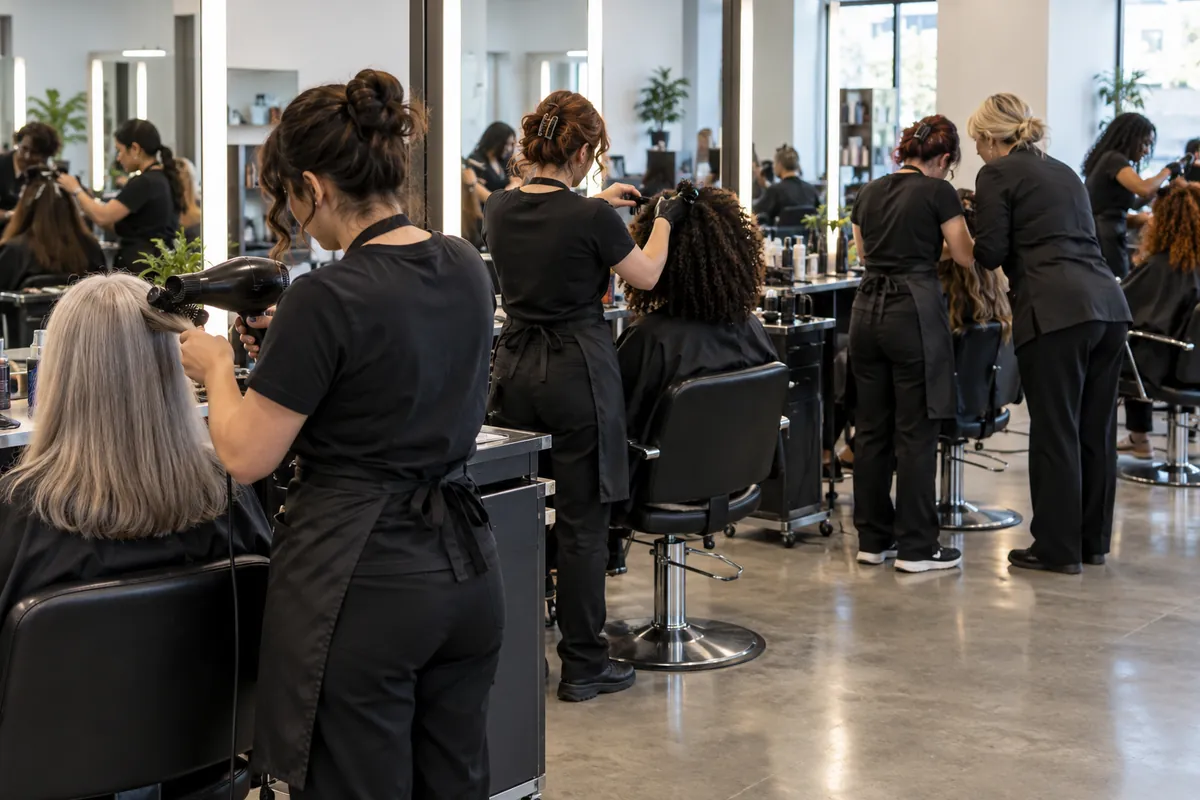
If I could check only one thing beyond state approval, it would be the student salon. This is where you turn classroom technique into working skill, and its value depends on how many real clients come through the door. A busy clinic floor gives you repetition, different hair types, different personalities, and practice at timing. A quiet one leaves students on mannequins, or sitting, while the clock counts hours that teach them little.
Visit unannounced, or at least at a time you choose, on a weekday afternoon and again on a Saturday if the school is open. Count the clients in chairs and the students without one. Watch how instructors behave. Are they moving between stations, checking sections, demonstrating corrections? Or are they gathered at the desk while students work alone? Ask how many students each instructor supervises on the floor, and compare the answer with what you see.
Ask how clients are assigned. In good schools, services are rotated so every student gets a mix of cuts, color, chemical services, skin, and nails. In weaker ones, confident students take the interesting clients and quieter students get shampoos. Ask whether there are minimum numbers of each service type to complete and how the school helps students who are behind on a category. Ask what students do when no clients are booked. A planned answer, such as assigned mannequin work with instructor feedback, shows a school that manages the time. A shrug shows one that does not.
Look at who the clients are. A school whose student salon draws a varied local clientele will give you experience with straight, wavy, curly, and coily hair, with gray coverage and lightening, with men's cuts and children. If every head on the floor looks alike, your training will have gaps. Ask directly how much instruction and practice the program gives to textured hair, since coverage differs widely between schools and it affects whom you can serve after graduation.
Curriculum depth and instructors
All approved schools teach the state minimum. The useful question is what they do beyond it and how well they teach the core. Ask for the curriculum outline with the time given to each subject. Ask how long students spend in the classroom phase before moving to clients and what they must demonstrate to move. Ask which advanced topics are included: clipper cutting and fades, textured hair, extensions, current color techniques, business skills. I describe the standard content in what you learn in cosmetology school, which gives you a baseline to compare against.
Ask about the textbook and learning system, since most schools build on one of a few standard published curricula. Ask how theory is taught: live lecture, video, online modules, or a mix, and whether any part is delivered by distance learning with state approval. Ask how often students are tested and what happens when someone fails a chapter test. A school with a clear routine for tutoring and retesting takes the written exam seriously.
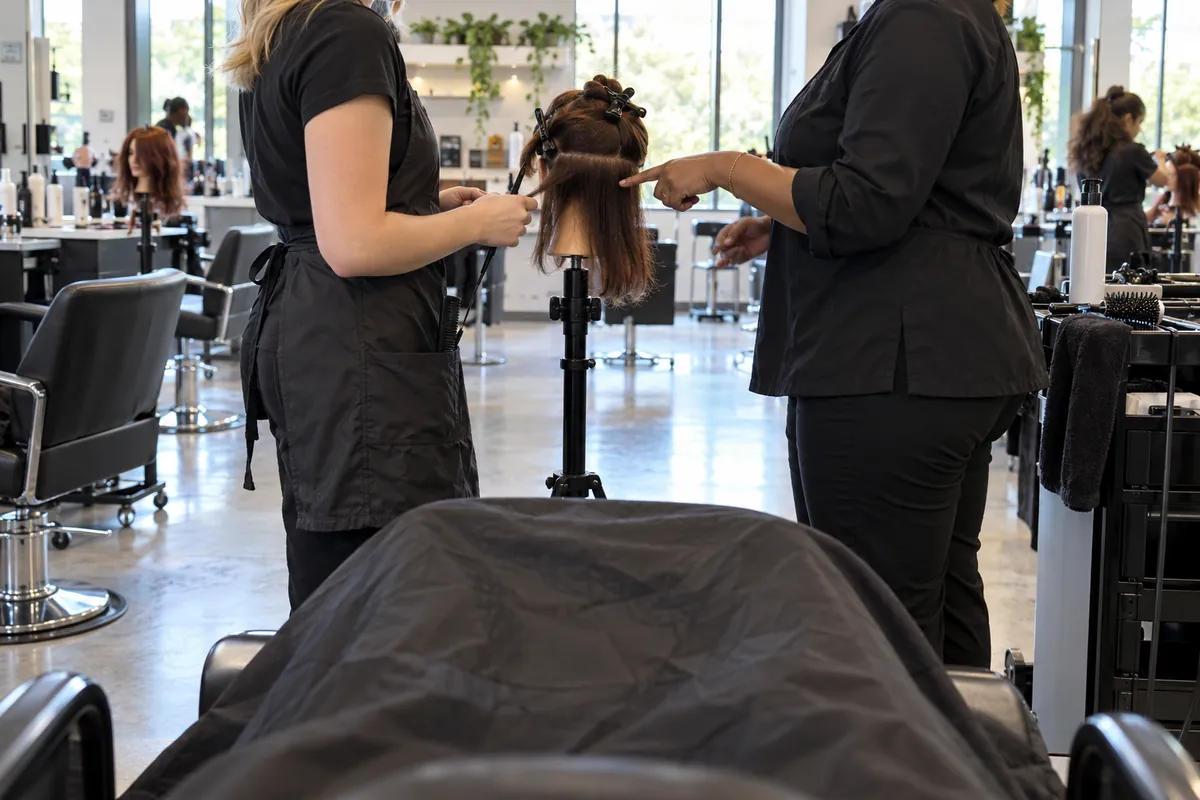
Instructors make or break a program. Ask how long each has taught, how long they worked behind the chair before teaching, and how recently they have taken advanced education themselves. High instructor turnover is a warning sign, because students end up with a series of substitutes and no continuity. Sit in on a theory class if the school allows it. Watch whether the instructor explains why a step is done as well as how, and whether students ask questions freely.
Ask specifically about state board preparation. A serious school runs timed mock practical exams where the state has a practical, graded against the examiner's criteria, and gives practice written tests in the format of the real one. It helps with the exam application and tells you the fees and timeline. Some schools include an exam review course in tuition and some charge extra. My guide to passing the cosmetology state board exam describes what good preparation looks like.
Class size is part of the same picture. Ask how many students start together in a group and how many are in the building at once. A large intake is fine when there are enough instructors, stations, and clients to go around, and it becomes a problem when students queue for a shampoo bowl or wait a long time for an instructor to check their work. Ask too what support exists for students who need extra help: tutoring for theory, additional practice sessions, or language support for students whose first language is not English.
Schedule, start dates, and attendance policy
A school you cannot attend consistently is the wrong school, however good it is. Ask which schedules are offered: full-time days, part-time days, evenings, weekends. Ask the expected completion time for each and whether you can switch tracks if your circumstances change. Ask when classes start. Some schools begin a new group every few weeks, and others only a few times a year, which can mean months of waiting.
Then read the attendance policy closely. Because the state counts your time, schools track it with a time clock. Find out how many absences are allowed, how missed time is made up, and what happens if you fall behind the contracted completion date. Many enrollment agreements include charges for time beyond that date. This is one of the most common unpleasant surprises for students, and it is always written in the contract for anyone who reads it.
Ask about leave of absence rules in case of illness, pregnancy, or a family emergency, and about holidays and scheduled closures. Consider the commute honestly, in bad weather and at rush hour, and check parking or transit. If you plan to keep a job, map a normal week hour by hour before committing to a track. The sibling guide cosmetology school while working full time covers how to make that realistic.
The kit and the true total cost
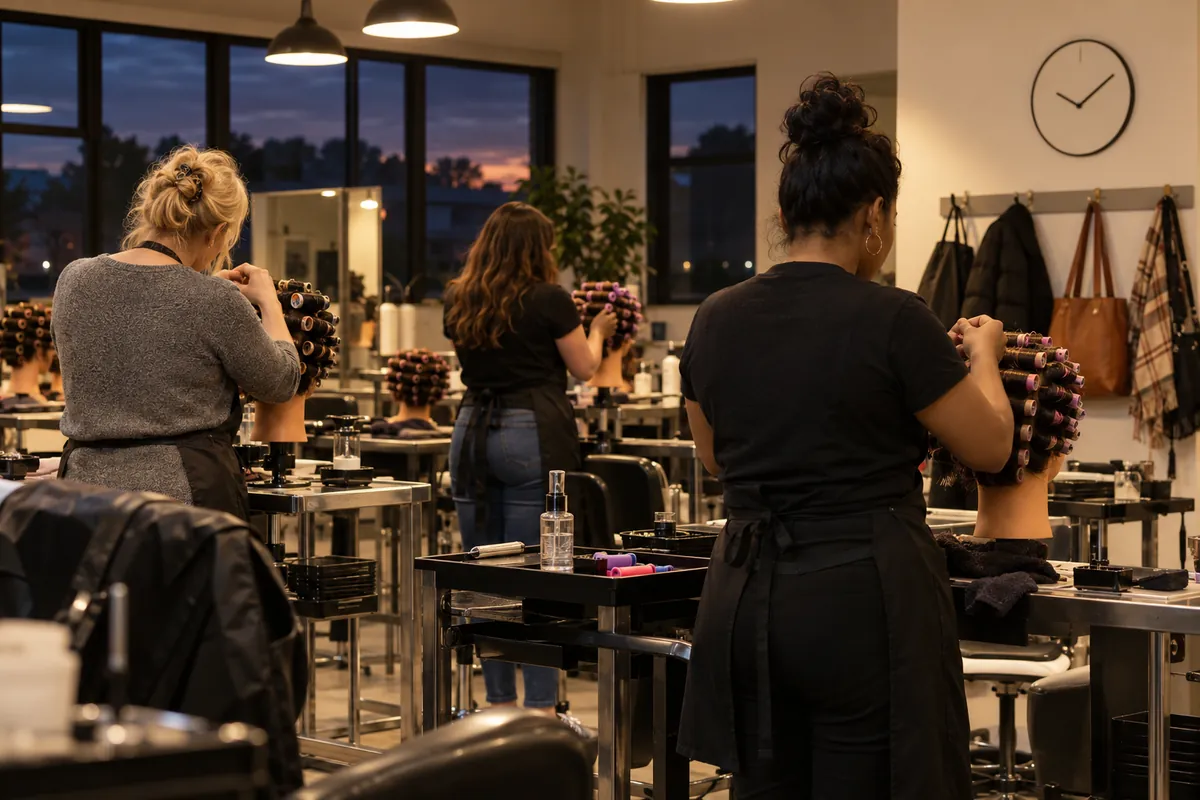
The student kit is the set of tools you use throughout the program: shears, combs, brushes, clips, a blow dryer and irons, mannequin heads, capes, nail and skin implements, and usually the textbook. Schools include it in different ways. Some fold it into tuition, some charge separately, and some require purchase through the school. Ask for the itemized kit list. Look at the quality of the shears and the thermal tools in particular, since you will rely on them daily and cheap ones make learning harder.
Ask how many mannequin heads are included and what replacements cost, because you will cut through several. Ask what consumables the school supplies on the clinic floor, such as color, lightener, and waving solution, and whether students ever pay for products used on clients. Ask whether you may bring tools you already own. Ask what you keep if you withdraw early and whether an opened kit can be returned. Kit charges are often non-refundable once issued.
For the cost comparison, ask each school for a single written sheet showing every charge from application to graduation: tuition, kit, books, registration, uniform, technology or lab fees, any charge for extra time, and any exam preparation or graduation fee. Add your state's exam and license fees from the board's site. Only then compare totals. The lowest tuition figure frequently does not belong to the lowest total. Schools that participate in federal aid also provide cost information through federal tools such as the net price calculator on their websites.
Contract terms that deserve a slow read
The enrollment agreement is a binding contract, and the catalog it refers to is part of it. Take both home. A reputable school expects you to. Read every page, and mark anything you do not understand so you can ask about it before signing. The terms that most often cause disputes later are listed below. If a friend or relative has experience reading contracts, ask them to look through it with you.
- Refund and withdrawal policy. How much you owe if you leave after one week, one month, or halfway, and how the amount is calculated.
- Cancellation period. How long you have after signing to cancel for a full or near-full refund, and which fees are kept.
- Contracted completion date and overtime charges. What you pay if you need time beyond the scheduled end.
- Kit and book charges. Whether they are refundable and under what conditions.
- Release of hours and transcripts. Whether the school will certify your hours if you transfer or owe a balance.
- Grounds for dismissal. Attendance, conduct, and academic standards that can end your enrollment.
- Transfer hours accepted. If you bring hours from elsewhere, the number credited, in writing.
- Dispute resolution. Any arbitration clause and the complaint process, including how to reach the state agency and accreditor.
- What happens if the school closes. Teach-out arrangements and where records would be held.
Refund terms deserve the most attention. State law, accreditor standards, and federal aid rules each influence how refunds are calculated, and the result is often that a student who withdraws partway owes more than they expected, especially when aid that was paid to the school has to be returned. Ask the school to walk you through an example: if I withdraw at this point, what would I owe? Ask for that example in writing.
If any promise made on the tour matters to you, such as a guaranteed schedule, a kit upgrade, or a number of transfer hours, make sure it appears in the written agreement. Verbal assurances from a representative who may no longer work there in six months are worth very little. If the school declines to write it down, assume it will not happen.

How to run your school visit
A tour is a sales presentation unless you turn it into an inspection. Arrive a few minutes early and watch the lobby. Notice whether students seem engaged or bored, whether the front desk is organized, and whether clients are greeted. During the tour, look past the decor to the working conditions. Are the stations clean? Are disinfectant containers filled and in use? Is there enough equipment for the number of students, or are people waiting for a shampoo bowl or a dryer?
Look at sanitation with a critical eye, because the school's habits become yours. Combs on the floor, hair left around stations, cluttered dispensaries, and dirty foot basins tell you what standard is being taught. State boards inspect schools as they do salons, and in some states the inspection results are public. A school that runs a clean floor is teaching the single most heavily tested subject on the exam every hour of the day.
Talk to students, preferably several at different stages, and preferably without staff standing beside you. Ask what surprised them, what they would change, how often instructors are available, and whether they would enroll again. Ask how many of the people who started with them are still there. If the school will not let you speak with students or observe the floor, ask why. Privacy during services is a fair concern, but a flat refusal to let prospects see normal operations is not a good sign.
Before you leave, book a service for yourself on another day. Sitting in the chair as a paying client lets you watch the whole process: the consultation, how the instructor checks the student's plan and work, how long it takes, and how the student handles a question. It costs little and shows you exactly what your own training days would look like from the other side.
Red flags
Some warning signs appear again and again in the stories of students who regret their choice. Pressure to enroll immediately is the first: a discount that expires today, a class that is supposedly almost full, a representative who discourages you from visiting competitors. A school with a good reputation fills its classes without urgency tactics. If you feel rushed, leave, and see whether the offer is still there next week. It usually is.
Promises about income and jobs are the second. No school can guarantee you employment or a particular level of earnings, and reputable ones do not try. Vague or shifting answers about cost are the third. If you cannot get a complete written list of charges, or the numbers change between conversations, expect that pattern to continue after you enroll. Reluctance to provide outcome figures, the catalog, or the enrollment agreement to take home belongs in the same category.
Other signs to weigh: an empty or chaotic clinic floor, frequent instructor changes, students doing cleaning or reception work for long stretches in place of training, poor sanitation, a pattern of similar complaints in online reviews, and any history of disciplinary action on the board's website. One negative review means little, since unhappy people write more than content ones. A repeated theme across many reviews and over several years means a good deal. I also treat any suggestion that hours can be signed off without attendance as an immediate disqualifier. It is illegal, and it puts your license at risk.
Chain and franchise schools are neither a red flag nor a guarantee. A recognized name tells you about the curriculum and branding. It tells you little about the instructors, the client flow, or the management at the particular campus you would attend, and those are what you will live with. Judge each location on its own evidence, the same way you would judge an independent school.
Comparing your shortlist
After two or three visits, put your notes side by side. A simple grid works well: one column for each school, and rows for state approval status, accreditation, total written cost, schedule fit, completion and pass rates with their source, clinic floor observations, instructor impressions, contract concerns, and commute. Filling it in reveals gaps. If a row is blank for one school, go back and ask. The effort of collecting comparable answers is small next to the commitment you are about to make.
Weight the rows according to your situation. For someone depending on federal aid, accreditation is essential. For a parent, schedule and attendance flexibility may decide it. For someone who learns best by doing, clinic floor volume should count the most. For someone anxious about tests, theory support and exam preparation matter. No school is best for everyone, and the right choice is the one that fits how you learn and what your life allows, at a cost you can carry.
If two schools are close, let the students and the local salons break the tie. Graduates who would enroll again, and employers who like to hire them, are the two endorsements that marketing cannot manufacture. And if none of the schools near you passes these checks, widen the search to public programs or a longer commute, or look at whether your state allows apprenticeship, which I compare in cosmetology apprenticeship vs beauty school.

Use the decision period to prepare
Choosing well takes a few weeks, and those weeks do not have to be idle. The early months of any program are heavy on theory: infection control, anatomy, hair and skin structure, chemistry. Students who meet that vocabulary for the first time in class often struggle to keep up, and students who have studied it ahead settle in and get more from the practical sessions. Beginning the theory before your start date also tells you whether the subject matter holds your interest, which is worth knowing before you sign a contract.
Our online cosmetology theory course is built for this stage and for exam review later. It teaches the knowledge base in a structured way that you can follow at your own pace. It is theory only. It does not count toward the in-person training hours your state requires, it does not replace an approved school or apprenticeship, and it does not issue a license. Used alongside a well-chosen school, it makes the classroom portion easier and the written exam less intimidating.
Use the time for practical preparation too. Gather your identification and education records. Complete the FAFSA if you intend to use federal aid. Arrange the schedule changes, childcare, and transportation your chosen track requires. Set aside a small reserve for supplies and slow weeks. Students who arrive on the first day with their paperwork, their finances, and their calendar in order have removed most of the common reasons people fall behind.

Your next step
This week, do three things. Look up your state's requirements and the board's list of approved schools. Choose three candidates, including at least one public program if any exists within reach, and verify each one's approval and accreditation yourself. Then book visits and take this checklist with you: outcomes, clinic floor, instructors, schedule, kit, total cost, and contract. Take the paperwork home, sleep on it, and compare. A careful month of research now protects the many months of training that follow, and it puts you in a school that prepares you for the license and for the first job after it.
State Requirements
State licensing guides
Hours, exams, fees, and the licensing board differ by state. Open your state for the current requirements.
Common Questions
FAQ
Start with current state approval, since only approved training counts toward a license. Then check accreditation if you need federal aid, completion and exam pass rates with their sources, how busy and well supervised the clinic floor is, instructor experience, schedule fit, the full written cost including kit and fees, and the refund terms in the enrollment agreement. Visit more than once and speak with current students.
Not for licensing purposes. What the state requires is that the school be approved or licensed by the state's regulating agency. Accreditation by an agency recognized by the US Department of Education is required for a school to offer federal student aid, and it adds outside oversight. If you need federal aid, choose an accredited school. Details on aid are in cosmetology school cost and financial aid.
Search your state board's list of licensed schools and confirm the specific campus and program are currently approved. Verify any accreditation claim in the accreditor's own directory or the Department of Education's database. Look for disciplinary actions on the board's site, read reviews for repeated themes, and ask local salon owners about the school's graduates. Do not rely only on what the school itself displays.
I will not give a single number, because rates are calculated in different ways and vary by state and year. What matters is that the school gives you a clear first-attempt rate for your program and campus, tells you how many graduates it is based on, and that the figure matches any data your state board publishes. Always view it together with the completion rate.
Not necessarily. Price reflects location, brand, facilities, and business model as much as teaching quality. A lower-cost public program can prepare students very well, and a costly private school can have a quiet clinic floor. Compare total written cost against outcomes, client volume, instructor quality, and contract terms. The best value is the school that gets you licensed and competent at a cost you can manage.
Treat it as a minor factor. A recognized curriculum or product line gives some structure and may offer extra classes, but the daily quality of your training depends on the instructors, the number of real clients, and how the campus is run. Two schools using the same brand can deliver very different experiences. Judge the location you would attend on its own evidence.
Usually, but it can be costly. The new school decides how many of your hours it will accept, the board may need to certify them, and your original contract's withdrawal terms determine what you still owe. Some schools delay releasing records when a balance is unpaid. Because transferring is difficult, careful research before enrolling is the better protection.
Your state board's website is the official source for required training, exam format, and approved schools. For a summary with links, open your state on our cosmetology licensing hub. Read it before your first tour so you can tell which parts of a school's presentation are legal requirements that every school meets and which are real differences.
Keep Reading
Related Guides


