Career
Electrolysis School Cost: What You Pay For and How to Save

Quick answer
Electrolysis school cost is a combination of tuition, a student kit, books and registration fees, state examination and license fees, and personal costs such as travel and reduced income during training. The total varies widely because states require different amounts of training. Ask each school for a written, itemized total, take exam and license fees from the state board, and plan for equipment after graduation.
Electrolysis school cost is not one price. It is a stack of separate charges: tuition, a student kit, books and registration, examination and license fees, and a set of expenses that never appear on the school's price sheet, such as travel, time away from paid work, and the equipment you need afterward. The total varies widely because the amount of required training varies widely between states, and tuition follows training length. Two students in different states can pay very different amounts for the same license title.
I am Aida Khazieva, a licensed electrologist and cosmetologist with more than twenty years in practice, and I help prospective students plan this budget regularly. You will not find dollar figures in this guide. Prices change, they differ by school and state, and a number I print today could mislead you next year. What you will find is every category you should expect to pay for, the questions that draw out the real total from a school, the costs people forget, and the legitimate ways to bring the figure down. With that list in hand you can collect current quotes and compare them fairly.
Why the cost varies so much
The first reason is state law. States that license electrologists each set their own required amount of in-person training. A school in a state with a longer requirement has to deliver more instructor time, more supervised practice, and more supplies per student, and its tuition reflects that. A school in a state with a shorter requirement can charge less for a complete program. Neither is overpriced or cheap on that basis alone. They are selling different quantities of training, each matched to the state it operates in.
The second reason is the school itself. Electrology programs are offered by small private schools dedicated to the field, by larger beauty schools that include it among other programs, and in some places by public or community institutions. Their cost structures differ. A small school with one experienced instructor and a few stations works differently from a large campus. Class size, the ratio of students to instructors, the age and variety of equipment, and local rent all feed into the price. So does what is bundled into tuition and what is charged separately.
The third reason is you. Whether you study full-time or part-time, live near the school or travel to it, keep working or stop, already own some supplies or start from nothing: these choices change your personal total far more than most people expect. That is why I ask students to stop looking for "the cost of electrolysis school" and start building "my cost." The first step is confirming what your state actually requires, which you can do in our electrolysis licensing hub.
Tuition: the largest line
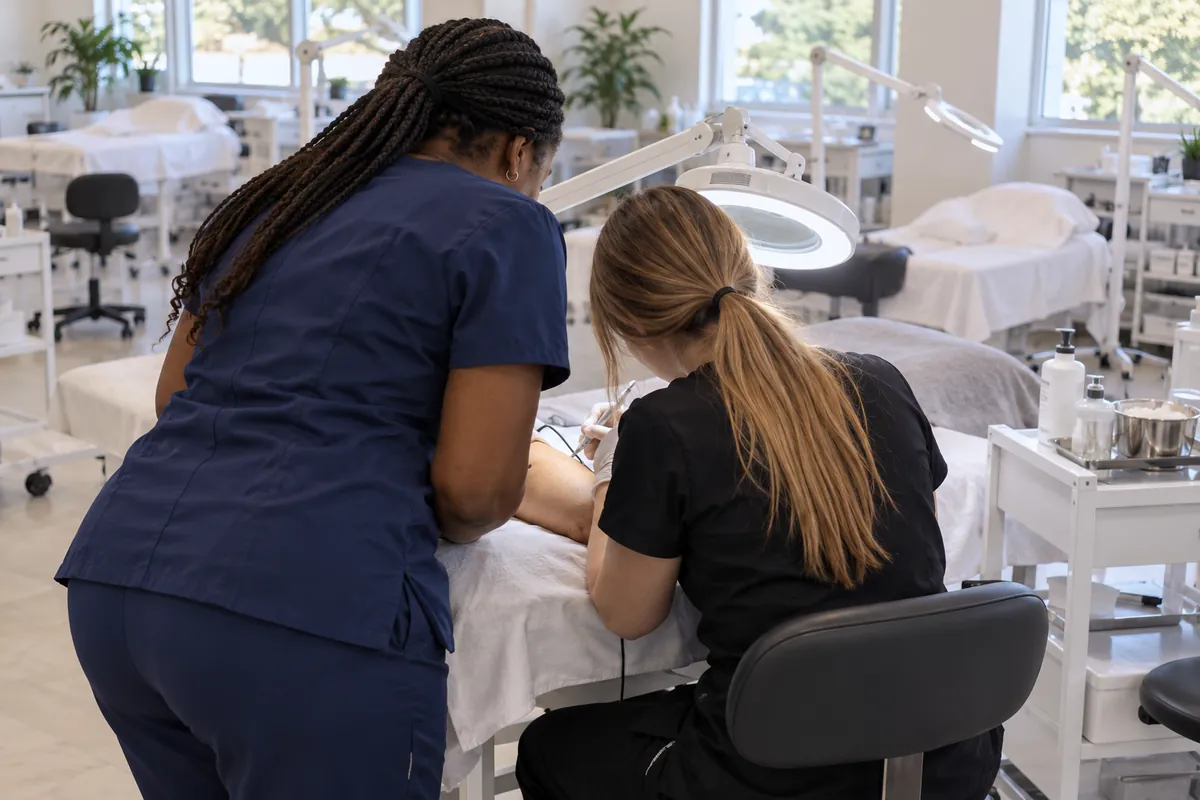
Tuition pays for instruction and supervised practice. In a good program that means classroom theory, demonstrations, and many hours at a station with an instructor correcting your insertions. It usually also covers use of the school's epilators, treatment beds, lamps, and sterilization equipment during training. Because electrolysis is taught at close range, one instructor can only supervise a limited number of students well. A program with close supervision costs more to run than one where students are left alone at their stations, and that difference is worth paying for.
When you compare tuition between schools, do not compare totals alone. Divide the tuition by the number of training hours to see what an hour of instruction costs at each school, then ask what that hour consists of. An hour with an instructor at your shoulder is not the same product as an hour of unsupervised practice or an hour of video. Ask how many students share an instructor during practical sessions, how many different epilators you will learn on, and how much of the program is hands-on work on live models.
Also confirm that the program length matches your state. A school may offer several programs of different lengths for students from different states, or a shorter program intended for people who already hold another license. Paying for a program that falls short of your state's requirement is the costliest mistake in this whole subject, because you will pay again to make up the difference. Get the program length, the state it is designed to satisfy, and its approval status in writing before you sign.
The student kit and supplies
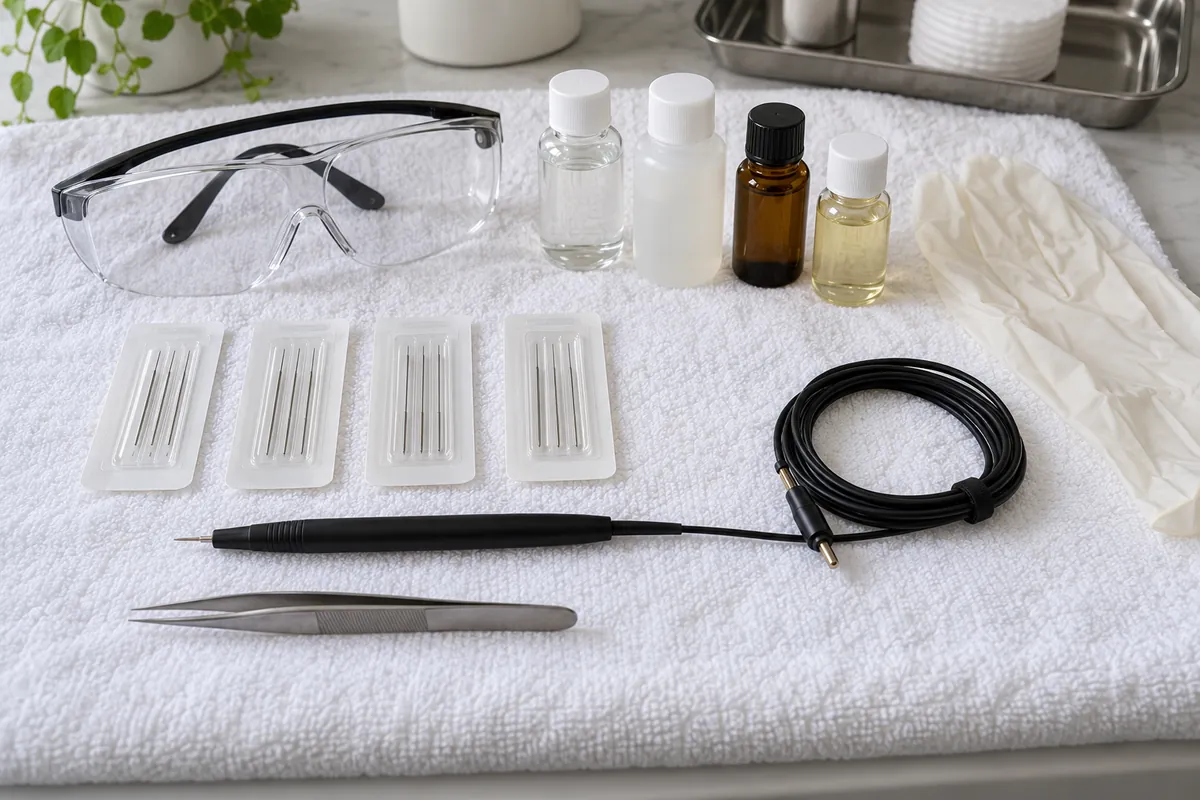
Most schools require a student kit. Its contents differ, but a typical one includes probes in several sizes, tweezers, a probe holder or handpiece compatible with the school's machines, protective eyewear, gloves, skin preparation and aftercare products, and sometimes a magnifier or loupes. Some schools sell the kit as a mandatory purchase. Others give you a list and let you buy items yourself. Some include the kit in tuition, and others add it as a separate charge, which is one reason headline tuition figures are hard to compare.
Ask for the itemized contents before enrolling. You want to know which items are consumed during training and need restocking, which you will keep and use in your own practice, and whether any are tied to a specific machine brand. Tweezers and good magnification are long-term tools, and quality matters. Consumables such as probes and gloves run out, and you may need to buy more partway through a longer program. A kit that looks inexpensive but covers only the first weeks is not a saving.
Be clear on one thing: a student kit does not usually include an epilator. The machine is the largest equipment purchase a new electrologist makes, and it normally comes after training, when you know which modality and which style of unit suit your hands. During school you use the school's machines. If a program requires you to purchase an epilator as a condition of enrollment, ask why, compare the price with the open market, and read our guide on how to choose an electrolysis machine before agreeing.
Books, registration, and administrative fees
Beyond tuition and kit there is usually a group of smaller charges. A registration or application fee is common and is often nonrefundable. Textbooks and printed materials may be included or billed separately. Some schools require a uniform or scrubs in a particular color. There can be fees for student identification, for liability coverage while you work on models in the school clinic, for technology or online learning platforms, and for the final transcript or certificate that the state needs to see.
None of these is large compared with tuition, but together they can add a meaningful amount, and they are the charges most likely to be missing from a quick quote over the phone. Ask the school for its enrollment agreement and catalog. In many states, schools are required to publish a catalog with all charges, the refund policy, and program details, and to give students a written contract. Read both documents in full. If a fee is mentioned in conversation but not written down, ask for it in writing.
Ask about charges that depend on how things go. Is there a fee for making up missed hours? Is there an extra charge if you take longer than the scheduled time to complete the program? What does it cost to repeat a failed internal test or to re-enroll after a leave of absence? Students rarely think about these at the start, when they are sure everything will go to plan. They become very relevant when a child is sick for a week or a job changes its shifts.
Examination and license fees
These charges are paid to the state or to a testing organization, not to the school, and they are easy to forget because they come at the end. In a licensing state you can expect an examination fee, sometimes split into separate written and practical portions, and a license application fee. Some states add a fee for a background check or fingerprinting, and some charge for an initial license separately from the application. The amounts are set by each state and change from time to time, so take them from the board's current fee schedule.
If your state uses a national written examination, the testing body sets that fee. Our guide to the IBEC certification exam explains how that exam fits into state licensing. A practical examination may also require you to bring your own supplies and a model, which can mean small extra costs and, sometimes, travel to a testing site in another city. Ask your school what recent graduates had to arrange for exam day.
Budget for the possibility of a retake. I do not say that to discourage you. Most well-prepared students pass. But a retake means a second fee and often a waiting period, and students who have budgeted to the last dollar find that stressful. Thorough theory preparation is the best protection. Then remember that a license is not a one-time expense. Renewal fees recur, and many states require continuing education to renew, which has its own cost. Those belong in your ongoing budget once you are working.

The costs that are not on the price sheet
In my experience the expenses that strain students most are the ones no school lists. The largest is usually income. If you reduce your working hours or leave a job to attend training, the pay you give up during that period is a real cost of becoming an electrologist, and for a longer program it can exceed tuition. Part-time study protects income and extends the calendar. Full-time study does the reverse. Work out both versions for your own situation before you choose a schedule.
Travel is the second. Electrology schools are scarce, and many students do not live near one. Daily commuting adds fuel, parking, or transit costs over the whole program. A distant school may mean temporary housing, meals away from home, and trips back to see family. Some schools offer intensive schedules specifically for traveling students, which shortens the stay and concentrates the cost. If you are in this position, finishing your theory at home first means every paid day on site goes to hands-on practice.
Then come the household costs: childcare during class hours, care for a relative, a second set of scrubs, a better pair of reading glasses or an eye exam, and sometimes small thank-you gestures for the friends and relatives who act as your practice models. Individually they are minor. Over many months they are not. I ask students to write them down honestly, because a budget that ignores them fails in the third month, and an interrupted program is the most expensive kind.
- Reduced income during training, from fewer work hours or unpaid leave.
- Commuting: fuel, parking, tolls, or transit for every training day.
- Temporary housing and meals if the school is far from home.
- Childcare or family care to cover class hours.
- Vision care: an eye exam and, if needed, glasses or loupes suited to close work.
- Restocking consumables when the kit runs low in a longer program.
- Make-up hours or schedule extensions if you miss days.
- Exam-day expenses: travel to the test site, supplies, and arranging a model where a practical exam requires one.
- A possible exam retake and its waiting period.

Costs that arrive right after school
Strictly speaking these are not school costs, but they fall due so soon after graduation that leaving them out gives a false picture. To begin working for yourself you need an epilator, a treatment bed or chair, a practitioner stool, a magnifying lamp or loupes, sterilization equipment that meets your state's standard, a supply of probes and consumables, and professional liability insurance. You also need a room, whether rented or at home, and any business registration or local permit that applies.
The size of this second budget depends on your route. If you join an existing practice as an employee or contractor, most of the equipment is already there and your startup cost is small. If you rent a furnished room in a salon suite, you bring your machine and supplies. If you set up your own studio from an empty room, you buy everything. Many new practitioners start modestly, with sound essentials and good optics, and upgrade as the calendar fills. That is a sensible approach, provided the sterilization side is never the place you economize.
I raise this here because students who spend their entire savings on training sometimes graduate unable to start. Plan the two budgets together. It is better to choose a slightly longer part-time route and finish with a reserve than to finish fast and then wait months to afford a machine. The sibling guide on how to start an electrolysis business goes through the setup list in order, and the guide on electrologist income factors explains how the early months of earnings usually look.
How to compare quotes from different schools
A fair comparison puts every school into the same template. The table below is the one I give students. Send the questions in the right-hand column to each school and record the answers in writing. A school that answers all of them clearly is showing you how it will treat you as a student. A school that avoids them is showing you that too. Price matters, but a complete and honest answer sheet matters more than the lowest figure.
| Cost category | Paid to | What to ask |
|---|---|---|
| Tuition | School | What is the total, how many training hours does it buy, and which state's requirement does the program satisfy? |
| Registration or application fee | School | Is it refundable, and under what conditions? |
| Student kit | School or outside supplier | Is it included in tuition, what exactly is in it, and may I source items myself? |
| Books and materials | School or bookseller | Which titles are required, and are used copies acceptable? |
| Uniform and other required items | Outside supplier | What must I wear and bring from day one? |
| Make-up and extension charges | School | What does it cost if I miss days or need longer to finish? |
| Examination fees | State or testing body | Which exams apply, and where can I find the current fee schedule? |
| License application | State board | What documents and fees does the board require after graduation? |
| Refund policy | School | How much is returned if I withdraw at different points in the program? |
Once the template is filled in, look at value as well as total. Ask each school how many students usually share an instructor in practical sessions, how many modalities and machine types you will train on, how the school sources models, and how its graduates do on the licensing exam. Visit if you can. The sibling guide on how to choose an electrolysis school covers the quality side in depth, and our school directory is a starting point for finding programs to contact.

Ways to pay for school
Many electrology schools offer payment plans that spread tuition across the program. Ask whether the plan carries interest or a fee, what happens if a payment is late, and whether the full balance becomes due if you withdraw. A plan with no finance charge is simply a convenience. A plan with finance charges is a loan and should be compared with other borrowing options. Get the schedule of payments in writing and check it against your household budget month by month.
Federal student aid is available only at schools that participate in the federal aid programs, and only for programs that meet the eligibility rules, which include a minimum program length. Many electrology programs are offered by small schools or are relatively short, so a good number do not qualify. Some do, especially programs within larger accredited institutions. Do not assume either way. Ask the school directly whether its electrology program is eligible for federal aid, and confirm the answer through the official federal student aid resources.
Other sources are worth a few phone calls. State and local workforce development programs sometimes fund vocational training at approved providers for eligible residents, including people who are unemployed or changing careers. Vocational rehabilitation agencies assist some people with disabilities. Veterans' education benefits can be used at approved schools. Some schools and professional associations offer scholarships. An employer that wants to add electrolysis to its services may contribute to training in exchange for a work commitment, in which case read that agreement with care.
Be cautious with private loans and credit cards. Borrowing to train can be reasonable, but this career has a gradual start, and repayment may begin before your calendar is full. Borrow as little as you can, and understand the terms fully. Whether education expenses have any tax consequences for you is a question for a qualified tax professional, since it depends on your circumstances. I mention it only so that you remember to ask and to keep every receipt.

Legitimate ways to lower the total
The most reliable saving is avoiding waste: paying once, for the right program, and finishing on schedule. That starts with confirming your state's requirement and the school's approval before enrolling. It continues with attendance. Every missed day risks make-up charges and pushes your completion date, which extends commuting, childcare, and reduced income. A schedule you can truly keep is worth more than a discount.
The second saving is preparing theory before you start. When you arrive already understanding skin and hair anatomy, the growth cycle, electricity, and infection control, your practical hours are used for practice, and you are much less likely to need an exam retake. Our online electrolysis theory course exists for that purpose, and it lets you test your interest in the subject before committing to tuition. To be precise about its limits: it does not count toward state-required in-person hours, and it is not a license. It makes the hours you pay a school for more productive.
Other savings are practical. Buy textbooks used if the edition is acceptable. Ask whether you may source kit items yourself, and compare prices, but do not downgrade tweezers or eyewear. Share travel with a classmate. If you must stay near a distant school, ask whether it knows of affordable short-term housing that other students have used. Choose an intensive schedule if it reduces your nights away. Delay buying an epilator until you have tried several in school. And keep your current job part-time for as long as the schedule allows.
Timing can save money as well. If a school offers several start dates, pick the one that lets you finish theory beforehand and that avoids the busiest season at your current job, so you are not forced to miss days. If you plan to travel, ask whether practical hours can be grouped into blocks, which reduces the number of trips. If you intend to work for an existing practice afterward, speak with possible employers before you enroll. Some will tell you which modality and equipment they use, which helps you avoid buying tools you will not need in your first year.
What I would not do is choose a school only because it is the cheapest, or choose a shorter program than your state requires because it costs less, or accept a certificate course in place of approved training in a licensing state. Each of those looks like a saving and turns into the largest expense on the list. For more on the order in which to study, see our guide on electrolysis school versus online theory first.
Refund policies and warning signs
Before you pay anything, read the refund policy. Life interrupts training more often than students expect, and the policy decides what a withdrawal costs you. Find out how much is returned if you cancel before the start date, in the first weeks, and at later points, and whether the kit and registration fee are excluded. Many states regulate private vocational schools and set minimum refund standards. The state agency that oversees such schools can tell you what applies and whether complaints have been filed against a school.
Certain signs should make you slow down. Be wary of pressure to enroll today to secure a special price. Be wary of any promise of a license, a job, or a specific income after graduation. Be wary of a school that will not give you its catalog and contract to read at home, cannot say plainly which state's requirement its program meets, or suggests that a short course or an online certificate lets you skip required training in a licensing state. No honest program makes that claim.
Online reviews are useful when read carefully and misleading when read quickly. Look for specific descriptions of instruction, supervision, and what happened after graduation, and be skeptical of both glowing and furious one-liners. Our guide on how to evaluate electrolysis course reviews shows what to look for. Better still, ask the school to put you in touch with recent graduates, and ask them what the program really cost in the end.
School cost is not treatment cost
A quick clarification, because searches mix the two. The price a client pays for electrolysis sessions and the price a student pays for electrolysis school are different subjects. If you arrived here wanting to know what treatment costs as a client, our guide on how much electrolysis costs explains what determines session pricing. This article is about the investment required to become the person on the other side of the treatment bed.
The two are connected in one way that matters for your planning. What clients pay per session in your area, together with how many hours you can treat and what your expenses are, determines how quickly your training investment is recovered. That is why I encourage prospective students to research local session prices and local practitioner availability at the same time as school prices. A larger investment can make good sense in a region with strong demand and few practitioners, and it deserves more caution where the market is crowded.
Electrolysis clients return for a series of sessions, so a practice fills gradually and then holds steady. For your budget this means the return on school cost arrives slowly at first and more reliably later. Plan for a building period after graduation during which income is partial. Students who include that period in their financial plan before enrolling handle it calmly. Students who expected immediate full income are the ones who feel the cost of school most sharply.

If your state does not license electrologists
Some states do not license electrologists as a separate profession. If you live in one, the state sets no required training for you to pay for, and the range of courses offered is wide, from thorough programs to very short workshops. The temptation is to pick the shortest and cheapest. I would resist it. The skill takes the same supervised practice to develop wherever you live, your clients' skin heals the same way, and insurers and referral sources will want to know how you were trained.
In that situation, the sensible budget is the one that buys full theory and substantial supervised hands-on practice, ideally from a program whose training would be recognized if you ever move to a licensing state. Many practitioners in these states also budget for the voluntary Certified Professional Electrologist credential offered through the national association. It is not a license, but it gives clients and physicians a recognized benchmark, and preparing for it gives your study a clear target.
Check local rules too. Even without a state electrology license, a city or county may require a business license, health department registration, or an inspection, each with its own fee. The sibling guide on whether you need a license to do electrolysis explains how the licensed and unlicensed situations differ in general terms and what to verify locally before you spend anything.
Your next step
Electrolysis school cost is the sum of tuition, kit, books and fees, exam and license charges, and the household costs of the training period, followed closely by the cost of setting up to work. You cannot know your figure from an article, but you can know it within a few days of focused effort. Look up your state's requirement in the electrolysis licensing hub, shortlist approved schools, send each the questions in the comparison table, and take exam and license fees from the board's own schedule.
While you wait for the replies, start on the theory. It costs little compared with tuition, it tells you whether the subject suits you, and it makes every paid practical hour count. Then build the spreadsheet, add a margin for delays, and choose the route you can finish without stopping. A complete, unhurried plan is the best cost control there is in this profession.
State Requirements
State licensing guides
Hours, exams, fees, and the licensing board differ by state. Open your state for the current requirements.
Common Questions
FAQ
There is no single figure. The total depends mainly on your state, because each licensing state sets its own required amount of training and tuition follows program length. It also depends on the school, on whether the kit and books are included, and on your own travel and living costs. Ask each school for a written, itemized total cost of attendance and check your state's requirement in the electrolysis licensing hub.
Tuition normally covers classroom instruction, supervised hands-on practice, and use of the school's epilators, treatment beds, lamps, and sterilization equipment during training. It may or may not include the student kit, textbooks, registration fee, uniform, and liability coverage for clinic work. State examination and license fees are paid separately to the state or testing body. Always ask for the enrollment agreement and catalog, which should list every charge.
Sometimes. Federal student aid is limited to schools that participate in the federal programs and to programs that meet eligibility rules, including minimum length, so many electrology programs do not qualify while some do. Ask the school directly and verify the answer. Also look into school payment plans, state workforce development funding, vocational rehabilitation, veterans' education benefits at approved schools, and scholarships from schools or professional associations.
The most significant is usually reduced income while you train. Others include commuting or temporary housing, childcare, restocking consumables in a longer program, an eye exam and suitable magnification, make-up hour charges if you miss days, exam-day travel and supplies, and a possible exam retake. Soon after graduation you will also need equipment, insurance, and a workspace unless you join an existing practice.
Usually not. A typical student kit contains probes, tweezers, a probe holder, protective eyewear, gloves, and skin care products for treatment. Students train on the school's epilators and buy their own machine later, once they know which modality and style of unit suit them. If a school requires you to purchase a machine through it, compare the price independently before agreeing.
It cannot reduce state-required in-person hours, so it does not shorten an approved program. What it can do is make those paid hours more productive and reduce the risk of exam retakes, because you arrive already knowing the theory. Our online electrolysis theory course is built for that role. It is preparation and review, not a substitute for hands-on training or a license.
Only if it also meets your state's requirements and gives close supervision. Compare the cost per training hour, the number of students per instructor in practical sessions, the equipment you will learn on, and how graduates perform on the licensing exam. A low price for a program your state does not accept, or for hours spent practicing alone, is not a saving. You would pay again to fix it.
That depends on the school's refund policy and on your state's rules for private vocational schools. Policies usually return a decreasing share of tuition the further into the program you withdraw, and registration fees and kits are often excluded. Read the policy before paying a deposit, keep a copy of the signed agreement, and contact the state agency that oversees such schools if you believe a refund was handled incorrectly.
Keep Reading
Related Guides


