Career
How to Start an Electrolysis Business: License to First Month
Quick answer
To start an electrolysis business, first hold the license your state requires and check whether your location needs its own facility license. Then choose a business structure, register locally, open a business bank account, pick a legal treatment room, buy a professional epilator and sterilization supplies, set time-based prices from your real costs, set up online booking, and get professional liability insurance before your first client.
Starting an electrolysis business is simpler than opening most beauty businesses and harder than it looks from the outside. Simpler, because the practice fits in one quiet room, needs one main machine, and does not depend on retail shelves or a team. Harder, because the work is regulated, the clients are trusting you with their faces, and income in the first months depends on details that school rarely teaches: where you set up, how you price your time, how you book, and what you say when a new client asks how long it will take.
I have run my own practice for many years and helped newly licensed electrologists open theirs, and the pattern is consistent. The people who struggle skipped a step or did things in the wrong order, such as signing a lease before checking the rules or buying an expensive machine before they had a single booking. This guide follows the order that works: license, a decision about what kind of practice you want, legal setup, location, equipment, pricing, booking, insurance, and a realistic plan for your first month. I keep to general principles on legal and tax matters, because the specifics depend on your state and city.
Step one: the license comes before the business
Everything else in this guide assumes you are legally allowed to perform electrolysis where you live. In most states that means holding a current electrologist license, earned by completing a state-approved program and passing the required exams. A few states regulate the work differently or not at all, and some attach additional conditions to how and where it may be performed. Do not rely on what another practitioner told you. Look up your own state on our electrolysis licensing hub and confirm the details with the regulator named there.
While you are reading the rules, look for two things beyond your personal license. First, whether your state requires a separate license or registration for the place where electrolysis is performed, often called an establishment, facility, or shop license. Second, whether there are rules about the room itself, such as a sink, flooring, a separate entrance, or sterilization equipment. These rules shape your choice of location, and learning about them after you have signed a lease is one of the most common and most expensive beginner mistakes.
If you are still in training or only considering the profession, this is a good moment to plan backward from the business you want. A structured electrolysis theory course can help you build the science and safety foundation and understand what the state exam covers. It does not replace the in-person hours your state requires and it does not license you. The business begins when the state says you may practice, not before, and no part of this guide should be read as a way around that.
Decide what kind of practice you are building
Before forms and equipment, answer a plain question: what do you want your working week to look like in a year? Some electrologists want a full-time solo practice. Some want a few focused days a week alongside another job or family responsibilities. Some would rather begin as an employee or contractor in an established practice, medical office, or spa and open their own room later. All of these are legitimate, and each one implies different costs, different risk, and a different pace of growth.
Think about who you want to serve, because electrolysis clients are not one group. Many practices are built on facial work for women with hormonal hair growth, including clients with PCOS and clients in or after menopause. Others see many transgender clients preparing for or continuing facial hair removal, which calls for long appointments and stamina. Some focus on finishing work after laser, treating the light, gray, or fine hairs that laser left behind. Your likely clientele affects your location, your appointment lengths, your hours, and even the table and magnification you buy.
Starting inside someone else's business first is worth serious thought. Working for an established electrologist, even part time, lets you build speed and confidence on a steady stream of clients while someone else carries the rent and the marketing. You will also see how a practice handles scheduling, records, and difficult conversations. The trade-off is lower earnings per hour and less control. Read any agreement carefully for clauses about client ownership and non-solicitation, since they affect what you can do when you leave. Booth rental, commission, and hourly pay are the common arrangements, and each divides risk and reward differently.
Write your decision down in a few sentences: the clients you expect, the days and hours you will work, where you will work, and what you need to earn for the practice to be worth it. This is the whole business plan a solo electrologist needs at the start. It does not have to be formal. It has to be honest, because every later choice, from rent to pricing, is tested against it.

Legal setup in general terms
Legal setup sounds intimidating and is mostly a sequence of ordinary registrations. The details differ by state, county, and city, so treat this section as a map of the territory, not as legal or tax advice. The typical pieces are a business structure, a business name, a tax identification number, state and local registrations, and a separate business bank account. An accountant or a small business attorney can walk you through your local version in a single meeting, and for most new owners that meeting pays for itself.
Business structure is the first decision. Many solo practitioners begin as sole proprietors because it is the simplest form. Others form a limited liability company, which is designed to separate business obligations from personal assets, though it does not shield you from responsibility for your own professional work. The right choice depends on your state's fees and tax treatment and on your personal situation. We compare the common options in our guide to business structure for independent beauty professionals, and it is a good thing to read before you talk to an accountant.
Next come name and registrations. If you operate under a name other than your own legal name, most places require you to register it. You will generally need a federal tax identification number for the business, and your state may require registration for state taxes. Whether services like electrolysis are subject to sales tax depends on the state, and retail products usually are treated differently from services. Many cities and counties also require a general business license. Your city or county clerk's website is usually the clearest place to see the local list.
Open a business bank account before you take your first payment. Mixing personal and business money is the bookkeeping mistake that causes the most misery at tax time, and it weakens the separation an LLC is meant to provide. Pay business expenses from the business account, deposit all client payments into it, and pay yourself from it. Set aside a portion of what you earn for taxes from the very first week, since nobody is withholding it for you. Your accountant can tell you how estimated tax payments work in your case.
Location options and how to choose
An electrologist has more location options than most beauty professionals, because the practice is quiet, clean, and compact. The four common choices are a room in your home, a room rented inside another business, a private salon suite, and your own leased commercial space. Each one has to pass the same three tests: it is legal under your state's facility rules and your local zoning, it is easy and comfortable for clients to reach, and its monthly cost fits what you can realistically earn in your first months.
| Option | Main advantages | Main cautions |
|---|---|---|
| Home treatment room | Lowest overhead, no commute, flexible hours | Zoning, state facility rules, HOA or lease limits, privacy and safety, insurance |
| Room inside another business | Shared reception and foot traffic, referrals from the host business | Dependence on the host's hours and reputation, written agreement needed |
| Private salon suite | Ready-to-use space, utilities often included, your own lock and schedule | Fixed weekly or monthly cost from day one, check sink and facility requirements |
| Leased commercial space | Full control, room to add staff or rooms later | Longer commitment, build-out costs, most risk for a new practice |
A home room keeps overhead low, which matters while your schedule is half empty. It also raises the most legal questions: zoning and home occupation rules, state facility requirements that may call for a separate entrance or a dedicated sink, landlord or homeowners association restrictions, and insurance. We cover that paperwork in detail in the home electrolysis studio legal checklist, so I will not repeat it here. I will add only that some clients love the privacy of a home studio and others are uneasy coming to a private residence, so think about who you serve.
Renting a room inside another business is my favorite starting point for many new electrologists. A dermatology or medical office, an esthetics studio, a hair salon, or a wellness practice already has clients walking through the door, and many of them have asked about permanent hair removal. You bring a service the host does not offer. Look for a room with a door that closes fully, good ventilation, access to a sink, and enough quiet for long appointments. Put the arrangement in writing: rent, hours of access, who books and who takes payment, and who owns the client records.
Salon suites sit in the middle. You rent a small private studio inside a building of independent professionals, usually with utilities included and your own key. It looks professional from day one and you set your own hours. The cost is fixed whether you have clients or not, so calculate how many treatment hours a week it takes just to cover the suite before you sign. A full commercial lease is rarely the right first move for a solo electrologist. For a side-by-side look at the trade-offs, see home studio versus renting a suite.

Equipment: what you need on opening day
The equipment list for an electrolysis practice is short, and that is one of the profession's real advantages. You need an epilator, a treatment table, an operator stool, magnification and light, probes and tweezers, a way to sterilize reusable instruments, and infection control supplies. Everything else is comfort and presentation. Resist the pull to furnish a spa. Clients come back because the hair is going away and their skin heals well, not because of the decor.
The epilator is the main purchase and the one beginners overthink. A reliable professional machine from an established manufacturer, offering the modalities you were trained in, is enough to start. If you learned on one brand, starting on the same or a similar machine shortens your adjustment period. A well-maintained used professional unit from a reputable source can be a sound choice, provided you can get it serviced and get parts. Never buy a consumer or hobby device for professional work. Our guide on how to choose an electrolysis machine goes through the decision in detail.
Spend where your body and eyes are involved. A treatment table that adjusts in height and tilts lets you position each area without twisting your own spine. A stool with good support and easy height adjustment is used every working minute. Magnification is personal: some electrologists work best with a lamp, others with loupes or a stereo microscope. Use what you trained with until you have income, then try alternatives. Good, cool, shadow-free light matters more than the room's general lighting, and clients appreciate not having a hot lamp over their face.
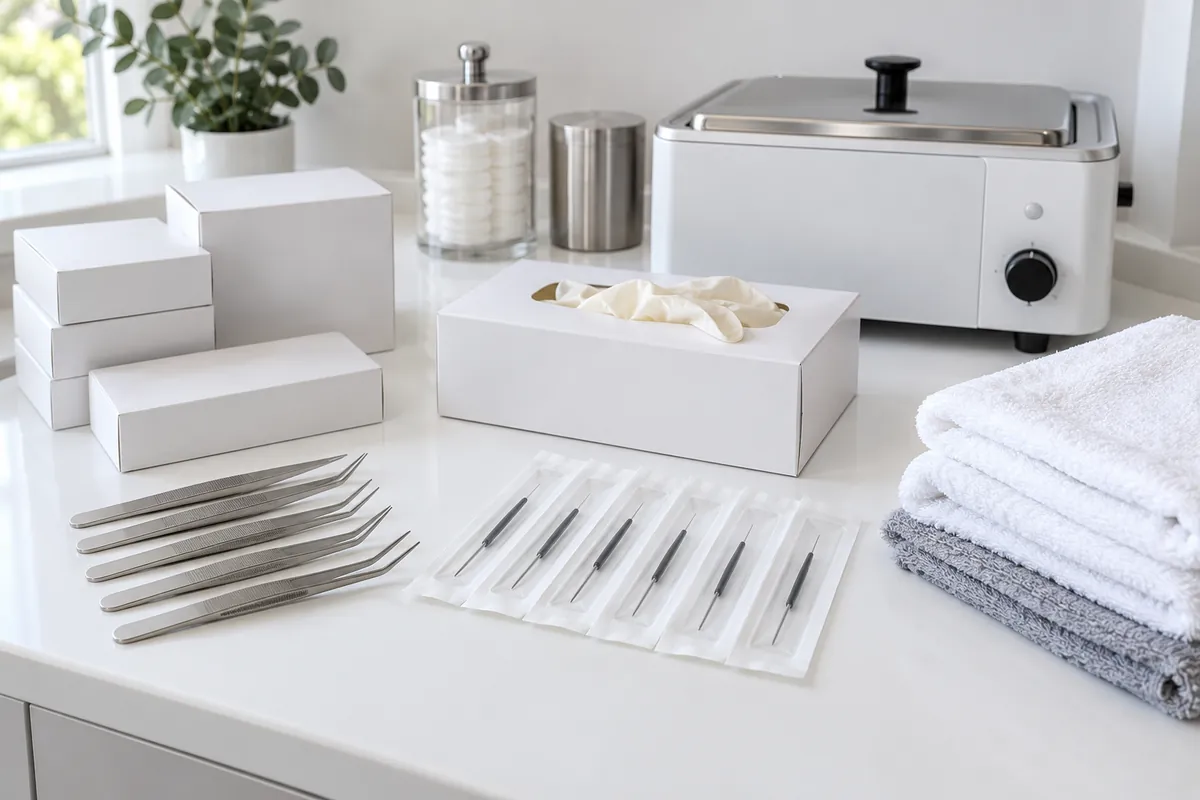
For supplies, start with what your first two months require and reorder as you learn your patterns. That means sterile disposable probes in the sizes you use most, several pairs of quality tweezers so one set is always sterilized and ready, gloves, table paper or washable covers, skin cleanser and antiseptic, aftercare product, cotton and gauze, surface disinfectant suitable for your setting, and a sharps container with a disposal arrangement that follows your local rules. Order probes in small quantities across several sizes at first, then adjust once you see which ones your clientele actually needs.
Setting up the room for safety and flow
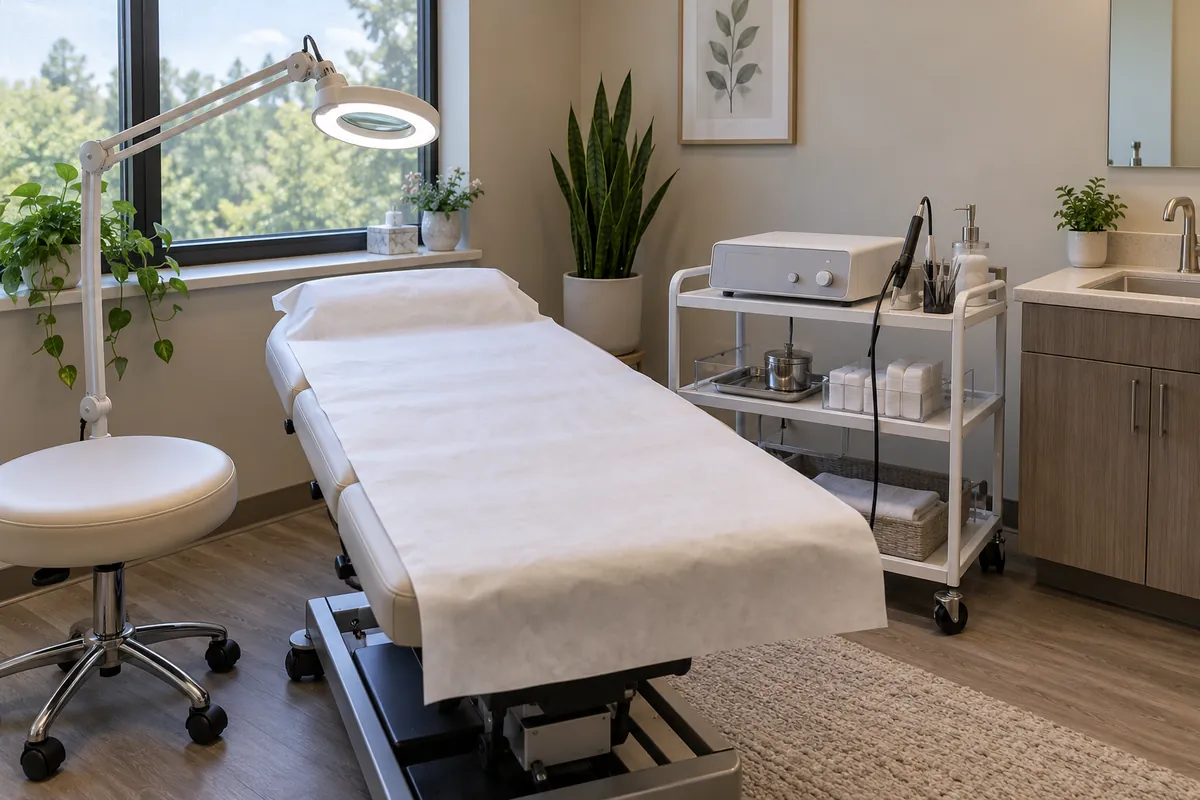
Lay the room out around the way a session actually moves. The client enters, sets down belongings, lies down, and stays for anywhere from a short touch-up to a long session. You sit at the head or side, with the epilator within easy reach of your non-dominant side, the probe holder cord free of tangles, and a clean tray for probes and tweezers. Used probes go straight into the sharps container without crossing the room. The fewer times you stand up or reach across the client, the smoother and safer the session.
Separate clean from used. Have one clearly defined clean area where sterile supplies are stored and opened, and another where used instruments wait for cleaning and sterilization. If your state or local health authority has specific requirements for sterilizer type, monitoring, or record keeping, follow them exactly and keep a log. Even where the rules are loose, keep the standard you were taught in school. A new practice has no reputation to absorb a skin infection, and a state inspector can arrive without an appointment.
Then think about the client's experience of the room. Electrolysis clients are often self-conscious about the reason they are there. A door that closes, a window covering, a place to sit and talk before lying down, a blanket, and a mirror for afterward all communicate respect. Keep the temperature comfortable, since people lying still get cold. Keep sound soft. None of this is expensive. It is the difference between a room that feels like a clinic you trust and one that feels like a spare room.
Pricing logic without guessing
Electrolysis is almost always priced by time, because the work is done follicle by follicle and no one can honestly promise how many hairs a session will clear. Most practices sell blocks of time, from very short appointments to an hour or more. I will not print prices here. They differ a great deal between regions and between a rural town and a large city, and a number in an article is out of date within months. What stays constant is the logic for arriving at your own.
Start with your costs. Add up everything the practice must pay each month whether or not anyone books: rent, insurance, software, phone, license renewals spread across the year, loan payments if any. Add the variable costs that rise with each client: probes, gloves, table covers, products, card processing. Then decide what you need to pay yourself, and remember taxes come out of that. Divide the total by the number of treatment hours you can realistically fill, not the hours you are open. In the first months that number is small, and it is better to see that on paper than in your bank balance.
Then look at your local market. Find the published rates of other electrologists within a reasonable drive and note what they charge for comparable appointment lengths. You are looking for the normal range, not a target to undercut. New practitioners often price at the bottom out of insecurity, and it backfires. Very low prices attract clients who leave for the next discount, signal inexperience, and leave you no room to pay for good supplies. A price near the middle of the local range, with honest communication that you are building your practice, is easier to sustain.
Structure matters as much as the rate. Shorter appointments usually cost more per minute than longer ones, because setup, cleanup, and sterilization take the same effort for every visit. Decide your shortest appointment and stick to it. Be careful with prepaid packages. They help cash flow and commitment, but check whether your state has rules about prepaid services, state your refund terms in writing, and never sell a package as a guarantee of a result. For the earning side of the equation, read electrologist income factors.

Booking, scheduling, and policies
Your schedule is the product you sell, so set it up deliberately. Choose an online booking system that lets clients see your availability, pick an appointment length, receive automatic reminders, and reschedule without calling you. Reminders alone reduce no-shows considerably in my experience. Make sure the system stores client contact details securely and lets you export your own data, because you may change software later and your client list belongs to your business, not to the app.
Offer a consultation as a distinct appointment type. A first visit should include a conversation about the client's hair growth history, health questions relevant to treatment, an honest explanation that electrolysis takes a series of sessions over time, and a short test treatment so they know how it feels and how their skin responds. Whether you charge for consultations is your choice. What matters is that new clients cannot book a long first treatment without one, since that is how misunderstandings about results and timelines begin.
Plan your hours around when your clients can actually come. Many electrolysis clients work standard hours and want early morning, lunchtime, evening, or Saturday appointments. A new practice that is open only on weekday mornings will fill slowly. You do not need to be open every day. Two or three well-chosen blocks that include an evening and part of a weekend often fill faster than five scattered days, and concentrated days are easier on your energy and your setup routine.
Write your policies before your first booking, while you are calm. Decide your cancellation notice period, what happens with late arrivals, how you handle no-shows, and whether you require a card on file. Put the policy on your booking page and in the confirmation message. Then apply it kindly and consistently. Regular electrolysis clients come every week or two for months, so the relationship matters, and a single waived fee with a clear reminder often buys more loyalty than rigid enforcement. Repeated no-shows are different, and a policy lets you address them without drama.

Insurance: what to ask for
Do not treat a single client without insurance in place. The core coverage for an electrologist is professional liability insurance, sometimes called malpractice insurance, which responds to claims that your treatment caused harm. General liability insurance covers accidents on the premises that are not about the treatment itself, such as a client tripping on a rug. Many policies sold to beauty and wellness professionals combine both. Professional associations in the field often offer members access to policies written for electrologists.
Read what the policy actually covers. Confirm that electrolysis is named as a covered service, not assumed under a general esthetics description. If you plan to add any other service later, check that it is covered before you offer it. Ask whether the policy covers you at the specific location where you work, and whether it follows you if you work at more than one. A landlord, suite operator, or host business will often require proof of insurance and may ask to be listed on the policy, which is a routine request.
Then look at the gaps. A homeowner's or renter's policy typically does not cover business activity or business equipment at home, so home-based practitioners should ask their insurer about an endorsement or a separate policy. Equipment coverage protects your epilator and other tools against theft or damage. If you ever hire, your state will have rules about workers' compensation. An independent insurance agent who works with small service businesses can explain these in plain language. I am describing categories here, not recommending a specific product.
Records, consent, and client communication
Good records protect the client and you. For every client, keep an intake form with contact details and relevant health history, a signed consent form that explains the treatment, its normal reactions, and aftercare, and a treatment note for each visit recording the date, area, modality, settings, probe, duration, and how the skin responded. If your state specifies what records an electrologist must keep and for how long, follow that. Store records securely, whether paper in a locked cabinet or software with proper access controls.
Health questions deserve care. You are not diagnosing anything, but you need to know about conditions and medications that affect treatment or healing, about implanted electrical devices, and about skin problems in the area. When something is outside your scope, the right move is to ask the client to check with their physician before you proceed. Keep your school notes on contraindications near your intake forms while you are new, and review them before each consultation.
Decide how you will talk about results before anyone asks. Clients will want to know how many sessions it will take, and the honest answer is that it depends on the area, the amount and type of hair, hormonal factors, previous hair removal methods, and how consistently they attend. Electrolysis is the method the FDA recognizes for permanent hair removal, and that is a strong, true statement. A promise of a specific number of sessions is not something you can stand behind. Clear expectations at the start are what keep clients for the full course of treatment.

The minimum visibility you need before opening
Marketing is a subject of its own, and I cover client acquisition separately. For opening day you need only a small set of basics so that people who look for you can find you and book. Claim a free business profile on the major search and map platforms, with your exact business name, address or service area, hours, phone, and booking link. Check your state's rules about what must appear in advertising, since some states require a license number or specific wording.
Put up a simple website, even a single page. It should say who you are, that you are a licensed electrologist, which areas and clients you treat, where you are, how to book, and what a first visit involves. Use your own words and real photos of your room. Do not post before-and-after photos you did not produce, and never invent reviews. A new practice with no reviews and an honest, clear page earns more trust than one with borrowed polish. Ask your earliest satisfied clients whether they would be willing to leave a review, and leave it at that.
Then tell people in person. Introduce yourself to nearby professionals whose clients ask about hair removal: estheticians, waxing specialists, laser clinics that cannot treat light hair, hair stylists, and medical offices that see patients with hormonal hair growth. Bring a card and a one-sentence description of what you do. Referral relationships are slow to start and extremely durable. One esthetician who trusts your work can send you clients for years.
Your first month, week by week
The first month is not about income. It is about proving that your systems work and beginning the relationships that will fill your schedule over the following months. Expect quiet days and plan to use them. Treat each empty hour as time to refine the room, practice your consultation wording, and meet neighboring businesses. Here is the rhythm I recommend to new owners.
- Week before opening: Run two or three full practice sessions on friends or family, from online booking to payment and aftercare instructions. Fix whatever felt awkward. Confirm licenses, insurance, and sterilization logs are in place.
- Week one: Open with limited, concentrated hours. Offer consultations generously. After each visit, complete your notes immediately and time your room turnover so your booking gaps are realistic.
- Week two: Follow up with every first-visit client about how their skin healed. Visit nearby businesses to introduce yourself. Adjust appointment lengths if you are consistently running over or under.
- Week three: Review your numbers: hours booked, rebooking rate, where each client heard about you, and supply usage. Reorder supplies based on real use, not guesses.
- Week four: Ask happy returning clients for a review. Compare income and expenses with your pricing calculation and note what needs to change. Set next month's hours based on when people actually booked.
The number I watch most closely in a new practice is rebooking. Electrolysis works through a series of regular treatments, so a client who books the next appointment before leaving is the foundation of your income and of their result. If first-time clients are not rebooking, look at the consultation: did they understand why a series is needed, was the treatment tolerable, did you suggest a specific interval and offer a specific time. Fixing rebooking does more for a young practice than any advertising.
Be patient with speed. New electrologists clear less hair per session than experienced ones, and some worry that clients will notice. What clients notice is whether the hair comes back and whether their skin looks good the next day. Work accurately, at a pace you can keep without sacrificing insertions, and speed will come with volume. Keep the habit of reviewing your own notes each week and asking what you would do differently. Small weekly corrections add up quickly in the first year.
Mistakes that slow new practices down
The first is overspending before opening. A long lease, a top-of-the-line machine, custom furniture, and a branding package can consume the savings that were supposed to carry you through the quiet months. Start with what is safe, legal, and comfortable, and upgrade from income. The second is the opposite error: saving on the things that touch clients. Cheap probes, a wobbly table, or poor lighting cost you in results and in comfort, and those are what clients talk about.
The third is vague boundaries. Friends who expect free treatments, clients who text at midnight, and appointments that run over because you are afraid to end them all erode a practice quietly. Decide your hours, your communication channels, and your policies, and state them warmly. The fourth is isolation. Solo practice is solitary, and new electrologists can go months without another professional seeing their work. Stay in touch with classmates, join a professional association, take continuing education, and find one experienced colleague you can call with a question.
The last is neglecting your own body. Long sessions bent over a magnifier strain the neck, shoulders, and eyes. Set the table and stool for each client instead of adapting your spine to them, take a short break between appointments, and build your schedule with recovery in mind. A practice that depends on one pair of hands needs those hands, and the back behind them, to last for decades.

Your next step
If you are already licensed, your next step is the unglamorous one: read your state's facility rules, choose a location that passes them, and get your registrations, bank account, and insurance in place before you buy anything large. Then set prices from your own costs, turn on booking, and open with concentrated hours. Track rebooking from the first week. A practice built in that order tends to grow steadily, because nothing underneath it has to be redone.
If you are not licensed yet, the business starts with training. Check your state's requirements on the licensing hub, find an approved program, and begin building your theory foundation now with our electrolysis course, which is designed to prepare you for the classroom and exam side of your training. It supports the in-person hours your state requires and never replaces them. For the school decision itself, see how to choose an electrolysis school.
State Requirements
State licensing guides
Hours, exams, fees, and the licensing board differ by state. Open your state for the current requirements.
Common Questions
FAQ
You need the professional license your state requires, any facility or establishment license that applies to your location, basic business registrations, a business bank account, and professional liability insurance. On the practical side you need a legal treatment room, a professional epilator, an adjustable table and stool, magnification and light, sterile probes, tweezers, sterilization equipment, infection control supplies, and a booking system. Check your state on the licensing hub first.
In many places you can, but it depends on your state's facility rules, local zoning and home occupation regulations, and any landlord or homeowners association restrictions. Some states have specific requirements for the room, such as a sink or a separate entrance. Your home insurance usually will not cover business activity without a change. Our home studio legal checklist lists what to verify before you set up.
It varies too much by state, city, and location type for a single figure to be useful. A room rented inside another business with a sound used epilator costs far less to open than a leased commercial space with new equipment. Build your own budget from real quotes: rent and deposit, machine, table, stool, magnification, sterilizer, opening supplies, insurance, licenses, registrations, and software. Keep a reserve for the slow first months.
Price by time. Add up your fixed monthly costs, your per-client supply costs, and what you need to earn after taxes, then divide by the treatment hours you can realistically fill. Compare the result with the normal range of published rates in your area and position yourself sensibly within it. Shorter appointments typically cost more per minute than longer ones. Avoid opening at the lowest price in town, because it is hard to raise later.
Not necessarily. Many solo electrologists begin as sole proprietors, and others form a limited liability company to separate business obligations from personal assets. An LLC does not remove responsibility for your own professional work, which is what liability insurance is for. Fees and tax treatment differ by state, so discuss the choice with an accountant. Our guide to business structures for beauty professionals explains the options.
The essential coverage is professional liability insurance that names electrolysis as a covered service. General liability, often bundled with it, covers accidents on the premises. Depending on your setup you may also need coverage for equipment, a home business endorsement, and workers' compensation if you hire. Landlords and host businesses commonly ask for proof of insurance. An independent agent who works with small service businesses can match coverage to your situation.
It builds gradually, because clients come for a series of regular sessions and referrals take time to start. The pace depends on your location, hours, local competition, and how well first-time clients rebook. I do not give a fixed timeline because none would be honest. Practices that open with evening or weekend availability, a clear consultation process, and steady local networking generally fill sooner than those waiting for clients to appear.
It can be a stable, low-overhead business, since one practitioner in one room with modest supplies can serve long-term repeat clients. How profitable depends on rent, pricing, how many hours you fill, and how long you can physically work each day. Nobody can promise you an income. For a realistic view of what drives earnings, read electrologist income factors and is electrology a good career.
Keep Reading
Related Guides


