Electrolysis
Electrolysis for the Neck: Permanent Neck Hair Removal Guide
Quick answer
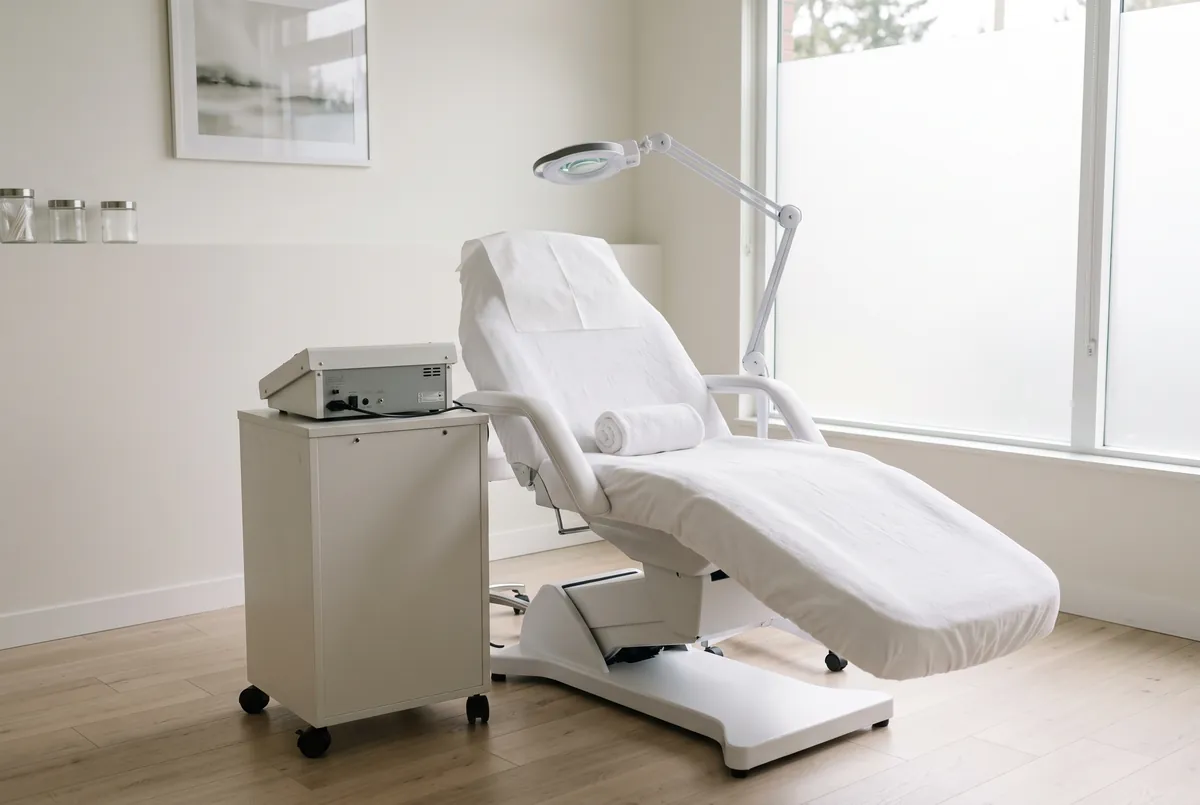
Electrolysis is the only method the FDA accepts for permanent hair removal claims, and it works under the jaw, on the front and sides of the neck, and on the nape. Between sessions, shave or trim and never tweeze. The front of the neck rubs against collars and necklaces, so aftercare matters. A sudden change in hair growth belongs with a physician.
Electrolysis for the neck is one of the requests I hear most often after the chin and upper lip, and it comes from very different people. Women come in with a scattering of coarse dark hairs under the jaw that they have tweezed for years. Men come in with a beard neckline that turns into razor bumps every time they shave. Others want the nape cleaned up so a short haircut keeps its shape. The neck looks like a small, simple area, but it is one of the more technical zones in electrology: the skin is thin and moves with every swallow, the hair grows in several directions, and the follicles are often bent from years of plucking. I have worked as a licensed electrologist and cosmetologist for more than twenty years, and I still slow down when I reach the neck.
This guide is written for two readers. If you are a client, it explains why neck hair appears, how the front, the sides, the area under the jaw, and the back of the neck differ, what a session feels like, how to look after the skin, and what to do with the hair between appointments. If you are an electrology student, the later sections cover positioning, stretch, insertion, and the mistakes I see most often on this area. Electrolysis is the only method the FDA accepts for permanent hair removal claims, which is why it suits a zone where people want the hair gone for good. Everything here is general education, not a diagnosis, and health questions belong with your physician or dermatologist.
Why Hair Grows on the Neck
Every person has follicles on the neck. Most of them produce vellus hair: short, soft, nearly colorless, and easy to overlook. What clients notice is terminal hair, which is thicker, darker, and deeper rooted. A follicle switches from one type to the other mainly under the influence of androgens, the group of hormones that includes testosterone. In men that switch is expected, and the beard normally extends some distance down the front and sides of the neck. In women the same follicles are present and simply stay quiet unless something makes them more responsive: a change in hormone levels, a follicle that is genetically more sensitive to normal levels, or both together.
Genetics explains a large share of what I see. Family background strongly shapes how much facial and neck hair is normal for a given person, how dark it is, and how early it shows. Many women with a few coarse hairs under the jaw have completely ordinary hormone levels and a mother or aunt with the same pattern. That hair is not a sign of illness. It is a cosmetic concern, and it is a perfectly reasonable one to want treated. I say this plainly in consultations because clients often arrive feeling that something is wrong with them, when the more accurate description is that their follicles are doing what their family's follicles have always done.
Hormonal patterns are the other large group. Polycystic ovary syndrome is a common reason for coarse hair along the jawline, under the chin, and down the front of the neck, often together with irregular periods, acne, or thinning scalp hair. Electrolysis treats the hair that exists, while the condition itself is managed by a physician, and the two work best side by side. I cover that combination in my guide to PCOS and unwanted hair. Menopause brings a different shift: estrogen falls, the balance tips toward androgens, and many women see new dark hairs on the chin and neck for the first time in their fifties or later. Pregnancy, some medications, and stopping or starting hormonal contraception can also change the picture.
There are situations where a visit to a physician should come before, or at least alongside, any hair removal. Hair that appears quickly over a short period, hair that spreads to the chest or abdomen at the same time, a deepening voice, marked scalp hair loss, missed or very irregular periods, or sudden weight change all deserve a medical evaluation. So does new growth that starts shortly after a new prescription. An electrologist cannot diagnose any of this and should not try. What I can do is notice a pattern, say so honestly, and suggest that the client talk to a primary care physician, a gynecologist, or an endocrinologist. Treating the hair is still possible while that conversation happens.
Front, Under the Jaw, Sides, and Nape: Four Different Areas
Clients say "my neck" as if it were one surface, but I plan it as four zones, each with its own hair and its own skin. The first is the submental area, the soft triangle under the chin and behind the jawbone. This is where most women's concerns begin, because chin hair rarely stops at the edge of the chin. I keep the chin itself brief in this article, since it has its own guide on electrolysis for the chin, but in real appointments the two are usually treated together. Under the jaw the hair tends to be coarse and deep, the skin is loose, and the shadow of the jawbone makes the hair hard to see without good positioning.
The second zone is the front of the neck, from below the jaw down to the collarbones, including the area over the larynx and the base of the throat. The skin here is among the thinnest that I treat, it sits over cartilage and moving structures, and it shows redness readily. In women the hair is usually sparse: single coarse hairs or a light sprinkling. In men this is the lower beard, and the hair can be dense, strongly curved, and prone to ingrowing. The front of the neck also rubs against collars, necklaces, and seat belts, which matters a great deal for aftercare.
The third zone is the sides of the neck, from below the ear down toward the shoulder. Hair here often continues from the sideburn and the angle of the jaw, and it commonly grows in a sweeping diagonal or in small swirls. The skin slides over a large muscle that stands out when the head turns, so the same patch of skin can be flat in one position and stretched over a ridge in another. Many women have a band of fine, pale hair on the sides that is noticeable only in certain light. I usually advise leaving truly vellus hair alone and treating only the hairs that are darker or coarser than their neighbors.
The fourth zone is the nape, the back of the neck below the hairline. The request here is different in character. It is less about hormonal growth and more about shape: a low or uneven hairline, stray hairs that grow down toward the shoulders, or the fuzz that reappears a few days after every haircut. Skin on the nape is thicker and generally more tolerant than on the throat, but the hair is dense and often grows from follicles sitting close together. Permanent work on a hairline needs a careful plan, because a line that looks right with one haircut should still look natural with another. I always agree the final shape with the client before the first hair is treated.

Why the Neck Is a Technically Demanding Area
The first difficulty is the skin itself. On the front of the neck it is thin, soft, and loosely attached to what lies underneath, so it shifts under the probe, moves when the client swallows or speaks, and pulses faintly near the large vessels at the sides. A follicle that was lined up perfectly a second ago can tilt as the skin slides. On a firmer area a small error in angle is forgiven. Here it means the probe meets the follicle wall instead of gliding down the canal, which the client feels as a prick and which makes the treatment less effective. Steady stretch with the free hand solves most of this, and it is the skill that takes students longest to learn.
The second difficulty is follicle shape. Most clients who come for electrolysis on the neck have tweezed, waxed, or threaded the area for years. Repeated pulling can leave follicles bent, hooked, or sitting at an unexpected angle, and the hair that grows from them may be thicker at the base than the hair that was first removed. A distorted follicle does not point where the visible hair points. The probe has to follow the canal by feel, sliding in without resistance, and stop when the natural depth is reached. Some of these follicles need more than one treatment before they stop producing, and that is a normal part of the work, not a failure of the method.
The third difficulty is direction of growth. On the cheek, hair mostly runs downward. On the neck it does not follow one rule. Under the jaw it often grows downward and backward. Lower on the throat it can grow upward toward the chin, so that two streams of hair meet in a line or a whorl. On the sides it sweeps diagonally, and on the nape it may fan out from the center toward each ear. In practice this means I read every small patch before I work on it, and I change my hand position many times during one appointment. A practitioner who holds one angle across the whole neck will miss a large share of follicles.
The fourth difficulty is everything around the follicle. Clients often ask about the thyroid, because the gland sits at the front of the lower neck. Electrolysis delivers a very small amount of energy at the tip of a fine probe inside a follicle in the skin, which is why the neck is routinely treated. Still, I ask about thyroid conditions, enlarged glands, nodules, and any neck surgery during the consultation, both because a physician's opinion is sensible in those cases and because thyroid problems can themselves change hair. Scars, raised moles, and skin tags are worked around. Hair growing from a mole is treated only with a physician's approval. Clients with a pacemaker or another implanted electrical device need clearance from their physician before any electrolysis.
Galvanic, Thermolysis, and Blend on the Neck
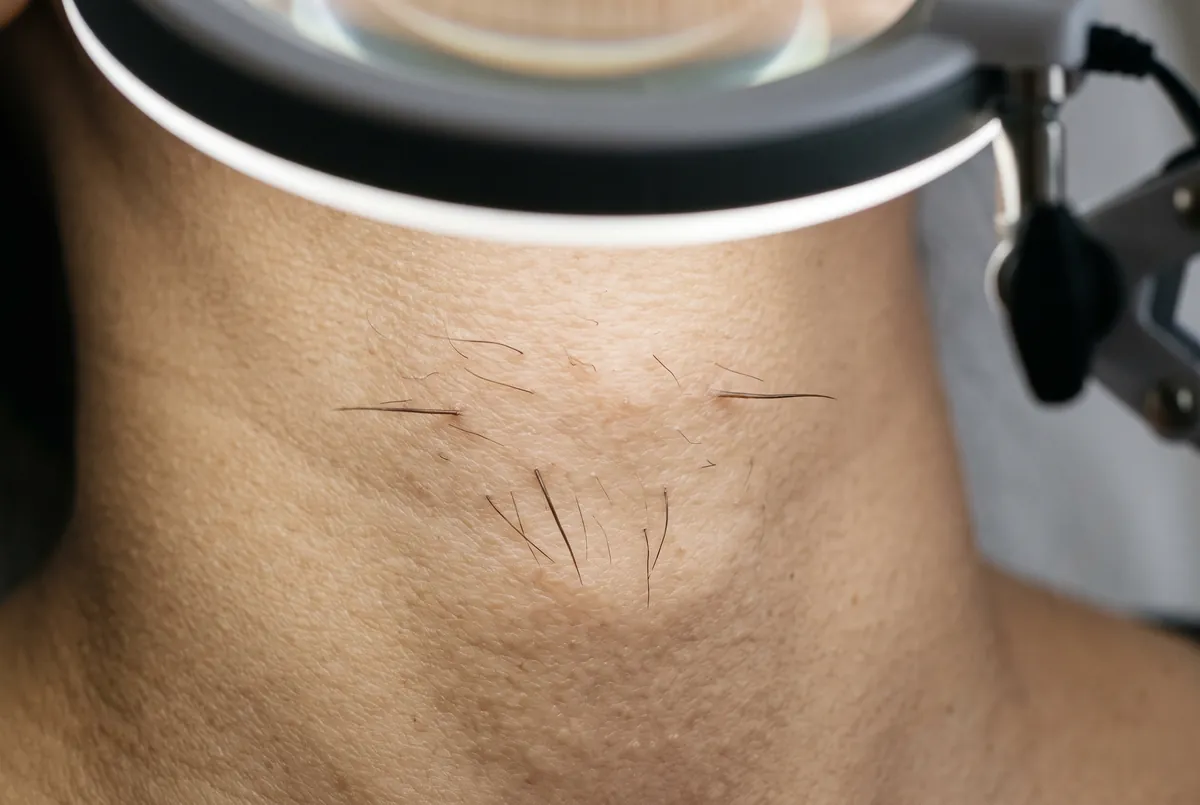
All electrolysis works the same way in outline: a sterile, hair-thin probe slides into the follicle alongside the hair, a measured current is released at the base, and the loosened hair is lifted out with tweezers without resistance. There are three ways of delivering that current. Galvanic electrolysis uses direct current to trigger a chemical reaction in the moisture of the follicle, producing a small amount of lye that breaks down the growth cells. Thermolysis uses a high-frequency current that produces heat. Blend combines both in the same insertion. All three are recognized forms of permanent hair removal, and the full comparison is in my guide to galvanic, thermolysis, and blend.
On the neck, the choice follows the hair and the skin in front of me. Fine to medium hairs in straight follicles respond well to thermolysis, which is quick and lets me clear a scattered area efficiently. Coarse, deep hairs, and especially follicles bent by years of tweezing, are where I more often choose blend or galvanic, because the chemical action spreads through a curved follicle in a way that heat alone does not always reach. On very thin skin at the front of the throat I work with conservative settings whichever modality I use, and I would sooner treat a stubborn follicle twice at a gentle level than once too strongly.

What a Neck Session Feels Like
A first appointment starts with a conversation. I ask about medical history, medications, hormonal conditions, skin reactions, and how the hair has been removed until now. Then I look at the neck under magnification in more than one head position, because hair that hides under the jaw with the chin down becomes obvious with the chin lifted. The skin is cleansed, a fresh sterile probe is fitted, and I usually treat a small test group of hairs first to see how the skin responds. The client lies on their back for the front and the area under the jaw, with the head turned for the sides, and face down or seated leaning forward for the nape.
The insertion itself should not hurt, because the probe enters an opening that already exists. What you feel is the current: a brief warmth, a quick sting, or a tingling that lasts a moment and stops. Sensation on the neck varies by zone. Many clients find the sides and the nape easy. The area directly under the jaw and the skin over the throat are usually more sensitive, and the line near the collarbones can feel sharp. Some people also notice an urge to swallow or a ticklish reflex when I work near the larynx. That is normal, and I simply pause while the client swallows and then continue.
Comfort is adjustable. Settings can be lowered, the area can be changed so that no single spot is worked for too long, and short breaks help more than people expect. Sensitivity also changes from day to day: tiredness, stress, and the days around a period often make the same treatment feel stronger. Tell your practitioner what you feel, since good feedback lets them fine-tune the work. If a treated hair is pulled out with a tug, say so, because a correctly treated hair slides free. Questions about numbing creams or pain relievers belong with a pharmacist or physician. I go through sensation in detail, area by area, in a separate guide on whether electrolysis hurts, so I will not repeat it here.
Straight after a session the neck is usually pink, slightly warm, and a little puffy around each treated follicle. On thin throat skin this can look more dramatic than it feels, and it tends to settle faster than clients fear. Small pinpoint scabs can form over the following days, more often after work on coarse hairs. They are part of healing and should be left to fall away on their own. How long redness lasts differs from person to person and from zone to zone, so I avoid promising a timetable. I do advise against booking a first neck session on the day of an important event.
How Sessions Are Planned, and Why Nobody Can Give You a Number
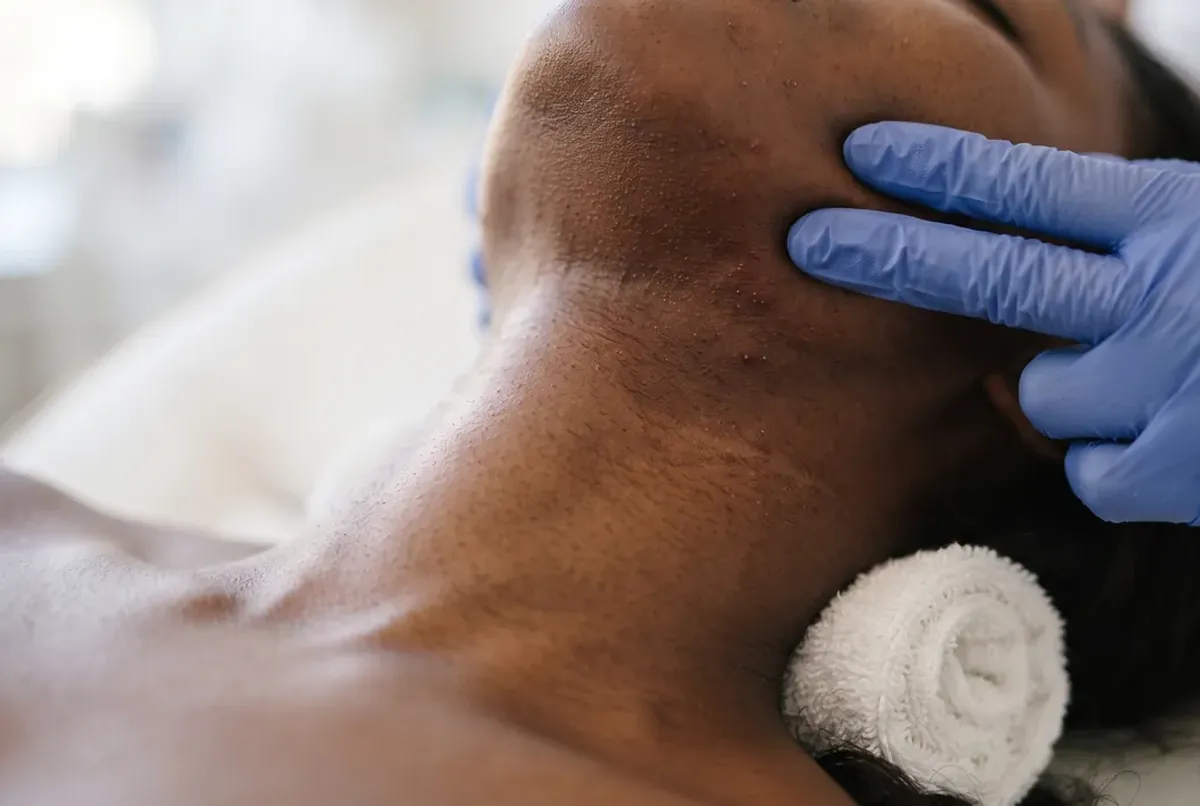
The most common question at a consultation is how many sessions the neck will take. I do not give a number, and I am wary of anyone who does before treating a single hair. Hair grows in cycles. At any moment only part of the hair on your neck is visible above the skin. Other follicles are resting and will produce a hair later. Electrolysis can treat only the hairs that are present on the day, so the work is repeated as new hairs surface. The total depends on how many follicles are active, how coarse the hair is, how distorted the follicles are, what is driving the growth, and how regularly the client attends.
What I can describe is the usual shape of the process. Early appointments are the longest and closest together, because there is the most hair to clear and because hairs from previously tweezed follicles keep arriving on their own schedule. As the area thins, appointments become shorter and the gaps between them widen. Toward the end, a client may come in only now and then for a few late hairs. Progress on the neck is rarely a straight line. A stretch of visible improvement can be followed by a week when a new group of hairs appears. That is the hair cycle showing itself, not treated follicles coming back.
Hormones influence the plan. When growth is driven by an active hormonal condition, new follicles can be recruited while existing ones are being cleared, so the work takes longer and occasional maintenance later is realistic. A client whose condition is being managed medically generally has a more predictable course. I also plan around the client's life: the front of the neck is visible, so some people prefer shorter, more frequent sessions that leave less redness, while others want long sessions to clear as much as possible at once. Both approaches work. Consistency matters more than session length, and long unplanned gaps are what stretch a treatment plan the most.
Beard Neckline, Ingrown Hairs, and Razor Bumps on the Neck
For men, the neck is the classic site of razor bumps. Beard hair on the lower neck is often curly and grows at a low angle, close to the skin. When it is shaved very short, the sharpened tip can curl back and pierce the skin beside the follicle, or fail to leave the follicle at all and grow sideways under the surface. The body treats that hair as a foreign object and builds an inflamed bump around it. Shaving over those bumps cuts them, and the cycle repeats. Collars and ties add friction on exactly the same strip of skin. Dermatologists call the condition pseudofolliculitis barbae, and it is especially common in men with tightly curled hair.
Electrolysis addresses the cause directly: a follicle that no longer produces a hair cannot produce an ingrown one. Many men do not want to remove the beard, only the part that gives them trouble. The usual plan is to set a permanent neckline, clearing everything below a line agreed in advance, so the lower neck no longer needs a razor at all. Others want only the worst clusters thinned. Because the result is permanent, I ask clients to think carefully about where the line sits and to consider how it will look with both a short and a fuller beard. The broader picture, including beard shaping and body areas, is in my guide to electrolysis for men.
Women get ingrown hairs on the neck too, most often under the jaw after years of tweezing. A plucked hair can break below the surface, or the regrowing hair can be too weak to push through and coil under the skin instead. Clients then dig for it with tweezers or a pin, which leaves dark marks and sometimes small scars. Treating an area with active ingrown hairs calls for patience. I work on the hairs I can reach cleanly and leave inflamed or infected bumps to calm down before going near them. A bump that is hot, painful, growing, or draining needs a physician, not an electrologist.
One practical change helps almost every client with razor bumps while treatment is under way: stop chasing a perfectly close shave on the neck. An electric trimmer that leaves the hair slightly above skin level removes the sharp tip that causes re-entry. Shaving in the direction of growth, with a clean blade and without stretching the skin, has a similar effect. These habits will not cure the problem, but they keep the skin calm enough to treat comfortably. I go into the mechanics of trapped hairs and how electrolysis resolves them in my guide on electrolysis for ingrown hairs.
Skin of Color and Pigmentation on the Neck
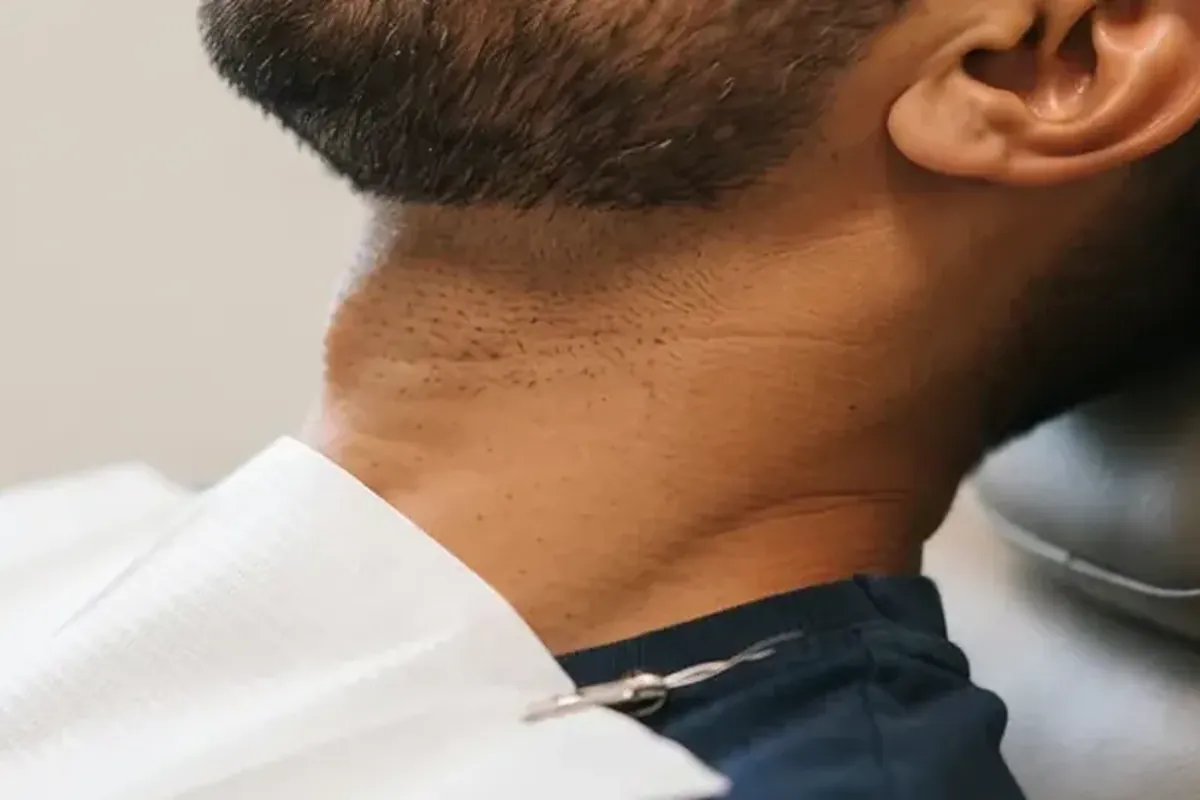
Electrolysis works on every skin tone and every hair color, because it targets the follicle directly and does not depend on the contrast between dark hair and light skin. That makes it a strong option for clients with brown and black skin, and for anyone with gray, red, or blond hair on the neck. The caution with deeper skin tones is not about whether the method works. It is about how the skin heals. Skin with more melanin is more inclined to respond to any irritation with a darker mark that can take a long time to fade, and some people are prone to raised scars.
The neck is already a place where pigmentation shows. Friction from collars, old marks from tweezing and ingrown hairs, sun exposure on the sides of the neck, and fragrance applied to the throat all leave their trace. Before I start on a client with deeper skin, I look at how earlier injuries have healed, ask about any history of keloids or thickened scars, and treat a small test area first. Then I wait to see how that area settles before planning a full session. I use conservative settings, space insertions so that neighboring follicles are not treated back to back, and keep sessions on one patch short.
Aftercare carries more weight here than on any other skin type. Picking at scabs, scrubbing, and unprotected sun are the three things most likely to turn a temporary dot into a lasting mark. Existing dark patches on the neck deserve attention too. Velvety, darkened skin in the folds of the neck can be linked to insulin resistance and is worth mentioning to a physician, and no cosmetic treatment should be used to cover it up. Lightening products are a question for a dermatologist, not something to start on freshly treated skin. My guide to electrolysis for dark skin covers settings, test patches, and healing in more depth.

Aftercare That Is Specific to the Neck
General aftercare rules apply to the neck as they do everywhere: keep the area clean, keep your hands off it, and let any tiny scabs fall away untouched. The complete routine is in my electrolysis aftercare guide, and your own practitioner's instructions come first. What makes the neck different is how much touches it during an ordinary day. Clothing, jewelry, hair, fragrance, sweat, and sun all meet on this small strip of skin. Most of the irritation I see after neck sessions comes from one of those sources, not from the treatment.
Friction comes first. A stiff shirt collar, a tie, a turtleneck, or a wool scarf rubs directly over freshly treated follicles, and on the front of the throat that rubbing repeats with every turn of the head. For the first day or two, an open neckline or a soft, loose, clean cotton fabric is the kindest choice. If you need a scarf in cold weather, pick a smooth one that has just been washed. Necklaces and chains are best left off until the skin has calmed, since metal both rubs and traps sweat. Long hair is another quiet irritant, especially hair carrying styling products, so tie it up and away from the neck after a session. Seat belts and bag straps deserve a thought as well.
Perfume is the mistake I see most. The neck is where people habitually spray fragrance, and they do it without thinking on the morning after a session. Alcohol and fragrance compounds on open follicles sting, and fragrance on irritated skin followed by sunlight is a well-known route to dark marks. Apply perfume to clothing or to the wrists until the neck has fully settled. The same caution applies to aftershave, scented body lotion, self-tanner, hair spray that drifts onto the neck, and strong active skincare such as exfoliating acids and retinoids. A plain, fragrance-free product recommended by your practitioner is enough.
Sun and sweat complete the list. The sides and back of the neck catch a great deal of sun, and people rarely think to protect them. Freshly treated skin marks more easily, so shade, a collar worn loosely, or a hat with a brim are useful at first. Ask your practitioner when it is appropriate to start applying sunscreen to the treated skin. Sweat collects in the creases of the neck and under the jaw, and sweat mixed with friction encourages small pimples around the follicles. I suggest keeping hard workouts, saunas, steam rooms, and swimming pools for another day. If you do sweat, rinse with lukewarm water and pat dry, without rubbing.

Between Sessions: Shave or Trim, Never Tweeze
What you do with the hair between appointments affects the result more than most clients realize. The rule is simple. You may cut the hair at the surface, by shaving or by trimming with small scissors or an electric trimmer. You should not pull it out by the root, which rules out tweezing, waxing, threading, sugaring, and epilator devices. Electrolysis needs a hair in the follicle to guide the probe and to show that the follicle is in an active phase. A tweezed follicle is empty on the day of your appointment, so it cannot be treated, and it will produce its hair later, on a schedule of its own.
Tweezing also works against the long-term goal. Repeated pulling is one of the reasons neck follicles become distorted in the first place, and it is the main source of ingrown hairs and dark marks under the jaw. Many women tell me they are afraid to shave the neck because they have heard it makes hair thicker or darker. It does not. Shaving cuts the hair straight across, so the blunt end feels coarser for a few days than a tapered natural tip, but nothing changes in the follicle. The number of hairs, their color, and their rate of growth stay the same.
The practical detail is timing. The hair has to be long enough for the practitioner to see it and grasp it with tweezers after the current is applied, so stop shaving or trimming ahead of your appointment. How far ahead depends on how fast your hair grows, and your practitioner will tell you what length they prefer. For clients who feel uncomfortable with visible hair on the front of the neck, trimming close with scissors is often easier to live with than shaving, and a high neckline or a light scarf covers the last few days. My guide on shaving between electrolysis sessions explains the timing and the technique.
| Between sessions | Effect on the follicle | My advice for the neck |
|---|---|---|
| Shaving | Cuts the hair at the surface, follicle untouched | Fine. Use a clean blade, shave with the direction of growth, and stop ahead of your appointment |
| Trimming with scissors or a trimmer | Cuts the hair just above the skin, follicle untouched | Best choice for sensitive skin and for anyone prone to razor bumps |
| Tweezing or threading | Removes the hair by the root and can distort the follicle | Avoid completely, including the single hair that annoys you |
| Waxing or sugaring | Removes many hairs by the root at once and stresses thin skin | Avoid on any area being treated with electrolysis |
| Depilatory creams | Dissolve the hair at the surface, can irritate skin | Not on recently treated skin. Ask your practitioner before using them at all |
| Bleaching | Lightens the hair, can irritate skin | Makes hairs harder for the practitioner to see. Discuss it first |

How to Choose a Practitioner for Neck Work
Start with credentials. Electrolysis is regulated state by state in the United States: many states license electrologists, the training and examination requirements differ from one state to the next, and a few states have no dedicated electrology license. Check what your state requires and confirm that the practitioner holds whatever license or registration applies. The state-by-state details are in the electrolysis licensing hub. A license is the minimum. Beyond it, ask how much of their daily work is facial and neck hair, since a practitioner who mostly treats large body areas may be less practiced on thin, mobile skin.
A proper consultation tells you a great deal. A careful practitioner asks about your health, medications, hormonal history, and how you have been removing the hair. They examine the neck in good light under magnification, explain which modality they intend to use and why, and offer to treat a small test area. They open a new sterile probe in front of you, wear gloves, and work in a room that is visibly clean. They talk about hair cycles and realistic expectations without quoting a guaranteed number of sessions, and they give you written or clearly explained aftercare. If you raise a medical concern, they refer you to a physician and do not offer a diagnosis.
Pay attention during the first treatment as well. Insertions should feel smooth, without a sharp prick before the current. Treated hairs should slide out without a tug. The practitioner should reposition your head several times and stretch the skin with their free hand, since a neck cannot be treated well from one angle. Afterward, pinkness and mild swelling are expected. Blistering, crusting over a wide area, or pitted marks once the skin has healed are not, and they are a reason to raise the issue with the practitioner and to see a dermatologist if the skin does not recover. You are entitled to change practitioners if something feels wrong.

Technique Notes for Electrology Students
If you are training, expect the neck to feel awkward long after the legs and forearms feel comfortable. Begin with positioning, since a good position does half the work. For the area under the jaw, have the client lie on their back with the chin lifted and a small roll under the neck, then turn the head away from you to open one side at a time. For the front of the throat, a neutral or slightly extended position is enough. Too much extension pulls the skin tight over the cartilage and makes the client uncomfortable. For the sides, turn the head and watch how the large muscle rises under the skin. For the nape, seat the client leaning forward onto a support, or have them lie face down with the forehead resting on a folded towel.
Stretch is your second tool. Use two or three fingers of the free hand to hold the skin taut on either side of the follicle, firmly enough that it does not slide and gently enough that you do not flatten the follicle or change its angle. On loose skin under the jaw, a three-way stretch, with two fingers of one hand and the side of the working hand as the third point, gives the most stable field. Re-establish the stretch for every insertion. Ask the client to tell you when they need to swallow, and lift the probe away from the skin while they do. Never rest your weight on the front of the throat.
Read direction before you insert. Look at the hair from the side under magnification, and note where it leaves the skin and which way it leans. Insert along that line, at the same angle as the hair, with a light hand. The probe should glide. If you meet resistance, stop, withdraw, and reassess. Do not push through. On previously tweezed follicles, expect the canal to curve and the depth to vary from one follicle to its neighbor. The hair you have just released is your best teacher: look at how long its root is and whether it is straight or hooked, and adjust the next insertion accordingly.
On settings, think conservatively and observe. Begin low, test on a few hairs, and increase only until the hair releases without traction. Watch the skin at the follicle opening during and after each application. Blanching, a visible surface reaction, or a client who flinches before the current flows all tell you to change something: depth, angle, intensity, or timing. Space your work on thin throat skin and avoid treating tightly clustered follicles back to back in one visit. Come back to them next time. Overtreating to clear an area fast is the error that leaves marks, and the neck forgives it less than most areas.
A word on training itself. Theory, including hair biology, the endocrine system, skin anatomy, electricity, and infection control, can be studied in a structured online format, and it makes your supervised practice far more productive. My electrolysis course is built for that purpose. It does not replace the in-person training hours, the examination, or the license that your state requires, and no online program can. Insertion on a living, moving neck is learned under the eye of a licensed instructor, on real clients, over time. Check your state's rules before enrolling anywhere, and treat any promise of a shortcut around licensing as a warning sign.
Mistakes I See Most Often With Neck Hair
- Tweezing "just one hair" between appointments. That follicle is then empty on treatment day and returns later on its own schedule.
- Arriving with the hair shaved flush to the skin, so there is nothing for the practitioner to see or lift.
- Treating only the chin and ignoring the hairs under the jaw, which belong to the same pattern and show from the side.
- Spraying perfume or aftershave on the neck the morning after a session.
- Wearing a stiff collar, tie, turtleneck, or necklace over freshly treated skin.
- Picking at pinpoint scabs, which is the most common route to dark marks on the neck.
- Forgetting the sun on the sides and back of the neck.
- Leaving long, irregular gaps between appointments and then judging the method by the regrowth.
- Expecting electrolysis to control a hormonal condition that has not been evaluated by a physician.
- For students: holding one insertion angle across the whole neck instead of reading each patch of hair.
- For students: raising the intensity to compensate for an inaccurate insertion, when the angle or the depth is the real problem.
Your Next Step
If you are a client, the next step is small and concrete. Put the tweezers away today and switch to trimming or shaving. If the hair appeared suddenly or comes with other changes in your body, book a visit with your physician as well. Then find a licensed electrologist who treats facial and neck hair regularly, ask for a consultation with a short test treatment, and judge the practitioner by how they examine your neck and how plainly they answer your questions. Give the process consistent attendance before you assess it. If you are a student, practice positioning and stretch on every neck your school allows, because no two are alike, and keep strengthening the theory underneath the technique. Careful, patient work on this area is what earns a practitioner clients who stay for years.
State Requirements
State licensing guides
Hours, exams, fees, and the licensing board differ by state. Open your state for the current requirements.
Looking for a practitioner or a program near you? Browse electrologists by state and city or beauty schools by state.
Common Questions
FAQ
Electrolysis is routinely performed on the neck, including under the jaw, on the front of the throat, on the sides, and on the nape. The current is delivered at the tip of a fine probe inside the follicle in the skin. The skin on the front of the neck is thin, so conservative settings, accurate insertion, and good aftercare matter. Tell your practitioner about thyroid conditions, neck surgery, implanted electrical devices such as a pacemaker, a tendency to keloids, and all medications. In those cases ask your physician before starting.
It depends on the zone and on the person. Many clients find the sides and the back of the neck comfortable, while the area directly under the jaw, the skin over the throat, and the line near the collarbones are more sensitive. The sensation is a brief warmth or sting during the current, and the insertion itself should not hurt. Settings can be adjusted, areas rotated, and breaks taken. Sensitivity also changes with tiredness, stress, and the hormonal cycle, so one session may feel different from the next.
Nobody can say in advance, and I do not quote a number. It depends on how many follicles are active, how coarse the hair is, whether follicles are distorted from tweezing, what is driving the growth, and how regularly you attend. Hair grows in cycles, so only the hairs visible on the day can be treated and others surface later. The usual pattern is longer, closer appointments at the start, then shorter visits with wider gaps as the area clears.
The most common reasons are genetics and hormones. Some families simply have more facial and neck hair. Polycystic ovary syndrome, menopause, pregnancy, and certain medications can make follicles on the chin and neck produce darker, coarser hair. A few stable hairs with no other symptoms are usually a cosmetic matter. Hair that appears quickly, spreads, or comes with irregular periods, acne, scalp hair loss, or voice changes should be evaluated by a physician. My guide to PCOS and unwanted hair explains how medical care and electrolysis fit together.
Razor bumps form when a shaved hair curls back into the skin or grows sideways under it. A follicle that has been permanently treated no longer produces a hair, so it cannot produce an ingrown one. Many men choose to clear the lower neck below an agreed beard line, which removes the need to shave the strip where bumps form. Inflamed or infected bumps are left to settle first, and anything painful, hot, or draining should be seen by a physician. See electrolysis for men for beard line planning.
Yes. Shaving and trimming cut the hair at the surface and leave the follicle intact, so they do not interfere with treatment. Shaving does not make hair thicker or darker. What you must avoid is anything that pulls the hair out by the root: tweezing, waxing, threading, sugaring, and epilator devices. Stop shaving ahead of your appointment so the hair is long enough to see and lift. Your practitioner will tell you the length they prefer. If your neck is prone to bumps, a trimmer is gentler than a blade.
Pinkness, warmth, and slight puffiness around treated follicles are normal and settle on their own. How quickly varies by person, skin type, and zone, so I do not promise a timetable. Until the skin is calm, avoid perfume and aftershave on the neck, stiff collars, ties, rough scarves, necklaces, heavy sweating, saunas, pools, sun, and strong active skincare. Do not pick at small scabs. Blistering, spreading redness, pus, or pain that increases are reasons to contact your practitioner and a physician.
They do different things. Electrolysis treats each follicle individually, works on every hair color and skin tone, and is the only method the FDA accepts for permanent hair removal claims. Laser depends on pigment in the hair, so it does not work on gray, white, blond, or red hairs, and it needs extra care on deeper skin tones. On the neck, where hairs are often scattered, hormonally driven, or light in color, many clients choose electrolysis from the start, and others use it to finish what laser left behind. A consultation with a licensed practitioner will show what suits your hair.
Keep Reading
Related Guides


