Electrolysis
Electrolysis for Dark Skin: Safety, Risks and Aftercare Guide
Quick answer
Electrolysis is safe for dark skin because it treats one follicle at a time with a fine probe and does not target skin pigment the way laser does. The real risks for deeper skin are post-inflammatory hyperpigmentation, keloid tendency and ingrown hairs, which a careful practitioner manages with conservative settings, a test patch, gentle aftercare and daily sun protection.
Electrolysis for dark skin is one of the safest and most reliable ways to remove unwanted hair permanently, and the reason is simple: the method does not care what color your skin is. It treats one follicle at a time with a fine probe and a small, controlled amount of energy, so the pigment in your skin is never the target. In more than twenty years as a licensed electrologist and cosmetologist, I have treated clients across the whole range of skin tones, and the ones with deep brown and black skin are often the people who were turned away elsewhere, told they were "not a candidate" for laser, or burned by a device that was never matched to their skin.
That does not mean darker skin needs no special care. Skin with more active pigment cells reacts to inflammation differently, and some clients also have a personal or family tendency toward keloids, or curly hair that grows back into the skin. This guide explains why electrolysis works regardless of skin tone, what the real risks are, how a careful practitioner adjusts modality and settings, what a test patch should look like, how to protect your results with aftercare and sun protection, and how electrolysis compares with laser for deeper skin. There is also a section for students and practitioners. It is general information, not a diagnosis, so talk to a dermatologist about any skin condition you already have.
Why Electrolysis Works on Every Skin Tone
Every light-based hair removal method, including laser and intense pulsed light, relies on melanin. The device sends light into the skin, the dark pigment in the hair absorbs it, and the resulting heat damages the follicle. The problem for deeper skin is that the surrounding skin also contains a lot of melanin, so it competes with the hair for that energy. That is why laser practitioners talk about contrast between hair and skin, and why darker skin requires specific wavelengths and cautious settings to avoid burns and pigment changes.
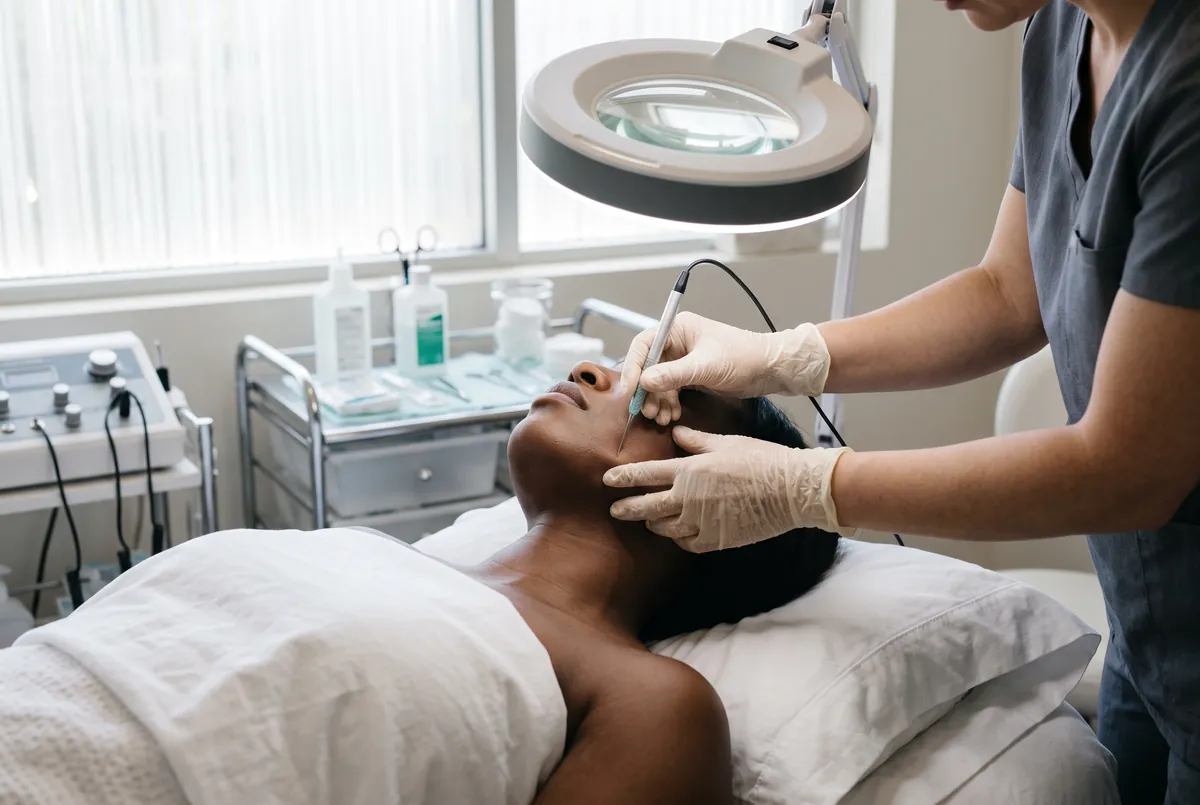
Electrolysis skips that competition completely. The electrologist slides a sterile, hair-thin probe into the natural opening of the follicle, alongside the hair, until it reaches the area where the hair grows from. Then a tiny current is delivered at the tip of the probe. Depending on the modality, that current produces heat, a chemical reaction, or both, and it damages the growth cells from inside the follicle. The skin surface only carries the probe; it is not what absorbs the energy. Melanin in the skin and in the hair plays no role in whether the treatment works, which is also why electrolysis handles blond, red, gray and white hairs that laser cannot see. If you want the full background on the method itself, the overview in our guide to galvanic, thermolysis and blend walks through each modality.
This is also why electrolysis is the only method the FDA accepts for claims of permanent hair removal, while laser is described as permanent hair reduction. For clients with deep skin, that combination matters: a method that works on every hair color, does not depend on skin tone, and removes hair permanently once each follicle is fully treated. The trade-off is time. Because each hair is treated individually, a course of electrolysis takes patience and regular sessions, and the number of visits depends on the area, hair density, hormones and how consistently you come in.
What Is Actually Different About Darker Skin
When I say darker skin needs a thoughtful approach, I do not mean it is fragile. Deep brown and black skin is often resilient, and many of my clients with rich skin tones heal beautifully. The difference is in how the skin responds after it has been irritated. Pigment cells in darker skin are more active, and they tend to react to inflammation by producing extra melanin. A bump, a scratch, a pimple or a small burn can leave a dark mark that lingers long after the original injury has healed. Most people with deeper skin already know this from their own experience with acne or insect bites.
Three concerns come up again and again in consultations with clients of color. The first is post-inflammatory hyperpigmentation, those dark marks after irritation. The second is scarring, especially keloids and raised scars, which some people are genetically more prone to. The third is curly or tightly coiled hair that tends to curve back into the skin, causing ingrown hairs, razor bumps and sometimes pseudofolliculitis. None of these is a reason to avoid electrolysis. In fact, electrolysis is often part of the solution for the third one. But each of them changes how I plan treatment, how much I do in one session, and what I ask the client to do at home.
Skin tone is only one part of the picture. The Fitzpatrick scale, which practitioners use to describe how skin reacts to sun, is a helpful shorthand, but two people with the same shade can behave completely differently in the chair. One client with very dark skin may never get a single mark, while a client with a medium olive tone may darken after almost any irritation. That is why a good electrologist asks about your history instead of guessing from how you look, and why the test patch described later in this guide matters more than any chart.

Hyperpigmentation After Electrolysis: Why It Happens and How to Prevent It
Hyperpigmentation after electrolysis is almost always post-inflammatory, which means it is the skin's reaction to the small amount of inflammation the treatment creates, not a burn from the current itself. After each hair is treated, the tissue around the follicle warms up, a little fluid collects, and the healing process begins. In darker skin, that healing signal can wake up the pigment cells, and tiny brown or dark gray dots may appear around the treated follicles a few days later. On areas where many hairs are close together, the dots can blend into a patch that looks like a shadow.
The good news is that this kind of darkening is usually temporary and gradually fades as the skin renews itself, although on deeper skin fading can take weeks or several months. The better news is that most of it can be prevented. In my practice, the biggest causes are predictable: energy that is higher than the skin needs, too many hairs treated too close together in one visit, sessions booked before the skin has fully calmed down, picking at scabs, and sun exposure on freshly treated skin. Each of those is something the practitioner or the client can control.
Prevention starts with the lowest effective energy. A well-trained electrologist adjusts the setting so the hair releases smoothly with no pulling, and then stops there instead of adding a margin "just to be sure." They space treated hairs out across the area instead of clearing a tight cluster, and they watch the skin during the session for early signs of too much heat, such as blanching, whitening around the follicle or a surface that looks shiny. They also schedule the next visit to that same patch only after it has settled. At home, the job is sun protection, gentle care and hands off. If darkening does appear, tell your electrologist before the next appointment so the plan can be adjusted, and read our overview of electrolysis side effects and risks for the broader picture of what is normal.
Keloids, Raised Scars and How a Practitioner Screens for Them
Keloids are raised scars that grow beyond the edges of the original wound. They are more common in people of African, Asian and Hispanic descent, and they often run in families. Someone who is prone to keloids may notice them after ear piercings, surgery, acne on the chest or shoulders, vaccinations, or even minor cuts. Hypertrophic scars are related: they are raised but stay within the boundary of the original injury and may flatten over time. Both are part of how some people's skin repairs itself, and both matter when planning any procedure that creates small wounds, including electrolysis.
Correctly performed electrolysis produces tiny, superficial reactions at the follicle opening, and it should not scar. Scarring happens when the energy is too high, the probe is inserted incorrectly and pierces the follicle wall, or the skin is overtreated and then picked or infected. For someone with a keloid tendency, the stakes are simply higher, because a small injury that would heal flat in most people can become a raised scar. That is why a careful practitioner asks about it at the first visit, even if the client does not bring it up.
When I screen a new client, I ask whether they have ever had keloids or raised scars, where they appeared, and whether anyone in their family has them. I look at piercings, old scars and areas like the chest, jaw and shoulders. If there is a clear history, I start with a very small test area, use the gentlest settings that release the hair, and wait for full healing before going further. For clients with active keloids or a strong history in the treatment area, I recommend a conversation with a dermatologist before starting. The same careful intake applies to other medical factors, which practitioners can review in our guide to electrolysis contraindications.

Curly Hair, Ingrown Hairs and Pseudofolliculitis
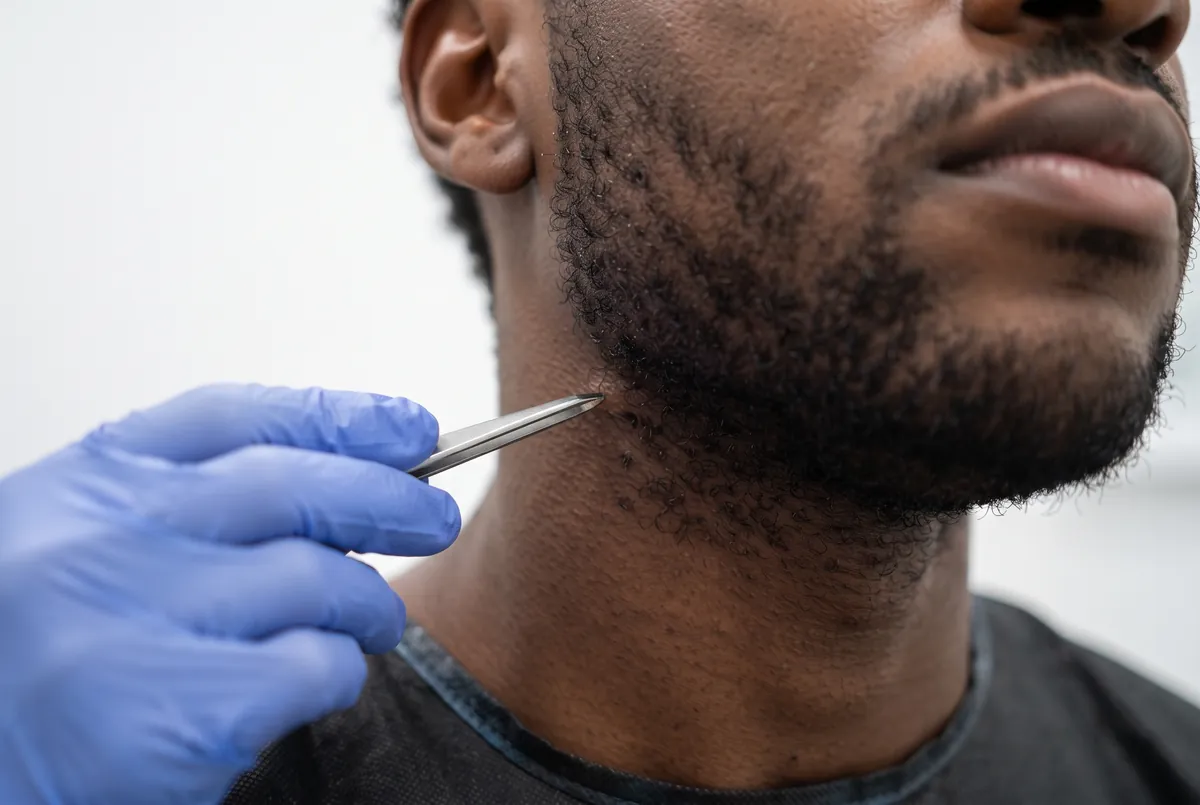
Many clients with deeper skin also have curly, coiled or coarse hair, and that hair shape changes both the problem and the treatment. A tightly curved hair that is shaved or tweezed can curl back and grow into the skin, or pierce the follicle wall on its way out. The result is ingrown hairs, razor bumps and, on the beard area especially, a chronic condition called pseudofolliculitis barbae. The same pattern shows up on the neck, bikini line, underarms and legs. Every bump is a spot of inflammation, and on dark skin every spot of inflammation can leave a mark, so clients often come to me with both the bumps and the dark spots they left behind.
Permanent removal of the hairs that keep growing back into the skin is one of the most effective long-term answers to this cycle, and electrolysis is well suited to it because it works on any hair color and any texture. There is one technical challenge: the follicle of a curly hair is often curved too. The electrologist has to read the angle of the hair above the skin, understand how the follicle likely bends beneath it, and insert the probe along that path. Galvanic and blend modalities are often preferred for curved or distorted follicles, because the chemical action spreads through the moisture in the follicle and can reach growth cells that a straight line of heat may not.
Active, inflamed bumps should not be treated directly. I work around them, let them calm down, and treat hairs in quieter areas first. Shaving habits between sessions also matter: clients who switch from close shaving to trimming or clipping often see fewer new ingrowns while the course progresses. For a full routine on dealing with ingrowns specifically, see our guide to electrolysis for ingrown hairs, and for the beard area, the dedicated guide on electrolysis for men covers shaving-related bumps in more detail.
How Modality and Settings Are Chosen Conservatively
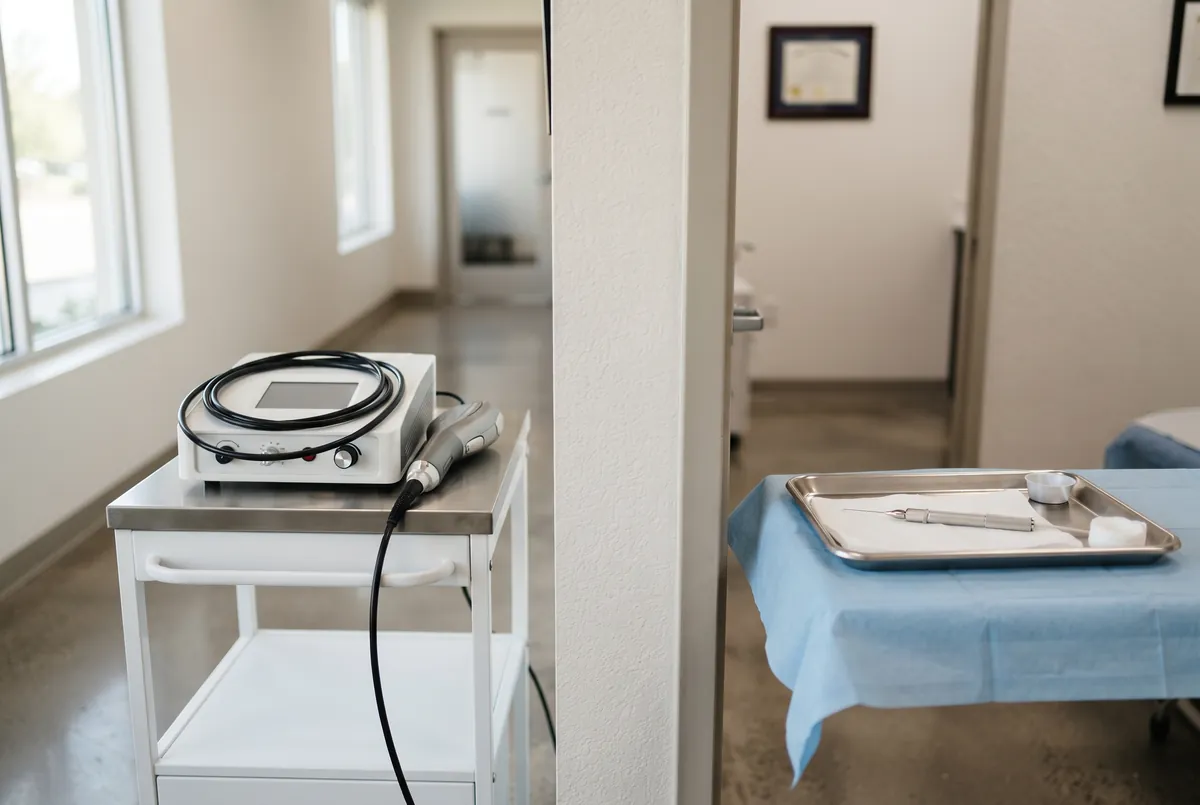
There are three electrolysis modalities, and all of them can be used on dark skin. Thermolysis uses high-frequency current to heat the follicle quickly. Galvanic electrolysis uses direct current to create a chemical reaction inside the follicle that breaks down the growth cells more slowly. Blend combines the two, using heat to speed up the chemical action. None of them is off limits for deeper skin tones, and the choice depends more on the hair, the follicle shape and the practitioner's training than on skin color alone.
What changes for skin that is prone to hyperpigmentation is the philosophy behind the settings. I aim for the least energy that releases the hair cleanly, and I adjust per area, because the skin on the upper lip, chin, neck and bikini line all behave differently. With thermolysis, that often means lower intensity and careful timing so heat stays deep in the follicle rather than near the surface. With galvanic and blend, it means watching the amount of chemical action, since too much can also irritate the skin around the opening. Probe size matters too: a probe that fits the follicle well delivers energy where it is needed, while one that is too small concentrates it near the surface.
Session design matters as much as machine settings. On deeper skin I tend to treat fewer hairs per square area in one visit, skip adjacent follicles and come back to them later, and keep an eye on total treatment time in one zone. I also avoid treating an area that is still pink, dark or healing from the last visit. None of this is exotic. It is simply the conservative end of what every well-trained electrologist learns, applied consistently. If you are curious about how practitioners choose between the three methods, this explanation of galvanic, thermolysis and blend goes deeper.
- Lowest effective energy: the hair should slide out with no resistance, and the setting stops there.
- Well-fitted probe: matched to the follicle size so energy stays deep and does not concentrate at the surface.
- Spacing: treated hairs spread out across the area instead of a dense cluster in one spot.
- Area rotation: the same small patch is not retreated until it has fully calmed down.
- Constant observation: the practitioner watches for blanching, shine or swelling and adjusts immediately.
- Modality by hair and follicle: galvanic or blend is often chosen for curved, coarse or distorted follicles.

The Test Patch and the First Sessions
For any client with a history of dark marks, keloids or sensitive skin, I recommend starting with a test patch. This is a short first session where only a small number of hairs are treated in a discreet part of the area you want to clear. The goal is not to make visible progress. It is to learn how your skin responds to the chosen modality, settings and probe, so the full treatment plan is built on evidence rather than assumptions.
After a test patch, the most important thing is waiting long enough. Redness and small bumps usually settle quickly, but pigment changes on deep skin can take a while to show up, so I ask clients to watch the area for a period of time and send a photo or come in for a check before the next real session. If the skin stays clear, we continue with the same approach and gradually increase the area covered in one visit. If there is darkening, raised texture or prolonged redness, I lower the energy, change the modality or the probe, and test again. It feels slow at the start, but it saves months of frustration later.
The first full sessions follow the same logic. I prefer shorter visits at the beginning, with a clear note of the settings used on each area so we can compare results over time. Clients should expect honest communication: what was treated, what to watch for, and when to call. If you have never had electrolysis before, our guide on preparing for your first electrolysis session explains what to do with your hair growth, skin care and schedule in the days before your appointment.
Aftercare and Sun Protection for Deeper Skin Tones
What you do in the days after each session has a strong effect on whether your skin stays even. Freshly treated follicles are tiny open pathways, and the goal is to keep them clean, calm and protected while they close and heal. Aftercare for dark skin follows the same basic routine as for any skin type, with a stronger emphasis on reducing inflammation and blocking light, because those are the triggers for extra pigment.
Sun protection deserves special attention. Many people with deep skin were told they do not need sunscreen, but both ultraviolet and visible light can deepen post-inflammatory marks. Dermatologists generally recommend a broad-spectrum sunscreen with SPF 30 or higher every day, and for clients who are prone to dark marks, a tinted mineral formula containing iron oxides adds protection against visible light. Tinted options now come in many shades, so they can blend into deep skin without the gray cast older sunscreens left. A hat or simply avoiding direct sun on the treated area is just as helpful.
- Keep hands off: no touching, scratching or picking at any tiny scabs, even when they itch.
- Cleanse gently with lukewarm water and a mild, fragrance-free cleanser, and pat dry with a clean towel.
- Apply only the soothing product your practitioner recommends, in a thin layer with clean hands.
- Skip makeup on the treated area until your practitioner says the follicles have closed.
- Avoid heat, saunas, hot yoga and heavy sweating for the first day or two.
- Pause exfoliating acids, retinoids and scrubs on that area until it has fully calmed down, and restart only with your practitioner's advice.
- Use broad-spectrum sunscreen and shade every day, not only on sunny days.
- Report any dark spots, raised bumps or redness that lingers before your next session.
A common mistake I see is clients trying to fix a new dark mark aggressively with strong lightening products, peels or scrubbing. On irritated skin, those can add inflammation and make the mark worse. Give the area time, protect it from light and let your electrologist know. If darkening persists or you want to treat it, a dermatologist can recommend options that suit your skin. The complete step-by-step routine is in our electrolysis aftercare guide, and clients who react easily in general will find more in our guide to electrolysis for sensitive skin.

Electrolysis vs Laser: The Best Hair Removal for Dark Skin
Clients ask me all the time what the best hair removal for dark skin is, and the honest answer depends on the hair, the area and the goal. Laser technology has improved for deeper skin tones. Longer-wavelength lasers such as the Nd:YAG are designed to pass through the melanin in the upper skin and reach the follicle more safely, and in experienced hands they can reduce dark, coarse hair on darker skin. But laser still depends on pigment, and it still carries a higher risk of burns and pigment changes on deep skin when the device or settings are wrong.
Electrolysis does not depend on pigment at all. It works on light, gray and fine hairs that laser cannot target, it is accepted by the FDA for permanent hair removal claims, and it is not limited by skin tone. Its limits are practical: it takes longer, because each hair is treated one by one, and it requires more sessions for large areas. For small and medium areas like the upper lip, chin, neck, eyebrows, underarms and bikini line, electrolysis is often the most reliable choice for deep skin. For very large areas with dark, coarse hair, some clients start with an appropriate laser to reduce the bulk and then finish with electrolysis for the remaining and lighter hairs.
| Factor | Electrolysis | Laser on darker skin |
|---|---|---|
| Depends on melanin | No, energy goes into the follicle directly | Yes, needs contrast and a wavelength suited to deep skin |
| Works on gray, blond, red hair | Yes | Generally no |
| FDA wording | Permanent hair removal | Permanent hair reduction |
| Main risk on deep skin | Temporary dark marks if overtreated | Burns and pigment changes if device or settings are wrong |
| Best for | Small to medium areas, curly hair, light hair, finishing work | Large areas of dark, coarse hair with an experienced provider |
| Speed | Slower, one hair at a time | Faster per session over large areas |
If you are weighing both options, look for providers who can show real experience with skin like yours and who explain their device and settings clearly. A consultation that starts with "you are not a candidate" without offering alternatives, or one that promises no risk at all, deserves a second opinion. For a broader comparison beyond skin tone, including cost factors, time commitment and which areas suit each method, read our electrolysis or laser guide.
Questions to Ask a Practitioner Before You Book
The single biggest factor in how your skin responds is the person holding the probe. Training, experience with deeper skin tones and a willingness to go slowly matter more than the brand of the machine. A good consultation should feel like a conversation about your skin, not a sales pitch, and you should leave it with a clear idea of how the practitioner plans to protect your skin from marks and scarring.
Licensing requirements for electrologists vary from state to state, and a few states regulate the profession very lightly, so check what your state requires on our electrolysis licensing hub and confirm the practitioner's status on the state board website where a license exists. When you are ready to find someone near you, our studio directory is a place to start your search. Then use the questions below at the consultation.
- How often do you treat clients with skin like mine, and how do you adjust for it?
- Which modality would you use for my hair type and area, and why?
- Will you start with a small test patch, and how long will we wait before the next session?
- How do you decide on energy settings, and do you record them for each area?
- What do you do if I start to see dark marks or raised bumps?
- Do you ask about keloids, scars and medications before treatment?
- Are your probes sterile, single-use and opened in front of me?
- What aftercare and sun protection do you recommend for my skin?
- When would you refer me to a dermatologist?
Listen for specific, calm answers. An experienced practitioner will talk about testing, spacing, lowering energy and watching the skin. Be cautious if you hear that dark skin never reacts, that a large area can be cleared in one or two visits, or that aftercare is optional. Also pay attention to how they look at your skin: good practitioners examine the area under magnification, ask about your shaving and tweezing habits, and look at old marks and scars before they suggest anything.
When to See a Dermatologist
Electrolysis is a cosmetic service, and an electrologist is not a physician. There are situations where a dermatologist should be part of the plan, either before you start or along the way. For clients with deep skin, a dermatologist who has experience with skin of color can be especially valuable, because some conditions look different on darker skin and are sometimes missed.
See a dermatologist before starting if you have active keloids or a strong history of them in the area you want treated, a current skin infection, active acne or inflammation where the hair grows, or a skin condition you are already treating with prescription products. Sudden new hair growth, or hair growth together with irregular cycles, acne or other changes, is also a reason to see a physician, since hormones may be involved. The guide on hormonal hair growth and electrolysis explains how medical care and electrolysis work together in that case.
During treatment, check in with a dermatologist if dark marks do not fade over a long period, if you notice raised, firm or growing scars, if you see signs of infection such as spreading redness, warmth, pus or fever, or if you want medical treatment for existing hyperpigmentation. A good electrologist will welcome this and adjust the plan around the dermatologist's advice. In my experience, the best results for clients with complex skin come when both professionals are informed and working in the same direction.
For Practitioners and Students: Working Safely With Diverse Skin Tones
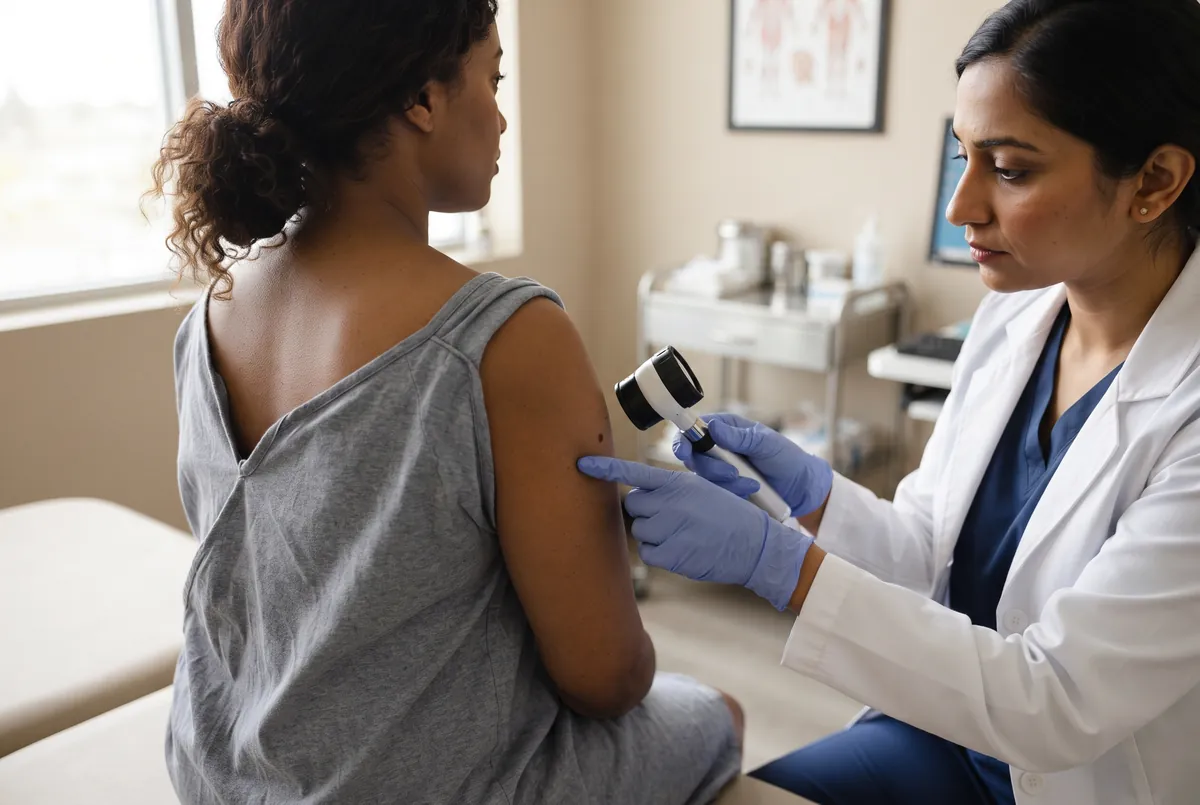
If you are training as an electrologist, learning to work confidently on every skin tone is not a specialty. It is basic competence. Many training materials and textbook photos still show mostly light skin, so students can finish their education without seeing how redness, swelling and early pigment changes look on deep brown and black skin. On darker skin, erythema may look purplish, dark or barely visible rather than pink. Learn to read texture, swelling, shine and warmth as well as color, and ask the client how the area feels.
Build your intake around the risks that matter for skin of color. Ask about keloids, raised scars, dark marks after acne or bites, and family history, and write down the answers. Look at old scars and piercings. Ask about shaving and tweezing habits, ingrowns and any products the client uses, including retinoids and lightening creams. Then document everything you do: modality, probe size, settings, number of hairs, the area, and the skin's immediate response. Good records let you adjust precisely instead of guessing, and they show clients that you take their skin seriously.
Technique habits make the difference. Master accurate insertion first, because a probe that pierces the follicle wall delivers energy into the surrounding tissue, which is exactly what causes marks and scarring. Practice reading the angle of curly hair and adjusting insertion depth for curved follicles. Start every new client at conservative settings and work up only as far as needed. Spread treatment across the area, limit time in one zone, and never re-treat skin that has not healed. Explain aftercare clearly, with sun protection as a daily habit rather than an afterthought, and invite clients to send photos if anything looks different.
Theory can be learned well through structured study, and an online course is a good way to build a foundation in skin structure, modalities, sanitation and client screening before you work on real people. It does not replace the hands-on training, supervised practice or license your state requires. To see what theory study covers, look through our electrolysis course options, and check the requirements for your state on the electrolysis licensing hub before you plan your path. Students preparing for broader beauty licensing may also find our guide to passing the cosmetology state board exam useful.
Your Next Step
If you have deep skin and unwanted hair, electrolysis is not something you have to settle for. It is often the best fit, because it works on every hair color and texture and does not depend on your skin tone. What protects your results is a practitioner who plans around your skin, starts with a test area, uses conservative settings and explains aftercare, plus your own consistency with sun protection and hands-off healing. Book a consultation, bring your questions from this guide, and take it one small area at a time.
If you are a student or a working professional, make diverse skin tones part of how you train and how you think from the start. Practice reading skin that does not turn pink, build a thorough intake, keep records, and stay conservative until the skin shows you what it tolerates. Clients with deeper skin often carry memories of bad experiences with other methods, and a careful, respectful practitioner earns their trust quickly. That trust, and the clear, even skin that follows, is what builds a lasting practice.

State Requirements
State licensing guides
Hours, exams, fees, and the licensing board differ by state. Open your state for the current requirements.
Looking for a practitioner or a program near you? Browse electrologists by state and city or beauty schools by state.
Common Questions
FAQ
Yes. Electrolysis is safe for dark skin because the energy is delivered inside the follicle through a fine probe rather than absorbed by pigment in the skin. The main risk for deeper skin tones is temporary dark marks from inflammation, which a skilled practitioner minimizes with low energy, spacing and test patches. Clients with a history of keloids should mention it at the consultation, and anyone with an active skin condition should check with a dermatologist first.
It can, mostly as post-inflammatory hyperpigmentation: small dark dots that appear around treated follicles as the skin heals. It is more likely on deeper skin and after overtreatment, sun exposure or picking. These marks usually fade gradually over weeks or months. Prevention matters most: conservative settings, spaced sessions, careful aftercare and daily sunscreen. Our electrolysis aftercare guide explains the routine step by step.
For small and medium areas, curly hair, and gray or light hairs, electrolysis is usually the more reliable choice on dark skin because it does not depend on melanin. Laser with a wavelength suited to deep skin can reduce large areas of dark, coarse hair in experienced hands, but it carries a higher risk of burns and pigment changes if the device or settings are wrong. Some clients combine both, using laser for bulk reduction and electrolysis to finish.
Correctly performed electrolysis creates tiny, superficial reactions and should not scar. People with a genetic tendency toward keloids have a higher risk from any skin injury, so overtreatment, poor insertion or picking at scabs could matter more for them. A careful practitioner asks about keloids at the first visit, starts with a small test area and uses the gentlest effective settings. With active keloids in the area, see a dermatologist before starting.
Often, yes. Curly hair that curves back into the skin causes ingrowns and razor bumps, and removing those hairs permanently breaks the cycle. Electrolysis works on any hair color and texture, and galvanic or blend modalities are often chosen for curved follicles. Inflamed bumps should be allowed to calm down before nearby hairs are treated. Our guide to electrolysis for ingrown hairs covers the full approach.
Long enough for the skin to calm down completely, which varies from person to person and area to area. On skin that tends to darken, your practitioner should wait until any redness, bumps and new marks have settled before treating the same patch again, and may rotate between areas in the meantime. There is no fixed rule, so ask your electrologist to base the schedule on how your own skin responds after the test patch.
Yes. Both ultraviolet and visible light can darken post-inflammatory marks on deep skin, even when you do not burn. Dermatologists generally recommend a broad-spectrum sunscreen with SPF 30 or higher every day, and a tinted mineral formula with iron oxides adds protection against visible light. Shade and a hat help too. Daily protection is one of the simplest ways to keep your skin even throughout a course of electrolysis.
Keep Reading
Related Guides


