Electrolysis
Electrolysis Apprenticeship: How Training Under a Licensed Pro Works
Quick answer
An electrolysis apprenticeship is training under a licensed electrologist, available only in states whose boards allow it. The board sets who may sponsor, how hours and skills are logged and which exam follows. Many states require graduation from an approved school instead. Check your state board first, get a written agreement, and keep signed copies of every logged hour.
An electrolysis apprenticeship is a route to electrology licensure where you train under a licensed, experienced electrologist in a working practice instead of, or alongside, attending an electrology school. Where it exists, the board usually sets the rules: who can sponsor an apprentice, how the training is registered, how hours and skills are logged, and which exam you take at the end. Many states do not offer an apprenticeship route for electrology at all and require graduation from an approved school, so the first question is always whether your state allows it.
I learned a great deal from watching experienced practitioners work, both during my training and long after, and I have seen how powerful one-on-one learning can be. I have also seen apprenticeship arrangements go wrong because nobody wrote down what was expected. This guide explains how an electrolysis apprenticeship generally works, how it compares with school, how to find a good mentor, and what an apprenticeship agreement should cover, without pretending the rules are the same everywhere. They are not.
What an Electrolysis Apprenticeship Is
In licensing terms, an apprenticeship is formal training that a board recognizes as a path to sitting for the licensing exam. It is not the same as informally shadowing a friend at her studio, and it is not the same as working as an assistant while you study on your own. A recognized apprenticeship typically has a registered start date, a sponsor who meets the board's qualifications, a defined curriculum or list of competencies, and a way of documenting progress that the board can review.
The appeal is easy to see. You learn in a real practice, with real clients, from someone who treats every day. You see consultation, scheduling, sterilization, record keeping and client communication as they actually happen, not as a textbook describes them. Some apprentices are able to keep part-time work or family responsibilities more easily than they could with a fixed school timetable, depending on how their sponsor schedules training.
The limitation is equally clear. The quality of an apprenticeship depends almost entirely on one person: your sponsor. A great mentor gives you an education no school can match. A poor one can leave you with gaps in theory, bad habits, or a stack of hours the board will not accept. That is why the structure around the apprenticeship, including the agreement, the curriculum and the records, matters so much.
Where the Apprenticeship Route Exists
Electrology licensing in the US is a patchwork. Some states license electrologists through a dedicated board, some through a cosmetology or health board, and a few do not license electrology separately. Among states that license it, the training path also varies. Some allow training only through approved schools. Some recognize an apprenticeship or preceptorship under a qualified electrologist as an alternative. Some describe the route in old statutes that are rarely used in practice, which can make the board staff the best source of current information.
When you research your state, look for terms such as apprentice, trainee, preceptor, student permit or supervised training. Read the definitions section of the board's rules, the section on education requirements for licensure, and any forms related to registering a trainee. If the rules are unclear, call or email the board and ask directly whether an apprenticeship route exists for electrology, what the sponsor must hold, and how hours are verified. Save their answer in writing.
If your state does not allow it, an apprenticeship-style arrangement can still be valuable after school, as a mentoring relationship that sharpens your skills once you are licensed. It just will not count toward licensure. Some people also consider training in another state that allows apprenticeship and then transferring; that path depends heavily on reciprocity and endorsement rules, which our guide on electrolysis license reciprocity explains. Never start training in another state on the assumption that it will transfer without checking first.
| Question for your board | Why you need the answer |
|---|---|
| Is apprenticeship a recognized route to electrology licensure? | Decides whether the path exists at all |
| What must a sponsor hold, and for how long? | Rules out ineligible mentors early |
| Must the apprenticeship be registered before training begins? | Hours before registration may not count |
| Is there a required curriculum or competency list? | Shapes your training plan |
| How are hours and progress documented and verified? | Protects your eligibility for the exam |
| Which exam do apprentices take, and is it the same as for school graduates? | Sets your study plan |

How an Apprenticeship Works Day to Day
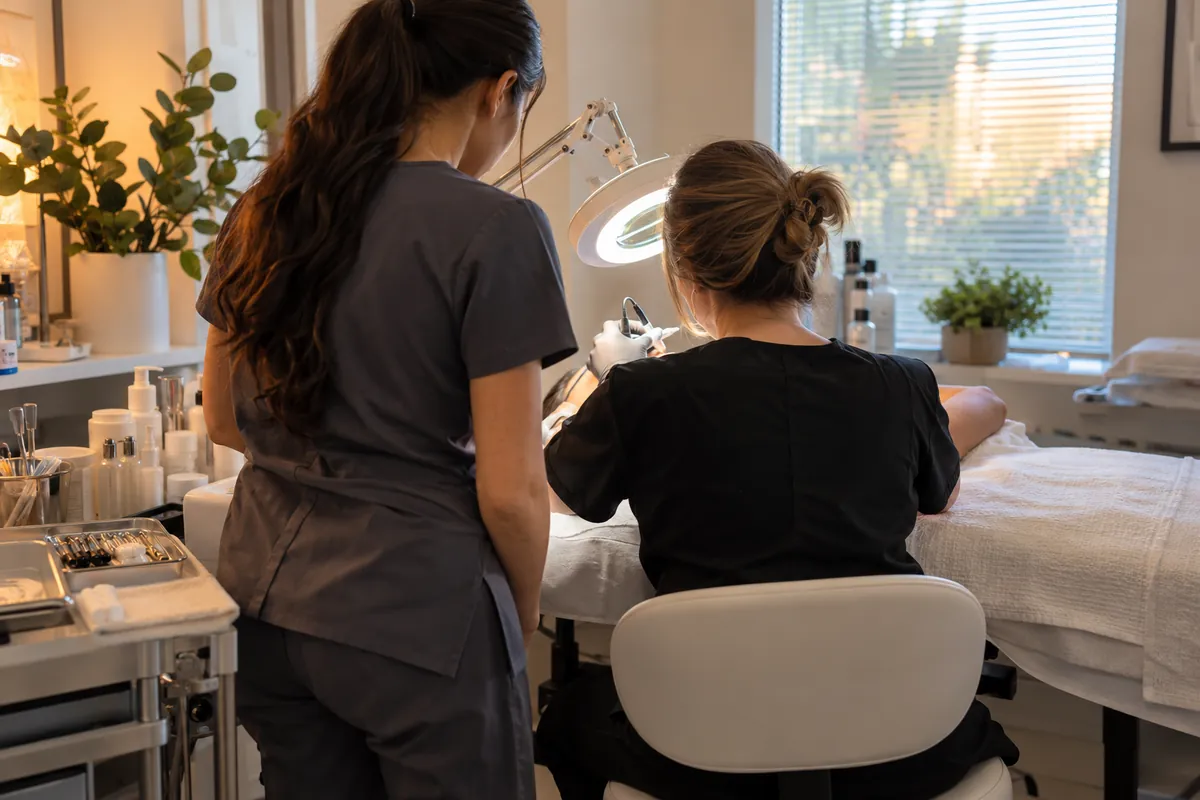
A well-run electrolysis apprenticeship usually moves through stages. In the first weeks you observe: consultations, setups, treatments, sterilization and cleanup. You learn the studio's routines and the reasoning behind them. You study theory in parallel, either from the sponsor's materials, textbooks, or a structured course. Observation is not passive time; you should be asking questions and writing notes after every client.
Next come supervised practice exercises: probe handling, insertion practice on training surfaces, station setup, sterilization cycles and documentation. Only when the sponsor is satisfied do you begin treating clients, starting with easy areas and cooperative clients who have agreed to be treated by an apprentice under supervision. The sponsor stays beside you, adjusts settings, watches the skin, and steps in whenever needed. Over time the supervision becomes less hands-on, though the sponsor remains responsible.
Throughout, you log your hours and competencies in whatever form the board requires. A good sponsor schedules regular reviews, perhaps weekly, to discuss progress, weak points and theory gaps. Toward the end, the focus shifts to exam preparation: practicing the specific procedures the exam tests, reviewing state laws and rules, and working through practice questions. An apprenticeship that never prepares you for the exam format leaves you exposed at the final step.
- Observation of all studio routines, with daily notes and questions.
- Theory study in parallel, following a written outline.
- Practice exercises on training surfaces: grip, insertion, timing.
- Station setup, sterilization and documentation under supervision.
- Supervised treatment of consenting clients on simpler areas.
- Gradual progression to more difficult areas and hair types.
- Focused exam preparation covering theory, practical procedures and state rules.
Expect the pace to be uneven. Some weeks are full of clients with ideal hair for practice, and you progress quickly. Other weeks bring cancellations or clients who prefer not to be treated by a trainee, and you spend more time on theory and drills. That is normal in a working practice. Talk with your sponsor about how to use slow periods well, for example by preparing for an upcoming area such as the bikini line, or by reviewing your consultation skills through role play.
Apprenticeship vs Electrolysis School
School and apprenticeship both aim at the same result: a competent practitioner who passes the exam. They get there differently. School offers a structured curriculum, several instructors, classmates to practice with, set schedules, and a clinic designed for teaching. Many schools have experience preparing students for the state exam. On the other hand, the clinic may be busy, your individual time with an instructor may be limited, and you may see fewer of the business realities of a working practice.
An apprenticeship offers close one-on-one attention and immersion in a real practice. You see what a full client day looks like, how a practitioner handles a difficult consultation, how they manage their schedule and finances. But the curriculum depends on your sponsor, theory coverage can be uneven, and you see only one way of working. If your sponsor uses only one modality, you may need to seek out the others yourself.
Neither route is universally better. Someone who learns best with structure and peers may thrive in school. Someone who learns best by doing, with a strong mentor who also teaches theory well, may thrive as an apprentice. The deciding factor is often practical: whether your state allows apprenticeship, whether there is a qualified sponsor near you willing to take you on, and whether a school is within reach. Our guide on how to choose an electrolysis school covers the school side in detail.
| Factor | Electrolysis school | Electrolysis apprenticeship |
|---|---|---|
| Availability | Required route in many states | Recognized only in some states |
| Curriculum | Set and approved in advance | Depends on sponsor and board rules |
| Teaching | Several instructors, group format | One mentor, individual attention |
| Practice | Teaching clinic, classmates as models | Real practice, real client schedule |
| Exposure to business | Often limited | Daily and direct |
| Exam preparation | Usually built in | Must be planned deliberately |
| Main risk | Less individual time | Quality rests on one person |
Filling the Theory Gaps
The weakest point of many apprenticeships is theory. A busy practitioner may teach beautifully at the table but have little time for structured lessons on anatomy, physiology, electricity, the chemistry of galvanic current, or infection control science. Yet the licensing exam tests that theory, and safe practice depends on it. If you are an apprentice, own this gap rather than hoping your sponsor covers it.
Ask your sponsor early which textbooks or materials they recommend, and agree on a schedule of theory topics that matches the board's curriculum, if one exists. Many apprentices use a structured online course to cover the knowledge side in an organized way. Our online electrolysis theory course is designed for that kind of study. To be clear, online theory never replaces the supervised hands-on training or licensing your state requires; it supports it.
Use your sponsor's time for what only they can give: correction of your hands, discussion of real cases, and explanations of why they made a particular decision. Bring questions from your theory study into those conversations. If you just read about the blend method, ask your sponsor to show you how they set it up and when they choose it. Linking theory to practice like this is how knowledge sticks.

How to Find a Mentor
Start with eligibility. If your state recognizes apprenticeship, the board will set requirements for sponsors, often an active license held for a certain period, a clean disciplinary record, and sometimes registration as a sponsor. Make a list of licensed electrologists in your area using the board's license lookup, professional association directories, and studio listings. Our studio directory can help you find practices near you.
Then do your homework on each one. Look at how they present their practice, how long they have been licensed, which modalities they offer, and what clients say about them in reviews you can verify. If possible, book a treatment yourself first. You learn a great deal about a practitioner by being their client: how they consult, how they explain, how clean the room is, how they handle your questions. If you would not want them treating you, you do not want them teaching you.
When you reach out, be direct and professional. Explain that you want to become a licensed electrologist, that you have confirmed your state allows the apprenticeship route, and that you would like to discuss whether they would consider sponsoring you. Mention any relevant background, such as cosmetology or esthetics work, healthcare experience, or theory study already completed. Many practitioners will say no simply because sponsoring takes a great deal of time; do not take it personally, and ask whether they know anyone who might say yes.
- Holds an active electrology license and meets the board's sponsor rules.
- Has a steady client base, so you will see enough real treatments.
- Works with more than one modality, or is willing to arrange exposure to others.
- Keeps a visibly clean, organized studio with documented sterilization.
- Explains reasoning clearly when you ask questions.
- Is willing to put the arrangement in writing.
- Has realistic time in their schedule to supervise you.
If your background is in a related field, use it. A licensed cosmetologist or esthetician already understands sanitation, client handling and skin basics, and a practitioner may see you as an easier apprentice to train. Someone from nursing or another healthcare role brings infection control habits and comfort with medical histories. Mention these strengths plainly in your first message, without overstating them, and show that you understand electrolysis is its own skill that you still need to learn from the ground up.
Be patient with the search. Sponsoring an apprentice is a large commitment for a solo practitioner, and the right person may take months to find. Keep studying theory while you search, so that when a sponsor does say yes you can show real preparation. A candidate who already understands hair growth cycles, modality basics and infection control is far more appealing than one starting from nothing, and the training itself will move faster.
Questions to Ask a Potential Sponsor
Before committing, have a frank conversation. Ask how many apprentices they have trained before and whether those apprentices went on to pass the exam. Ask how they structure the training: how long the observation phase lasts, when you would begin treating clients, how often they review progress, and how they handle theory. Ask which modalities and treatment areas you will learn. Ask how they record your hours and whether they have worked with the board's forms before.
Ask about practicalities too. What days and hours will you train? Will there be enough clients willing to be treated by an apprentice? What happens if the sponsor is ill, on vacation or decides to close the practice? Will you be paid for any work you do, and if so, how? Is there a fee for the training itself? Who provides supplies, probes and your study materials? These questions may feel awkward, but unclear money and time arrangements are the most common source of conflict in apprenticeships.
Finally, pay attention to how the sponsor answers. A good mentor welcomes these questions, because they show you are serious. Someone who is vague, irritated or unwilling to put anything in writing is showing you how the arrangement will feel when problems arise. Trust that signal. It is far easier to walk away before you begin than six months into training.

The Apprenticeship Agreement
Even if your board does not require a written agreement, insist on one. It protects both of you. It does not need to be long, but it should be specific. Start with the basics: names, license numbers, the studio address, the start date, and the board registration details if your state requires registration. State the expected length of the apprenticeship and the weekly schedule, with an understanding that progress, not the calendar alone, decides when you move to the next stage.
Set out the training plan: the competencies to be covered, the theory topics, the modalities, the treatment areas, and how progress will be reviewed. Describe how hours and competencies will be logged and who signs the records. Cover the money: whether the apprentice pays a training fee, whether the apprentice is paid for any work, who provides supplies and materials, and how any payments are scheduled. If employment law applies to your arrangement, such as when an apprentice also performs paid work, get proper advice on how to structure it.
Include what happens if things change. How much notice does either side give to end the arrangement? What happens to your logged hours if the sponsor closes, moves or loses eligibility? Who keeps copies of the records? Add expectations on conduct, confidentiality of client information, infection control standards, and insurance coverage while you train. Have a professional review the agreement if you have any doubts; a small cost now can prevent a large problem later.
- Parties, license numbers, studio address and board registration details.
- Start date, expected length and weekly schedule.
- Training plan: competencies, theory topics, modalities and treatment areas.
- How hours and competencies are logged, signed and stored.
- Fees, any pay, and who supplies materials and equipment.
- Client consent for treatment by an apprentice under supervision.
- Insurance arrangements during training.
- Confidentiality of client information.
- Notice period and what happens to records if the arrangement ends.
Logging Hours and Competencies
Your records are the evidence that turns months of training into eligibility for the exam. Use the board's forms if it provides them, and follow their instructions exactly. If the board does not provide forms, create a clear log with dates, times, activities, the competency practiced, and your sponsor's initials or signature. Keep the log current, ideally daily, rather than reconstructing it at the end of each month.
Keep your own copy of everything. If the sponsor holds the official log, photograph or scan each page after it is signed. If the sponsor relationship ends badly, or the sponsor becomes unavailable, your copies may be the only proof of your training. Note also any days you were scheduled but training did not happen, so that the record reflects reality and does not raise questions later.
Some boards require periodic reports or inspections during the apprenticeship. Put those dates in your calendar and make sure your log is ready before each one. If the board changes its forms or rules during your training, ask how the change affects you. Do not assume that what was true when you started still applies when you finish. This is one of the reasons to stay in occasional contact with the board throughout the process.

Client Safety and Consent During Training
Clients treated by an apprentice should know it. Before any treatment, the sponsor should explain that an apprentice will be working under direct supervision, and the client should agree, preferably in writing on the consent form. Most clients are comfortable with this when it is explained honestly, and many enjoy being part of someone's training. A client who does not want to be treated by an apprentice should be able to say so without pressure.
The sponsor carries responsibility for safety during your treatments. That means checking the consultation and health history, confirming there are no contraindications, setting or verifying the epilator settings, watching the skin throughout, and stopping you when needed. As an apprentice, your job is to follow instructions, speak up when you are unsure, and never treat a client unsupervised before the board and your sponsor allow it. Our guide to contraindications for electrolysis practitioners is essential reading early in your training.
Learn record keeping from the first day. Every treatment you perform should be documented: area, modality, settings, duration, skin response and aftercare given. These records protect the client, the sponsor and you. Our sibling guide on electrolysis consent forms and client records explains what good documentation looks like and how to handle privacy.

Common Apprenticeship Problems and How to Avoid Them
The most damaging problem is training that does not count. It happens when the apprenticeship was never registered, when the sponsor did not meet the board's requirements, or when the logs are incomplete. Prevent it by confirming every requirement in writing at the start, registering before you begin training if your state requires it, and keeping your logs current with your own copies.
The second problem is becoming unpaid labor. Some arrangements drift into the apprentice cleaning, answering phones and doing laundry while seeing little actual training. A modest amount of studio help is reasonable, but if weeks go by without supervised practice or theory review, raise it with your sponsor using the training plan in your agreement. If nothing changes, consider whether the arrangement can serve you at all.
The third problem is narrow training. If your sponsor works in only one modality or sees mostly one type of client, you may arrive at the exam, or at your own practice, with gaps. Plan to fill them with additional study, short workshops or time observing another practitioner, if your board allows. The fourth problem is conflict, often over schedule or money. A clear written agreement prevents most of it, and a respectful, early conversation solves much of the rest.
After the Apprenticeship: Exam and First Steps
When your training hours and competencies are complete, you will typically submit your records to the board along with an application to take the licensing exam. Prepare for the exam deliberately. Apprentices often have strong practical skills but less practice with formal written questions and the specific procedures an exam observer expects to see. Our sibling guide on the electrology state board exam covers how to prepare.
After licensing, your relationship with your sponsor can continue in a new form. Some apprentices stay on as employees or rent space in the same studio. Others open their own practice and keep their mentor as a person to call about difficult cases. Leave on good terms whatever you choose: the electrology community is small, and a mentor's good word matters for years. Thank the clients who agreed to be treated by you during training, too; some of them may become your first clients once you are licensed, if your agreement with the sponsor allows it.
Keep learning. One mentor gave you one way of working; your career will benefit from seeing others. Plan continuing education early, especially in modalities and areas your apprenticeship covered lightly. Our guide on electrolysis continuing education explains how to build a plan around your own gaps.

Red flags when you are choosing a sponsor
Not every offer of an apprenticeship is a good one. The clearest warning sign is vagueness: no written agreement, no clear plan for supervised hours, no explanation of how your progress will be tracked, or a sponsor who cannot say how the arrangement fits your state's rules. Be careful if someone asks for large payments upfront without a contract, or promises a license by a certain date regardless of what the board requires. A sponsor who dismisses theory, infection control or consent as a formality is also a poor choice, because those topics are central to your safety and your future license.
Another warning sign is a studio where the apprentice mostly does cleaning, reception or product sales. Some tasks are part of every training environment, but your time should include real supervised practice. Ask to observe a day before committing, and notice how the sponsor treats clients, handles instruments and answers hard questions. Talk with former trainees if possible. If your board has a list of approved supervisors or programs, use it, and when something seems unclear, ask the board directly before signing. You can walk away from a weak arrangement, but hours you log under an unapproved setup may not be counted.
- No written agreement or training plan
- Promises that skip or soften state requirements
- No process for logging and signing off hours
- Sponsor unwilling to discuss infection control and consent
- Apprentice used mainly for unrelated tasks
- Pressure to commit before you have observed the studio
Building practical confidence step by step
The best apprenticeships move in stages. Early weeks are about observation, setup and cleanup, learning how to sterilize, how to prepare the room, and how to talk with clients. Next come supervised practice on a mannequin or practice skin, then on willing models, then on real clients under close watch. You are ready to move on when your instructor says so, not when you feel impatient. Each stage should have a checkpoint, whether a short skills review, a signed list of competencies or a conversation about what went well and what did not.
Practice with purpose. Ask your sponsor to describe exactly what they want to see in your next session, such as steady probe angle, consistent insertion depth or controlled timing, and record your own notes afterward. Review your mistakes without defending them. A practitioner who can say what went wrong learns quickly. Keep theory study running in parallel, because understanding why a technique works makes it easier to adjust to different skin and hair. Over months, speed and comfort will come, and they come faster to people who built the right habits first.
Keep your own copy of everything. Photograph or scan every signed page of your log, your agreement and any written feedback, and store the copies somewhere separate from the studio. If your sponsor closes, moves or becomes unavailable, those records may be the only proof of the training you completed, and your board will ask for documentation, not memories.
Your Next Step
Begin with one email or phone call to your state board asking whether an electrolysis apprenticeship is a recognized route to licensure and, if so, what a sponsor must hold and how training is registered. Our electrolysis licensing hub lists state boards and links to their rules. If the answer is no, compare schools instead, and consider a mentoring relationship after licensing.
If the answer is yes, start your search for a sponsor, book a treatment with the practitioners on your list, and prepare your questions and a draft agreement. Begin structured theory study early, for example through our electrolysis course, so that your time with your mentor goes to what only a mentor can teach. And keep a copy of every record from the first day.
State Requirements
State licensing guides
Hours, exams, fees, and the licensing board differ by state. Open your state for the current requirements.
Looking for a practitioner or a program near you? Browse electrologists by state and city or beauty schools by state.
Common Questions
FAQ
In some states, yes. A few states recognize an apprenticeship or supervised training route under a qualified licensed electrologist. Many others require graduation from an approved electrology school, and some do not license electrology separately at all. Ask your state board directly and get the answer in writing. Our licensing hub links to state boards.
Sometimes, but not always. Some sponsors charge a training fee, apprentices may need to buy their own study materials and supplies, and training may take longer if client volume is low. Some apprentices earn a little through studio work. Compare actual written costs from a school and a sponsor rather than assuming one route is cheaper.
Where the route exists, the board sets sponsor rules, often requiring an active electrology license held for a certain period and a clean disciplinary record, and sometimes registration as a sponsor. Confirm your sponsor meets every requirement before training begins, because hours under an ineligible sponsor may not count.
Not automatically. Each state decides what training it accepts, and some only accept school graduation. If you might move, check the rules of the destination state before you start training. Our guide on electrolysis license reciprocity explains how transfers generally work.
No. A responsible apprenticeship begins with observation, theory and practice exercises, and moves to supervised client treatments only when the sponsor judges you ready and the board's rules allow it. Clients should consent to being treated by an apprentice, and the sponsor stays responsible for their safety.
An online course can help you learn theory in an organized way, which is often the weakest part of an apprenticeship. It does not replace the supervised hands-on training, hours or licensing your state requires. Check whether your board counts any theory study toward training; many do not.
Contact the board right away to ask how your logged hours are treated and whether you can transfer to another sponsor. Your own copies of signed records become essential at that point. A written agreement that covers what happens if the arrangement ends makes this situation much easier to manage.
Neither is better for everyone. School offers structure, several instructors and built-in exam preparation. Apprenticeship offers close mentoring and real practice experience but depends heavily on one person. The deciding factors are whether your state allows it, whether a qualified and willing sponsor is near you, and how you learn best.
Keep Reading
Related Guides


