Waxing
Waxing During Pregnancy: Safety, Comfort, and Timing by Trimester

Quick answer
Waxing is a surface service and is widely treated as a reasonable option in an uncomplicated pregnancy, but skin is usually more sensitive, so redness, irritation and bruising are more likely. Ask your OB or midwife first, never wax over varicose veins, expect hard wax, small sections and side-lying positions, and skip pain relievers or numbing cream unless your provider approves.
Waxing during pregnancy is one of the most common questions I hear from regular clients the moment they share their news, and from new clients who suddenly cannot see or reach the areas they used to shave. The short version is that many pregnant people continue to wax through all three trimesters, but the appointment is not the same as it was before. Skin reacts more strongly, hair may grow differently, lying on a table gets harder as the months go by, and a few situations call for postponing. This is general information from a practitioner, not medical advice, and your obstetrician or midwife has the final word for your pregnancy.
I have written this guide for two readers at once. If you are pregnant, it explains what changes in your skin, how each trimester affects comfort on the table, which areas need extra care, when to skip a wax, how to time one before your due date, and when to come back after birth. If you are a waxing professional or student, it covers what to ask at intake, how to position a pregnant client, how to adapt the room, and where your scope ends and a medical provider's begins. Both sides work better when each understands what the other is watching for.
Is It Safe to Wax While Pregnant: The General Picture
Waxing is a surface service. Warm wax grips the hair, the hair is pulled from the follicle, and the effect stays in the top layers of skin. That is why waxing is widely treated as a reasonable hair removal option in an uncomplicated pregnancy, and why most studios keep pregnant clients on their books. The realistic risks are the same ones that exist for any client, only more likely: irritation, lingering redness, bruising, skin lifting, burns from wax that is too warm, ingrown hairs, and infection of freshly opened follicles. Pregnancy does not make waxing a different procedure. It changes the skin the procedure is performed on and the body lying on the table.
What I cannot tell you, and what no waxer can, is whether waxing is appropriate for your particular pregnancy. That depends on things outside a beauty professional's training: complications your provider is monitoring, medications you take, your skin history, and how your body is handling circulation and swelling. So the sensible order is simple. Mention at a prenatal visit that you plan to keep waxing, name the areas, and ask whether there is any reason to avoid it. For most people that conversation takes a minute. If your provider says to wait or to skip a specific area, that instruction overrides anything a studio menu or an online guide says, including this one.
Why Skin Is More Sensitive and Hair Growth Changes
Pregnancy increases blood volume and blood flow to the skin, and hormone levels shift throughout. In the wax room this shows up in predictable ways. Skin flushes faster and stays pink longer after a pull. Small capillaries are more visible and bruise more easily, especially on the inner thighs and bikini line. Many clients describe their skin as thinner or more tender even though it looks the same. The bikini area in particular carries more blood flow and often some swelling as pregnancy progresses, so a service that used to feel routine can feel sharper. None of this means something is wrong. It means the same technique needs a lighter hand.
Pigment behaves differently too. Pregnancy commonly darkens areas that already have more pigment, produces a dark line down the center of the abdomen, and in some people brings melasma, the blotchy brown or gray patches on the cheeks, forehead, and upper lip. Skin in this state is quicker to leave a dark mark after any irritation, heat, or minor injury, and deeper skin tones are generally more prone to these marks. For waxing, that turns a small mistake into a longer-lasting one. A patch of lifted skin or a mild burn that would normally fade quickly can leave discoloration that lingers, which is why I become much more conservative on a pregnant client's face.
Hair changes surprise people most. During pregnancy more hairs tend to stay in their growth phase, so scalp hair often feels fuller and body hair can seem thicker, darker, or simply more noticeable. New hair may appear on the abdomen, around the nipples, on the lower back, or on the chin and upper lip. Other clients report the opposite on their legs: slower, finer growth. Both patterns are common, and much of the extra hair sheds on its own in the months after birth. That is a good reason to choose temporary methods now and to hold off on judging what is permanent. If facial or body hair appears suddenly and heavily, mention it to your provider.
Smell and nausea matter more than most waxers expect. A heightened sense of smell is typical in early pregnancy, and the scent of warm wax, pre-wax cleanser, or a perfumed after-wax oil can be enough to make a client queasy. Skin can also react to products it tolerated for years, including fragranced lotions, essential oil blends, and adhesive residue removers. The practical consequences are a fragrance-free product lineup, a patch test even for long-standing clients, and an honest question at the start of every visit about how the client is feeling that day, because the answer changes from week to week.
When to Skip or Postpone a Wax
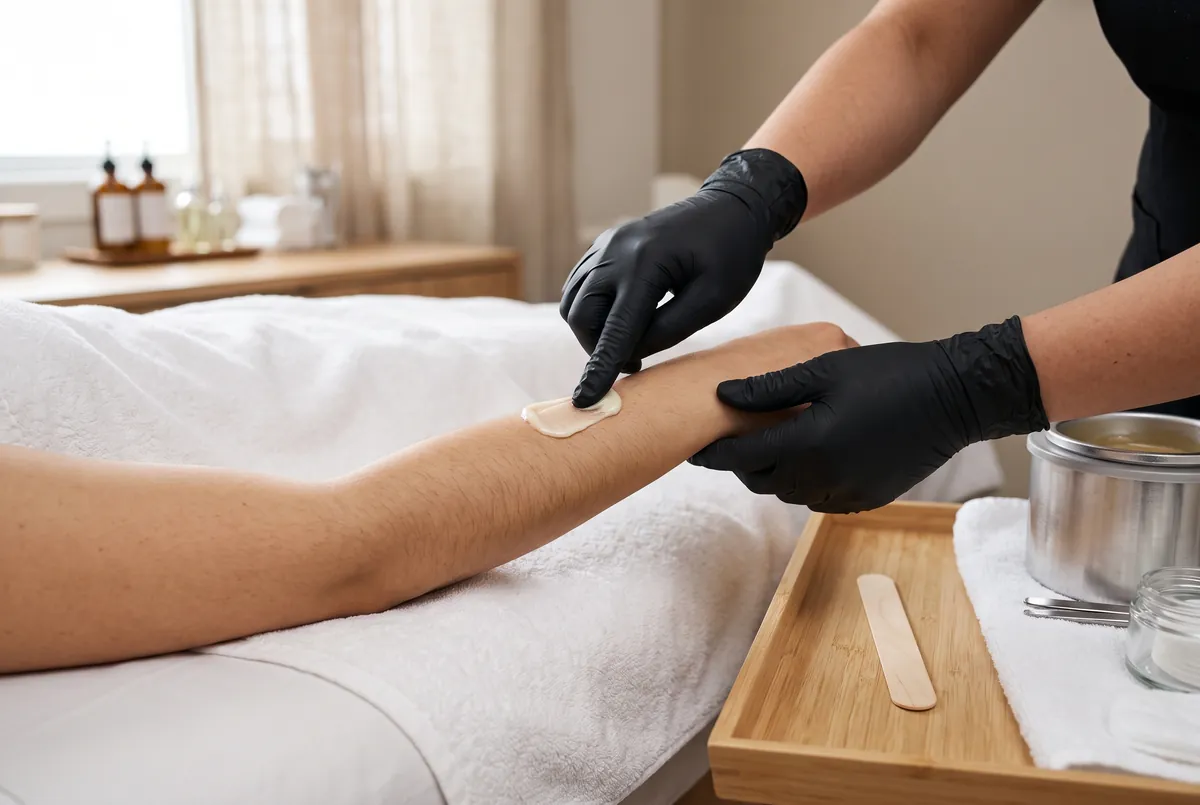
Some reasons to postpone have nothing to do with pregnancy and apply to every client: sunburn, broken skin, an active rash or infection in the area, recent use of retinoids or strong exfoliating acids, and recent procedures such as peels or laser. Pregnancy adds its own list, and it also raises the stakes on the ordinary one, because skin that is already reactive forgives less. The table below is the screen I use. It is a guide to when to stop and ask, not a diagnostic tool. A waxer who sees any of these should pause the service rather than work around the problem and hope for the best.
| Situation | What to do |
|---|---|
| Pregnancy described as high risk, bed rest, or any activity restriction | Do not book until your OB or midwife says waxing is fine for you |
| Varicose veins on the legs or in the vulvar area | Never wax directly over them; ask your provider whether nearby skin can be treated at all |
| Itchy rash, hives, or widespread itching without a rash | Postpone and tell your provider, since itching in pregnancy sometimes needs medical evaluation |
| Melasma or new dark patches on the face | Skip waxing on and around the patches; consider threading or tweezing instead |
| Eczema, psoriasis, or dermatitis flare in the area | Wait until the skin is calm, and see a dermatologist if it persists |
| Cuts, sores, infection, or an active herpes outbreak | Do not wax; tell your provider about any outbreak during pregnancy |
| Sunburn or recent tanning | Wait until the skin has fully recovered |
| Diabetes, including gestational diabetes | Ask your provider first, because healing and infection risk can differ |
| Blood thinners or other prescription medication | Ask the prescriber whether waxing is appropriate and tell your waxer |
| Retinoids or strong acids used on the area before pregnancy or now | Tell your waxer exactly what and when; the area may need to be skipped |
| Feeling faint, feverish, nauseated, or generally unwell on the day | Reschedule, no explanation needed |
Varicose veins deserve a specific word. Pregnancy puts extra pressure on the veins of the legs and pelvis, and some people develop bulging veins on the calves, behind the knees, on the thighs, or in the vulvar area. Wax should not be applied over them. The pull stresses skin that is already stretched over a fragile vessel, and bruising or worse is a real possibility. Whether the surrounding skin can be waxed is a question for the provider, not the waxer. Clients sometimes do not know they have vulvar varicosities because they cannot see the area, so a professional who notices swollen, bluish veins should stop, describe what they see in plain words, and suggest the client mention it at the next prenatal visit.
Trimester by Trimester: What Changes on the Table
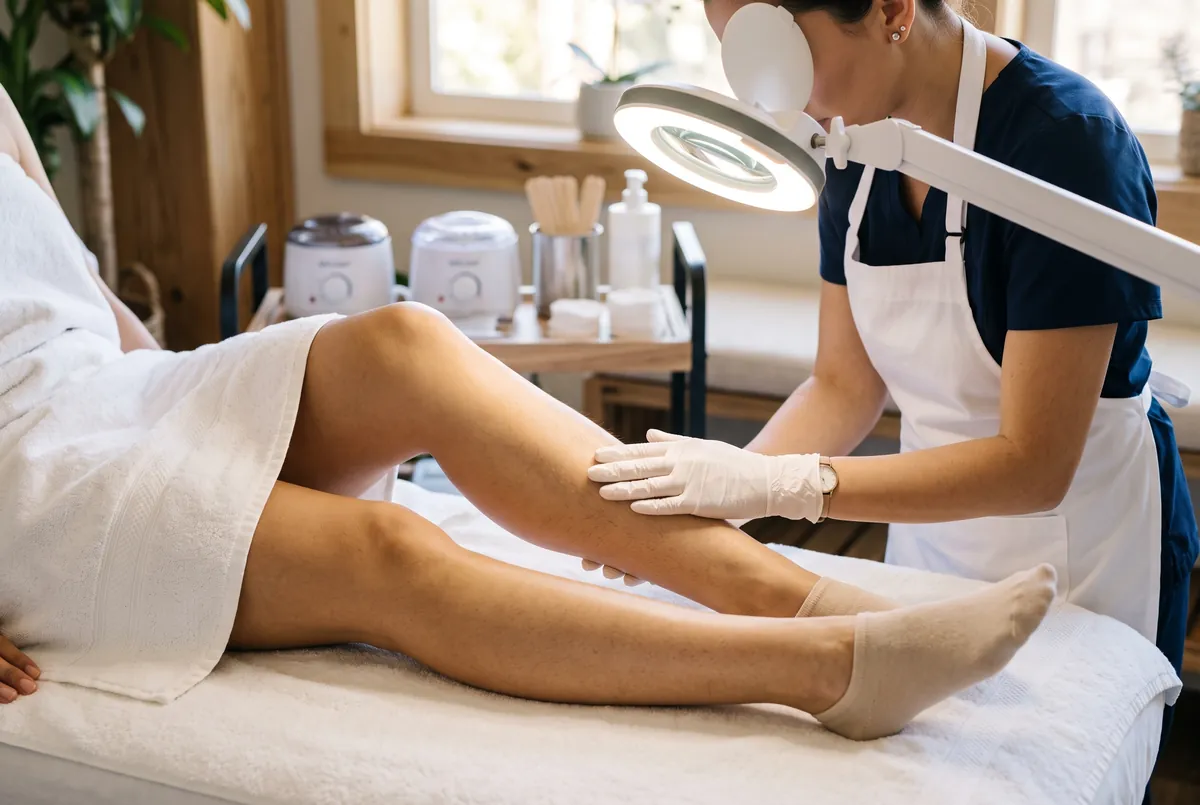
In the first trimester the body looks much the same, and the service can usually be performed in the usual positions. The challenges are less visible: nausea, fatigue, tender breasts, and a strong reaction to smells. Clients often have not told many people yet, so they may not mention the pregnancy unless the intake form asks. Book at the time of day when nausea is usually lightest, eat something small beforehand, and bring water. Some people prefer to wait until this stretch passes, and some providers suggest holding off on non-essential services early on. Either choice is reasonable. If you do come in, say so quietly at check-in so your waxer can adjust products and pace.
The second trimester is the stretch most clients find easiest. Nausea has often eased, energy is better, and the belly is present but not yet in the way. It is a good time to settle into a regular rhythm, because skin that is waxed on a steady schedule tends to tolerate each visit better than skin that is waxed after a long gap. Position changes begin here. Lying completely flat becomes less comfortable as the weeks pass, so I start raising the backrest and adding a pillow under one hip well before a client asks. This is also when I begin planning the rest of the pregnancy with her, including a rough idea of the last appointment before birth.
The third trimester asks the most of both people. Reaching, bending a knee out to the side, and holding skin taut all become harder, so the waxer does more of the stretching and the client does less. Bikini-area skin is usually at its most sensitive, the legs may be swollen by afternoon, and the bladder does not wait. Appointments need extra time for slow position changes and breaks, even though the waxing itself should move quickly and in small sections. Later in pregnancy, lying flat on the back for long can leave a person dizzy, clammy, or short of breath as the weight of the uterus presses on major blood vessels, so that position is kept brief or avoided.
Positioning: Side-Lying, Semi-Reclined, and Bolsters
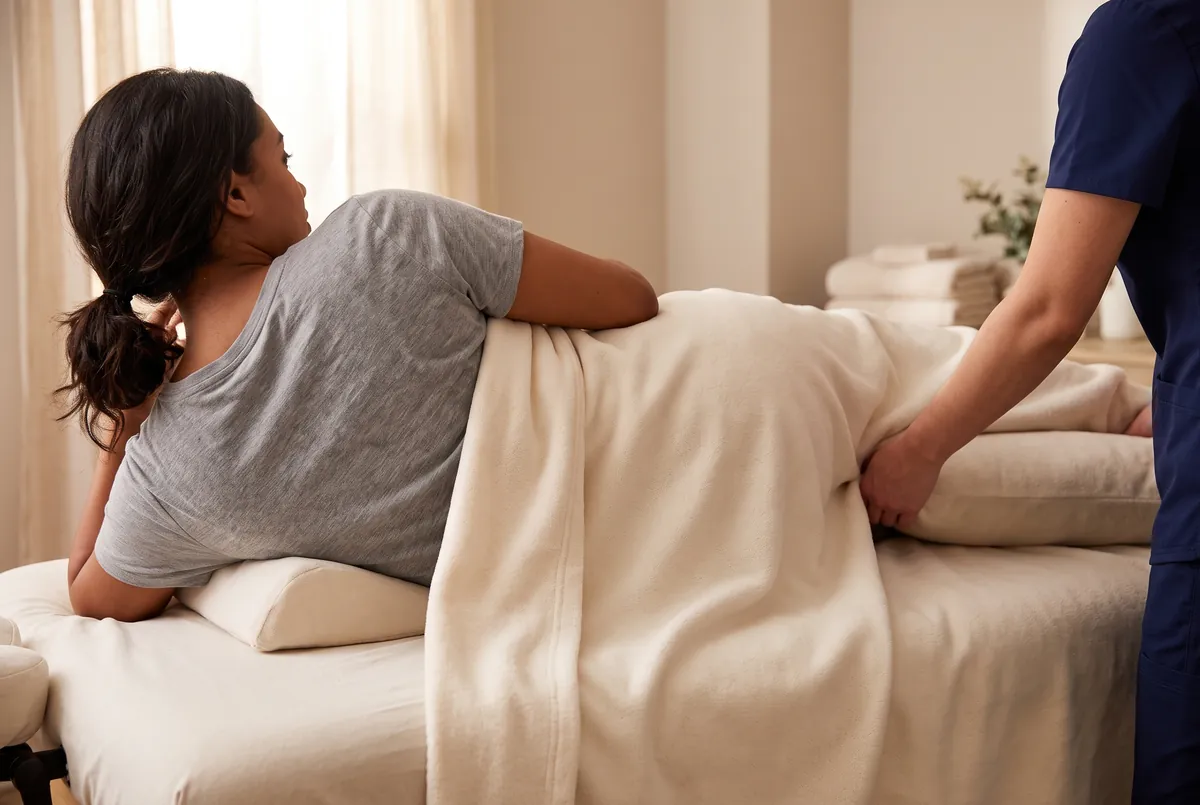
Positioning is where a prenatal wax differs most from a standard one. The rule I work by is that from the middle of pregnancy onward, the client should not spend long stretches flat on her back. A semi-reclined position, with the backrest raised and a pillow under the knees, works for most of the front of the body. If the table does not adjust, a firm wedge behind the shoulders and a small rolled towel under the right hip to tilt the body slightly to the left does a similar job. I ask the client to tell me the moment she feels lightheaded, hot, or breathless, and I turn her onto her side straight away if she does.
Side-lying is the workhorse position late in pregnancy. With the client on her side, a pillow between her knees, another supporting the belly, and one under her head, I can reach the outer and back leg, the back of the thigh, the buttock strip, and much of the bikini line. She then rolls to the other side for the second half. For the front bikini area, a semi-reclined position with one foot resting on the table and the knee supported outward by a bolster lets the hip relax without the client having to hold it. Underarms are easy in a seated or semi-reclined position, and facial waxing can be done seated in a chair with a headrest.
Getting on and off the table is the moment I watch most closely. A stable step stool, a table lowered as far as it goes, and a hand offered without fuss prevent slips. I ask clients to roll onto their side first and push up with their arms, then sit on the edge for a few breaths before standing, because standing up quickly can bring on dizziness. Paper sheets alone are slippery, so a towel or fitted cover under the paper helps. Never leave a heavily pregnant client alone on a narrow table with the height raised. These habits take less than a minute and matter more than any product choice.
Patch Testing and Choosing Hard or Soft Wax
I patch test pregnant clients even when I have waxed them for years, because the skin I knew is not necessarily the skin in front of me. The test is simple: a small amount of the wax and the pre- and post-wax products applied to a discreet spot near the area to be treated, removed as usual, then observed. A brief pink flush that settles is expected. Welts, hives, lifting, a burning feeling that continues, or redness that keeps spreading are reasons not to proceed with that product that day. Ideally the test is done a day or two ahead for a first prenatal visit, since some reactions take hours to appear.
For sensitive zones, hard wax is my default in pregnancy. It is applied thicker, sets around the hair, and is lifted off without a cloth strip, so it tends to grip hair more than the surface of the skin. That matters on the bikini line, underarms, and face, where pregnant skin is most reactive. Soft wax, removed with a strip, is efficient on large areas such as the lower legs and is still a fair choice there if the skin tolerates it, provided each section is waxed once and not repeatedly. Going over the same patch two or three times is how irritation and lifting happen. Stray hairs are better finished with tweezers.
Temperature deserves more attention than brand. Wax should be warm and workable, never hot, and I test every fresh dip on my own inner wrist before it touches a pregnant client, then ask how the first application feels. Skin that flushes easily can also feel heat more intensely, and a burn on pigment-prone skin may leave a mark for a long time. Formulas made for sensitive skin, without added fragrance or colorants, are the safer pick. Some clients do well with sugaring paste, which is used at a lower temperature. For a full comparison of formulas and where each belongs, see my guide to the types of wax for hair removal.

Bikini and Brazilian Wax While Pregnant
The bikini area is the most requested service in pregnancy and the one that needs the most judgment. Many clients book it for a practical reason: as the belly grows, they cannot see what they are doing with a razor. A Brazilian wax while pregnant is commonly performed, with provider approval, by waxers who are comfortable with prenatal positioning. Expect it to feel more intense than before, expect more redness afterward, and expect your waxer to work in smaller sections with firm skin support. If you have never had one, pregnancy is not the easiest time to start: a bikini line is a gentler first step, and my first Brazilian wax guide explains what the full service involves.
The technique changes are specific. The waxer checks the area visually before applying anything and stops if she sees swollen veins, broken skin, or anything she cannot identify. Hard wax is applied in narrow strips, the skin is held taut by the waxer because the client often cannot reach, and no section is waxed twice. The back strip is done in a side-lying position, never by asking a heavily pregnant client to pull her knees to her chest or kneel on the table. Increased vaginal discharge is normal in pregnancy and nothing to apologize for. A cleansing wipe handed over before the service, in private, takes care of it without comment. If the pain is sharply worse than you remember, or you feel faint, say so and the service ends there. A half-finished bikini wax is a minor inconvenience.
Legs, Underarms, and Facial Waxing
Legs are usually the most straightforward area, with two cautions. Swelling in the lower legs and ankles is common late in pregnancy, and swollen skin is tighter, more tender, and marks more easily, so a morning appointment before the day's swelling builds is often more comfortable. And any visible varicose or bulging veins are left alone entirely, along with a margin around them. Sudden swelling, swelling in one leg only, or a painful, warm calf is not a beauty issue at all. It is something to report to your provider promptly, and a waxer who notices it should say so and stop the service.
Underarms are quick and easy to position, but the skin there is thin and often darker and more tender in pregnancy, and breast tissue extends toward the armpit and may be sore. Hard wax in small patches, with the arm supported on a pillow instead of held overhead by the client, keeps the pull short. Deodorant goes back on only after the skin has calmed, and a fragrance-free one is kinder to freshly waxed skin. Technique for this area, including the direction changes of underarm hair, is covered in my guide to waxing underarms correctly, so I will not duplicate it here.
The face is where I am most cautious. Pregnancy often brings new hair on the upper lip and chin at the very time the same skin is most prone to melasma. Heat and irritation are both known to aggravate pigment in melasma-prone skin, and the upper lip is a classic site for it. If a client already has patches there, or a history of melasma from a previous pregnancy or from hormonal contraception, I steer her away from waxing that area and toward threading or tweezing, which involve no heat and no product. Eyebrows are generally less of a concern, though sensitive-skin wax, a patch test, and daily sunscreen afterward remain sensible.
Does Waxing Hurt More When Pregnant, and How Aftercare Changes
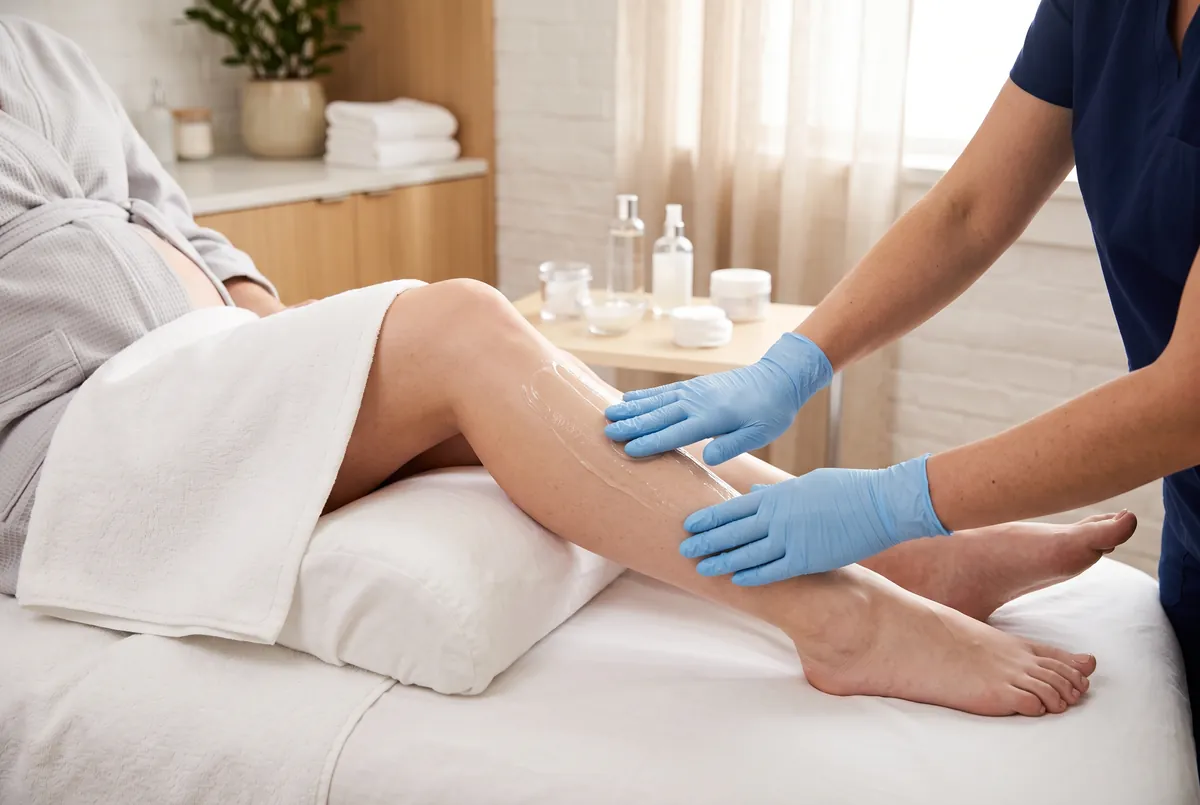
Most clients tell me yes, at least somewhat, and the bikini area is where they notice it. More blood flow, more sensitive nerve endings, and some swelling all make the pull feel sharper, and fatigue lowers anyone's tolerance. It is not universal. Clients who have waxed regularly for years often report only a modest difference, because their hair is finer and sparser to begin with. What helps is unglamorous: staying on a regular schedule so hair never gets long and dense, booking at a time of day when you feel your best, breathing out on the pull, and a waxer who works fast in small sections with firm pressure applied right after each removal.
What changes is the usual advice about taking the edge off. Outside pregnancy, clients are sometimes told to take an over-the-counter pain reliever before a wax. In pregnancy, do not take any pain medication for this purpose without asking your provider or pharmacist first, since some common ones are not recommended at certain stages. The same applies to numbing creams, which contain active drugs absorbed through the skin: ask before using one, and never apply one a studio offers without knowing what is in it. Non-drug methods are covered in detail in my guide on whether waxing hurts and how to reduce discomfort.
Aftercare follows the same principles as always, with a few pregnancy adjustments. Keep the area clean and dry, wear loose cotton clothing home, and skip hot baths, hot tubs, and saunas, which pregnant clients are generally advised to limit anyway. Choose plain, fragrance-free soothing products, and check with your provider before using anything medicated, including hydrocortisone, antibiotic ointments, and exfoliating acids marketed for ingrown hairs. Expect redness to last somewhat longer than it used to. Contact your provider, not the studio, if you see spreading redness, increasing pain, pus, fever, or swelling that worsens after the first day. The full routine is in my waxing aftercare guide.

Waxing Before Delivery: Timing the Last Appointment
Many clients want a final bikini or Brazilian wax before the birth, mostly for their own comfort in the weeks afterward, when bleeding and limited mobility make grooming the last thing anyone wants to deal with. The first thing to know is that it is entirely optional. Hair removal is not needed for labor or delivery, and no one in a delivery room is judging grooming. If you would feel better with it done, that is a perfectly good reason. If you would prefer to skip it, that is equally fine, and no professional should suggest otherwise.
On timing, opinions among providers differ. Some are comfortable with bikini waxing until late in pregnancy, while others prefer that patients avoid it in the final weeks, because freshly waxed follicles are tiny open points in the skin and they would like that skin settled before birth. So ask the question directly at a prenatal visit: "Is there a point after which you would like me to stop waxing the bikini area?" In my practice I plan the last appointment with enough room for redness and any ingrown hairs to resolve, and I remind clients that babies do not follow the calendar. Leaving it to the final days is the one plan I advise against.
A planned cesarean adds a separate consideration. The incision is usually made low on the abdomen near the upper pubic hairline, and hospital teams have their own approach to hair in that area. If hair needs to be out of the way, staff typically handle it themselves at the time, and many providers specifically ask patients not to shave the area at home in the days before surgery, since razor nicks can raise the risk of infection. Ask your provider what they want you to do, and whether a wax in the weeks beforehand is acceptable to them. Do not make this decision based on what a studio or a friend recommends.
If you are working toward a last wax, a little planning helps. Hair needs enough length for wax to grip, so the appointment before it should be spaced accordingly, and shaving in between resets the clock. Your waxer can map out the remaining visits once you know your provider's preference. I explain regrowth cycles and spacing in detail in my guide on how long waxing lasts. Keep the plan loose. If the last appointment falls on a day when you are exhausted, swollen, or having contractions of any kind, cancel it without a second thought and let your provider know about any symptoms.

For Professionals: Intake Questions and Adapting the Room
If you wax for a living, pregnancy should be a line on your intake form and a question you ask out loud at every visit for clients of childbearing age, phrased neutrally: "Any changes to your health or medications since last time, including pregnancy?" Clients in the first trimester often have not told anyone, and many assume it is irrelevant to a wax. Once you know, the consultation is short but specific. You are not assessing the pregnancy. You are collecting what you need to position her safely, choose products, and recognize when the right answer is to send her back to her provider before you touch the wax pot.
- How far along are you, and how are you feeling today?
- Has your OB or midwife said waxing is fine for you, and did they mention any areas or timing to avoid?
- Has your pregnancy been described as high risk, or have you been given any restrictions on activity?
- Do you have varicose veins, swelling, or tenderness in the legs or in the bikini area?
- Any skin changes: rashes, itching, dark patches on the face, new sensitivity to products?
- What medications and topical products are you using now, and what did you stop when you became pregnant?
- Do you have diabetes, a bleeding or clotting condition, or a history of herpes outbreaks?
- Have you felt dizzy or faint lying on your back, and which positions are comfortable for you right now?
- Are any smells bothering you at the moment?
- Would you like to stop for a bathroom or water break partway through?
Know where your scope ends. A waxer does not diagnose rashes, judge whether swelling is normal, advise on medication, or reassure a client that a symptom is nothing. The useful sentence is: "I am not able to wax over this today, and I would mention it to your provider." Say what you see, without alarm and without guessing at a cause. That boundary protects the client and your license. It is also what students should take from any training on this topic: online theory, including our waxing course, builds knowledge of skin, contraindications, and consultation, but it never replaces the supervised practical hours and the license your state requires. Check the rules for your state in the waxing licensing hub.
A prenatal-friendly room is mostly ordinary equipment used deliberately. An adjustable table that lowers and has a backrest is the biggest help. If yours is fixed, keep a firm wedge, a body pillow, two or three standard pillows with wipeable covers, and a rolled towel for hip tilt. Add a wide, non-slip step stool. Keep the room slightly cooler than usual, since pregnant clients often run warm, with a light blanket available and a small fan within reach. Remove diffusers and scented candles. Place water where the client can reach it, and know exactly how far the restroom is, because she will ask.
Keep your product lineup short and fragrance-free, and never introduce a new product without a patch test. Hygiene standards do not change in pregnancy, but your tolerance for shortcuts should be zero. Fresh gloves, a new applicator for every dip with no double-dipping, fresh table paper, disinfected tweezers, and clean linens are the baseline for every client. For a pregnant client, an avoidable skin infection carries more worry and more medical follow-up than it would otherwise, and she is trusting you with that. Work in small sections, support the skin firmly, never wax the same spot twice, and check in more often than you normally would. If you feel unsure about any part of the service, the professional choice is to do less.
Finally, have a plain plan for the client who feels unwell on the table. Stop the service, help her turn onto her left side, raise the backrest once she is steady, offer water, cool the room, and stay with her. Do not let her stand until she feels normal, and do not finish the wax afterward. If symptoms do not pass quickly, or if she reports pain, bleeding, fluid, or contractions, she needs her provider or emergency care, not reassurance from you. Every person on your team should know this routine, including whoever works the front desk, and it should be written into your studio procedures.

Alternatives if Waxing Does Not Suit You Right Now
If your provider advises against waxing, or your skin simply will not tolerate it this time, there are other temporary options. Trimming with an electric trimmer and a guard is the lowest-risk choice for the bikini area: it does not touch the follicle, cannot burn, and can be done seated with a hand mirror or with a partner's help. Shaving is fine where you can see and reach, with a fresh blade, a plain shaving gel, and no rushing, but it becomes awkward and nick-prone once the belly blocks the view. Threading and tweezing suit the face well, particularly for melasma-prone skin, since neither involves heat or product.
Sugaring is the closest relative of waxing and a reasonable alternative for some clients, because the paste is used at a lower temperature and is made from simple ingredients. It still pulls hair from the root, so the same cautions about veins, broken skin, and positioning apply. Hair removal creams work by dissolving the hair chemically. They have a strong odor that many pregnant people cannot stand, and skin that has become more reactive may respond to them differently than before, so ask your provider first and patch test if you get a yes.
Laser hair removal and electrolysis are usually postponed until after pregnancy. The reason is a lack of dedicated research on pregnant clients, not documented harm, and most studios follow that cautious standard. Laser results are also less predictable while hormones are driving new growth. If pregnancy has brought hair you would like gone for good, the practical plan is to manage it with temporary methods now, wait to see what sheds on its own after birth, and then consider permanent removal for whatever remains.

Returning to Waxing After Birth
There is no single date when waxing becomes appropriate again, and I do not give one. For the bikini area, wait until postpartum bleeding has stopped, any tear or stitches have healed, and your provider has confirmed at a postpartum visit that the area has recovered. After a cesarean, the incision and the skin around it need your provider's clearance before any wax goes near the lower abdomen or upper bikini line, and many people find that area numb or oddly sensitive for a long time afterward. Legs, underarms, and brows are less affected by the birth itself and can usually resume earlier, once you feel up to lying on a table.
Expect your skin and hair to keep changing for a while. Hormone levels shift again after delivery, and the hair that stayed in its growth phase during pregnancy begins to shed, most visibly on the scalp. Body hair that appeared during pregnancy often thins as well. Skin may remain more reactive than your pre-pregnancy baseline, and melasma can take time to fade, so the facial caution continues, along with daily sun protection. Treat the first postpartum wax like a first visit: a fresh intake, a patch test, hard wax on sensitive zones, and a conservative service. Tell your waxer if you are nursing and about any medication you are taking.
Your Next Step
If you are pregnant and want to keep waxing, do three things this week. Ask your OB or midwife at your next visit whether waxing is fine for you and whether they want you to stop the bikini area at any point before your due date. Tell your studio you are pregnant when you book, and ask how they position clients later in pregnancy. Then choose a time of day when you usually feel well and book a longer slot than you used to. If you do not yet have a waxer you trust with this, browse licensed providers in our studio directory and ask those same questions before you commit.
If you are a professional or a student, turn this guide into a routine: add pregnancy to your intake form, stock the pillows and the step stool, write down your procedure for a client who feels faint, and decide your studio's policy on provider approval before the next pregnant client walks in. If you are still building your foundation, online theory covers skin, contraindications, and consultation, to be combined with the in-person training and license your state requires. Calm, well-prepared prenatal service is one of the clearest ways a waxer earns long-term trust.
State Requirements
State licensing guides
Hours, exams, fees, and the licensing board differ by state. Open your state for the current requirements.
Common Questions
FAQ
Waxing is a surface service and is widely treated as a reasonable option in an uncomplicated pregnancy, which is why most studios continue to see pregnant clients. Skin is usually more sensitive, so irritation, redness, and bruising are more likely than before. Whether it suits your pregnancy is a question for your OB or midwife, especially if you have complications, varicose veins near the area, a skin condition, diabetes, or prescription medications. This is general information, not medical advice.
Many people do, with their provider's approval and a waxer experienced in prenatal positioning. Expect it to feel more intense than usual and expect the waxer to use hard wax, small sections, and side-lying or semi-reclined positions. The service should stop if you feel faint or if the waxer sees swollen veins or broken skin. If you have never had one, a bikini line is a gentler place to start.
For many clients it does, mainly in the bikini area, because blood flow and skin sensitivity increase and fatigue lowers pain tolerance. Regular waxers often notice only a modest difference. Staying on a steady schedule, booking when you feel your best, and a fast, careful technique help most. Do not take pain relievers or use numbing cream for a wax without asking your provider or pharmacist first, since some products are not recommended in pregnancy.
There is no single rule, and providers differ. Some are comfortable with bikini waxing late in pregnancy, while others prefer that patients avoid it in the final weeks so the skin is settled before birth. Ask your OB or midwife directly, particularly if a cesarean is planned. I advise clients not to leave the last wax to the final days, because skin needs time to calm down and babies often arrive earlier than expected.
Waxing acts on hair and the surface layers of skin, and I am not aware of evidence that it affects the baby or brings on labor. The realistic risks are to your own skin: irritation, burns, lifting, bruising, and infection. That said, a waxer is not the right person to rule out risk for your pregnancy. If you have been told your pregnancy is high risk, or you notice pain, bleeding, or contractions, speak with your provider and skip the appointment.
Skin directly over varicose veins, any area with a rash, broken skin, or infection, and facial skin with melasma or new dark patches should be left alone. I also do not wax the pregnant belly or the breast area, where the skin is stretched and tender, and trimming is a better choice. Legs, underarms, brows, and the bikini area are commonly waxed when the skin is healthy and your provider has no objection.
It depends on the area and on your recovery. Legs, underarms, and brows can usually resume once you feel comfortable on a table. For the bikini area, wait until bleeding has stopped, any tear or stitches have healed, and your provider has cleared you at a postpartum visit. After a cesarean, get clearance before waxing near the incision. Treat the first appointment as a new start, with a patch test and a conservative service.
Keep Reading
Related Guides


