Electrolysis
Electrolysis Continuing Education: Requirements and Planning

Quick answer
Continuing education for electrologists is set by each state board. Some require credit hours or specific topics for renewal and some require none. Ask your board how many hours, which subjects and which providers it accepts, keep certificates for every course, and choose training that improves your technique and safety, not only your renewal status.
Electrolysis continuing education is the training a licensed electrologist completes after school and after the state exam, usually to keep a license active and always to keep skills current. Some states attach a specific number of credit hours to each renewal cycle, some list required topics such as infection control, and some require nothing formal at all. The rules are set by your state board, so the first thing I tell any new electrologist is to read their own board's renewal rules before they spend a dollar on a class.
I have been practicing for more than twenty years, and the courses that changed my work most were rarely the ones I took to satisfy a requirement. They were the ones I picked because a client situation stumped me: a coarse, distorted follicle I could not clear, a skin type that reacted more than I expected, a modality I had stopped using. This guide covers why continuing education matters, what formats exist, how to judge a provider, and how to keep records that hold up if your board ever audits your renewal.
What Continuing Education Means for Electrologists
In licensing language, continuing education (often shortened to CE, and sometimes measured in continuing education units or contact hours) is structured learning that a board recognizes toward renewal. The key word is recognizes. A board may accept courses from approved providers only, from any provider that meets certain content rules, or from a list of professional associations. A workshop that teaches you a great deal might still not count if it falls outside those rules, and a course that counts might teach you very little. Both facts matter when you plan your year.
For electrologists, continuing education usually falls into a few content areas: infection control and sterilization, the three modalities (galvanic, thermolysis and blend), skin and hair biology, endocrinology and hormonal hair growth, client safety and contraindications, and practice management. Some boards care which of these you cover. Others only count the total. If your license is held under a broader cosmetology or medical board, the categories may be written for several professions at once, which can make the language harder to apply to electrology specifically.
There is also the continuing education you do for yourself, with no credit attached. Watching a skilled colleague work, practicing insertions under magnification on your own time, or reading current dermatology material all count in the real sense, even when they do not count on a renewal form. A good practitioner does both kinds. The required kind keeps the license. The self-directed kind keeps the clients.
Why CE Matters Beyond Renewal
The obvious reason is legal. If your state requires continuing education and you skip it, you may not be able to renew, and working on a lapsed license creates problems with your board, your insurance carrier and your clients. That alone makes it worth planning. But in my experience the bigger payoff comes from the clinical side. Electrolysis is a hand skill built on judgment, and judgment drifts if you never test it against new information.
Consider what changes over a career. Equipment gets updated, and a newer epilator may handle current, timing and modality settings in ways your school machine did not. Probe styles and coatings change. Client populations change too: many studios now see more clients with hormonal conditions, more clients in gender-affirming care, and more clients who have already had laser and arrive with patchy, resistant regrowth. Each of these groups benefits from a practitioner who has studied them specifically, not one relying on what was taught years ago.
Continuing education also protects you. Infection control standards are refined over time, and a board inspector or a client with a complaint will judge you by current expectations, not by what was normal when you trained. A recent sterilization course, documented in your file, shows that you kept up. And finally there is the business reason. Clients notice when you can explain why you chose a modality, why you adjusted your settings, and what to expect. That confidence comes from learning that did not stop at graduation.
I also see continuing education as a guard against isolation. Many electrologists work alone in a small room for years. Without classes, conferences or study groups, it is easy to keep repeating a habit that a colleague would have corrected in five minutes. Some of my most useful corrections came from a single comment by another practitioner during a hands-on session, the kind of feedback you cannot get from your own reflection in a mirror.

How State Requirements Differ
Electrology regulation in the United States is uneven. Some states license electrologists through a dedicated board, some through a cosmetology or barbering board, some through a health or medical board, and a few do not license electrology as a separate profession at all. Continuing education rules follow that structure. A state with a dedicated electrology board may spell out detailed topic requirements, while a state that folds electrology into a broader license may write general rules that apply to many beauty professions at once.
The variables to look for are consistent even when the answers differ: the length of the renewal cycle, whether there is any CE requirement, the number of hours if there is one, required subject areas, whether online or home-study hours count and whether there is a cap on them, whether providers must be pre-approved, how long you must keep proof, and whether the board audits a sample of renewals. Write those answers down in one place for your state. I keep mine on a single page at the front of my CE binder.
If you hold licenses in more than one state, or you plan to move, the work doubles. Courses that satisfy one board may not satisfy another, and the timing of renewal cycles rarely lines up. Our guide on electrolysis license reciprocity between states explains the transfer side; for continuing education, the practical answer is to pick courses that meet the stricter of your boards' rules whenever possible, so one class serves both renewals.
| Question to answer for your state | Where to find it | Why it matters |
|---|---|---|
| Is CE required for electrology renewal? | Board statutes or renewal page | Decides whether you need a plan at all |
| How many hours per cycle, and how long is the cycle? | Board rules or renewal form | Sets your yearly pace |
| Are certain topics mandatory? | Board rules | Infection control is a common required topic |
| Do online or home-study hours count, and is there a limit? | Board rules or FAQ | Affects which formats you can rely on |
| Must providers be approved in advance? | Board provider list | Unapproved courses may not count |
| How long must you keep certificates? | Board rules | Audits can ask for past cycles |
Common Continuing Education Formats
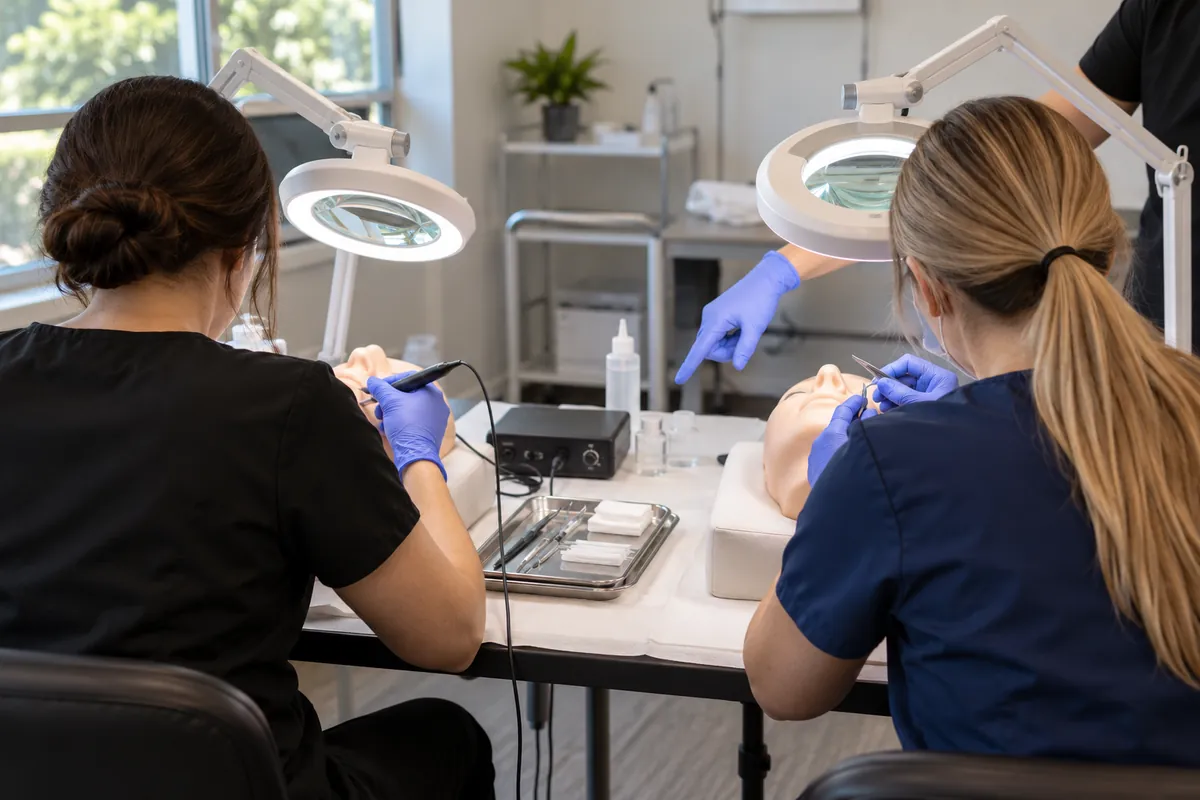
Electrolysis continuing education comes in a handful of formats, and each one teaches a different kind of thing. Live in-person workshops are the strongest for hand skills. You watch an instructor insert, you insert while someone watches you, and you get corrected in real time on angle, depth and timing. Nothing replaces that for technique. The downside is cost, travel and time away from clients, so most practitioners take these less often and choose them carefully.
Live online classes, taught in real time over video, work well for theory, case discussion and business topics. You can ask questions, and the instructor can respond to what the group is struggling with. Recorded online courses are the most flexible: you study at your own pace, often with quizzes at the end. They suit subjects such as endocrinology, skin conditions, infection control theory and record keeping. Whether recorded hours count for renewal depends entirely on your board.
Conferences and conventions mix lectures, demonstrations and vendor exhibits. They are useful for seeing new equipment and meeting colleagues, though the credit value of each session varies. Manufacturer trainings on a specific epilator can be very practical, but they are partly product education, so treat claims about one machine with the same care you would treat any sales talk. Finally, some practitioners arrange private one-on-one sessions with an experienced electrologist for focused technique work. These may or may not carry formal credit, yet they are often the fastest way to fix a specific problem.
Topics Worth Studying After Licensing
If your board leaves topic choice to you, it helps to build a rotation rather than repeating whatever is convenient. I think of it in layers. The first layer is safety: infection control, sterilization, sharps handling and bloodborne pathogen awareness. These are the topics an inspector will ask about and the ones where errors cause real harm, so I refresh them every cycle even when not required. Our sibling guide on autoclave and sterilization for electrolysis covers the practical side.
The second layer is technique: modality theory, insertion accuracy, current and timing adjustments, working on difficult areas, and treating distorted or curved follicles. If you trained mostly in one modality, a course in another can open options for clients you currently struggle with. Our explainer on galvanic, thermolysis and blend is a good refresher before you choose a modality course.
The third layer is the client: hair growth cycles, hormones, medications that affect skin and healing, skin of color, sensitive skin, aftercare, and contraindications. A course here changes your consultations more than your hands. The fourth layer is the business: record keeping, consent, pricing, marketing, ethics and communication. These rarely feel urgent, yet they are often where a practice succeeds or quietly struggles. Rotating through all four layers over a few years keeps you balanced.
- Safety: infection control, sterilization cycles and monitoring, sharps disposal, exposure response.
- Technique: modality theory, insertion depth and angle, current and timing, difficult and curved follicles.
- Client knowledge: hair growth phases, endocrine conditions, skin of color, medications, contraindications, aftercare.
- Practice: consent and records, ethics, communication, pricing, scheduling, marketing basics.
- Teaching and mentoring: for practitioners who plan to train others later.
How to Choose a CE Provider
Start with eligibility, because a beautiful course that your board rejects is a loss of time and money. If your board publishes a list of approved providers, check it first. If it does not, read the board's description of acceptable content and match the course outline against it. When in doubt, email the board with the course title, provider and outline, and keep their reply. That one email has saved colleagues of mine from an unpleasant surprise during an audit.
Next, look at who teaches. A good instructor for electrolysis continuing education is an experienced, licensed electrologist or, for medical topics, a qualified clinician speaking within their own field. Look for a clear outline with learning objectives, a stated number of hours, a description of how attendance or completion is verified, and a certificate that includes your name, the course title, the date, the hours and the provider's details. Vague promises such as "master advanced techniques" without an outline are a warning sign.
For hands-on courses, ask about group size and practice time. A workshop where twenty people watch one demonstration is a lecture, not a practical. Ask what you will practice on, whether you will be observed, and whether you get individual feedback. For online courses, look for a sample lesson or a syllabus you can read before paying. Be cautious with any provider that suggests their course replaces state-required training hours or a license. Theory courses, including our own electrolysis course, build knowledge; they never substitute for the in-person training and licensing your state requires.

Online vs In-Person CE: What Each Does Well
The debate about online versus in-person learning often misses the point. They do different jobs. Online study is efficient for knowledge: the biology of the follicle, the chemistry of lye production in galvanic work, the signs of a skin reaction, the elements of a consent form. You can pause, rewind and take notes, and you can fit it around clients. For many practitioners, especially those far from training centers, it is the only realistic way to keep up with theory.
In-person learning is necessary for hand skills. You cannot learn to feel the slight give at the base of a follicle, or to correct a habit of inserting too steeply, from a video alone. A trained eye watching your hands catches things you cannot see yourself. That is why I recommend pairing them: study a technique topic online first so you arrive at the hands-on session already understanding the theory, then use the workshop time entirely for practice and feedback.
From a credit standpoint, check whether your board limits online hours, requires some live hours, or treats live online classes differently from recorded ones. Those distinctions are common in licensing rules generally, and they decide how you build your plan. If your board allows mostly online hours, it is still worth adding at least occasional in-person technique work on your own initiative. The renewal form may not ask for it, but your clients' results will show it.
| Format | Best for | Limitations |
|---|---|---|
| Recorded online course | Theory, biology, infection control concepts, records | No feedback on your hands; credit may be limited |
| Live online class | Case discussion, questions, business topics | Still no hands-on correction |
| In-person workshop | Insertion technique, modality practice, difficult areas | Travel, cost, time away from clients |
| Conference | Equipment, networking, varied lectures | Credit varies by session; sales content mixed in |
| Private mentoring session | Fixing a specific technique problem | May not carry formal credit |
Building a Yearly CE Plan
A plan prevents the most common CE problem I see: a scramble in the final weeks before renewal, when the only available courses are whatever fits the calendar. Start by writing your renewal date and your board's requirements at the top of a page. Then list the gaps you notice in your own work. Maybe you avoid certain body areas, maybe your regrowth rate on a particular hair type is higher than you would like, maybe your consultation notes are thin. Those gaps are your syllabus.
Spread the hours across the cycle rather than stacking them at the end. A rhythm that works for many practitioners is one theory topic each season and one hands-on session per cycle, adjusted for what your board actually requires. Put the course dates in your appointment book as blocked time so clients cannot fill them. If you work in a shared studio, coordinate with colleagues so you can attend the same workshop and share travel, or so one of you covers the other's clients.
Budget for it, too. Course fees, travel, and lost appointment time are all real costs, and they are easier to absorb when planned. Many self-employed practitioners treat continuing education as a business expense; ask your tax professional how it applies to your situation. If you are new and money is tight, prioritize required topics and one technique course that addresses your weakest area, then add more as your practice grows.

Tracking CE Credits and Keeping Records
Many boards accept your word at renewal, then audit a sample of licensees afterward and ask for proof. If you are selected, you need certificates showing that the hours were completed within the cycle and met the rules. Losing a certificate can mean scrambling to contact a provider who may no longer exist, so I treat CE records the way I treat client records: organized, dated and kept in two places.
My system is simple. Every certificate goes into a physical binder in date order and is also scanned into a cloud folder named by renewal cycle. Alongside them I keep a one-page log with columns for date, course title, provider, format, hours, topic category and where the certificate is stored. At renewal time I add up the log and compare it to the requirement. If the board asks for proof, I can send everything the same day.
Check how long your board wants records kept, and keep them at least that long. Some practitioners keep them for their whole career, which costs nothing with digital storage. Also keep course outlines and any approval correspondence with the board. If a course's eligibility is ever questioned, the outline shows exactly what was covered, and the email from the board shows that you checked in good faith.
- Save the certificate the day you receive it, both on paper and as a scan.
- Confirm it shows your name, course title, date, hours and provider details.
- Add a line to your CE log with the topic category and format.
- File the course outline and any board approval email with it.
- Before renewal, total the hours by category and compare with the board rules.
- Keep the full set for at least the period your board specifies.
Continuing Education in Your First Years
New electrologists often assume continuing education is something for later. I would argue the first two or three years are when it pays most. School and the exam give you a foundation, but the volume of real clients you see in your first years exposes gaps quickly. You meet hair types you rarely saw in school, clients with conditions you only read about, and treatment areas you practiced only a handful of times.
In that period, the most valuable learning is usually technique feedback. Find an experienced practitioner willing to watch you work, even for one session, and ask them to be honest. Then pick one theory course on a topic that keeps coming up in your consultations, such as hormonal hair growth or electrolysis on skin of color. Our guide with advice for beginner electrologists covers more of what to focus on in those early years.
Keep a short notebook of clinical questions as they come up during the week. Which hairs did not release easily? Which client reacted more than expected and why? Over a few months, the notebook shows patterns, and the patterns tell you which course to take next. This approach turns continuing education from a box to tick into a direct response to your own clients' needs, which is what it should be.

Advanced Learning and Specialization
Once the basics are solid, continuing education can shape the direction of your practice. Some electrologists build a reputation for gender-affirming work, including facial clearing and, where it is part of their scope, pre-surgical hair removal in coordination with a surgical team. Others focus on clients with hormonal conditions, on eyebrow and fine facial work, or on clients with darker skin who want to avoid pigment changes. Each specialty rewards targeted study.
Specialization also brings responsibility. If you advertise a focus, clients will expect deeper knowledge, and in some areas, such as work related to surgery, coordination with medical providers matters. Make sure any specialty work stays inside your licensed scope, which varies by state; check with your board if you are unsure. A specialty course does not expand your legal scope of practice, even if it teaches a technique.
Some practitioners pursue a voluntary professional certification on top of their license, such as the exam discussed in our guide to IBEC certification. Voluntary credentials may come with their own continuing education rules for maintaining them, separate from your state board's. Read those rules carefully so you can choose courses that satisfy both at once when possible.
Mistakes Electrologists Make With CE
The first mistake is waiting until the last month. Courses fill, approved options shrink, and practitioners end up taking whatever is available rather than what they need. The second is assuming a course counts because the provider says it is "accredited" or "approved." Approved by whom, and for which state? Unless the approval comes from your board, or meets your board's stated rules, it may not apply to you.
The third mistake is poor record keeping: certificates left in email inboxes, providers that close, scans never made. The fourth is taking the same comfortable topic every cycle. If every course you take is about business, your hands stagnate; if every course is technique, your records and consent process may fall behind current expectations. The fifth is confusing a certificate of attendance with competence. Sitting through a course does not mean the skill transferred. Practice what you learned in the following weeks, ideally with feedback.
One more mistake is worth naming. Some practitioners renew their license while on inactive status or after a long break and then return straight to a full schedule. If you have stepped away for a while, plan a hands-on refresher before you take on difficult cases, even if the board does not require one. The cost of a refresher is small compared with the cost of an avoidable reaction or a complaint.

Turning CE Into Better Client Results
The test of continuing education is whether your clients notice the difference. After each course, choose one specific change to make in your practice for the next month. It might be a new way to explain the treatment plan during consultations, an adjustment to your setting approach on coarse hair, or a revised aftercare sheet. One change, applied consistently, beats ten ideas that fade by the next week.
Track what happens. If a course taught a technique for reducing regrowth on deep terminal hair, note which clients you used it on and compare how their hairs return over the following sessions. If a course improved your consultation, notice whether clients ask fewer worried questions afterward. This is informal, but it turns learning into evidence and helps you decide what to study next.
Share what you learn with clients in plain terms when it helps them. A client who knows you recently trained in working with sensitive skin, for example, feels reassured. Avoid inflating it into marketing claims you cannot support. Continuing education should make you more careful and more honest, not more promotional. Our guide on marketing an electrolysis business online covers how to talk about your training without overpromising.
A Simple Electrolysis CE Checklist
Here is the checklist I would give any licensed electrologist at the start of a renewal cycle. It covers the legal side and the professional side together, because in practice they belong together. Print it, put it in the front of your CE binder, and tick items off as you go. It takes a few minutes per cycle and removes almost all of the stress from renewal time.
- Confirm your renewal date and cycle length on the board's website.
- Write down the required hours, topics, format limits and provider rules for your state.
- List three gaps in your current work that you want to close this cycle.
- Choose at least one safety topic, one technique topic and one client or practice topic.
- Verify eligibility of each course before paying, and save the board's reply if you ask.
- Block course dates in your appointment book.
- Save each certificate on paper and as a scan the day you receive it.
- Update your CE log with date, provider, format, hours and topic.
- Apply one change in your practice after each course and note the result.
- Total your hours well before the renewal deadline and fill any gap calmly.
Questions to ask your board about CE
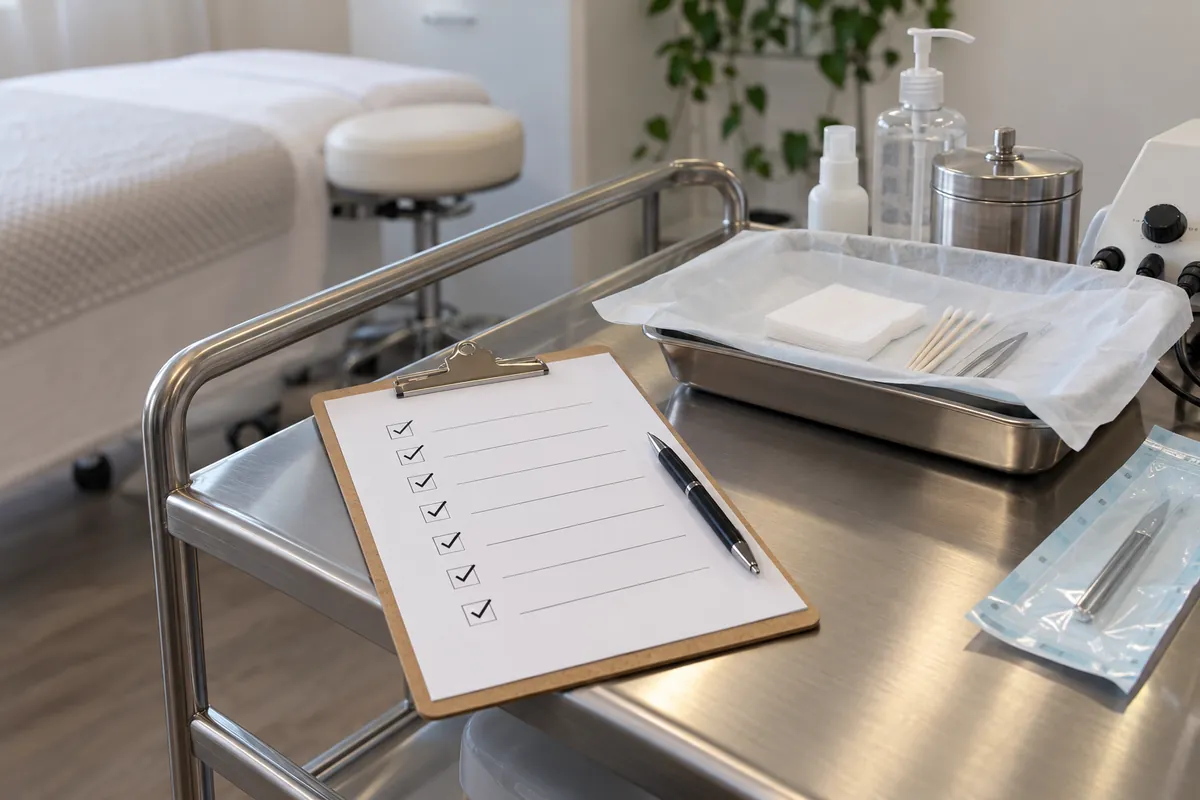
Rules for continuing education change, and general guides go out of date quickly, so the most reliable habit is to ask your board directly. Ask how many hours your license requires, over what period, which subjects are mandatory, whether online courses are accepted, how a provider is approved, and what proof you must keep. Ask what happens if you finish late, and whether there is a grace period or a reinstatement route. Write down the date and the name of the person who answered. If a rule is unclear, request the answer by email so you have a record.
Also ask whether your professional association or another credential has its own education requirements. Some electrologists keep several credentials active, and the hours for one may or may not count toward another. Keep a single list of every deadline in one place, with reminders set well ahead. A missed renewal can mean extra fees or a longer path back, and in the meantime you cannot legally work. A fifteen minute phone call or email now is far cheaper than fixing a lapse later.
Your Next Step
Open your state board's website today and find the renewal rules for electrology. Write down your renewal date, whether continuing education is required, and how it is counted. If you are not yet sure which board licenses electrologists in your state, our state-by-state electrolysis licensing hub will point you to the right place. Then choose one course that addresses the problem you most want to solve this year.
If you are still in training or thinking about becoming an electrologist, remember that study habits formed early tend to last. Our online electrolysis theory course is one way to build a strong knowledge base, alongside the in-person training and licensing your state requires. If teaching interests you later, see our guide on how to become an electrology instructor, since instructors often carry their own continuing education expectations.
State Requirements
State licensing guides
Hours, exams, fees, and the licensing board differ by state. Open your state for the current requirements.
Looking for a practitioner or a program near you? Browse electrologists by state and city or beauty schools by state.
Common Questions
FAQ
No. Requirements vary widely. Some states require a set number of continuing education hours each renewal cycle, some require specific topics such as infection control, and some have no CE requirement for electrology at all. A few states do not license electrology separately. Check the current rules on your state board's website or start with our electrolysis licensing guides, and confirm again before each renewal because rules change.
Often, but it depends on your board. Some boards accept online or home-study courses without limits, some cap the number of online hours, and some require part of the credit to be completed live. Online study works very well for theory, infection control concepts and record keeping. For hand skills, pair it with occasional in-person workshops even if your board does not require them.
Check whether your board publishes a list of approved providers, and if so, confirm the provider is on it. If not, compare the course outline with the board's description of acceptable content. When unsure, email the board with the course title, provider and outline, and keep the reply. Do not rely only on a provider's statement that a course is approved.
At least as long as your board requires, which is set in its rules. Many practitioners keep them much longer because digital storage is cheap and audits can ask about past cycles. Keep a paper copy and a scan, along with the course outline and any correspondence with the board about eligibility.
Contact the provider right away and ask for a replacement certificate. Many providers keep completion records. If the provider no longer exists, explain the situation to the board honestly and provide whatever proof you have, such as payment records or course materials. Consequences depend on your board. The best protection is filing certificates the day you receive them.
No. A course can teach you a technique, but your legal scope of practice is set by your state's laws and board rules. If an advanced course demonstrates something outside electrology's scope in your state, completing it does not make that service legal for you. Confirm scope with your board before offering anything new.
In the first years, focus on infection control, insertion technique feedback from an experienced practitioner, and client topics that come up often in your consultations, such as hormonal hair growth, sensitive skin or skin of color. Keep a weekly notebook of clinical questions and let the patterns guide your next course. Our guide with advice for beginner electrologists covers more.
Keep Reading
Related Guides


