Career
Electrologist Ergonomics: Preventing Back Pain and Eye Strain
Quick answer
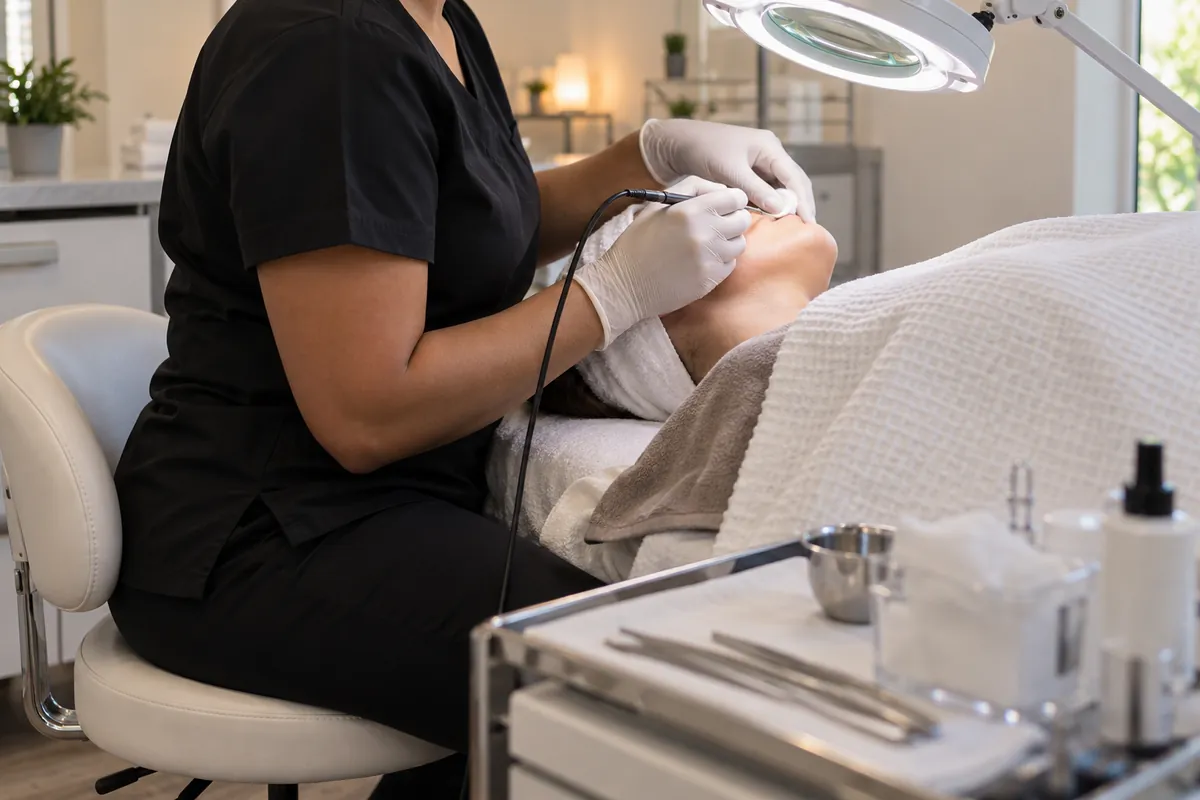
Electrologist ergonomics means bringing the work to you: an adjustable table and client positioning that put the treatment area at a comfortable height, a supportive rolling stool, and a magnifier positioned so you look through it while sitting upright. Use even, glare-free lighting, keep a relaxed grip with straight wrists, take regular short breaks, care for your hands, and see a professional for persistent pain or vision changes.
Electrologist ergonomics is something most of us learn about too late. Training focuses on insertions, modalities and sterilization, and rightly so. But the job itself asks you to sit still for long periods, lean toward a small target under magnification, hold a probe holder with steady fingers, and repeat the same fine movement many hundreds of times a day. Done with poor posture and poor lighting, that work leaves a mark: a stiff neck, an aching lower back, burning eyes, tingling fingers. I have worked as an electrologist for more than twenty years, and the practitioners I have seen leave the profession early often did so because of their bodies, not their skills.
This guide covers the practical side of protecting your back, neck, eyes and hands: how to set up your chair and table height, how to use magnification and lighting, how to position clients, how to plan breaks and how to care for your hands. It is general information from practice, not medical advice. If you already have persistent pain, numbness, weakness or vision changes, see a physician, physical therapist or eye care professional. Small adjustments can make a large difference, but they do not replace proper evaluation when something is wrong.
Why ergonomics matter so much in electrolysis
Electrolysis combines several risk factors that occupational health specialists recognize in many precision jobs. The work is static: you hold your trunk, shoulders and neck in roughly the same position for long periods. It is close and visual: you focus intensely on a small area, often under magnification. It is repetitive: the same pinch grip and small wrist movement repeat with every insertion. And it often involves leaning or twisting, especially when the treatment area is awkward or the table is at the wrong height. Each factor alone is manageable. Together, over years, they add up.
The good news is that most of the strain is under your control. Unlike many jobs, you usually choose your own chair, table, lamp and schedule. That means a few decisions made once, and a few habits repeated daily, can prevent much of the discomfort that many practitioners accept as normal. Ergonomics also improves your work. A practitioner who can see clearly, sit comfortably and keep a steady hand performs more accurate insertions, which means better results and less skin reaction for clients.
Neutral posture: the baseline to aim for
A neutral posture is one where your joints are close to the middle of their range and your muscles are not working hard just to hold you in place. For seated precision work, that usually means your feet flat on the floor or a footrest, your knees roughly level with or slightly below your hips, your lower back supported in its natural curve, your shoulders relaxed rather than raised, your upper arms close to your body, and your head balanced over your shoulders rather than pushed forward. Your forearms and wrists should be supported where possible so your fingers can do the fine work.
No one holds a perfect posture all day, and the aim is not rigidity. The aim is to return to a neutral starting point often, and to avoid long stretches at the extremes: head bent far forward, shoulders hunched, trunk twisted toward the client, wrist bent sharply. Notice your posture at the start of each client and again partway through. Many practitioners discover that they begin each session upright and finish it bent over the client, without realizing when it happened.
- Feet: flat on the floor or a footrest, not tucked under the stool.
- Hips and knees: hips level with or slightly above knees.
- Lower back: supported, keeping its natural curve.
- Shoulders: relaxed and down, not lifted toward the ears.
- Upper arms: close to the body rather than reaching out.
- Head and neck: balanced over the shoulders, with only a slight downward gaze.
- Forearms and wrists: supported, wrists close to straight.
Choosing and setting up your chair or stool
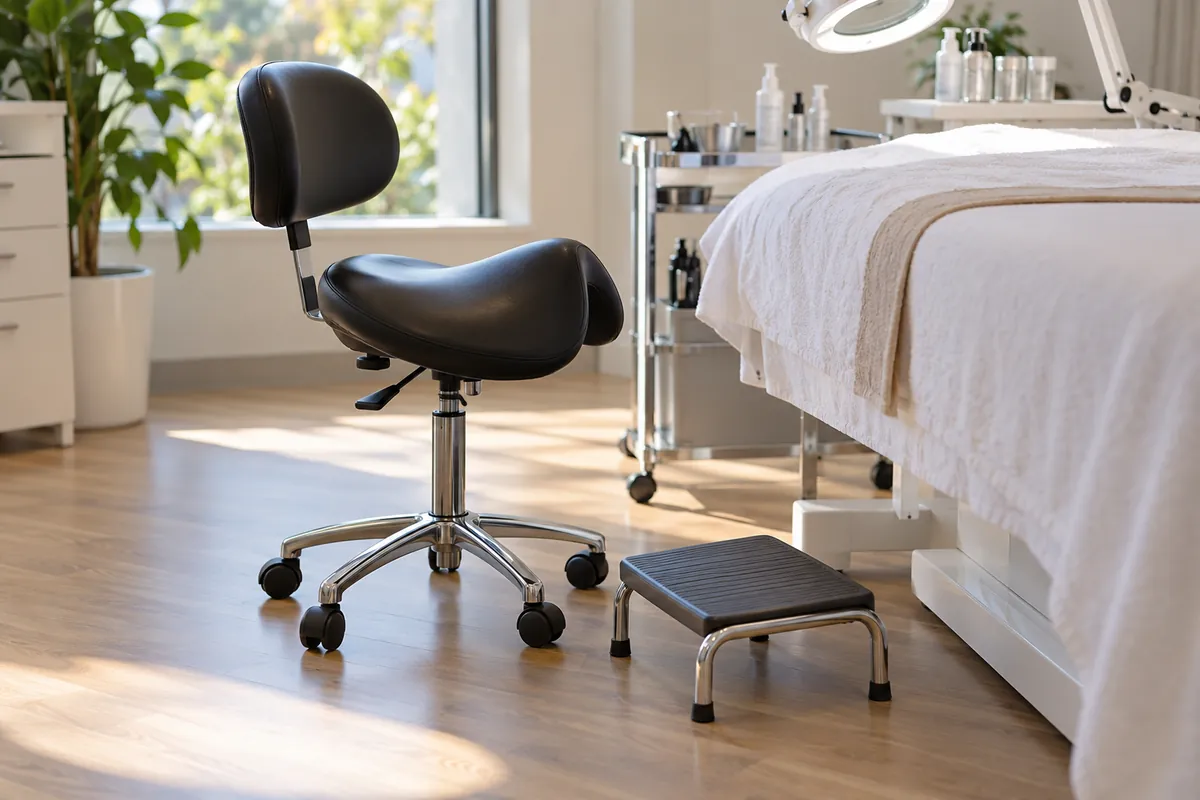
Your chair is the foundation of your posture, and it is worth investing in. Look for a stool or chair that adjusts easily in height, rolls smoothly, and can be positioned close to the table without bumping your knees. Some electrologists prefer a saddle-style stool, which opens the hip angle and encourages a more upright spine; others prefer a conventional operator stool with a small backrest. Try different types if you can. The best choice is the one that lets you sit upright, close to the work, for long periods without discomfort.
Set the height first. With your feet flat, adjust the seat until your hips are level with or a little above your knees. Then check whether you can reach the treatment area without raising your shoulders or bending far forward. If you cannot, the answer is usually to change the table height or client position, not to sit lower or lean in. A backrest helps only if you use it; position it to support your lower back when you sit upright, and adjust it so you can lean against it between insertions.
Mobility matters too. A rolling stool lets you move around the client rather than twisting your trunk to reach different areas. For a chin and neck session, for example, you may work from one side of the head and then roll around to the other side rather than leaning across. Clear the floor around the table so you can move freely, and route cords where they will not catch on stool wheels or feet.
Treatment table height and client positioning
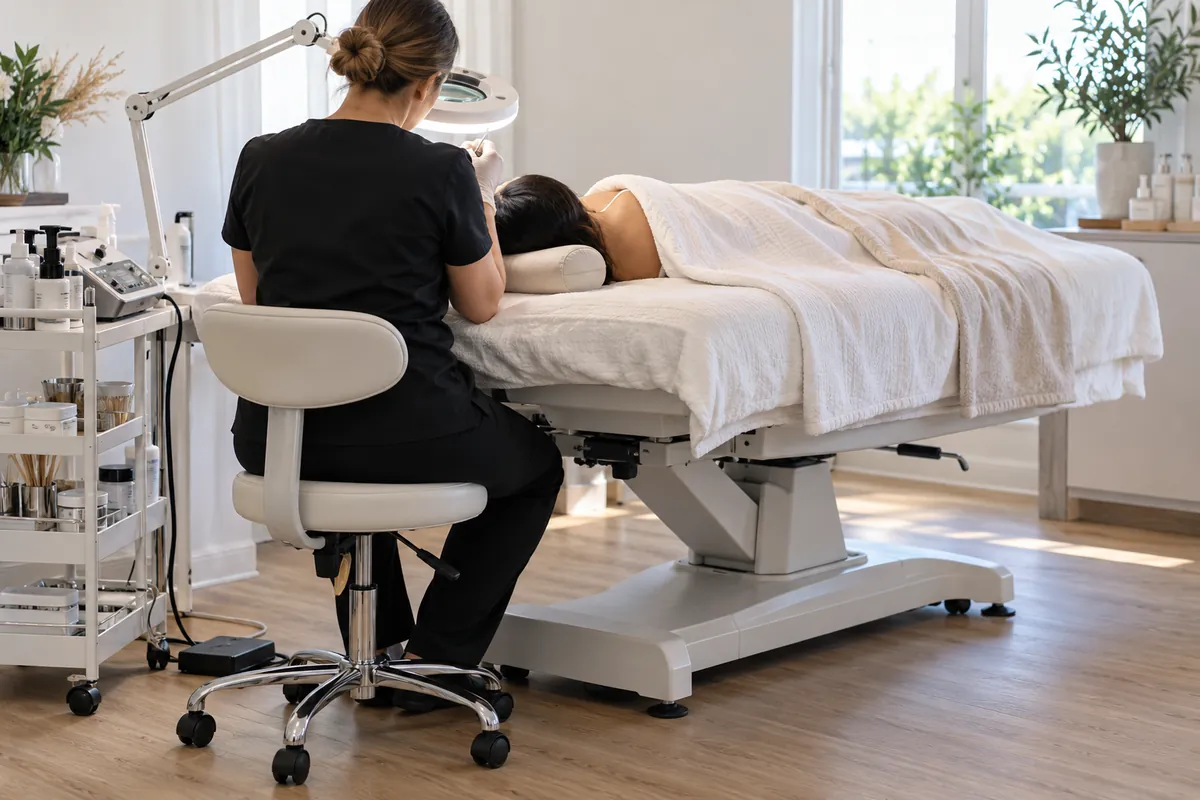
The single most useful ergonomic tool for many electrologists is an adjustable treatment table. Different clients, different areas and different modalities need different working heights. A facial session might need the client's face at one height; an underarm session needs a different position. With a fixed table, the practitioner adapts by bending or reaching. With an adjustable table, usually electric or hydraulic, you raise or lower the client and keep your own posture neutral.
As a general guide, the treatment area should be at a height that allows your elbows to stay close to your body and bent at a comfortable angle, with your forearms supported if possible. Your eyes should be able to look slightly downward at the area through the magnifier without bending your neck far forward. Exact heights depend on your body size and your magnifier, so experiment: adjust the table, sit in your neutral posture, and see whether you can reach and see the area without strain.
Client positioning is just as important. Ask the client to turn their head, tilt their chin or move toward the edge of the table rather than leaning across them. Use pillows, bolsters or rolled towels to support the client so they can hold the position comfortably. A client who is comfortable stays still, which makes your work easier and more accurate. Explain at the start that you may ask them to shift position often; most clients are happy to help once they understand why.
Magnification and how it affects your eyes and neck
Magnification is essential in electrolysis. You need to see the follicle opening, the angle of the hair and the skin's response clearly to insert accurately. Most electrologists use a magnifier lamp, and some use head-mounted loupes or a combination. Each choice affects your posture. A magnifier lamp positioned well lets you sit upright and look through the lens; positioned poorly, it pulls you forward into a hunched posture. Loupes move with your head, which can encourage a forward head tilt if the working angle is wrong.
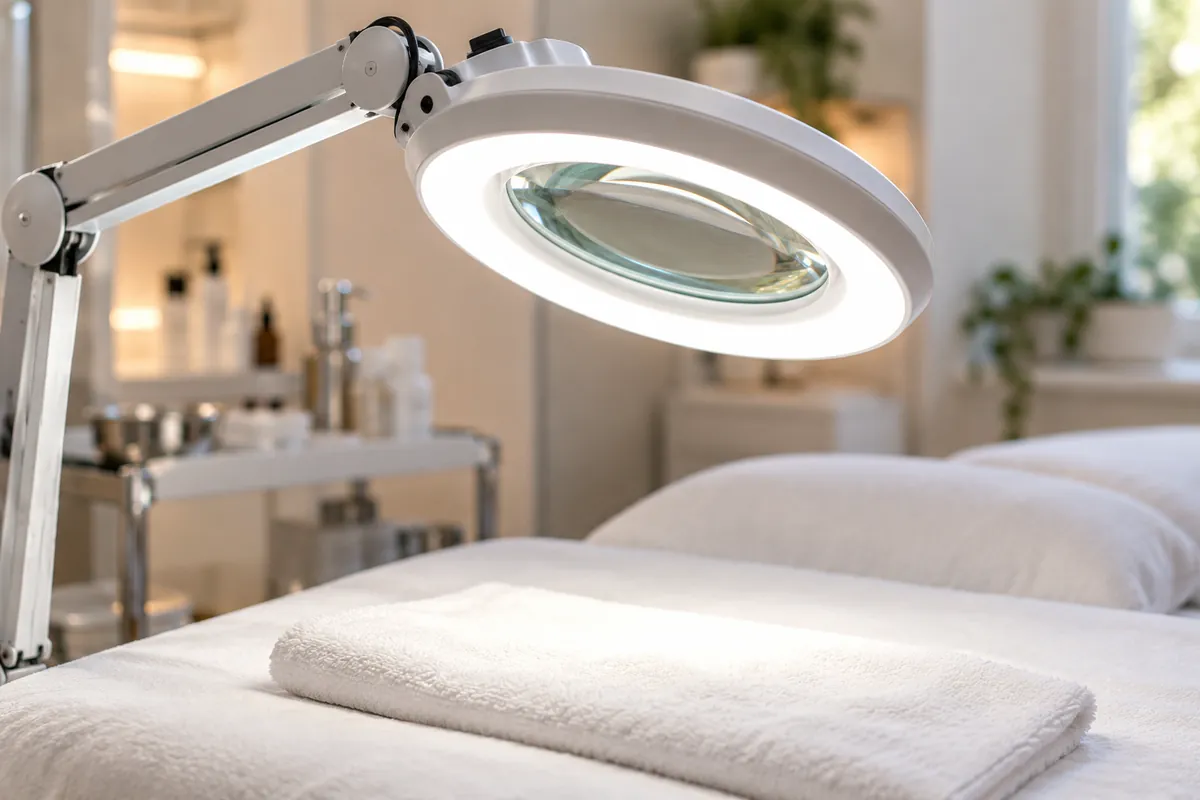
With a magnifier lamp, position the lens between your eyes and the treatment area so you can look through it with a slight downward gaze while sitting upright. Adjust the lamp arm before you start, not partway through. Choose a magnification strength that gives a clear view at a comfortable working distance; too strong can make the image harder to hold in focus and force you closer, too weak can make you lean in. If you use loupes, choose a working distance and declination angle that suit your posture, ideally with professional fitting.
Eye strain often comes from long periods of intense focus at a fixed distance, combined with reduced blinking. Symptoms can include tired or burning eyes, dryness, blurred vision late in the day and headaches. Small habits help: blink deliberately, look away at something across the room between clients or during short pauses, and keep the room air from becoming too dry. Have regular eye examinations, tell your eye care professional what your work involves, and ask whether your prescription suits your working distance.
Lighting for precision work
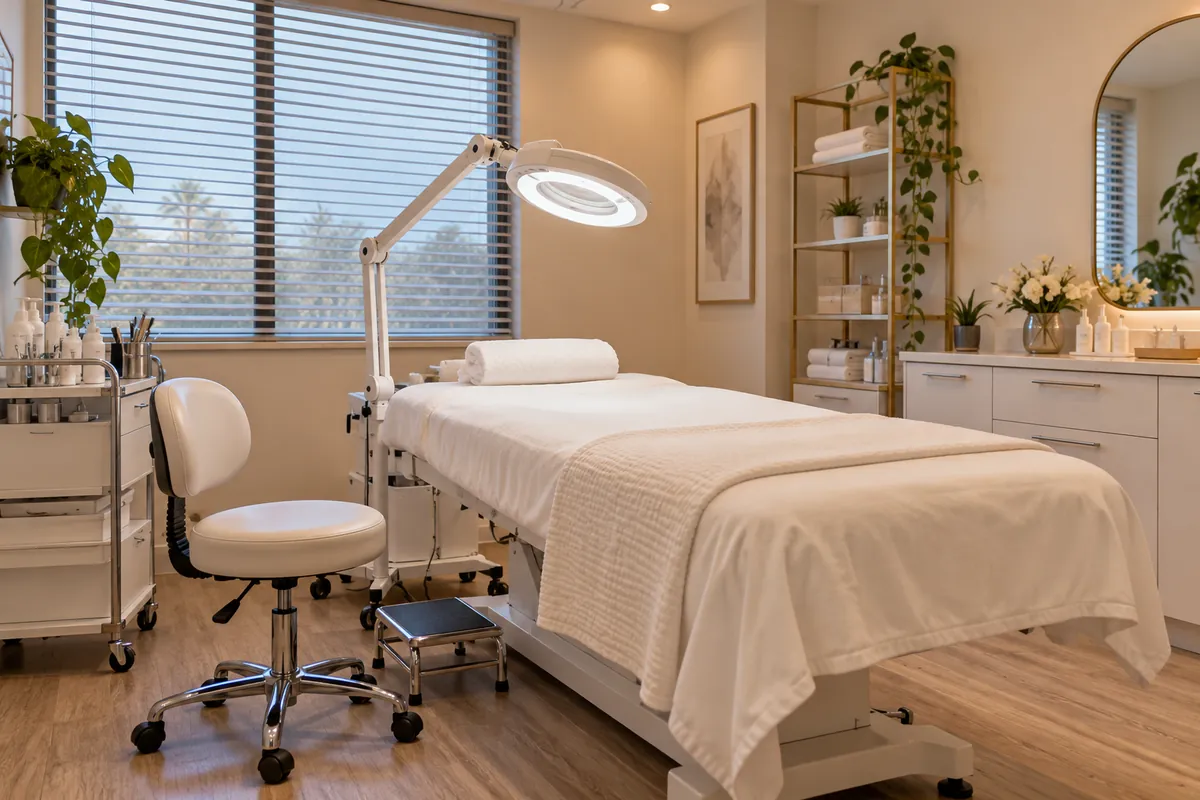
Good lighting reduces eye strain and improves accuracy. You need bright, even, shadow-free light on the treatment area, with good color rendering so you can see subtle skin reactions such as redness or blanching. Many magnifier lamps include built-in light around the lens. Check that it is bright enough without glare, and that it does not create harsh reflections on the client's skin. Some practitioners find adjustable color temperature useful for seeing different skin tones and hair colors clearly.
Room lighting matters too. Working under a bright lamp in an otherwise dark room makes your eyes adjust constantly between the bright work area and the dim surroundings, which can be tiring. Moderate, even ambient light reduces that contrast. Avoid strong light sources behind or beside the client that shine into your eyes or create glare on the magnifier lens. Natural light is pleasant, but direct sunlight on the treatment area can change throughout the day and cause glare, so use blinds to control it.
Keep lenses and light covers clean. A smudged magnifier lens forces your eyes to work harder to focus, and you may unconsciously lean closer to see. Wipe the lens with a product the manufacturer approves as part of your room turnover routine; our guide on autoclave and sterilization for electrolysis covers disinfecting equipment between clients without damaging lenses and housings.
Hands, wrists and grip
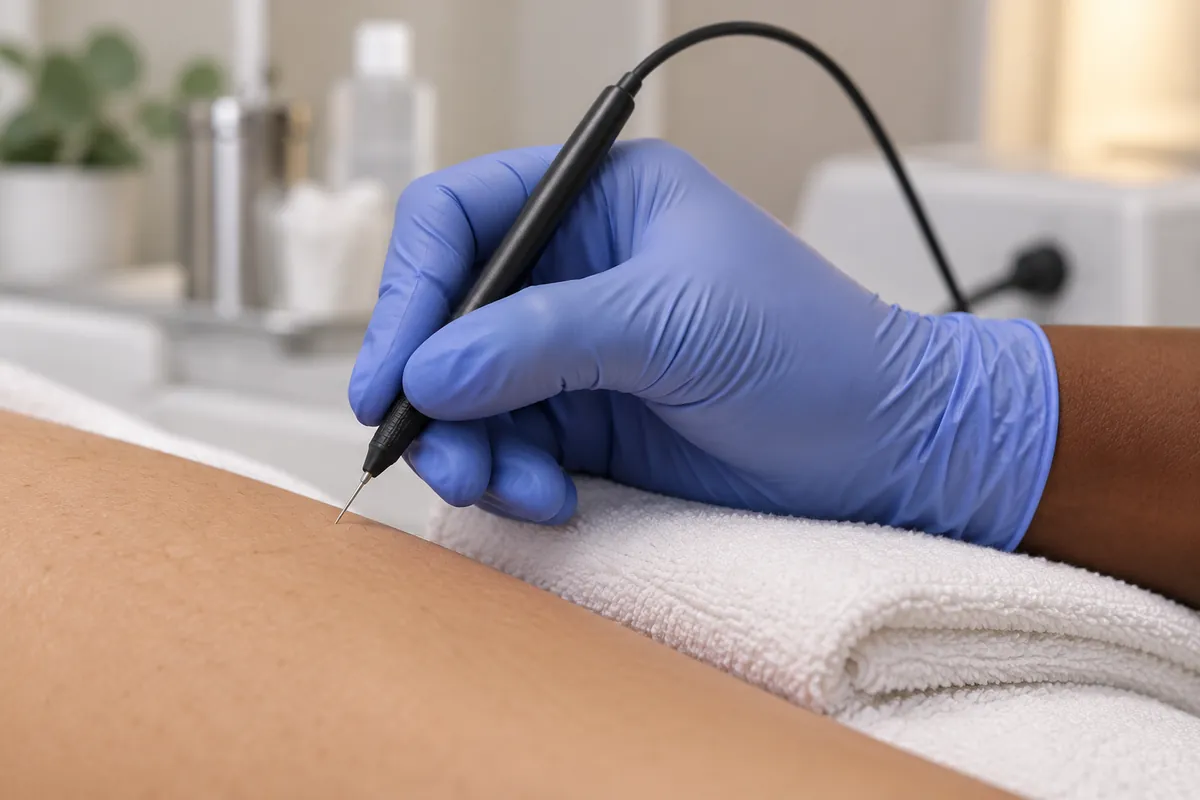
Your hands do the most precise part of the work, and they need care. The probe holder is held in a pinch grip many times a day, and the tweezers in the other hand are used repeatedly to lift hairs. Gripping too tightly is common, especially for beginners and on difficult areas. A tight grip tires the small muscles of the hand and forearm and may contribute to discomfort over time. Hold the probe holder firmly enough for control and no more. Check your grip several times during a session and consciously relax it.
Keep your wrists close to straight where possible. Bending the wrist sharply up, down or sideways while performing insertions places more strain on the tendons and structures of the wrist. Rather than bending the wrist to reach an awkward angle, move your body, the client or the table. Rest the side of your hand or your fingers lightly on the client's skin or a support where appropriate, which steadies the hand and reduces muscle effort. This also improves insertion accuracy.
Equipment choices matter. Some probe holders are lighter or more comfortable to hold than others, and some machines offer a foot pedal or finger switch. If your hand often aches after work, consider whether a different holder, tweezers with a better grip, or a change in how you activate current might help. Our guide to choosing an electrolysis machine discusses equipment features, and the review of insertion technique for beginners covers hand positioning in more detail.
Hand care and skin protection
Frequent hand washing, sanitizer use and long hours in gloves can dry out and irritate the skin on your hands. Cracked or inflamed skin is uncomfortable, can make gloves harder to use, and can be an infection control concern, because damaged skin is a less effective barrier. Use a gentle cleanser, dry your hands thoroughly, and apply a suitable hand cream regularly, especially at the end of the day. Choose products that will not interfere with glove integrity, and ask your glove supplier if unsure.
Pay attention to glove fit. Gloves that are too tight can compress the hand and increase fatigue; gloves that are too loose can bunch and reduce your control. Try different sizes and materials until you find a comfortable fit. If you notice itching, redness or rash after wearing gloves, you may be reacting to the glove material or to chemicals on the gloves. See a physician or dermatologist for persistent hand dermatitis or suspected allergy, and switch glove types as advised.
Simple hand stretches can help between clients. Gently open and close your hands, spread your fingers, and gently bend your wrists in different directions within a comfortable range. Shake out your hands after long sessions. These movements are not a treatment for injury, but they can relieve tension from sustained gripping. If you experience persistent numbness, tingling, weakness or pain in your hands or wrists, consult a healthcare professional rather than trying to work through it.
Breaks and scheduling to protect your body
Breaks are not a luxury in electrolysis; they are part of doing the job well. Sustained posture and focus are what cause most strain, so the remedy is regular change. Build short breaks into your schedule between clients, and consider micro-pauses within longer sessions. Even a brief moment to sit back, roll your shoulders, look across the room and relax your hands can reduce cumulative strain. Many clients also appreciate a short pause during a long session.
Plan your schedule with your body in mind. Avoid booking long blocks back to back all day, every day. Mix longer and shorter appointments, and give yourself a real lunch break away from the treatment room. If you have a particularly demanding client, such as a long body area session, consider placing a shorter or less demanding appointment after it. Pay attention to how you feel at different times of day, and arrange your schedule accordingly.
- Change posture or stand briefly between clients.
- Look at a distant point to relax focusing muscles.
- Roll your shoulders and gently move your neck within a comfortable range.
- Open and close your hands, and relax your grip.
- Drink water and take a proper lunch break.
- Alternate long and short appointments where you can.
- Keep at least one day each week fully away from treatment work.
Your schedule is also a business decision. A plan that only works if you treat clients continuously all day is fragile. Pricing that allows reasonable breaks protects your health and your career. Our guide on how to price electrolysis services explains how to include rest and non-treatment time in your pricing so your schedule remains sustainable.

Strength, mobility and life outside the treatment room
What you do outside work affects how your body handles the job. Sitting still for long periods with focused attention is demanding, and a body with reasonable strength and mobility tolerates it better. Many practitioners benefit from regular activity that strengthens the back, shoulders and core and that encourages good posture, such as walking, swimming, or structured exercise guided by a qualified professional. The right program depends on your health, so ask your physician or a physical therapist for advice suited to you.
Pay attention to your neck and upper back in particular. Precision work tends to pull the head forward and round the shoulders. Gentle movements that open the chest and encourage an upright head position can be helpful, but they should be learned from a qualified professional, especially if you have existing pain. Avoid forcing stretches, and stop any exercise that increases pain. The goal is gradual, comfortable improvement, not dramatic effort.
Sleep and stress matter too. Tired muscles are more likely to ache, and stress often shows up as raised shoulders and clenched jaws. A good sleep routine, regular meals and time away from work all help your body recover. Electrolysis is a long-term career for many people, and treating your health as part of your professional toolkit makes that career possible.
Some practitioners also find it useful to keep a short weekly note of any aches, how many hours they treated and what changed in their setup. Patterns appear quickly: a sore neck after a week of long facial sessions, or tired eyes after a lamp was moved. Those notes are also helpful to bring to a healthcare professional if a problem develops.

Designing an ergonomic treatment room
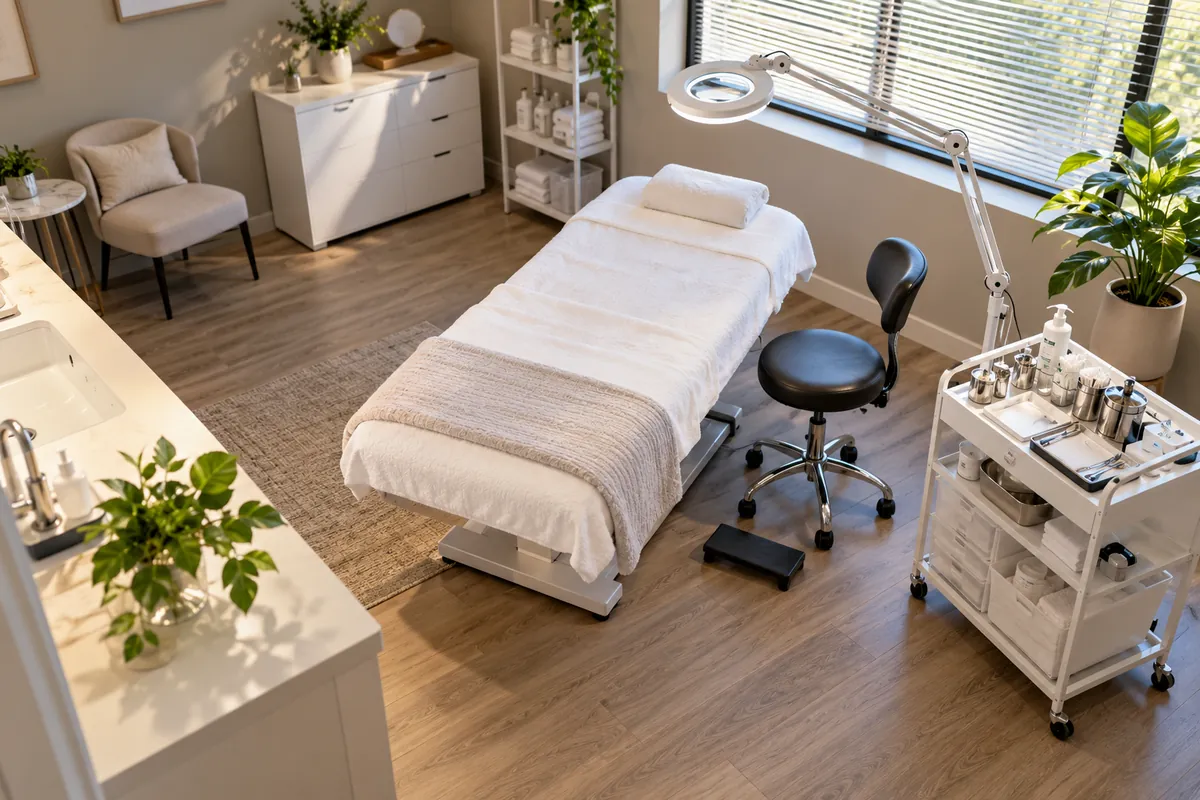
If you are setting up or redesigning a treatment room, think about ergonomics from the start. Allow enough space around the table to move your stool freely to each side and to the head end. Place the epilator, cart and sharps container within easy reach so you do not twist or stretch to reach them repeatedly. Position the magnifier lamp on a stable arm that reaches all common working positions. Route cords neatly, and make sure the floor is clear and even for rolling.
Organize supplies by frequency of use. Items you use with every client should be within arm's reach while seated. Items used occasionally can be farther away. Avoid storing frequently used supplies on high or very low shelves that require reaching or bending. Think about the whole flow of a session: from greeting the client to setup, treatment, cleanup and documentation, and remove any awkward movement you repeat many times a day.
If you work in a rented space or a home studio, some of these choices may be limited, but most can be adapted. A compact rolling cart, a wall-mounted lamp arm or a smaller adjustable table can make a big difference in a tight room. Our guide on home studio vs renting a suite discusses space considerations, including how room size affects setup.
| Element | Ergonomic goal | Practical tip |
|---|---|---|
| Treatment table | Bring the area to working height | Choose an adjustable model |
| Stool | Support an upright posture | Height adjustable, rolling, back support |
| Magnifier lamp | Clear view without leaning | Stable arm, positioned before each session |
| Cart and supplies | Avoid twisting and stretching | Keep frequent items within arm's reach |
| Room lighting | Reduce glare and contrast | Even ambient light, controllable blinds |
| Floor space | Move around, not across, the client | Clear, even floor and neat cords |
Warning signs and when to get help
Mild tiredness at the end of a long day is normal. Pain that persists, worsens, wakes you at night or affects your daily life is not. Watch for signs such as persistent neck, shoulder or back pain; numbness, tingling or weakness in your hands or arms; frequent headaches; and ongoing eye strain or vision changes. These are signals to adjust your setup and habits, and also to seek professional evaluation. Early attention often prevents a minor issue from becoming a long-term problem.
A physician, physical therapist or occupational therapist can assess your symptoms, examine how you work, and suggest specific changes or treatment. An eye care professional can check whether your vision and any corrective lenses suit your working distance. Some practitioners benefit from a professional ergonomic assessment of their workstation. Take photos or a short video of yourself working, with client consent or using a model, to show a specialist how you sit and move.
Do not ignore symptoms out of worry about losing work. Untreated problems tend to get worse and can eventually force longer breaks than early care would have required. It is also worth reviewing whether your insurance includes any coverage for interruption to your work due to illness or injury; our guide to insurance for electrologists explains the general types of coverage practitioners consider.
A short pre-session routine that protects your body
Most electrologists set up their instruments carefully and their own body not at all. A two-minute routine before the first client changes how the day feels by the afternoon. I walk the room once: stool height checked against the table, magnifier arm positioned and locked, lamp angled so the shadow of my hand does not fall on the treatment area, foot pedal placed where my foot lands without reaching, and supplies on the working side within an easy arm's length. Then I stand, roll my shoulders back, and take a few slow breaths. It sounds small, but the habit means that I never begin a long session already compensating for a setup I was too busy to fix.
The second half of the routine happens at the table, before the first insertion. Settle the client in a position that lets you keep your elbows close to your sides and your wrists straight. If the area you are treating requires you to lean, adjust the table or ask the client to shift rather than adapting your spine to the situation. Clients almost always agree when you explain it in one sentence. A practitioner who starts every session in good alignment makes fewer corrections midway, and fewer corrections mean steadier hands, which matters more in electrolysis than in nearly any other beauty service.
- Stool height set so hips are slightly above knees
- Magnifier locked in position and focus checked
- Lamp placed to avoid shadows and glare on skin
- Pedal and supplies within easy reach, no stretching
- Table height and angle adjusted for the first treatment zone
- Water nearby and a planned stretch break
Common ergonomic mistakes I see in practice
The most frequent mistake is working with a stool that is too low. A low seat tilts the pelvis backward, rounds the lower back and pushes the head forward to see the skin. Close behind it is the habit of leaning toward the client instead of bringing the magnifier to the work. Some practitioners tape a magnifier at the wrong distance and then tilt the neck to find the focus, which loads the same muscles for hours. Others keep the table too low or too far away so they reach over the client. Each of these feels minor in one session and costly after months of full schedules.
The second group of mistakes involves the hands. Gripping the handpiece or forceps too tightly, resting the wrist on a hard edge, and holding the shoulder lifted while working all create tension that you stop noticing. Another is skipping the foot pedal technique and working with a held-up foot, which twists the pelvis. Many new electrologists also never change their position during a long session, staying in one posture for an hour or more. If you notice any of these in yourself, fix one at a time and ask a colleague or instructor to watch you work. An outside view finds habits you cannot feel.
Long sessions and talking with clients about comfort
Electrolysis often involves long appointments, especially for large areas or clients who come in only occasionally. The longer the session, the more the setup matters, and the more important it is to build in micro-changes: shifting your weight, adjusting the stool by a notch, relaxing the grip, looking away from the magnifier for a few seconds. I tell new clients at the first visit that I will pause now and then and that it helps my accuracy. They are almost always understanding, and some are relieved because it also gives them a moment to relax a tensed muscle or ask a question.
Client positioning is part of ergonomics, not a courtesy. If a client is uncomfortable, they move, and movement near a fine needle is a safety problem and a precision problem. Use pillows and bolsters, explain the position in advance, and agree on a simple way for the client to signal when they need a break. This protects both of you. It also cuts the number of times you have to re-find your target mid-treatment, which is one of the quiet reasons sessions run long and practitioners tire. Good communication is part of a sustainable practice and belongs in your standard consultation.
Finally, think about the whole week, not only the single session. Spread long or demanding appointments through the schedule instead of stacking them, and leave a real break for lunch away from the treatment room. If you are renting a space, ask whether the furniture can be adjusted before you commit. The room, the stool and the lamp are working tools, as much as the machine, and they deserve the same care. Compare options in our guide to a home studio versus renting a suite before you decide where to build your practice.
Your next step
Pick one change this week. Adjust your stool and table so the treatment area comes to you, reposition your magnifier before each client, or schedule short breaks between appointments. Then notice how you feel after a few days. If you are still training, build these habits now; our electrolysis course covers the theory of safe practice, alongside, not instead of, the in-person hours and license your state requires, which you can check on our electrolysis licensing hub. Your body is your most important tool. Taking care of it is part of taking care of your clients.
State Requirements
State licensing guides
Hours, exams, fees, and the licensing board differ by state. Open your state for the current requirements.
Common Questions
FAQ
There is no single best chair, but a good one is height adjustable, rolls smoothly, lets you sit close to the table, and supports an upright posture. Many electrologists like saddle-style stools because they open the hip angle; others prefer a conventional operator stool with a small backrest. Try several if possible and choose the one that lets you work upright for long periods without discomfort.
Bring the treatment area to you by adjusting the table height and client position, and position your magnifier so you can look through it with only a slight downward gaze while sitting upright. Take short breaks to change posture and gently move your neck within a comfortable range. If neck pain persists or comes with numbness or weakness, see a physician or physical therapist.
Both can work well when set up correctly. A magnifier lamp positioned between your eyes and the work allows an upright posture without anything on your head. Loupes move with you and give consistent magnification, but the working distance and angle must suit your posture, ideally with professional fitting. Choose based on comfort, then review the setup if you notice strain.
There is no fixed rule, but regular short breaks between clients and brief micro-pauses during long sessions help reduce strain from sustained posture and focus. Use them to change position, stand, relax your hands and look at a distant point. Plan your schedule so you are not treating continuously all day, and include a proper lunch break away from the treatment room.
Repetitive gripping and bent wrists are recognized risk factors for hand and wrist problems in many precision jobs, but only a healthcare professional can diagnose a specific condition. Reduce risk by relaxing your grip, keeping wrists close to straight, supporting your hand and taking breaks. If you have persistent numbness, tingling, weakness or pain in your hands, seek medical evaluation promptly.
It depends on your body size, your stool, your magnifier and the area being treated. In general, the treatment area should sit at a height where your elbows stay close to your body, your forearms can be supported, and you can see through the magnifier without bending your neck far forward. An adjustable table makes this much easier for different clients and areas.
Use a gentle cleanser, dry your hands fully, and apply a suitable hand cream regularly, especially at the end of the day. Make sure gloves fit well, and choose products that do not interfere with glove integrity. If itching, redness or rash continue, see a physician or dermatologist, as you may be reacting to glove materials or chemicals.
Keep Reading
Related Guides


